Malaysia Urea Market Size, Share & Growth Rate
The Malaysia Urea Market was estimated at USD 412 Million in 2025 and is projected to reach USD 537 Million by 2032, growing at a CAGR of 3.9% from 2026 to 2032. This growth trajectory is primarily fueled by the robust demand from the agriculture sector, where urea remains a preferred choice due to its high nitrogen content and affordability. Furthermore, governmental initiatives aimed at enhancing agricultural productivity and ensuring food security continue to play a pivotal role in sustaining market demand.
Malaysia Urea Market Year-wise Growth Rate and Key Drivers
This graph highlights how the Malaysia Urea Market has steadily grown over the years, supported by major growth factors.
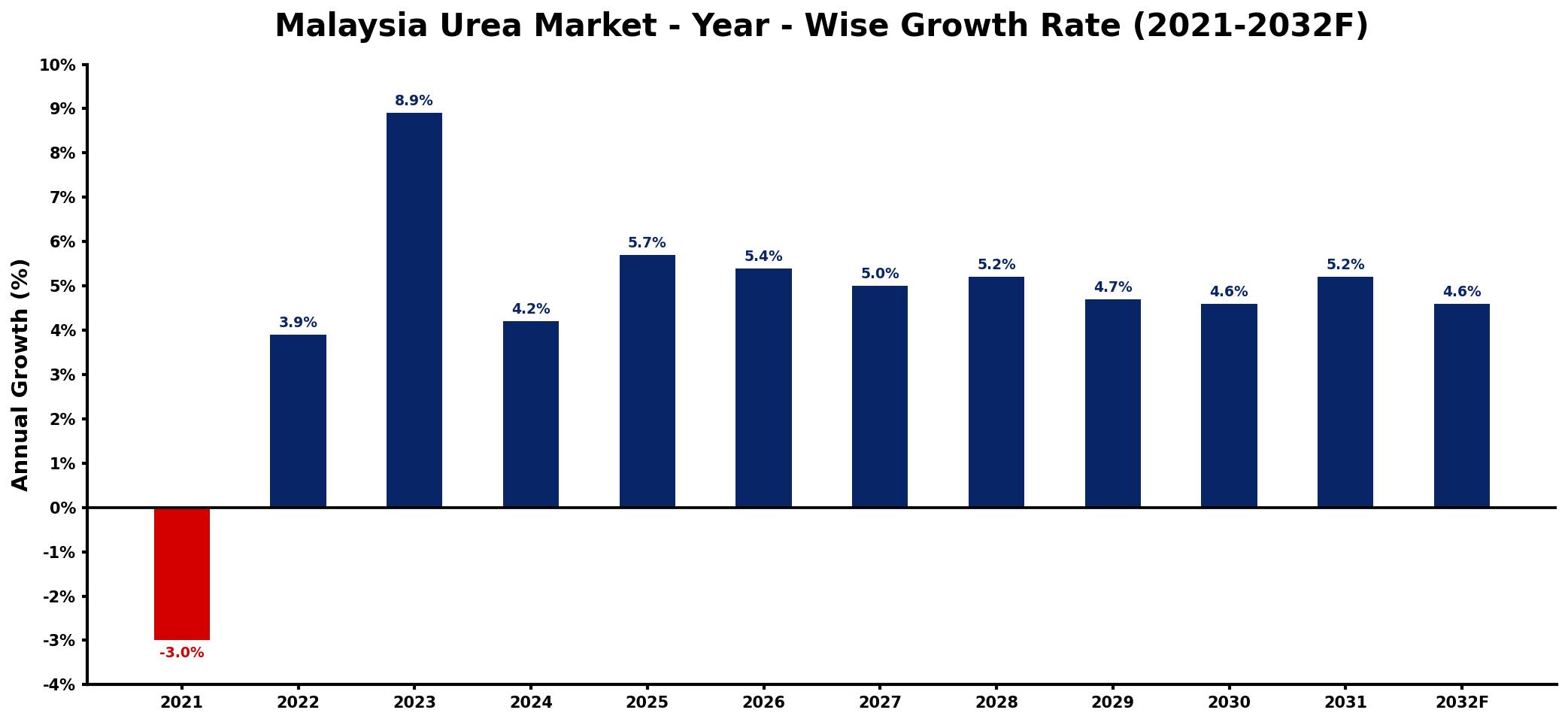
The table below presents the year‑wise growth rates along with the key drivers influencing the market
| Year | Growth Rate | Major Drivers |
| 2021 | -3.0% | Agricultural sector facing uncertainties |
| 2022 | 3.9% | Increased fertilizer demand from agriculture |
| 2023 | 8.9% | Rising crop production investments |
| 2024 | 4.2% | Growing awareness of soil health |
| 2025 | 5.7% | Expansion of agricultural technologies |
| 2026 | 5.4% | Higher global commodity prices |
| 2027 | 5.0% | Increased government agricultural support |
| 2028 | 5.2% | Rise in export opportunities |
| 2029 | 4.7% | Technological advancements in farming |
| 2030 | 4.6% | Increased sustainability initiatives adoption |
| 2031 | 5.2% | Growth in biofuel production sectors |
| 2032 | 4.6% | Enhanced supply chain efficiencies |
Note: Market size estimations and growth projections presented in this report are based on 6Wresearch's proprietary forecasting methodology, utilizing the latest available industry data, government publications, and primary research inputs.
Malaysia Urea Market Synopsis
The urea market in Malaysia has recently shown a steady growth pattern, largely attributed to increased agricultural activities and heightened awareness of food security. Moving forward, the market is anticipated to face certain pressures, including fluctuating raw material costs and the emerging need for sustainable practices in fertilizer application.
As global trends evolve towards greater environmental responsibility, the Malaysia Urea Market must adapt, balancing agricultural needs with ecological considerations. The focus on digitalization and technological advancements in production processes further underscores a transformation that could enhance efficiency and reduce environmental footprints.
Malaysia Urea Market Key Takeaways
- Moderate growth expected, driven by agriculture's reliance on nitrogen fertilizers.
- Government initiatives are fostering increased agricultural productivity and food security.
- Environmental regulations necessitate a shift towards sustainable urea application practices.
- Volatility in natural gas prices poses challenges to production costs and market stability.
- Digital transformation in navigation and distribution is reshaping market dynamics.
Evaluation of Restraints in Malaysia Urea Market
The Malaysia Urea Market encounters several restraints that could limit its growth potential. Key among these is the volatility of natural gas prices, which significantly influences production costs. As natural gas is a primary feedstock in urea synthesis, any fluctuations can directly impact profit margins. Additionally, competition from international producers who benefit from lower production costs poses a threat to local manufacturers. Environmental regulations aimed at reducing greenhouse gas emissions are also tightening, potentially requiring costly adaptations in production technology. Finally, issues related to nitrogen runoff and the ecological impact of urea in agriculture demand ongoing attention and innovative solutions.
Malaysia Urea Market Trends
Several trends are currently shaping the Malaysia Urea Market. There is a clear shift towards precision agriculture, where farmers leverage data and technology to optimize fertilizer usage, enhancing both yield and sustainability. The rising awareness of environmental issues is pushing for greener alternatives and improved methods of application to minimize nitrogen runoff. Additionally, the integration of digital technologies in production and distribution is becoming increasingly prevalent, driving efficiencies and responsiveness in the market. Investment in research and development is also on the rise as stakeholders seek to innovate within urea production methods.
Malaysia Urea Market Opportunities
As the Malaysia Urea Market evolves, numerous opportunities are emerging for growth and investment. The push towards sustainable agricultural practices opens avenues for the development of eco-friendly fertilizers and alternative nitrogen sources. Collaborations between governmental bodies and private sectors can further stimulate innovations in fertilizer application techniques. Moreover, enhancing distribution channels and logistics capabilities represents a vital area for investment, ensuring timely and efficient access to urea for farmers across the nation. The expansion of digital platforms for monitoring and managing fertilizer use also holds potential for future market growth.
Government Initiatives in the Malaysia Urea Market
The Malaysian government has been actively promoting agricultural development through various initiatives that directly impact the urea market. Policies aimed at enhancing food security and agricultural productivity are a priority, with significant public funding directed towards research and technology in crop production. Incentives for sustainable practices and the adoption of alternative nitrogen sources are also being explored. These governmental efforts create a conducive environment for the growth of the urea market, encouraging investments and innovation.
Future Insights of the Malaysia Urea Market
Looking ahead to the period from 2026 to 2032, the Malaysia Urea Market is poised for a phase of transformation driven by evolving agricultural demands and environmental considerations. The combination of governmental support and technological advancements will likely facilitate enhanced productivity in the agricultural sector. However, addressing the challenges posed by global competition and environmental regulations will be crucial. As the market adjusts to these factors, a balanced approach that incorporates sustainability will be essential for continued growth and profitability.
Malaysia Urea Market Latest Developments (2025 - 2026)
Recent developments within the urea market indicate a shift towards greater sustainability and efficiency. Industry players are increasingly investing in advanced production technologies and exploring eco-friendly alternatives to traditional urea. Furthermore, supply chain dynamics are being optimized to address logistics challenges encountered during the COVID-19 pandemic, ensuring that farmers have reliable access to this critical fertilizer. Collaborative research efforts between academia and industry are also on the rise, reflecting a commitment to innovating agricultural practices.
Malaysia Urea Market - Key Attractiveness of the Report
- 10 Years of Market Numbers
- Historical Data Starting from 2022 to 2025
- Base Year: 2025
- Forecast Data until 2032
- Key Performance Indicators Impacting the Market
- Major Upcoming Developments and Projects
Key Highlights of the Report:
- Malaysia Urea Market Outlook
- Market Size of Malaysia Urea Market, 2025
- Forecast of Malaysia Urea Market, 2032
- Historical Data and Forecast of Malaysia Urea Revenues & Volume for the Period 2022-2032F
- Malaysia Urea Market Trend Evolution
- Malaysia Urea Market Drivers and Challenges
- Malaysia Urea Price Trends
- Malaysia Urea Porter's Five Forces
- Malaysia Urea Industry Life Cycle
- Historical Data and Forecast of Malaysia Urea Market Revenues & Volume By Grade for the Period 2022-2032F
- Historical Data and Forecast of Malaysia Urea Market Revenues & Volume By Fertilizer for the Period 2022-2032F
- Historical Data and Forecast of Malaysia Urea Market Revenues & Volume By Feed for the Period 2022-2032F
- Historical Data and Forecast of Malaysia Urea Market Revenues & Volume By Technical for the Period 2022-2032F
- Historical Data and Forecast of Malaysia Urea Market Revenues & Volume By End-user Industry for the Period 2022-2032F
- Historical Data and Forecast of Malaysia Urea Market Revenues & Volume By Agriculture for the Period 2022-2032F
- Historical Data and Forecast of Malaysia Urea Market Revenues & Volume By Chemical for the Period 2022-2032F
- Historical Data and Forecast of Malaysia Urea Market Revenues & Volume By Automotive for the Period 2022-2032F
- Historical Data and Forecast of Malaysia Urea Market Revenues & Volume By Medical for the Period 2022-2032F
- Historical Data and Forecast of Malaysia Urea Market Revenues & Volume By Others for the Period 2022-2032F
- Malaysia Urea Import Export Trade Statistics
- Market Opportunity Assessment By Grade
- Market Opportunity Assessment By End-user Industry
- Malaysia Urea Top Companies Market Share
- Malaysia Urea Competitive Benchmarking By Technical and Operational Parameters
- Malaysia Urea Company Profiles
- Malaysia Urea Key Strategic Recommendations






































