Malta Automotive Windshield Market Size (2020-2030)
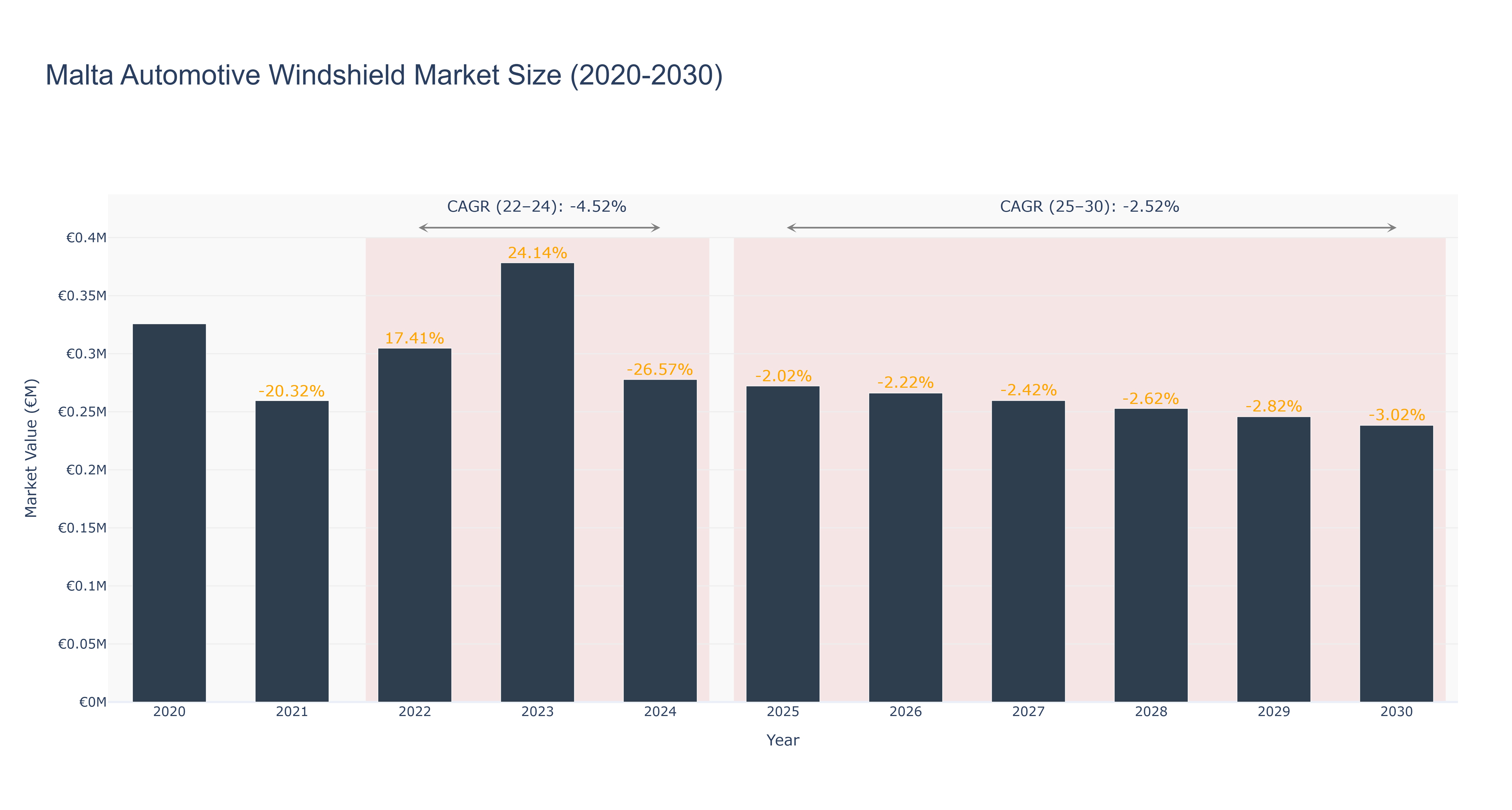
Malta Automotive Windshield Market has experienced fluctuations in market size over the years. The peak market size of €0.38 million was recorded in 2023. Actual market size declined from €0.33 million in 2020 to €0.28 million in 2024, with a notable decrease of -26.57%. Forecasted market size is expected to continue decreasing from €0.27 million in 2025 to €0.24 million in 2030, with CAGR values of -2.52% for the period 2025-30. The market's downward trend can be attributed to factors such as economic uncertainties impacting consumer spending on automotive accessories. Looking ahead, advancements in automotive technology and increasing focus on sustainability may drive market growth. Recent developments include collaborations between local automotive manufacturers and international suppliers to enhance product quality and innovation in automotive windshield technologies.
Malta Automotive Windshield Market: Production & Trade Performance (2019-2025)
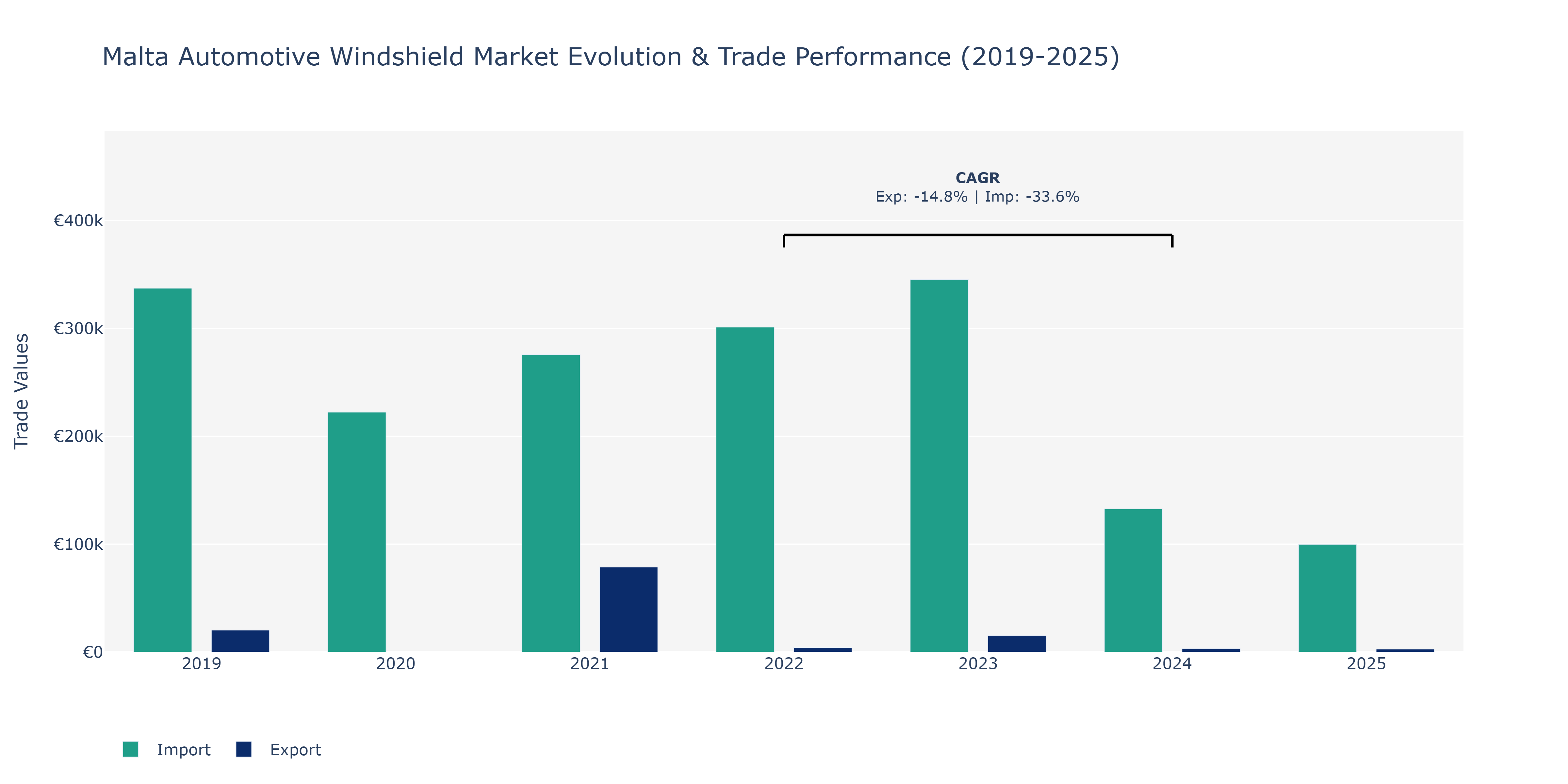
The Malta Automotive Windshield Market experienced varying trends in exports and imports over the years analyzed. In 2019, imports were substantially higher than exports, with imports reaching €337.35 thousand and exports at €20.34 thousand. However, in 2020, there was a notable decrease in both exports, which were €14 thousand, and imports, which decreased to €222.45 thousand. The market saw a significant rebound in 2021, with exports rising to €78.8 thousand and imports to €275.78 thousand. The following years displayed fluctuations, with exports and imports showing mixed results. Exports peaked in 2023 at €15.06 thousand but dropped to €2.74 thousand in 2025. Meanwhile, imports peaked in 2023 at €345.28 thousand and declined to €99.81 thousand in 2025. These fluctuations could be attributed to global economic conditions impacting demand for automobiles, supply chain disruptions affecting trade, and technological advancements in automotive manufacturing processes.
Key Highlights of the Report:
- Malta Automotive Windshield Market Outlook
- Market Size of Malta Automotive Windshield Market, 2025
- Forecast of Malta Automotive Windshield Market, 2032
- Historical Data and Forecast of Malta Automotive Windshield Revenues & Volume for the Period 2022 - 2032F
- Malta Automotive Windshield Market Trend Evolution
- Malta Automotive Windshield Market Drivers and Challenges
- Malta Automotive Windshield Price Trends
- Malta Automotive Windshield Porter`s Five Forces
- Malta Automotive Windshield Industry Life Cycle
- Historical Data and Forecast of Malta Automotive Windshield Market Revenues & Volume By Glass Type for the Period 2022 - 2032F
- Historical Data and Forecast of Malta Automotive Windshield Market Revenues & Volume By Laminated for the Period 2022 - 2032F
- Historical Data and Forecast of Malta Automotive Windshield Market Revenues & Volume By Tempered for the Period 2022 - 2032F
- Historical Data and Forecast of Malta Automotive Windshield Market Revenues & Volume By Material Type for the Period 2022 - 2032F
- Historical Data and Forecast of Malta Automotive Windshield Market Revenues & Volume By Thermoset for the Period 2022 - 2032F
- Historical Data and Forecast of Malta Automotive Windshield Market Revenues & Volume By Thermoplastic for the Period 2022 - 2032F
- Historical Data and Forecast of Malta Automotive Windshield Market Revenues & Volume By Position for the Period 2022 - 2032F
- Historical Data and Forecast of Malta Automotive Windshield Market Revenues & Volume By Front for the Period 2022 - 2032F
- Historical Data and Forecast of Malta Automotive Windshield Market Revenues & Volume By Rear for the Period 2022 - 2032F
- Malta Automotive Windshield Import Export Trade Statistics
- Market Opportunity Assessment By Glass Type
- Market Opportunity Assessment By Material Type
- Market Opportunity Assessment By Position
- Malta Automotive Windshield Top Companies Market Share
- Malta Automotive Windshield Competitive Benchmarking By Technical and Operational Parameters
- Malta Automotive Windshield Company Profiles
- Malta Automotive Windshield Key Strategic Recommendations






































