Malta Handbag Market Size (2020-2030)
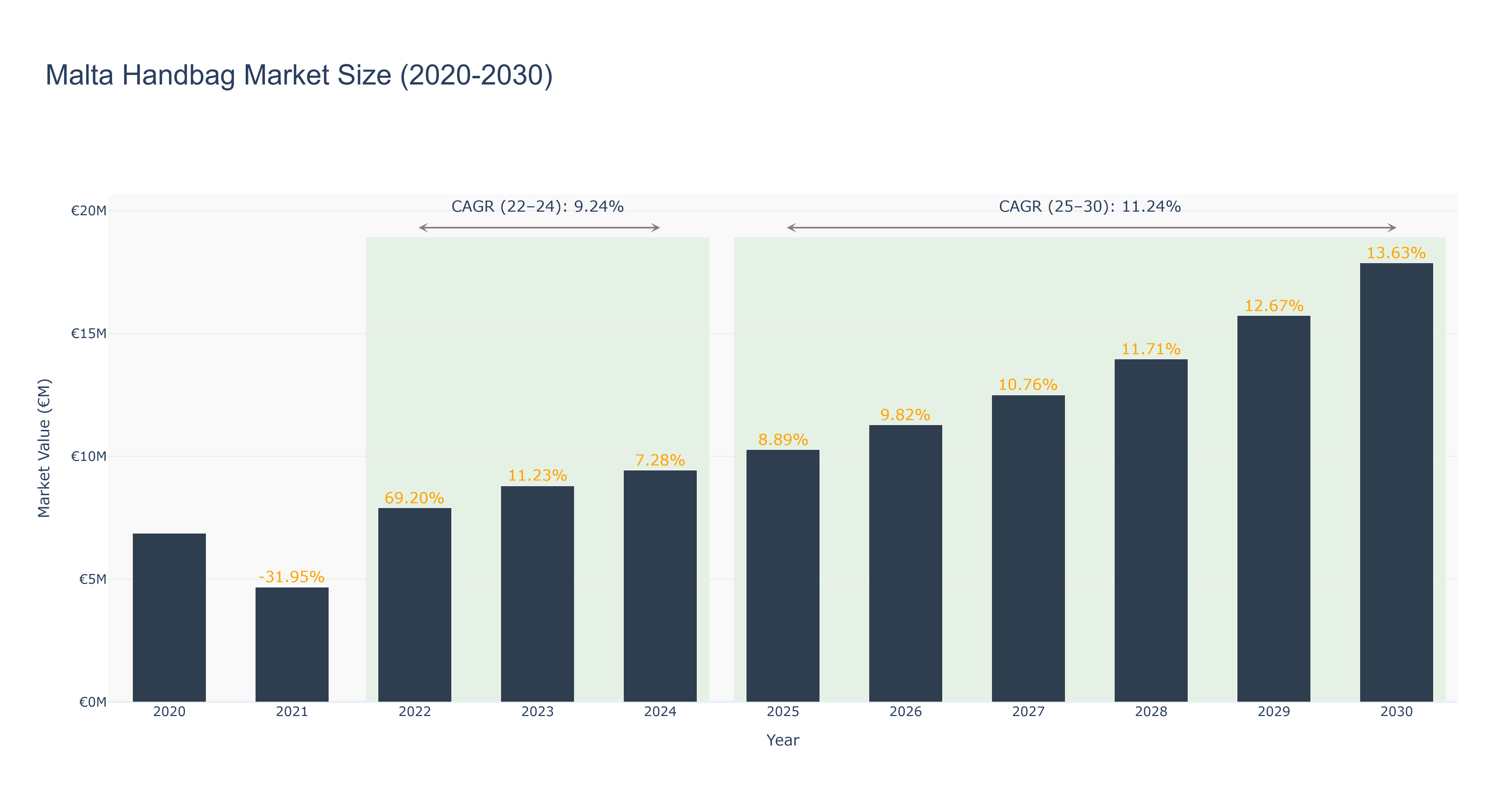
Malta Handbag Market has shown a steady growth trajectory over the years. The peak market size of €17.88 million is projected for 2030, with a notable increase from €6.87 million in 2020. The market experienced a decline in 2021, attributed to external economic factors impacting consumer spending. However, strong recovery and consistent growth from 2022 onwards can be attributed to increased consumer confidence and expanding target demographics. The CAGR for the period 2022-24 stands at 9.24%, while for 2025-30, it is projected at 11.24%, indicating sustained growth momentum. Industry drivers include evolving fashion trends and increasing disposable incomes. Looking ahead, Malta Handbag Market is set to witness further growth with upcoming collaborations between local designers and international brands, driving innovation and market competitiveness.
Malta Handbag Market: Production & Trade Performance (2019-2025)
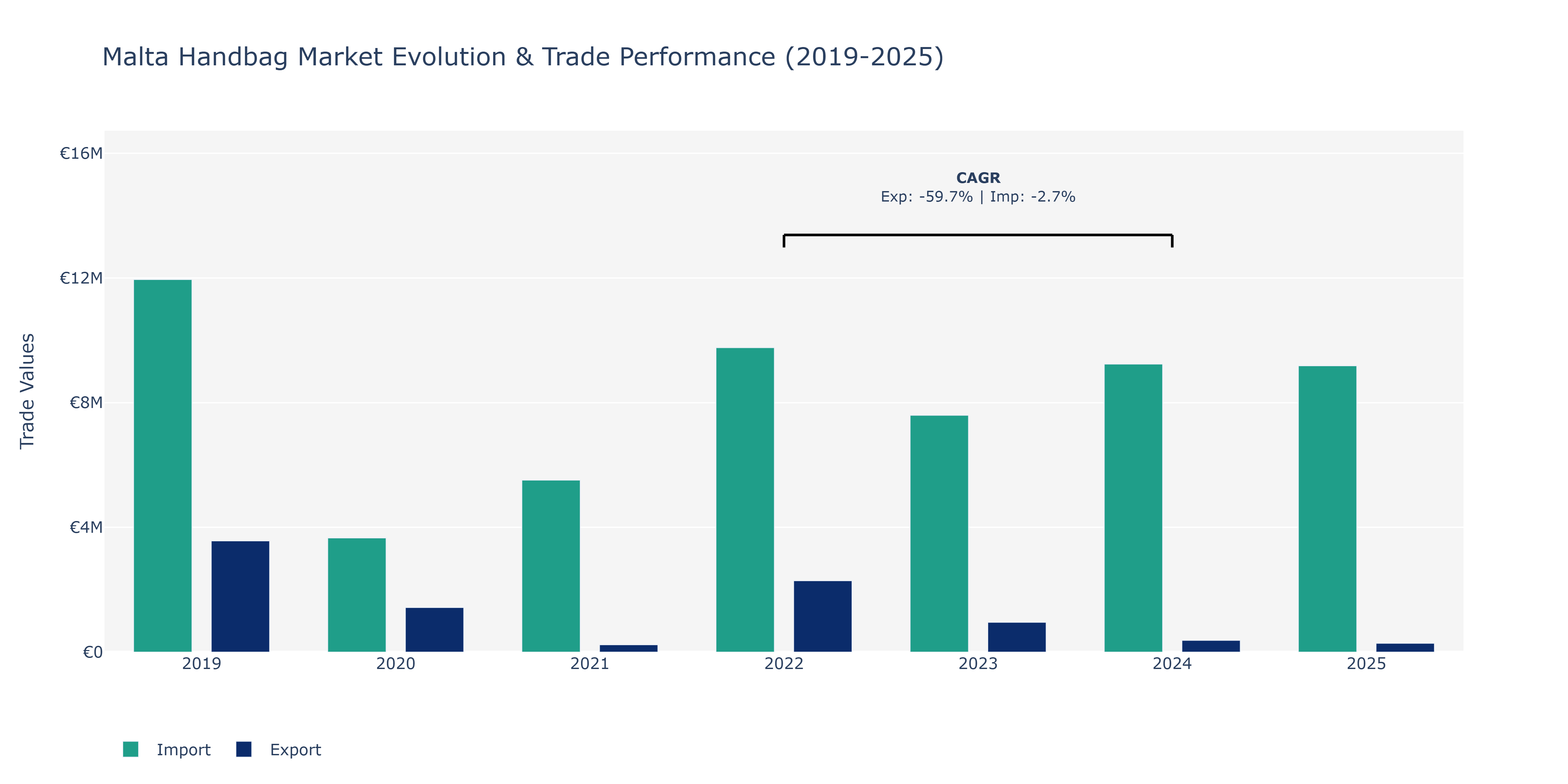
The Malta Handbag Market experienced notable fluctuations in both Exports and Imports over the specified years. From 2019 to 2020, Exports decreased by approximately €2.14 billion, while Imports decreased by around €8.3 billion. This significant decline can be attributed to the global economic slowdown and disruptions in supply chains due to the COVID-19 pandemic, impacting consumer demand and international trade. In 2021, both Exports and Imports rebounded, with Exports increasing to €229.66 thousand and Imports rising to €5.51 million. This recovery aligns with the gradual reopening of economies and the resumption of trade activities. However, in 2022, Exports surged to €2.28 million, showcasing a strong upward trend, possibly driven by strategic marketing efforts or the introduction of new product lines. Meanwhile, Imports also increased to €9.76 million, indicating growing domestic consumption or expanded distribution channels. In 2023, both Exports and Imports experienced a decline, potentially influenced by changing consumer preferences or shifts in trade policies. The market saw a further decrease in 2024, with Exports dropping to €370.88 thousand and Imports declining to €9.24 million, reflecting a challenging operating environment or intensified competition. By 2025, Exports decreased to €278.81 thousand, while Imports remained relatively stable at €9.18 million, suggesting a need for market players to innovate product offerings or enhance operational efficiencies to maintain competitiveness in the global market.
Key Highlights of the Report:
- Malta Handbag Market Outlook
- Market Size of Malta Handbag Market, 2025
- Forecast of Malta Handbag Market, 2032
- Historical Data and Forecast of Malta Handbag Revenues & Volume for the Period 2022 - 2032F
- Malta Handbag Market Trend Evolution
- Malta Handbag Market Drivers and Challenges
- Malta Handbag Price Trends
- Malta Handbag Porter`s Five Forces
- Malta Handbag Industry Life Cycle
- Historical Data and Forecast of Malta Handbag Market Revenues & Volume By Product Type for the Period 2022 - 2032F
- Historical Data and Forecast of Malta Handbag Market Revenues & Volume By Satchel for the Period 2022 - 2032F
- Historical Data and Forecast of Malta Handbag Market Revenues & Volume By Bucket Bag for the Period 2022 - 2032F
- Historical Data and Forecast of Malta Handbag Market Revenues & Volume By Clutch for the Period 2022 - 2032F
- Historical Data and Forecast of Malta Handbag Market Revenues & Volume By Tote Bag for the Period 2022 - 2032F
- Historical Data and Forecast of Malta Handbag Market Revenues & Volume By Other Product Types for the Period 2022 - 2032F
- Historical Data and Forecast of Malta Handbag Market Revenues & Volume By Distribution Channel for the Period 2022 - 2032F
- Historical Data and Forecast of Malta Handbag Market Revenues & Volume By Online Retail Stores for the Period 2022 - 2032F
- Historical Data and Forecast of Malta Handbag Market Revenues & Volume By Offline Retail Stores for the Period 2022 - 2032F
- Malta Handbag Import Export Trade Statistics
- Market Opportunity Assessment By Product Type
- Market Opportunity Assessment By Distribution Channel
- Malta Handbag Top Companies Market Share
- Malta Handbag Competitive Benchmarking By Technical and Operational Parameters
- Malta Handbag Company Profiles
- Malta Handbag Key Strategic Recommendations






































