Mexico Process Automation And Instrumentation Market Size, Share & Growth Rate
The Mexico Process Automation And Instrumentation Market was estimated at USD 343 Million in 2025 and is projected to reach USD 423 Million by 2032, growing at a CAGR of 3.0% from 2026 to 2032. This growth is largely fueled by the accelerated industrialization in Mexico, coupled with rapid technological advancements that promote enhanced operational efficiency. As manufacturers increasingly prioritize safety and accuracy, the demand for cutting-edge automation solutions is poised to rise, creating a substantial opportunity for investment and innovation.
Mexico Process Automation And Instrumentation Market Year-wise Growth Rate and Key Drivers
This graph highlights how the Mexico Process Automation And Instrumentation Market has steadily grown over the years, supported by major growth factors.
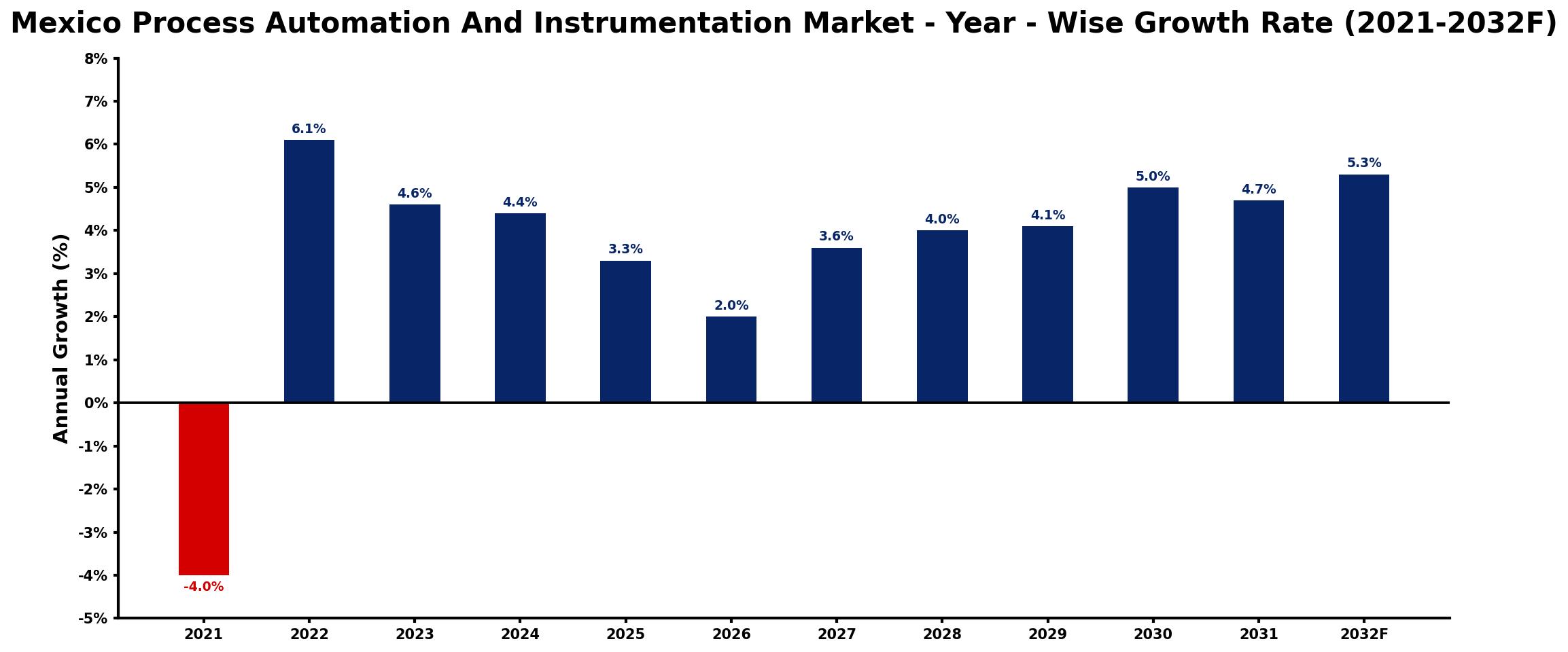
The table below presents the year‑wise growth rates along with the key drivers influencing the market
| Year | Growth Rate | Major Drivers |
| 2021 | -4.0% | decreased industrial investment activities |
| 2022 | 6.1% | rising demand for efficiency solutions |
| 2023 | 4.6% | expansion in manufacturing sector growth |
| 2024 | 4.4% | increased focus on energy savings |
| 2025 | 3.3% | growing adoption of smart technologies |
| 2026 | 2.0% | enhanced regulatory compliance requirements |
| 2027 | 3.6% | strengthened supply chain resilience initiatives |
| 2028 | 4.0% | surge in renewable energy projects |
| 2029 | 4.1% | growing need for real-time data |
| 2030 | 5.0% | expansion of digital transformation initiatives |
| 2031 | 4.7% | increased funding for innovation projects |
| 2032 | 5.3% | rising focus on sustainability practices |
Note: Market size estimations and growth projections presented in this report are based on 6Wresearch's proprietary forecasting methodology, utilizing the latest available industry data, government publications, and primary research inputs.
Mexico Process Automation And Instrumentation Market Synopsis
The Mexico Process Automation and Instrumentation Market has witnessed significant momentum in recent years, with various industries striving to modernize their operational frameworks. As businesses embrace Industry 4.0 principles, the trajectory of this market appears robust, indicating a forward march toward comprehensive automation.
Looking ahead, the market is expected to evolve significantly, driven by a combination of increasing investments in smart manufacturing and a growing focus on minimizing operational risks. The adoption of advanced control systems, sensors, and software tools will be pivotal in shaping the future landscape of industrial processes across Mexico.
Mexico Process Automation And Instrumentation Market Key Takeaways
- Substantial growth projected, with the market estimated to reach USD 423 Million by 2032.
- Rising demand for operational efficiency and safety is leading to increased automation investments.
- Government initiatives are facilitating the adoption of automation technologies in industrial sectors.
- Industries are increasingly modernizing operations to align with Industry 4.0 standards.
- Automation solutions such as DCS, PLC, and robotics are critical drivers for market expansion.
Evaluation of Restraints in Mexico Process Automation And Instrumentation Market
Despite the positive growth prospects, several restraints are holding back the Mexico Process Automation and Instrumentation Market. Chief among these are the challenges posed by resistance to technology adoption, particularly in traditional manufacturing sectors. Interoperability issues between new and legacy systems complicate seamless integration and can lead to increased operational costs. Furthermore, ensuring cybersecurity and data privacy is paramount, as the shift towards digitization raises concerns regarding potential vulnerabilities. Workforce skills gaps also present a significant challenge, highlighting the need for training programs to ensure that personnel can effectively engage with new technologies.
Mexico Process Automation And Instrumentation Market Trends
A number of current and emerging trends are shaping the demand for process automation and instrumentation solutions. First, there is a marked increase in the adoption of smart manufacturing techniques, which leverage data analytics and IoT technologies to optimize production. Additionally, the integration of artificial intelligence and machine learning into control systems is enhancing predictive maintenance capabilities, ultimately reducing downtime. Another noteworthy trend is the growing emphasis on sustainability, with organizations seeking automation solutions that minimize energy consumption and environmental impact. These trends underscore a broader shift toward digital transformation across industrial landscapes in Mexico.
Mexico Process Automation And Instrumentation Market Opportunities
The Mexico Process Automation and Instrumentation Market offers a wealth of genuine growth opportunities, particularly in sectors poised for significant technological transformation. Industries such as oil & gas, food & beverage, and pharmaceuticals are increasingly investing in automation solutions to improve productivity and product quality. Furthermore, the potential for smart factory implementations provides fertile ground for innovative solutions that enhance operational efficiencies. As companies look to stay competitive and agile in a rapidly evolving marketplace, the integration of advanced automation technologies presents a compelling opportunity for investors and stakeholders.
Government Initiatives in the Mexico Process Automation And Instrumentation Market
In response to the evolving industrial landscape, the Mexican government is actively promoting the adoption of process automation and instrumentation technologies. Initiatives such as investment incentives and technical assistance programs are designed to foster growth in manufacturing and industrial sectors. By developing standards and frameworks that facilitate the deployment of automation solutions, the government aims to enhance productivity and safety across diverse industries, positioning Mexico as a competitive player on the global stage.
Future Insights of the Mexico Process Automation And Instrumentation Market
Looking toward the future, the Mexico Process Automation and Instrumentation Market is set for transformative growth from 2026 to 2032. With industries increasingly recognizing the importance of operational efficiency and safety, the demand for advanced automation solutions will intensify. Enhanced connectivity through IoT and real-time data analytics will empower manufacturers to make informed decisions, further driving productivity. The alignment with global Industry 4.0 trends will catalyze investment in modern technologies, ensuring that the market remains agile and innovative as it navigates the challenges and opportunities of the upcoming years.
Mexico Process Automation And Instrumentation Market Latest Developments (2025 - 2026)
In recent months, there has been a significant push towards digital transformation within the Mexican manufacturing sector. Companies are increasingly exploring partnerships with technology providers to implement smart automation systems. In particular, the focus on cybersecurity has gained prominence, with initiatives aimed at securing automated processes against potential threats. Additionally, training programs are being launched to address workforce skills gaps, ensuring that employees are well-equipped to utilize advanced automation technologies effectively. Overall, these developments indicate a proactive approach to embracing innovation and resilience in the face of industry challenges.
Mexico Process Automation And Instrumentation Market - Key Attractiveness of the Report
- 10 Years of Market Numbers
- Historical Data Starting from 2022 to 2025
- Base Year: 2025
- Forecast Data until 2032
- Key Performance Indicators Impacting the Market
- Major Upcoming Developments and Projects
Key Highlights of the Report:
- Mexico Process Automation And Instrumentation Market Outlook
- Market Size of Mexico Process Automation And Instrumentation Market, 2025
- Forecast of Mexico Process Automation And Instrumentation Market, 2032
- Historical Data and Forecast of Mexico Process Automation And Instrumentation Revenues & Volume for the Period 2022-2032F
- Mexico Process Automation And Instrumentation Market Trend Evolution
- Mexico Process Automation And Instrumentation Market Drivers and Challenges
- Mexico Process Automation And Instrumentation Price Trends
- Mexico Process Automation And Instrumentation Porter's Five Forces
- Mexico Process Automation And Instrumentation Industry Life Cycle
- Historical Data and Forecast of Mexico Process Automation And Instrumentation Market Revenues & Volume By Instrument for the Period 2022-2032F
- Historical Data and Forecast of Mexico Process Automation And Instrumentation Market Revenues & Volume By Field Instruments for the Period 2022-2032F
- Historical Data and Forecast of Mexico Process Automation And Instrumentation Market Revenues & Volume By Control Valve for the Period 2022-2032F
- Historical Data and Forecast of Mexico Process Automation And Instrumentation Market Revenues & Volume By Analytical Instruments for the Period 2022-2032F
- Historical Data and Forecast of Mexico Process Automation And Instrumentation Market Revenues & Volume By Solution for the Period 2022-2032F
- Historical Data and Forecast of Mexico Process Automation And Instrumentation Market Revenues & Volume By Advanced Process Control (APC) for the Period 2022-2032F
- Historical Data and Forecast of Mexico Process Automation And Instrumentation Market Revenues & Volume By Distributed Control System (DCS) for the Period 2022-2032F
- Historical Data and Forecast of Mexico Process Automation And Instrumentation Market Revenues & Volume By Human Machine Interaction (HMI) for the Period 2022-2032F
- Historical Data and Forecast of Mexico Process Automation And Instrumentation Market Revenues & Volume By Manufacturing Execution System (MES) for the Period 2022-2032F
- Historical Data and Forecast of Mexico Process Automation And Instrumentation Market Revenues & Volume By Programmable Logic Controller (PLC) for the Period 2022-2032F
- Historical Data and Forecast of Mexico Process Automation And Instrumentation Market Revenues & Volume By Safety Automation for the Period 2022-2032F
- Historical Data and Forecast of Mexico Process Automation And Instrumentation Market Revenues & Volume By Supervisory Control and Data Acquisition (SCADA) for the Period 2022-2032F
- Historical Data and Forecast of Mexico Process Automation And Instrumentation Market Revenues & Volume By End-user Industry for the Period 2022-2032F
- Historical Data and Forecast of Mexico Process Automation And Instrumentation Market Revenues & Volume By Oil and Gas for the Period 2022-2032F
- Historical Data and Forecast of Mexico Process Automation And Instrumentation Market Revenues & Volume By Food and Beverage for the Period 2022-2032F
- Historical Data and Forecast of Mexico Process Automation And Instrumentation Market Revenues & Volume By Pharmaceutical and Biopharma for the Period 2022-2032F
- Historical Data and Forecast of Mexico Process Automation And Instrumentation Market Revenues & Volume By Chemical and Petrochemical for the Period 2022-2032F
- Historical Data and Forecast of Mexico Process Automation And Instrumentation Market Revenues & Volume By Other End-user Industries for the Period 2022-2032F
- Mexico Process Automation And Instrumentation Import Export Trade Statistics
- Market Opportunity Assessment By Instrument
- Market Opportunity Assessment By Solution
- Market Opportunity Assessment By End-user Industry
- Mexico Process Automation And Instrumentation Top Companies Market Share
- Mexico Process Automation And Instrumentation Competitive Benchmarking By Technical and Operational Parameters
- Mexico Process Automation And Instrumentation Company Profiles
- Mexico Process Automation And Instrumentation Key Strategic Recommendations






































