Morocco Cyber Security Market Growth Rate
According to 6Wresearch internal database and industry insights, the Morocco Cyber Security Market is growing at a compound annual growth rate (CAGR) of 11.3% during the forecast period (2022-2032).
Morocco Cyber Security Market Year-wise Growth Rate and Key Drivers
This graph highlights how the Morocco Cyber Security Market has steadily grown over the past five years, supported by major growth factors.
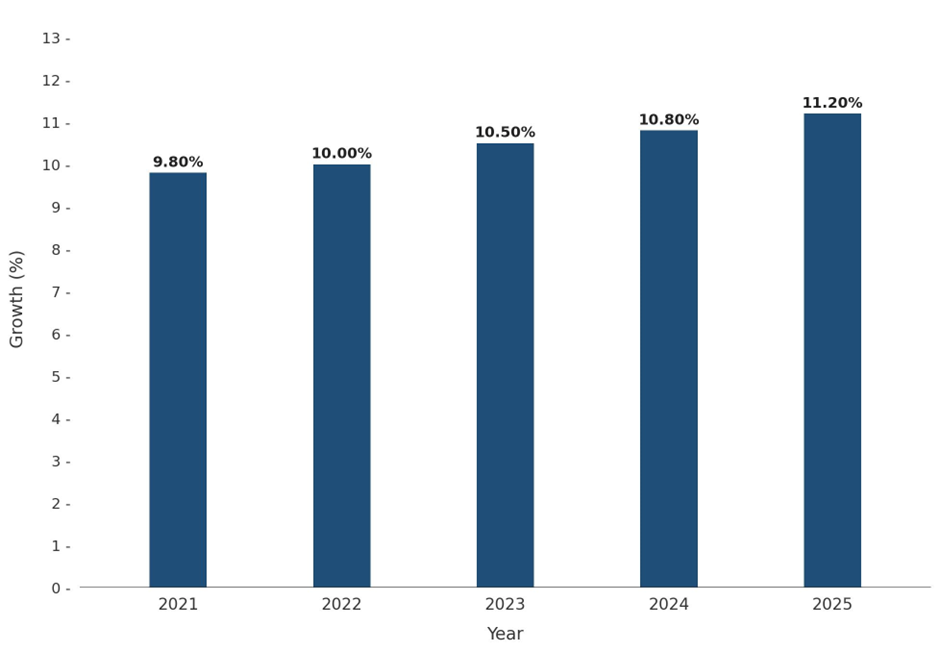
The table below presents the year‑wise growth rates along with the key drivers influencing the market
| Years | Est. Annual Growth in % | Growth Drivers |
| 2021 | 9.8% | Grown frequency of cyber-attacks and data breaches across key sectors. |
| 2022 | 10% | Government regulations and cybersecurity awareness programs improving investments. |
| 2023 | 10.5% | Increasing demand for cloud security solutions as businesses adopt digital transformation. |
| 2024 | 10.8% | Expanding reliance on online platforms and e-commerce powering the need for security. |
| 2025 | 11.2% | Emergence of new cybersecurity solutions and technologies to fight evolving threats. |
Topics Covered in the Morocco Cyber Security Market Report
Morocco Cyber Security Market report thoroughly covers the market by product type, end-user industry, and deployment models. The market report provides an unbiased and detailed analysis of ongoing market trends, opportunities/high growth areas, and market drivers, which would help stakeholders devise and align their market strategies according to the current and future market dynamics.
Morocco Cyber Security Market Highlights
| Report Name |
Morocco Cyber Security Market |
| Forecast period | 2026-2032 |
| CAGR | 11.3% |
| Market Size |
Threat Detection & Prevention |
Morocco Cyber Security Market Synopsis
The Morocco Cyber Security Market is set to grow at a steady pace, led by an increasing frequency of cyber-attacks and the adoption of digital transformation strategies across major industries. The government’s push for cybersecurity regulations, awareness, and initiatives helps to shape a secure environment for businesses and consumers. Moreover, the growth of cloud computing and the rising number of online services will support to further market growth. Cybersecurity services, especially in threat detection, identity and are about to dominate the market as businesses and governmental agencies work to robust their security measures.
Evaluation of Growth Drivers in the Morocco Cyber Security Market (2026-2032)
Below mentioned are some growth drivers and their impact on market dynamics:
| Drivers | Primary Segments Affected | Why It Matters |
| Increasing Cyber-Attacks | Solutions (Threat Detection, DDoS Mitigation, IDS) | Heightens demand for advanced security solutions and services to combat rising cyber threats. |
| Government Regulations | Solutions (Security Information & Event Management, Identity & Access Management) | Mandates for stricter cybersecurity compliance are driving investments in security systems. |
| Digital Transformation | End-User Industry (Healthcare, Retail, IT & Telecom) | Being fueled by the increasing adoption of cloud computing and digital commerce. It is creating a greater need for strong cybersecurity operations. |
| Rise in Cloud Computing | Deployment (Cloud, On-Premises) | Increase in demand for cloud-based solutions that provide improved flexibility and scalability in maintaining cybersecurity. |
| Increase in E-commerce & Online Transactions | End-User Industry (Retail, IT & Telecom) | Leads the need for cybersecurity to protect financial transactions and consumer data. |
The Morocco Cyber Security Market is expected to grow significantly, with a CAGR of 11.3% during the forecast period of 2022-2032. The growth is launched by the increasing number of cyber-attacks, government-led cybersecurity regulations, the expansion of cloud computing services, and a surge in e-commerce and digital platforms. As digital transformation accelerates in key industries, the demand for advanced cybersecurity solutions like threat detection, identity management, and data protection is growing rapidly.
Evaluation of Restraints in the Morocco Cyber Security Market
Below mentioned are some major restraints and their influence on market dynamics:
| Restraints | Primary Segments Affected | What This Means |
| Lack of Skilled Cybersecurity Professionals | Solutions (Threat Detection, DDoS Mitigation) | Limits the ability to implement and manage featured cybersecurity systems, restricting market growth. |
| High Implementation Costs | Solutions (Security Information & Event Management, Identity & Access Management) | Create significant financial hurdles and makes it harder for smaller businesses to embrace cybersecurity operations. |
| Regulatory Compliance Complexity | Solutions (All Types) | Complexities in regulatory infrastructure can lead to delays in executing cybersecurity measures. |
| Evolving Cyber Attracts | Solutions (All Types) | The continuous evolving nature of cyber-attacks requires frequent updates and innovations, that challenges businesses to stay ahead. |
| Cultural Barriers | End-User Industry (Retail, Healthcare) | Hinders the adoption of cybersecurity techniques in certain industries or regions, particularly where trust in digital solutions is low. |
Morocco Cyber Security Market Challenges
The market faces challenges like shortage of skilled cybersecurity professionals, high execution costs, and complex maintenance adherence that can limits the deployment of cybersecurity systems. Besides, the constantly evolving cyber-attacks landscape requires continuous innovation and updates, which places a strain on companies in Morocco Cyber Security Industry. Cultural barriers in some regions also inhibit global adoption of necessary cybersecurity practices.
Morocco Cyber Security Market Trends
Some major trends contributing to the Morocco Cyber Security Market Growth are:
- Rising Need for Threat Detection & Prevention: As cyber threats evolve; there is a growing urgency on threat detection and prevention technologies. Businesses are expanding in advanced tools such as SIEM (Security Information and Event Management) to detect vulnerabilities in real-time.
- Focus on Identity & Access Management: As digital transactions increases, so does the need for strong identity and access management systems to secure sensitive data and ensure adherence while maintaining privacy.
- Growing E-commerce and Online Transactions: The surge in online shopping and digital services is leading the need for improved cybersecurity measures, particularly for financial transactions and data protection.
Investment Opportunities in the Morocco Cyber Security Market
Here are some investment opportunities in the Morocco Cyber Security Industry:
- Cloud-Based Security Solutions: With the increase of cloud computing, there is a significant potential to invest in cybersecurity solutions that is designed specifically for cloud environments only.
- Cybersecurity Education and Training: Expending in training programs and certifications for cybersecurity professionals is significant to address the skills gap in the industry.
- E-commerce Security Solutions: By offering security tools to protect online retailers, financial services, and customers’ data from cyber-attacks presents a profitable opportunity.
Top 5 Leading Players in the Morocco Cyber Security Market
Here are some top companies contributing to Morocco Cyber Security Market Share:
1. Fortinet Inc
| Company Name | Fortinet, Inc. |
|---|---|
| Established Year | 2000 |
| Headquarters | Casablanca, Morocco |
| Official Website | Click Here |
Fortinet provides advanced threat detection, network security, and cloud security solutions. They are known for their comprehensive cybersecurity products and strong presence in Morocco.
2. Cisco Systems Inc
| Company Name | Cisco Systems, Inc. |
|---|---|
| Established Year | 1984 |
| Headquarters | Rabat, Morocco |
| Official Website | Click Here |
Cisco is a global leader in network security solutions, offering a range of cybersecurity products that cater to both enterprise and governmental cybersecurity needs in Morocco.
3. Check Point Software Technologies
| Company Name | Check Point Software Technologies |
|---|---|
| Established Year | 1993 |
| Headquarters | Casablanca, Morocco |
| Official Website | Click Here |
Check Point is a prominent cybersecurity firm offering solutions for network security, cloud security, and endpoint protection, with a significant market share in Morocco.
4. Palo Alto Networks
| Company Name | Palo Alto Networks |
|---|---|
| Established Year | 2005 |
| Headquarters | Casablanca, Morocco |
| Official Website | Click Here |
Palo Alto Networks is a key player in cybersecurity, providing threat intelligence, network security, and automation solutions to Moroccan enterprises and government agencies.
5. Kaspersky
| Company Name | Kaspersky |
|---|---|
| Established Year | 1997 |
| Headquarters | Casablanca, Morocco |
| Official Website | Click Here |
Kaspersky is a global leader in antivirus and cybersecurity solutions, focusing on providing advanced protection against cyber threats for businesses and individuals in Morocco.
Government Regulations Introduced in the Morocco Cyber Security Market
According to Moroccan government data, they have several initiatives have been introduced to support cybersecurity growth. The National Cybersecurity Strategy aims to protect the country’s digital framework from growing cyber threats. The Moroccan Cybersecurity Agency (ANSSI) is actively strengthening the nation's security through a combination of policy development, training programs, and the implementation of national security frameworks. Moreover, the Cybersecurity Awareness and Training Program aims to raise awareness and develop a skilled work environment to act on evolving cyber risks in Morocco.
Future Insights of the Morocco Cyber Security Market
The Morocco Cyber Security Market is focused to continue increasing as businesses and government organizations raise their focus on digital transformation and improving their cybersecurity framework. The adoption of cloud technologies and the rising number of cyber-attacks will lead to a demand for security solutions, while government initiatives and regulatory compliance requirements will support market growth. With the level of growing reliance on e-commerce and digital services, cybersecurity will remain a priority across all sectors.
Market Segmentation Analysis
The report offers a comprehensive study of the subsequent market segments and their leading categories.
Threat Detection & Prevention to Dominate the Market – By Product Type
According to Mansi Aneja, Senior Research Analyst at 6Wresearch, threat detection and prevention solutions are expected to dominate the market due to increasing cyber-attacks and the demand for real-time security initiative. These solutions help businesses spot and stop cyber-attacks before they can do any damage.
Aerospace & Defense to Dominate the Market – By End-User Industry
The aerospace and defense industry is expected to dominate due to the high demand for private coversations, data protection, and advanced cybers safety procedure required to safeguard sensitive military and defense systems.
Cloud Deployment Models to Dominate the Market – By Deployment
Cloud deployment models gain a prominence due to the scalability, flexibility, and cost-effectiveness they offer. The adoption of cloud computing across sectors is expanding the need for cloud security solutions.
Key attractiveness of the report
- 10 Years Market Numbers
- Historical Data Starting from 2022 to 2025
- Base Year: 2025
- Forecast Data until 2032
- Key Performance Indicators Impacting the Market
- Major Upcoming Developments and Projects
Key Highlights of the Report:
- Morocco Cyber security Market Overview
- Morocco Cyber security Market Outlook
- Morocco Cyber security Market Forecast
- Historical Data of Morocco Cyber security Market Revenues for the Period 2022-2032
- Morocco Cyber security Market Size and Morocco Cyber security Market Forecast of Revenues, Until 2032
- Historical Data of Morocco Cyber security Market Revenues, by Product, for the Period 2022-2032
- Market Size & Forecast of Morocco Cyber security Market Revenues, by Product, Until 2032
- Historical Data of Morocco Cyber security Market Revenues, by Deployment Mode, for the Period 2022-2032
- Market Size & Forecast of Morocco Cyber security Market Revenues, by Deployment Mode, Until 2032
- Historical Data of Morocco Cyber security Market Revenues, by Regions, for the Period 2022-2032
- Market Size & Forecast of Morocco Cyber security Market Revenues, by Regions, Until 2032
- Market Drivers and Restraints
- Morocco Cyber security Market Trends and Industry Life Cycle
- Porter’s Five Force Analysis
- Market Opportunity Assessment
- Morocco Cyber security Market Share, By Players
- Morocco Cyber security Market Share, By Regions
- Morocco Cyber security Market Overview on Competitive Benchmarking
Market covered
The report subsequently covers the market by following segments and subsegments.
By Product Type
- Solutions
- Identity & Access Management
- Threat Detection & Prevention
- DDoS & Mitigation
- IDS
- Security Information & Event Management
- Others
- Services
By End-User Industry
- Aerospace & Defence
- Healthcare
- Manufacturing
- Retail
- Utility
- IT & Telecom
- Others
By Deployment
- On-Premises
- Cloud






































