Morocco Higher Education Market Size & Growth Rate (2026-2032)
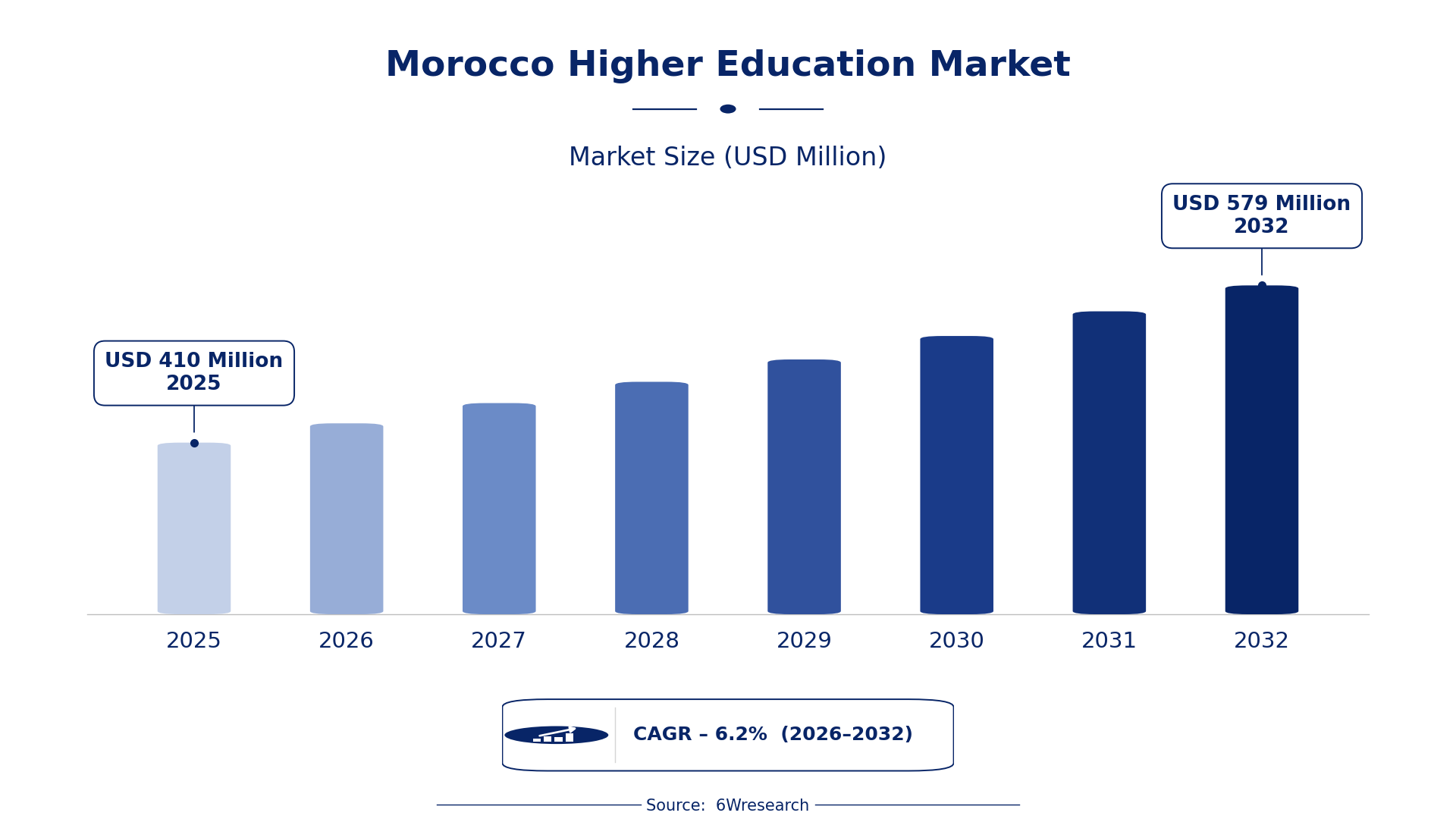
The Morocco Higher Education Market was estimated at USD 410 Million in 2025 and is projected to reach USD 579 Million by 2032, growing at a CAGR of 6.2% from 2026 to 2032.
Morocco Higher Education Market Synopsis
The higher education market in Morocco has experienced notable growth in recent years, fueled by government investments in educational infrastructure and a rising demand for skilled labor. However, as the market evolves, it faces challenges in adapting educational programs to better align with job market needs.
Looking ahead, the focus on enhancing educational quality and accessibility is paramount. With an increasing emphasis on technical and vocational training, the Moroccan government is positioning itself to not only improve educational outcomes but also to meet the evolving demands of a competitive workforce.
Morocco Higher Education Market Year-wise Growth Rate and Key Drivers
This graph illustrates the annual growth rates of the Morocco Higher Education Market from 2021 to 2032, highlighting a steady upward trajectory and projected expansion over the forecast period.
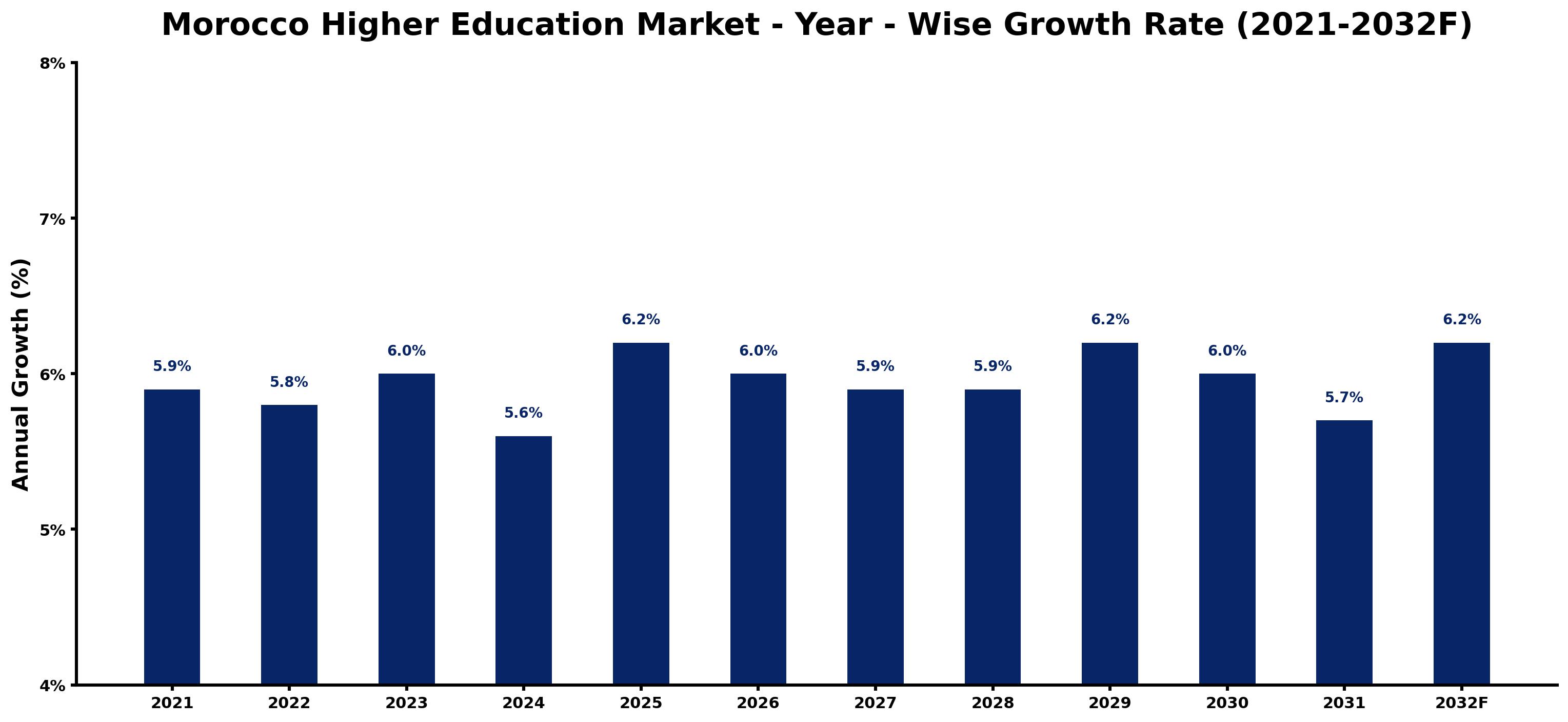
The table below presents the year‑wise growth rates along with the key drivers influencing the market
| Year | Growth Rate | Major Drivers |
| 2021 | 5.9% | Government reforms enhancing university accessibility and quality. |
| 2022 | 5.8% | Growth in partnerships with international educational institutions. |
| 2023 | 6.0% | Increased enrollment in STEM fields from local initiatives. |
| 2024 | 5.6% | Moroccan scholarship programs boosting student participation abroad. |
| 2025 | 6.2% | Emergence of private universities in urban centers. |
| 2026 | 6.0% | Rising interest in foreign languages among students. |
| 2027 | 5.9% | Government incentives for digital education technologies deployment. |
| 2028 | 5.9% | Increased awareness of lifelong learning and adult education. |
| 2029 | 6.2% | Growth in research funding from Moroccan higher education institutions. |
| 2030 | 6.0% | Favorable demographic trends focusing on youth education. |
| 2031 | 5.7% | Strengthened links between universities and local industries. |
| 2032 | 6.2% | Rising popularity of hybrid learning models post-pandemic. |
Note: Market size estimations and growth projections presented in this report are based on 6Wresearch's proprietary forecasting methodology, utilizing the latest available industry data, government publications, and primary research inputs.
Morocco Higher Education Market Key Takeaways
Below are some of the specific key takeaways from the market, including:
- The government is prioritizing educational reforms to enhance skill sets and employability.
- Investment in online education platforms is on the rise, providing greater access to higher education.
- Collaboration between educational institutions and industries is essential for aligning curricula with market needs.
- Affordability and accessibility continue to pose challenges for many prospective students.
- Research and innovation are increasingly recognized as critical components of economic development.
Evaluation of Restraints in Morocco Higher Education Market
Despite its growth, the Morocco higher education market grapples with several restraints. One major issue is the relevance of educational content, which often fails to keep pace with the rapidly changing job market. Many graduates find themselves underprepared for real-world challenges due to outdated curricula. Additionally, access remains a significant hurdle, as socio-economic factors limit opportunities for many students. The need for strategic partnerships between academia and industry to foster research capabilities is urgent, yet often overlooked.
Morocco Higher Education Market Trends
Current trends indicate a shift towards digital and hybrid learning environments, driven by technological advancements and changing student preferences. The rise of online education platforms is democratizing access to higher education, particularly in remote areas. on top of that, there is a growing emphasis on international collaboration, with Moroccan institutions seeking partnerships with foreign universities to enhance their educational offerings and research capabilities.
Morocco Higher Education Market Opportunities
Opportunities for growth in the Morocco higher education market are significant. The demand for skilled professionals across various sectors presents a ripe landscape for institutions that can innovate and adapt. Investment in technical and vocational training programs is particularly promising, as these initiatives are designed to equip students with the skills needed in the labor market. Additionally, with the government's focus on enhancing research capabilities, there is potential for universities to become hubs of innovation and economic development.
Government Initiatives in the Morocco Higher Education Market
Government policy is a crucial driver in shaping the higher education market in Morocco. The current regulatory framework emphasizes improving educational quality and accessibility. Public-sector priorities focus on funding allocations for infrastructure development and programs that promote equity in education. As the government seeks to align educational outcomes with workforce requirements, these initiatives are vital for future growth.
- A recently completed initiative focused on upgrading digital infrastructure in universities to support online learning.
- A currently ongoing program aims to increase the number of scholarships available for underprivileged students.
- A planned initiative set to launch in 2026 will enhance research capabilities through partnerships with international institutions.
- A new regulatory framework established in 2025 mandates periodic curriculum reviews to ensure relevance to market needs.
- An upcoming public-private partnership expected to foster innovation in vocational training is slated for 2027.
Future Insights of the Morocco Higher Education Market
Between 2026 and 2032, the Morocco higher education market is expected to continue its upward trajectory, driven by ongoing investments and policy reforms. The increasing emphasis on quality education and alignment with job market demands will play a critical role in shaping the future. Institutions that can adapt to these changes while maintaining accessibility will likely thrive in this evolving environment.
Morocco Higher Education Market Latest Developments
In the past year, the Morocco higher education market has seen a flurry of activity, marked by both institutional reforms and technological advancements. As the demand for skilled professionals grows, educational institutions are increasingly focused on innovative approaches to learning and collaboration.
- A major technology vendor launched a new online learning platform in early 2025 aimed at enhancing digital literacy among students.
- An initiative to establish a network of research centers across universities is currently underway, expected to strengthen innovation capacity.
- In late 2025, a regional operator announced a partnership with several universities to enhance access to vocational training programs.
- A rollout of a nationwide awareness campaign about the importance of higher education is planned for Q3 2026.
- A new accreditation process aimed at improving educational quality is set to begin in mid-2026.
Morocco Higher Education Market - Key Attractiveness of the Report
- 10 Years of Market Numbers
- Historical Data Starting from 2022 to 2025
- Base Year: 2025
- Forecast Data until 2032
- Key Performance Indicators Impacting the Market
- Major Upcoming Developments and Projects
Key Highlights of the Report:
- Morocco Higher Education Market Outlook
- Market Size of Morocco Higher Education Market, 2025
- Forecast of Morocco Higher Education Market, 2032
- Historical Data and Forecast of Morocco Higher Education Revenues & Volume for the Period 2022-2032F
- Morocco Higher Education Market Trend Evolution
- Morocco Higher Education Market Drivers and Challenges
- Morocco Higher Education Price Trends
- Morocco Higher Education Porter's Five Forces
- Morocco Higher Education Industry Life Cycle
- Historical Data and Forecast of Morocco Higher Education Market Revenues & Volume By Component for the Period 2022-2032F
- Historical Data and Forecast of Morocco Higher Education Market Revenues & Volume By Solutions for the Period 2022-2032F
- Historical Data and Forecast of Morocco Higher Education Market Revenues & Volume By Services for the Period 2022-2032F
- Historical Data and Forecast of Morocco Higher Education Market Revenues & Volume By Deployment Type for the Period 2022-2032F
- Historical Data and Forecast of Morocco Higher Education Market Revenues & Volume By On-premises for the Period 2022-2032F
- Historical Data and Forecast of Morocco Higher Education Market Revenues & Volume By Cloud for the Period 2022-2032F
- Historical Data and Forecast of Morocco Higher Education Market Revenues & Volume By Vertical for the Period 2022-2032F
- Historical Data and Forecast of Morocco Higher Education Market Revenues & Volume By State Universities for the Period 2022-2032F
- Historical Data and Forecast of Morocco Higher Education Market Revenues & Volume By Community Colleges for the Period 2022-2032F
- Historical Data and Forecast of Morocco Higher Education Market Revenues & Volume By Private Colleges for the Period 2022-2032F
- Morocco Higher Education Import Export Trade Statistics
- Market Opportunity Assessment By Component
- Market Opportunity Assessment By Deployment Type
- Market Opportunity Assessment By Vertical
- Morocco Higher Education Top Companies Market Share
- Morocco Higher Education Competitive Benchmarking By Technical and Operational Parameters
- Morocco Higher Education Company Profiles
- Morocco Higher Education Key Strategic Recommendations






































