Morocco Kitchen Cabinets Market Size, Share & Growth Rate
The Morocco Kitchen Cabinets Market was estimated at USD 398 Million in 2025 and is projected to reach USD 532 Million by 2032, growing at a CAGR of 4.2% from 2026 to 2032. This growth trajectory is propelled by the increasing urbanization and rising disposable incomes, which are reshaping consumer preferences towards modern, functional kitchen designs. Additionally, the blending of traditional Moroccan craftsmanship with contemporary aesthetics is enhancing the appeal of kitchen cabinets, further stimulating demand.
Morocco Kitchen Cabinets Market Year-wise Growth Rate and Key Drivers
This graph highlights how the Morocco Kitchen Cabinets Market has steadily grown over the years, supported by major growth factors.
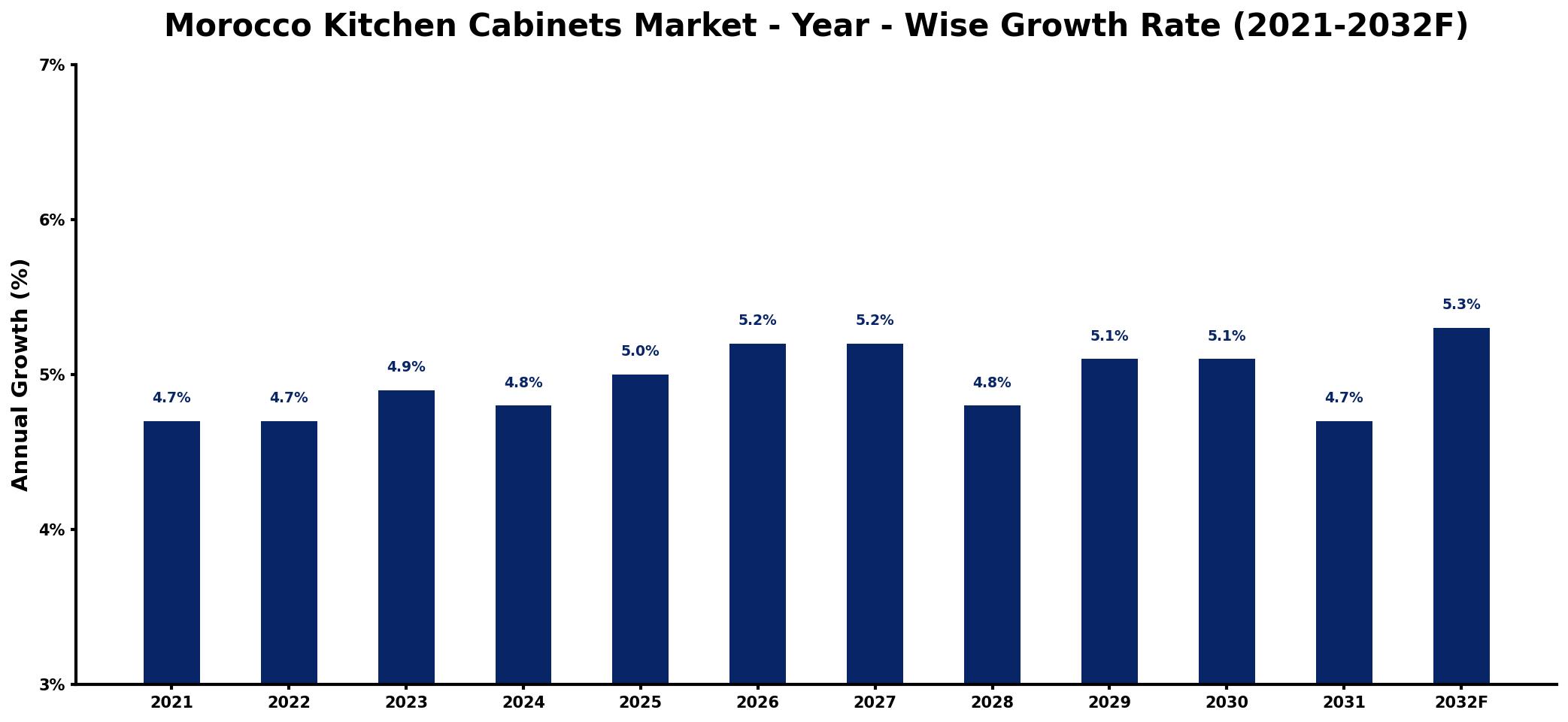
The table below presents the year‑wise growth rates along with the key drivers influencing the market
| Year | Growth Rate | Major Drivers |
| 2021 | 4.7% | Rising real estate developments demand |
| 2022 | 4.7% | Increased consumer renovation projects |
| 2023 | 4.9% | Growing interest in home aesthetics |
| 2024 | 4.8% | Expansion of local manufacturing facilities |
| 2025 | 5.0% | Surge in disposable income levels |
| 2026 | 5.2% | Boost in foreign investment influx |
| 2027 | 5.2% | Strengthened online retail platforms |
| 2028 | 4.8% | Growing trend of sustainable materials |
| 2029 | 5.1% | Increased urban population density |
| 2030 | 5.1% | Rising demand for custom designs |
| 2031 | 4.7% | Improved accessibility to financing options |
| 2032 | 5.3% | growing commercial sector adoption |
Note: Market size estimations and growth projections presented in this report are based on 6Wresearch's proprietary forecasting methodology, utilizing the latest available industry data, government publications, and primary research inputs.
Morocco Kitchen Cabinets Market Synopsis
The Morocco kitchen cabinets market stands out for its unique fusion of traditional craftsmanship and modern design elements. A surge in urban development and remodeling activities is driving the demand for innovative kitchen solutions that cater to diverse customer preferences.
As consumers increasingly seek high-quality, customizable options, the market is seeing a rise in the popularity of eco-friendly materials and smart storage solutions. This shift reflects a broader trend towards creating aesthetically pleasing yet functional living spaces within Moroccan homes.
Morocco Kitchen Cabinets Market Key Takeaways
- The market is experiencing robust growth, driven by urbanization and rising disposable incomes.
- Modern, minimalist designs are becoming the preferred choice for consumers seeking space-saving kitchen solutions.
- Customization and eco-friendly materials are increasingly important to Moroccan consumers.
- The competitive landscape includes both local and international suppliers, each targeting unique customer segments.
- Government policies are supporting local manufacturers through incentives and quality standards.
Evaluation of Restraints in Morocco Kitchen Cabinets Market
Despite the growth potential, the Morocco kitchen cabinets market faces significant challenges that could hinder its expansion. Intense competition among local and international brands often results in price wars, making it challenging for local manufacturers to maintain profit margins. Moreover, fluctuating raw material prices, particularly for wood and hardware components, can add unpredictability to production costs. Furthermore, as consumer preferences evolve towards more personalized and sustainable solutions, manufacturers must continuously innovate to meet these demands, which may strain their resources and capacities.
Morocco Kitchen Cabinets Market Trends
Current trends indicate a clear shift towards modern and minimalist kitchen designs that emphasize both function and aesthetics. Consumers are opting for high-quality materials, such as solid wood and MDF, and are showing a preference for various finishes that enhance their kitchens visual appeal. Additionally, the interest in eco-friendly cabinet solutions is gaining traction, with consumers more conscious of their environmental impact and demanding sustainable practices from manufacturers.
Morocco Kitchen Cabinets Market Opportunities
The market presents considerable investment opportunities, particularly for those willing to innovate in product design and sustainable manufacturing. There is a burgeoning demand for customizable kitchen solutions that align with individual consumer needs. Investors can also explore partnerships with local distributors or establish retail showrooms, tapping into the expanding consumer base seeking modern kitchen upgrades. With ongoing development in the Moroccan real estate sector, there is ample room for growth within the kitchen cabinets market.
Government Initiatives in the Morocco Kitchen Cabinets Market
The Moroccan government has introduced various initiatives aimed at bolstering the local manufacturing industry, including the kitchen cabinets market. These initiatives offer incentives and subsidies to support local manufacturers while promoting the use of locally sourced materials. Furthermore, government efforts to implement stringent quality standards ensure consumer protection and product safety. A commitment to sustainable practices in manufacturing is also emphasized, reflecting the government's dedication to reducing environmental impacts associated with the industry.
Future Insights of the Morocco Kitchen Cabinets Market
Looking ahead to 2026-2032, the Morocco kitchen cabinets market is expected to maintain a positive growth trajectory. As urbanization continues and disposable incomes rise, consumers will likely focus on home improvement and renovation projects, further driving demand for stylish kitchen solutions. The integration of eco-friendly materials and smart technologies into kitchen designs will shape consumer preferences, making it crucial for manufacturers to adapt their offerings to align with these evolving trends. Overall, the future appears promising, with ample opportunities for innovation and market expansion.
Morocco Kitchen Cabinets Market Latest Developments (2025 - 2026)
Recent developments in the Morocco kitchen cabinets market highlight a growing emphasis on sustainability and innovation. Manufacturers are increasingly adopting eco-friendly practices in production processes while launching new product lines featuring smart storage solutions. Additionally, collaborations between local brands and international firms are becoming more prevalent, as they seek to merge local craftsmanship with global design trends. These shifts indicate a dynamic market landscape that is responsive to consumer demands and environmental considerations.
Morocco Kitchen Cabinets Market - Key Attractiveness of the Report
- 10 Years of Market Numbers
- Historical Data Starting from 2022 to 2025
- Base Year: 2025
- Forecast Data until 2032
- Key Performance Indicators Impacting the Market
- Major Upcoming Developments and Projects
Key Highlights of the Report:
- Morocco Kitchen Cabinets Market Outlook
- Market Size of Morocco Kitchen Cabinets Market, 2025
- Forecast of Morocco Kitchen Cabinets Market, 2032
- Historical Data and Forecast of Morocco Kitchen Cabinets Revenues & Volume for the Period 2022-2032F
- Morocco Kitchen Cabinets Market Trend Evolution
- Morocco Kitchen Cabinets Market Drivers and Challenges
- Morocco Kitchen Cabinets Price Trends
- Morocco Kitchen Cabinets Porter's Five Forces
- Morocco Kitchen Cabinets Industry Life Cycle
- Historical Data and Forecast of Morocco Kitchen Cabinets Market Revenues & Volume By Type for the Period 2022-2032F
- Historical Data and Forecast of Morocco Kitchen Cabinets Market Revenues & Volume By Ready-to-assemble (RTA) for the Period 2022-2032F
- Historical Data and Forecast of Morocco Kitchen Cabinets Market Revenues & Volume By Stock Kitchen Cabinets for the Period 2022-2032F
- Historical Data and Forecast of Morocco Kitchen Cabinets Market Revenues & Volume By Semi-custom Kitchen Cabinets for the Period 2022-2032F
- Historical Data and Forecast of Morocco Kitchen Cabinets Market Revenues & Volume By Custom Kitchen Cabinets for the Period 2022-2032F
- Historical Data and Forecast of Morocco Kitchen Cabinets Market Revenues & Volume By Raw Material for the Period 2022-2032F
- Historical Data and Forecast of Morocco Kitchen Cabinets Market Revenues & Volume By Wood for the Period 2022-2032F
- Historical Data and Forecast of Morocco Kitchen Cabinets Market Revenues & Volume By Metal for the Period 2022-2032F
- Historical Data and Forecast of Morocco Kitchen Cabinets Market Revenues & Volume By Other Raw Materials for the Period 2022-2032F
- Historical Data and Forecast of Morocco Kitchen Cabinets Market Revenues & Volume By Distribution Channel for the Period 2022-2032F
- Historical Data and Forecast of Morocco Kitchen Cabinets Market Revenues & Volume By Retail for the Period 2022-2032F
- Historical Data and Forecast of Morocco Kitchen Cabinets Market Revenues & Volume By Online for the Period 2022-2032F
- Historical Data and Forecast of Morocco Kitchen Cabinets Market Revenues & Volume By Other Distribution Channels for the Period 2022-2032F
- Historical Data and Forecast of Morocco Kitchen Cabinets Market Revenues & Volume By Application for the Period 2022-2032F
- Historical Data and Forecast of Morocco Kitchen Cabinets Market Revenues & Volume By Home for the Period 2022-2032F
- Historical Data and Forecast of Morocco Kitchen Cabinets Market Revenues & Volume By Restaurants for the Period 2022-2032F
- Historical Data and Forecast of Morocco Kitchen Cabinets Market Revenues & Volume By Other Applications for the Period 2022-2032F
- Morocco Kitchen Cabinets Import Export Trade Statistics
- Market Opportunity Assessment By Type
- Market Opportunity Assessment By Raw Material
- Market Opportunity Assessment By Distribution Channel
- Market Opportunity Assessment By Application
- Morocco Kitchen Cabinets Top Companies Market Share
- Morocco Kitchen Cabinets Competitive Benchmarking By Technical and Operational Parameters
- Morocco Kitchen Cabinets Company Profiles
- Morocco Kitchen Cabinets Key Strategic Recommendations






































