Morocco Security Printing Market Size, Share & Growth Rate
The Morocco Security Printing Market was estimated at USD 184 Million in 2025 and is projected to reach USD 256 Million by 2032, growing at a CAGR of 4.8% from 2026 to 2032. This growth trajectory is primarily driven by heightened concerns surrounding document and currency counterfeiting, alongside robust government initiatives aimed at enhancing document security. As Morocco continues to modernize its security measures and adapt to the challenges posed by digital transactions, the demand for innovative printing solutions is poised to escalate.
Morocco Security Printing Market Year-wise Growth Rate and Key Drivers
This graph highlights how the Morocco Security Printing Market has steadily grown over the years, supported by major growth factors.
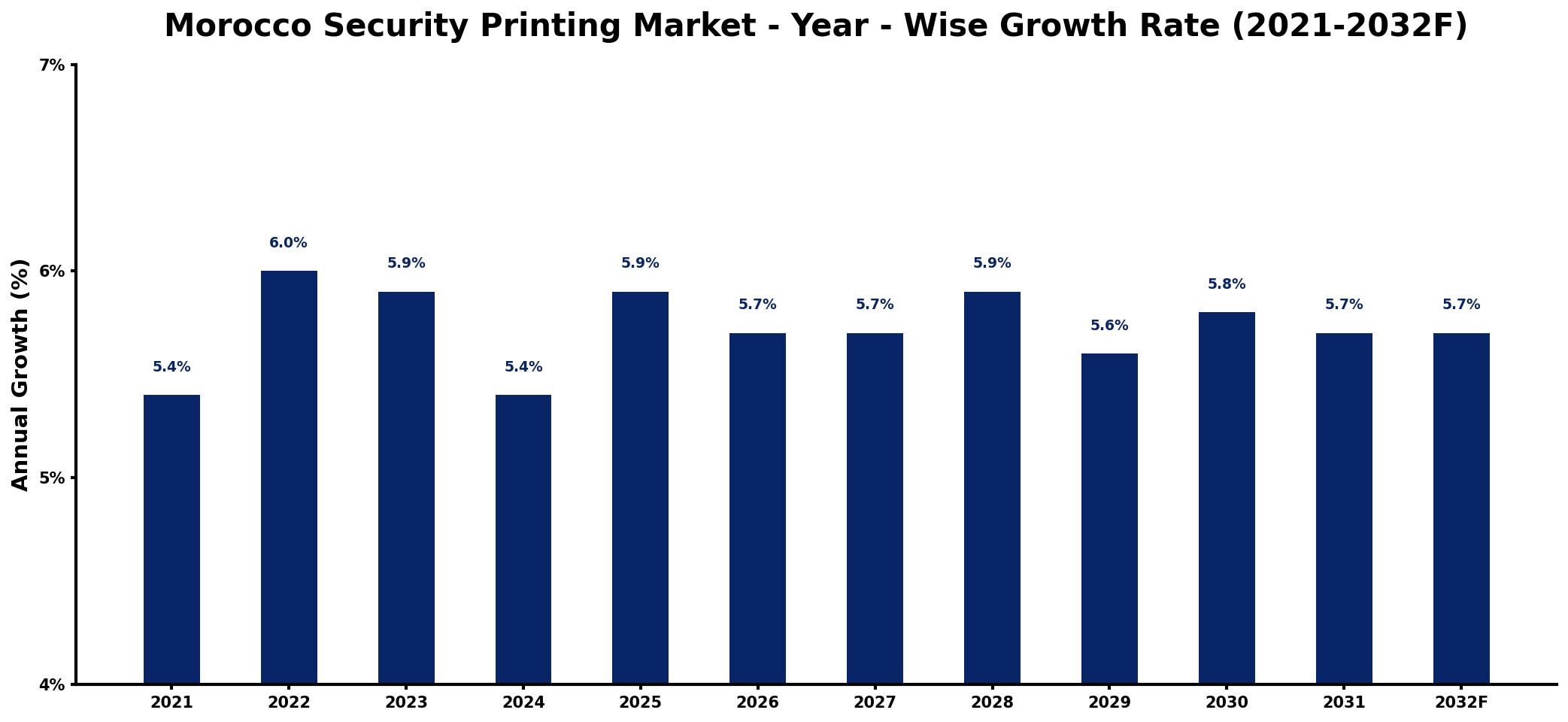
The table below presents the year‑wise growth rates along with the key drivers influencing the market
| Year | Growth Rate | Major Drivers |
| 2021 | 5.4% | Rising government expenditure initiatives |
| 2022 | 6.0% | Increased demand for authentication solutions |
| 2023 | 5.9% | Growth in financial sector investments |
| 2024 | 5.4% | growing emerging market penetration |
| 2025 | 5.9% | Surge in retail sector requirements |
| 2026 | 5.7% | Increased focus on anti-counterfeiting measures |
| 2027 | 5.7% | strengthening underlying market demand |
| 2028 | 5.9% | Rising consumer confidence in markets |
| 2029 | 5.6% | Investment in technology upgrades |
| 2030 | 5.8% | Strengthening of regulatory compliance frameworks |
| 2031 | 5.7% | expanding manufacturing base activity |
| 2032 | 5.7% | Expansion of e-commerce platforms |
Note: Market size estimations and growth projections presented in this report are based on 6Wresearch's proprietary forecasting methodology, utilizing the latest available industry data, government publications, and primary research inputs.
Morocco Security Printing Market Synopsis
The primary force shaping the Morocco Security Printing Market is the increasing emphasis on secure document and currency production. With the rise of fraudulent activities, there is a pressing need for high-quality security features in printed materials, ranging from currency to identification documents. This focus is further amplified by governmental efforts aimed at combating counterfeiting through stringent regulations and enhanced printing technologies.
As the market evolves, innovative technologies are being integrated into security printing processes. Features such as holograms, microprinting, and advanced security inks are now commonplace, offering robust protection against forgery and tampering. Additionally, the trend towards sustainability is prompting companies to explore eco-friendly printing practices, further enriching the market landscape.
Morocco Security Printing Market Key Takeaways
- The market is driven by increasing government initiatives focused on enhancing document security.
- Technological advancements are introducing sophisticated security features that deter counterfeiting.
- The rising trend of e-commerce is creating demand for secure packaging and labeling solutions.
- Investment opportunities exist in developing innovative digital security solutions and partnerships with governmental bodies.
- Compliance with governmental regulations remains critical for maintaining market integrity.
Evaluation of Restraints in Morocco Security Printing Market
Despite its growth, the Morocco Security Printing Market encounters various restraints. The persistent threat of sophisticated counterfeiting tactics poses challenges for companies striving to maintain their competitive edge. Additionally, the requirement for continuous innovation can strain resources, particularly for smaller firms. Economic fluctuations, along with the demand for digital solutions, compel traditional security printing businesses to adapt their strategies, which may prove challenging. Regulatory compliance adds another layer of complexity, necessitating ongoing diligence from companies in the sector.
Morocco Security Printing Market Trends
In the Morocco Security Printing Market, several notable trends are emerging. There is a significant increase in the adoption of advanced security features, such as UV inks, holograms, and biometric technologies that enhance the security of essential documents. Furthermore, the shift towards digital solutions is increasingly common, with companies investing in RFID tags and authentication software to meet growing consumer demands. Environmental sustainability is also becoming a focal point, with firms exploring eco-friendly printing technologies to align with global sustainability goals.
Morocco Security Printing Market Opportunities
The Morocco Security Printing Market presents robust investment opportunities driven by the persistent need for enhanced security in documentation. Key areas ripe for investment include the development of next-generation security features like advanced holograms and high-security inks. Collaborations with governmental entities and financial institutions could lead to lucrative contracts for secure document printing. Moreover, investing in research and development to innovate and integrate digital security solutions will be vital for companies aiming to capitalize on emerging market demands.
Government Initiatives in the Morocco Security Printing Market
The Moroccan government plays a pivotal role in regulating the security printing landscape through stringent policies and initiatives. The General Directorate of National Security (DGSN) and the General Directorate of National Security (DGST) have implemented comprehensive measures to ensure the integrity and security of essential documents. These measures include quality control protocols, routine audits, and partnerships with international organizations, aimed at enhancing the security features of printed materials. Adhering to these regulations is crucial for security printing firms striving to maintain their operational legitimacy.
Future Insights of the Morocco Security Printing Market
Looking ahead to 2026-2032, the Morocco Security Printing Market is set to flourish, spurred by increasing adoption of secure printing technologies by both governmental and financial institutions. The growth in demand for secure identification documents—such as passports and ID cards—will drive this expansion. With ongoing advancements in printing technologies and an unwavering commitment to enhancing security measures, the market is expected to provide an array of opportunities for players willing to innovate and invest in future solutions.
Morocco Security Printing Market Latest Developments (2025 - 2026)
Recent developments in the Morocco Security Printing Market indicate a notable push towards integrating advanced technologies in security printing solutions. Companies are increasingly adopting digital printing capabilities that allow for cost-effective customization of security features. Moreover, partnerships between public and private sectors are being strengthened to improve document security, leveraging new technologies and methodologies to safeguard against counterfeit threats. This strategic collaboration aims to ensure that Morocco remains at the forefront of document security innovation.
Morocco Security Printing Market - Key Attractiveness of the Report
- 10 Years of Market Numbers
- Historical Data Starting from 2022 to 2025
- Base Year: 2025
- Forecast Data until 2032
- Key Performance Indicators Impacting the Market
- Major Upcoming Developments and Projects
Key Highlights of the Report:
- Morocco Security Printing Market Outlook
- Market Size of Morocco Security Printing Market, 2025
- Forecast of Morocco Security Printing Market, 2032
- Historical Data and Forecast of Morocco Security Printing Revenues & Volume for the Period 2022-2032F
- Morocco Security Printing Market Trend Evolution
- Morocco Security Printing Market Drivers and Challenges
- Morocco Security Printing Price Trends
- Morocco Security Printing Porter's Five Forces
- Morocco Security Printing Industry Life Cycle
- Historical Data and Forecast of Morocco Security Printing Market Revenues & Volume By Printing Type for the Period 2022-2032F
- Historical Data and Forecast of Morocco Security Printing Market Revenues & Volume By Screen Printing for the Period 2022-2032F
- Historical Data and Forecast of Morocco Security Printing Market Revenues & Volume By Letterpress Printing for the Period 2022-2032F
- Historical Data and Forecast of Morocco Security Printing Market Revenues & Volume By Digital Printing for the Period 2022-2032F
- Historical Data and Forecast of Morocco Security Printing Market Revenues & Volume By Lithographic Printing for the Period 2022-2032F
- Historical Data and Forecast of Morocco Security Printing Market Revenues & Volume By Intaglio Printing for the Period 2022-2032F
- Historical Data and Forecast of Morocco Security Printing Market Revenues & Volume By Others for the Period 2022-2032F
- Historical Data and Forecast of Morocco Security Printing Market Revenues & Volume By Application for the Period 2022-2032F
- Historical Data and Forecast of Morocco Security Printing Market Revenues & Volume By Cheques for the Period 2022-2032F
- Historical Data and Forecast of Morocco Security Printing Market Revenues & Volume By Legal & Government Documents for the Period 2022-2032F
- Historical Data and Forecast of Morocco Security Printing Market Revenues & Volume By Certificates for the Period 2022-2032F
- Historical Data and Forecast of Morocco Security Printing Market Revenues & Volume By Others for the Period 2022-2032F
- Morocco Security Printing Import Export Trade Statistics
- Market Opportunity Assessment By Printing Type
- Market Opportunity Assessment By Application
- Morocco Security Printing Top Companies Market Share
- Morocco Security Printing Competitive Benchmarking By Technical and Operational Parameters
- Morocco Security Printing Company Profiles
- Morocco Security Printing Key Strategic Recommendations






































