Morocco Telecom Services Market Size, Share & Growth Rate
The Morocco Telecom Services Market was estimated at USD 345 Million in 2025 and is projected to reach USD 482 Million by 2032, growing at a CAGR of 4.9% from 2026 to 2032. This growth is primarily driven by a significant increase in mobile penetration and a burgeoning demand for high-speed internet services. The ongoing rollout of 5G technologies, coupled with the expansion of digital services, further accelerates this upward trajectory.
Morocco Telecom Services Market Year-wise Growth Rate and Key Drivers
This graph highlights how the Morocco Telecom Services Market has steadily grown over the years, supported by major growth factors.
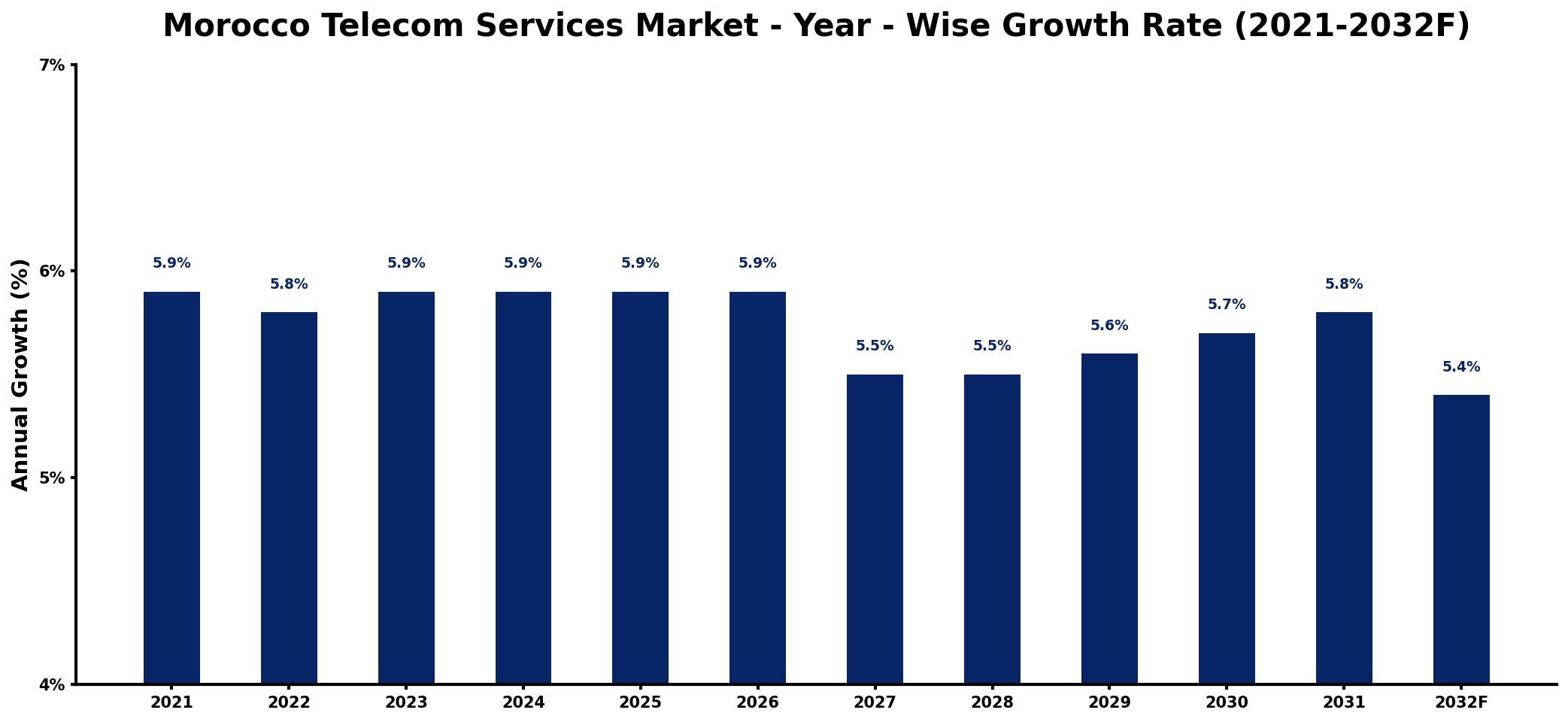
The table below presents the year‑wise growth rates along with the key drivers influencing the market
| Year | Growth Rate | Major Drivers |
| 2021 | 5.9% | Rising smartphone adoption rates |
| 2022 | 5.8% | Increased internet penetration growth |
| 2023 | 5.9% | Expansion of 5G infrastructure |
| 2024 | 5.9% | Growing demand for data consumption |
| 2025 | 5.9% | Investment in digital transformation |
| 2026 | 5.9% | Enhanced mobile payment adoption |
| 2027 | 5.5% | Increased competition among providers |
| 2028 | 5.5% | growing automotive sector requirements |
| 2029 | 5.6% | Growth in IoT applications usage |
| 2030 | 5.7% | Rising demand for cloud solutions |
| 2031 | 5.8% | Increased focus on cybersecurity measures |
| 2032 | 5.4% | Growing interest in smart cities |
Note: Market size estimations and growth projections presented in this report are based on 6Wresearch's proprietary forecasting methodology, utilizing the latest available industry data, government publications, and primary research inputs.
Morocco Telecom Services Market Synopsis
In Morocco, mobile data consumption is experiencing unprecedented growth, spurred by the increasing availability of affordable smartphones and the desire for digital connectivity. This market's rapid evolution is underpinned by a competitive landscape featuring major players who are constantly innovating to capture the attention of a tech-savvy consumer base.
The push towards digitalization is reflected in the increasing adoption of streaming platforms, online gaming, and mobile payment solutions. As consumers shift towards unlimited data plans, the telecom sector is adapting, enhancing service offerings to meet this growing demand effectively.
Morocco Telecom Services Market Key Takeaways
- The telecom services market in Morocco is rapidly evolving, with increasing mobile and internet penetration driving demand.
- There is a notable shift towards unlimited data plans and bundled services, catering to changing consumer preferences.
- The expansion of 5G networks represents a key opportunity for telecom providers to enhance service capabilities.
- Innovative digital services, such as streaming and e-commerce, are becoming integral to the telecom landscape.
- Ongoing regulatory reforms aim to promote competition and digital inclusion, further energizing market growth.
Evaluation of Restraints in Morocco Telecom Services Market
While the Morocco Telecom Services Market exhibits promising growth potential, several restraints persist. Intense competition among operators often leads to aggressive pricing strategies, exerting pressure on profit margins. Regulatory constraints may pose challenges, hindering swift innovation and necessary infrastructure investments. Furthermore, reaching underserved rural areas remains a hurdle, complicating efforts to provide comprehensive coverage. These elements create an intricate landscape that companies must navigate while striving for growth and sustainability.
Morocco Telecom Services Market Trends
Current trends in the Morocco Telecom Services Market include a dramatic rise in data consumption, facilitated by advancements in mobile network technology. The deployment of 5G is beginning to take shape, promising to unlock new service capabilities and enhance user experiences. Additionally, a surge in digital platforms and services is shaping consumer behavior, as more users embrace streaming, gaming, and e-commerce. Investment in fiber optic infrastructure is also critical to accommodating the insatiable demand for high-speed internet.
Morocco Telecom Services Market Opportunities
Genuine growth opportunities abound within the Morocco Telecom Services Market, particularly in areas such as broadband expansion and 5G technology deployment. The increasing smartphone penetration presents avenues for mobile network operators to innovate with digital solutions like mobile payments and enriched digital content services. Moreover, government-backed initiatives aimed at digital transformation and smart city development open doors for investments in IoT and smart technologies, which could further enhance connectivity.
Government Initiatives in the Morocco Telecom Services Market
The Moroccan government plays a pivotal role in shaping the telecom services landscape through the National Telecommunications Regulatory Agency (ANRT). This agency oversees licensing, spectrum allocation, and promotes competition within the sector, ensuring fair practices. Recent policies emphasize the need for improved service quality, broader network coverage, and reduced consumer prices, while also encouraging the deployment of advanced technologies to foster innovation and digital inclusion across the nation.
Future Insights of the Morocco Telecom Services Market
Looking ahead to 2026-2032, the Morocco Telecom Services Market is well-positioned for continued expansion, driven by the increasing internet penetration rates and the appetite for mobile data services. The implementation of 5G technology will play a crucial role in enhancing network capabilities, catering to the rising demand for high-speed connectivity. As digital services like e-commerce and online entertainment continue to gain traction, the telecom sector will be tasked with keeping pace to meet the evolving preferences of consumers.
Morocco Telecom Services Market Latest Developments (2025 - 2026)
In the past year, the Morocco Telecom Services Market has seen a surge in investment focused on enhancing digital infrastructure and expanding 5G coverage. Operators are rolling out new technologies designed to improve network reliability and user experience. Additionally, there has been a notable increase in partnerships aimed at leveraging emerging technologies, with a focus on creating smarter, more connected urban environments.
Morocco Telecom Services Market - Key Attractiveness of the Report
- 10 Years of Market Numbers
- Historical Data Starting from 2022 to 2025
- Base Year: 2025
- Forecast Data until 2032
- Key Performance Indicators Impacting the Market
- Major Upcoming Developments and Projects
Key Highlights of the Report:
- Morocco Telecom Services Market Outlook
- Market Size of Morocco Telecom Services Market, 2025
- Forecast of Morocco Telecom Services Market, 2032
- Historical Data and Forecast of Morocco Telecom Services Revenues & Volume for the Period 2022-2032F
- Morocco Telecom Services Market Trend Evolution
- Morocco Telecom Services Market Drivers and Challenges
- Morocco Telecom Services Price Trends
- Morocco Telecom Services Porter's Five Forces
- Morocco Telecom Services Industry Life Cycle
- Historical Data and Forecast of Morocco Telecom Services Market Revenues & Volume By Service Type for the Period 2022-2032F
- Historical Data and Forecast of Morocco Telecom Services Market Revenues & Volume By Fixed Voice Services for the Period 2022-2032F
- Historical Data and Forecast of Morocco Telecom Services Market Revenues & Volume By Fixed Internet Access Services for the Period 2022-2032F
- Historical Data and Forecast of Morocco Telecom Services Market Revenues & Volume By Mobile Voice Services for the Period 2022-2032F
- Historical Data and Forecast of Morocco Telecom Services Market Revenues & Volume By Mobile Data Services for the Period 2022-2032F
- Historical Data and Forecast of Morocco Telecom Services Market Revenues & Volume By Pay-TV Services for the Period 2022-2032F
- Historical Data and Forecast of Morocco Telecom Services Market Revenues & Volume By Machine-to-Machine (Mobile IoT) Services for the Period 2022-2032F
- Historical Data and Forecast of Morocco Telecom Services Market Revenues & Volume By Transmission for the Period 2022-2032F
- Historical Data and Forecast of Morocco Telecom Services Market Revenues & Volume By Wireline for the Period 2022-2032F
- Historical Data and Forecast of Morocco Telecom Services Market Revenues & Volume By Wireless for the Period 2022-2032F
- Historical Data and Forecast of Morocco Telecom Services Market Revenues & Volume By End-use for the Period 2022-2032F
- Historical Data and Forecast of Morocco Telecom Services Market Revenues & Volume By Consumer/Residential for the Period 2022-2032F
- Historical Data and Forecast of Morocco Telecom Services Market Revenues & Volume By Business for the Period 2022-2032F
- Morocco Telecom Services Import Export Trade Statistics
- Market Opportunity Assessment By Service Type
- Market Opportunity Assessment By Transmission
- Market Opportunity Assessment By End-use
- Morocco Telecom Services Top Companies Market Share
- Morocco Telecom Services Competitive Benchmarking By Technical and Operational Parameters
- Morocco Telecom Services Company Profiles
- Morocco Telecom Services Key Strategic Recommendations






































