Morocco Whiskey Market Size, Share & Growth Rate
The Morocco Whiskey Market was estimated at USD 406 Million in 2025 and is projected to reach USD 550 Million by 2032, growing at a CAGR of 4.4% from 2026 to 2032. This growth trajectory is fueled primarily by the rising disposable income among Moroccan consumers and the increasing preference for premium whiskey brands. As social drinking becomes more integrated into cultural practices, the demand for quality whiskey is expected to climb, further supported by innovative product offerings and the entrance of international brands into the market.
Morocco Whiskey Market Growth Rate Analysis (2021-2032)
The Morocco whiskey market has exhibited stable growth, with a consistent annual increase of approximately 5.3% in both 2021 and 2022, tapering slightly to 5.0% in 2023 and 2024. This stability reflects ongoing investments in local distilleries and infrastructure improvements, which have significantly bolstered production capabilities. In the following years, growth is projected to rise to 5.4% in 2025 as consumer demand for premium alcoholic beverages continues to surge, driven by evolving lifestyle preferences and increased tourism. However, annual growth rates such as 5.2% in 2026 and 5.0% in 2029 highlight minor fluctuations influenced by changing regulatory policies and market saturation. As the market matures, a steady expansion is anticipated, with dynamic shifts appearing as digitalization plays a growing role in consumer engagement and sales strategies.
Morocco Whiskey Market Year-wise Growth Rate and Key Drivers
This graph highlights how the Morocco Whiskey Market has steadily grown over the past five years, supported by major growth factors.
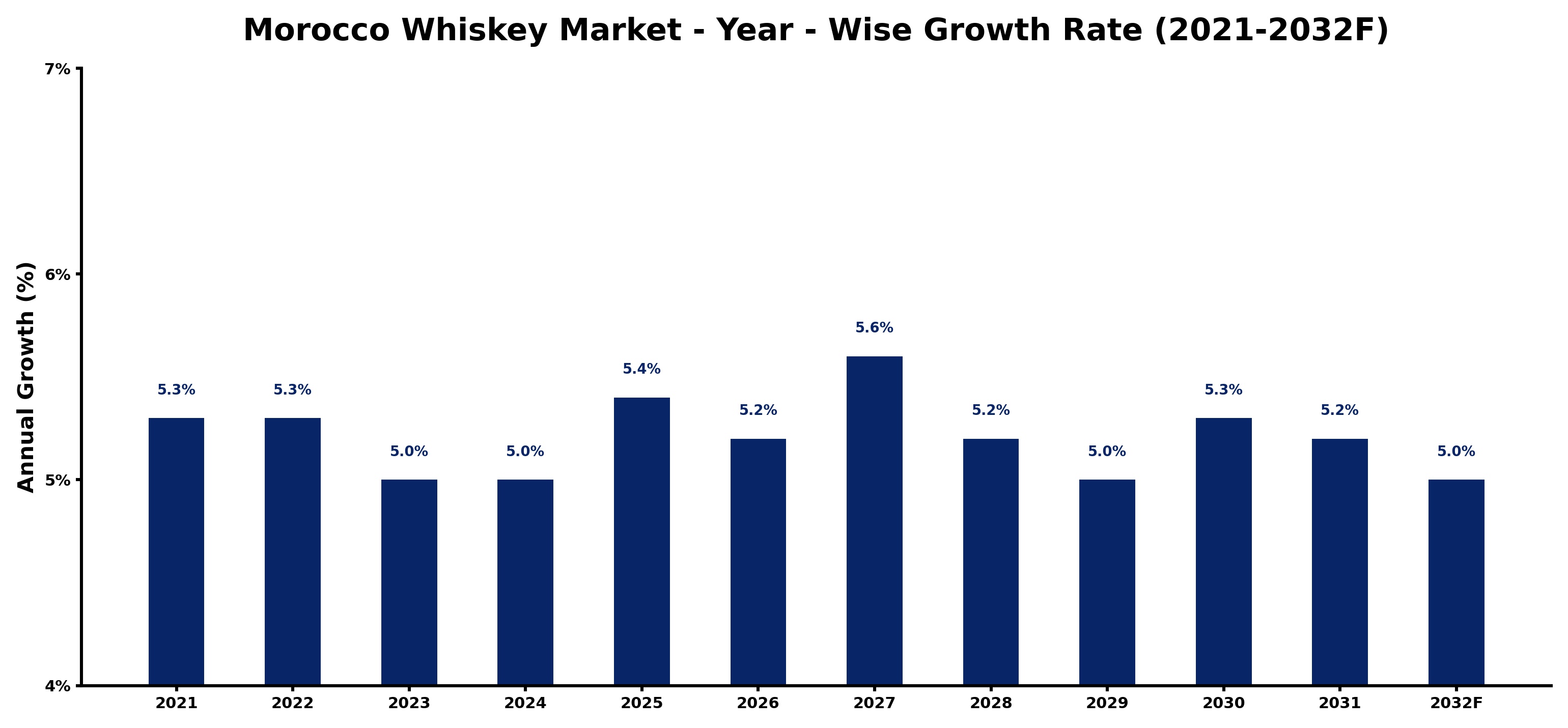
The table below presents the year‑wise growth rates along with the key drivers influencing the market
| Year | Growth Rate | Major Drivers |
| 2021 | 5.3% | Increased tourism boosted sales |
| 2022 | 5.3% | Local distilleries expanded production |
| 2023 | 5.0% | Growing cocktail culture enhanced demand |
| 2024 | 5.0% | E-commerce platforms improved accessibility |
| 2025 | 5.4% | Social media marketing gained traction |
| 2026 | 5.2% | Whiskey tasting events attracted consumers |
| 2027 | 5.6% | Craft whiskey popularity surged upward |
| 2028 | 5.2% | Export opportunities expanded significantly |
| 2029 | 5.0% | Consumer education increased brand loyalty |
| 2030 | 5.3% | Collaborations with restaurants flourished |
| 2031 | 5.2% | Sustainable practices attracted new customers |
| 2032 | 5.0% | Whiskey festivals promoted local brands |
Note - Market size estimations and growth projections presented in this report are based on 6Wresearch’s advanced forecasting approach, validated with industry datasets as of June 2026.
Morocco Whiskey Market Synopsis
The most significant force currently shaping the Morocco Whiskey Market is the surge in consumer preference for premium alcoholic beverages. This trend is not just a passing phase but reflects a deeper cultural shift towards appreciating quality over quantity in alcoholic selections.
Moreover, the growing awareness of various whiskey varieties is enhancing consumer knowledge and encouraging new experiences. With an expanding number of local distilleries and improved distribution channels, the market is ripe for continued growth.
Morocco Whiskey Market Key Takeaways
- The Moroccan whiskey market is transitioning towards premiumization, with consumers increasingly favoring high-quality options.
- Innovation in flavors and product offerings is driving a robust demand for whiskey in social and cultural settings.
- Rising disposable incomes are enhancing consumers' purchasing power, directly influencing whiskey consumption.
- The influx of international whiskey brands is diversifying the market and catering to varied consumer preferences.
- Distribution channels are expanding, making premium whiskey more accessible to consumers throughout Morocco.
Evaluation of Restraints in Morocco Whiskey Market
Despite the promising growth, the Morocco Whiskey Market faces notable restraints. Competition from other spirits categories poses a significant challenge, as consumers often have numerous choices when selecting alcoholic beverages. Furthermore, regulatory requirements concerning production and distribution are becoming increasingly stringent, which may hinder new market entrants. Additionally, meeting consumer demands for premium and craft products requires significant investment in quality and marketing, complicating the landscape for producers.
Morocco Whiskey Market Trends
The market is currently witnessing a trend towards premium whiskey brands that emphasize quality craftsmanship and unique flavor profiles. Social media and influencers are playing a crucial role in shaping consumer perceptions and preferences, driving demand for artisanal and small-batch offerings. Additionally, the introduction of whiskey tasting events and festivals is enhancing the cultural appreciation of whiskey, creating opportunities for brands to engage directly with consumers and build loyalty.
Morocco Whiskey Market Opportunities
The Morocco Whiskey Market holds significant growth potential, particularly in the realm of product innovation and diversification. Brands that can introduce novel flavors or unique whiskey blends stand to capture the attention of adventurous consumers. Furthermore, partnerships with local bars and restaurants can enhance brand visibility and foster an appreciation for whiskey culture. There is also an opportunity to expand into untapped regions where whiskey consumption remains low, providing a new customer base for both local and international brands.
Government Initiatives in the Morocco Whiskey Market
The Moroccan government has implemented various policies aimed at ensuring product quality and safety within the alcoholic beverage market. Regulations are in place to protect consumers while promoting responsible consumption. Additionally, initiatives to support local distilleries are fostering domestic production and encouraging innovation within the sector, ultimately enhancing the overall market landscape.
Future Insights of the Morocco Whiskey Market
Looking ahead to 2026-2032, the Morocco Whiskey Market is poised for continued growth driven by evolving consumer tastes and increasing disposable incomes. The trend toward premiumization is expected to persist, alongside the proliferation of craft distilleries and innovative product offerings. Enhanced distribution networks will likely facilitate greater market penetration, making whiskey increasingly accessible to diverse demographics throughout Morocco. Additionally, the impact of global whiskey trends may influence local preferences, further shaping the market dynamics.
Morocco Whiskey Market Latest Developments (May 2025 - June 2026)
Recent developments in the Morocco Whiskey Market have indicated a greater focus on sustainability and local sourcing, with many distilleries exploring environmentally friendly practices. Additionally, the rise of online retail platforms is transforming how consumers access whiskey, making it easier to obtain premium selections. Notably, whiskey tasting events are gaining popularity, further integrating whiskey into Moroccan social culture and enhancing consumer engagement.
Morocco Whiskey Market - Key Attractiveness of the Report
- 10 Years of Market Numbers
- Historical Data Starting from 2022 to 2025
- Base Year: 2025
- Forecast Data until 2032
- Key Performance Indicators Impacting the Market
- Major Upcoming Developments and Projects
Key Highlights of the Report:
- Morocco Whiskey Market Outlook
- Market Size of Morocco Whiskey Market, 2025
- Forecast of Morocco Whiskey Market, 2032
- Historical Data and Forecast of Morocco Whiskey Revenues & Volume for the Period 2022-2032F
- Morocco Whiskey Market Trend Evolution
- Morocco Whiskey Market Drivers and Challenges
- Morocco Whiskey Price Trends
- Morocco Whiskey Porter's Five Forces
- Morocco Whiskey Industry Life Cycle
- Historical Data and Forecast of Morocco Whiskey Market Revenues & Volume By Product Type for the Period 2022-2032F
- Historical Data and Forecast of Morocco Whiskey Market Revenues & Volume By American Whisky for the Period 2022-2032F
- Historical Data and Forecast of Morocco Whiskey Market Revenues & Volume By Irish Whisky for the Period 2022-2032F
- Historical Data and Forecast of Morocco Whiskey Market Revenues & Volume By Scotch Whisky for the Period 2022-2032F
- Historical Data and Forecast of Morocco Whiskey Market Revenues & Volume By Canadian Whisky for the Period 2022-2032F
- Historical Data and Forecast of Morocco Whiskey Market Revenues & Volume By Others for the Period 2022-2032F
- Historical Data and Forecast of Morocco Whiskey Market Revenues & Volume By Distribution Channel for the Period 2022-2032F
- Historical Data and Forecast of Morocco Whiskey Market Revenues & Volume By On-trade for the Period 2022-2032F
- Historical Data and Forecast of Morocco Whiskey Market Revenues & Volume By Off-trade for the Period 2022-2032F
- Morocco Whiskey Import Export Trade Statistics
- Market Opportunity Assessment By Product Type
- Market Opportunity Assessment By Distribution Channel
- Morocco Whiskey Top Companies Market Share
- Morocco Whiskey Competitive Benchmarking By Technical and Operational Parameters
- Morocco Whiskey Company Profiles
- Morocco Whiskey Key Strategic Recommendations






































