Myanmar Bamboo Furniture Market Size, Share & Growth Rate
The Myanmar Bamboo Furniture Market was estimated at USD 323 Million in 2025 and is projected to reach USD 434 Million by 2032, growing at a CAGR of 4.3% from 2026 to 2032. This positive trajectory is fueled by the increasing consumer inclination towards sustainable living, along with a rising demand for unique, handcrafted furniture that reflects both aesthetic sensibility and environmental consciousness. With bamboo's natural durability and the government's support for eco-friendly initiatives, the market is well-positioned for growth.
Myanmar Bamboo Furniture Market Year-wise Growth Rate and Key Drivers
This graph highlights how the Myanmar Bamboo Furniture Market has steadily grown over the years, supported by major growth factors.
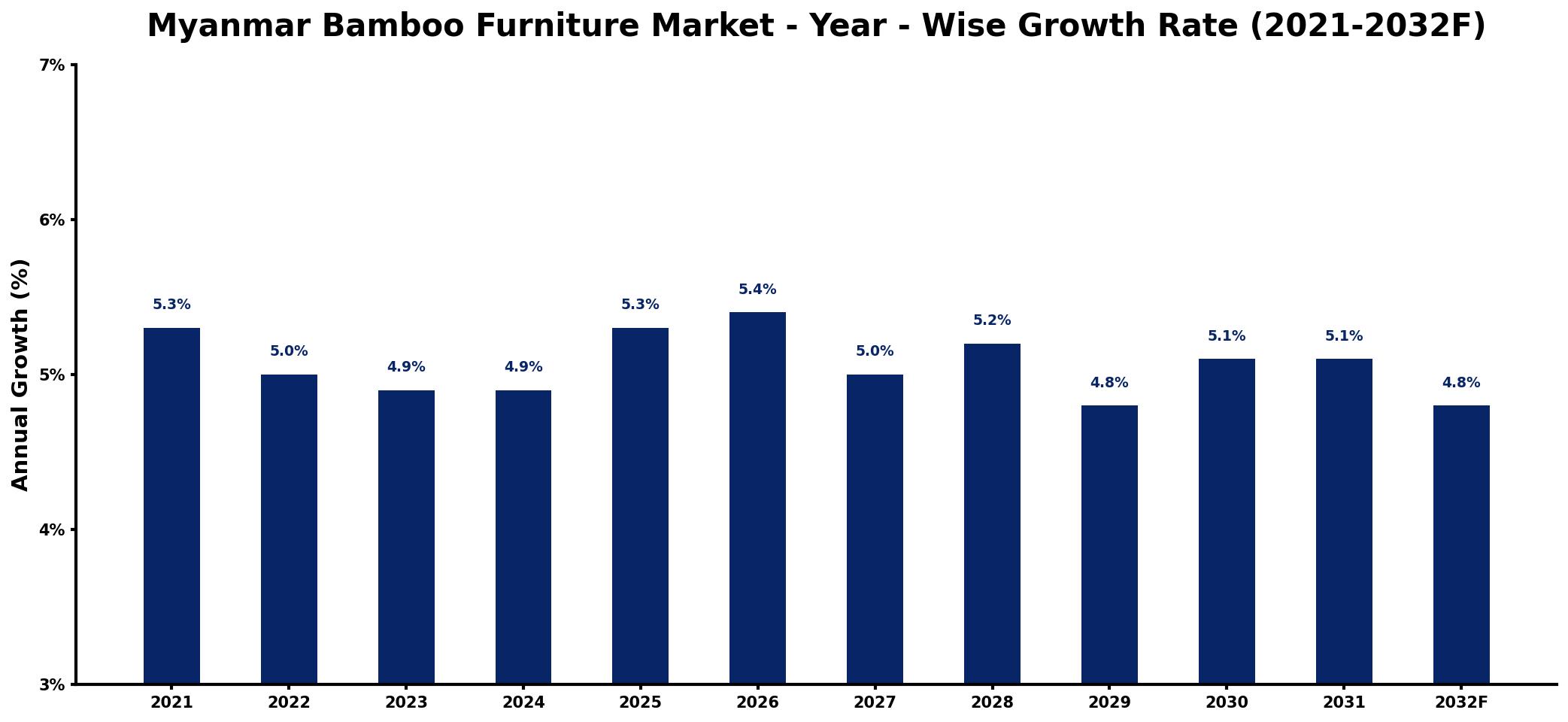
The table below presents the year‑wise growth rates along with the key drivers influencing the market
| Year | Growth Rate | Major Drivers |
| 2021 | 5.3% | Rising eco-friendly consumer preferences |
| 2022 | 5.0% | Increased investment in sustainability |
| 2023 | 4.9% | Growing popularity of natural materials |
| 2024 | 4.9% | Expansion of online retail channels |
| 2025 | 5.3% | Surge in domestic production capacity |
| 2026 | 5.4% | Enhanced design innovations in market |
| 2027 | 5.0% | Strengthened export opportunities abroad |
| 2028 | 5.2% | Increased focus on local craftsmanship |
| 2029 | 4.8% | Broader awareness of environmental benefits |
| 2030 | 5.1% | Emerging trends in minimalist design |
| 2031 | 5.1% | Growing interest in artisanal products |
| 2032 | 4.8% | Strengthened partnerships with suppliers |
Note: Market size estimations and growth projections presented in this report are based on 6Wresearch's proprietary forecasting methodology, utilizing the latest available industry data, government publications, and primary research inputs.
Myanmar Bamboo Furniture Market Synopsis
The Myanmar Bamboo Furniture Market is on an upswing, marked by an expanding consumer base that values eco-friendly options. Traditional craftsmanship is seamlessly merging with contemporary design, creating a diverse offering that appeals to both local and international consumers. As the market evolves, it is expected to attract more stakeholders interested in sustainable materials.
While recent momentum has been positive, with increasing awareness of bamboo's benefits, the future promises even more potential. The synergy between local artisans and innovative designers is set to produce unique products that cater to modern tastes while honoring cultural heritage. This blend of tradition and innovation is crucial for maintaining a competitive edge.
Myanmar Bamboo Furniture Market Key Takeaways
- Strong growth potential due to rising consumer demand for sustainable furniture options.
- Bamboo's unique properties provide a competitive advantage over traditional wooden furniture.
- Innovative collaborations between artisans and designers are leading to unique product offerings.
- Government initiatives are enhancing bamboo cultivation and processing practices.
- Increased global interest in eco-friendly products supports market expansion opportunities.
Evaluation of Restraints in Myanmar Bamboo Furniture Market
Despite its promising growth, the Myanmar Bamboo Furniture Market faces several significant restraints. Many consumers remain unaware of bamboo's advantages compared to traditional wooden furniture, hindering broader adoption. Additionally, the industry struggles with inconsistencies in quality control and a shortage of skilled artisans, which can impact production standards. Infrastructure limitations further complicate logistics, making it challenging for producers to reach both local and international markets efficiently.
Myanmar Bamboo Furniture Market Trends
A notable trend in the Myanmar Bamboo Furniture Market is the increasing demand for innovative and aesthetically pleasing designs that reflect a blend of modern and traditional styles. Theres also a growing emphasis on eco-conscious consumerism, prompting manufacturers to highlight the environmental benefits of bamboo. Furthermore, collaborations between local artisans and designers are becoming common, resulting in high-quality, unique products that cater to diverse consumer preferences.
Myanmar Bamboo Furniture Market Opportunities
The Myanmar Bamboo Furniture Market presents several lucrative investment opportunities. With bamboo being a fast-growing and renewable resource abundantly available in Myanmar, investors can tap into the rising global demand for sustainable products. Additionally, the unique craftsmanship inherent in Myanmar's bamboo furniture production can enhance product appeal, making it easier to capture international markets. Companies that prioritize sustainable practices in their operations are likely to benefit significantly from this trend.
Government Initiatives in the Myanmar Bamboo Furniture Market
The Myanmar government actively supports the Bamboo Furniture Market through policies aimed at promoting sustainable practices. Various initiatives encourage bamboo cultivation and processing, including financial incentives for producers. Regulations ensure environmentally responsible harvesting and processing, while efforts to boost exports of bamboo products are designed to enhance the competitiveness of Myanmar's bamboo furniture industry on a global scale.
Future Insights of the Myanmar Bamboo Furniture Market
Looking forward to the 2026-2032 period, the Myanmar Bamboo Furniture Market is expected to flourish as consumer awareness of sustainability continues to grow. The demand for unique, environmentally friendly furniture is on the rise, and the government's support for bamboo cultivation will further strengthen the industry's infrastructure. As innovative designs emerge and the global focus on eco-conscious living expands, Myanmars bamboo furniture market is well-positioned for steady growth and opportunity.
Myanmar Bamboo Furniture Market Latest Developments (2025 - 2026)
Recent developments in the Myanmar Bamboo Furniture Market indicate a shift towards more sustainable production methods. Several initiatives have been launched to enhance local craftsmanship and expand access to global markets. There is an observable increase in exhibitions and trade fairs focused on bamboo furniture, providing platforms for local artisans and designers to showcase their innovative creations. This growing visibility is crucial for enhancing the market's appeal on both domestic and international fronts.
Myanmar Bamboo Furniture Market - Key Attractiveness of the Report
- 10 Years of Market Numbers
- Historical Data Starting from 2022 to 2025
- Base Year: 2025
- Forecast Data until 2032
- Key Performance Indicators Impacting the Market
- Major Upcoming Developments and Projects
Key Highlights of the Report:
- Myanmar Bamboo Furniture Market Outlook
- Market Size of Myanmar Bamboo Furniture Market, 2025
- Forecast of Myanmar Bamboo Furniture Market, 2032
- Historical Data and Forecast of Myanmar Bamboo Furniture Revenues & Volume for the Period 2022-2032F
- Myanmar Bamboo Furniture Market Trend Evolution
- Myanmar Bamboo Furniture Market Drivers and Challenges
- Myanmar Bamboo Furniture Price Trends
- Myanmar Bamboo Furniture Porter's Five Forces
- Myanmar Bamboo Furniture Industry Life Cycle
- Historical Data and Forecast of Myanmar Bamboo Furniture Market Revenues & Volume By Type for the Period 2022-2032F
- Historical Data and Forecast of Myanmar Bamboo Furniture Market Revenues & Volume By Chairs & Tables for the Period 2022-2032F
- Historical Data and Forecast of Myanmar Bamboo Furniture Market Revenues & Volume By Stools for the Period 2022-2032F
- Historical Data and Forecast of Myanmar Bamboo Furniture Market Revenues & Volume By Beds for the Period 2022-2032F
- Historical Data and Forecast of Myanmar Bamboo Furniture Market Revenues & Volume By Others for the Period 2022-2032F
- Historical Data and Forecast of Myanmar Bamboo Furniture Market Revenues & Volume By End User for the Period 2022-2032F
- Historical Data and Forecast of Myanmar Bamboo Furniture Market Revenues & Volume By Residential for the Period 2022-2032F
- Historical Data and Forecast of Myanmar Bamboo Furniture Market Revenues & Volume By Commercial for the Period 2022-2032F
- Myanmar Bamboo Furniture Import Export Trade Statistics
- Market Opportunity Assessment By Type
- Market Opportunity Assessment By End User
- Myanmar Bamboo Furniture Top Companies Market Share
- Myanmar Bamboo Furniture Competitive Benchmarking By Technical and Operational Parameters
- Myanmar Bamboo Furniture Company Profiles
- Myanmar Bamboo Furniture Key Strategic Recommendations






































