Myanmar Battery Materials Market Size Growth Rate
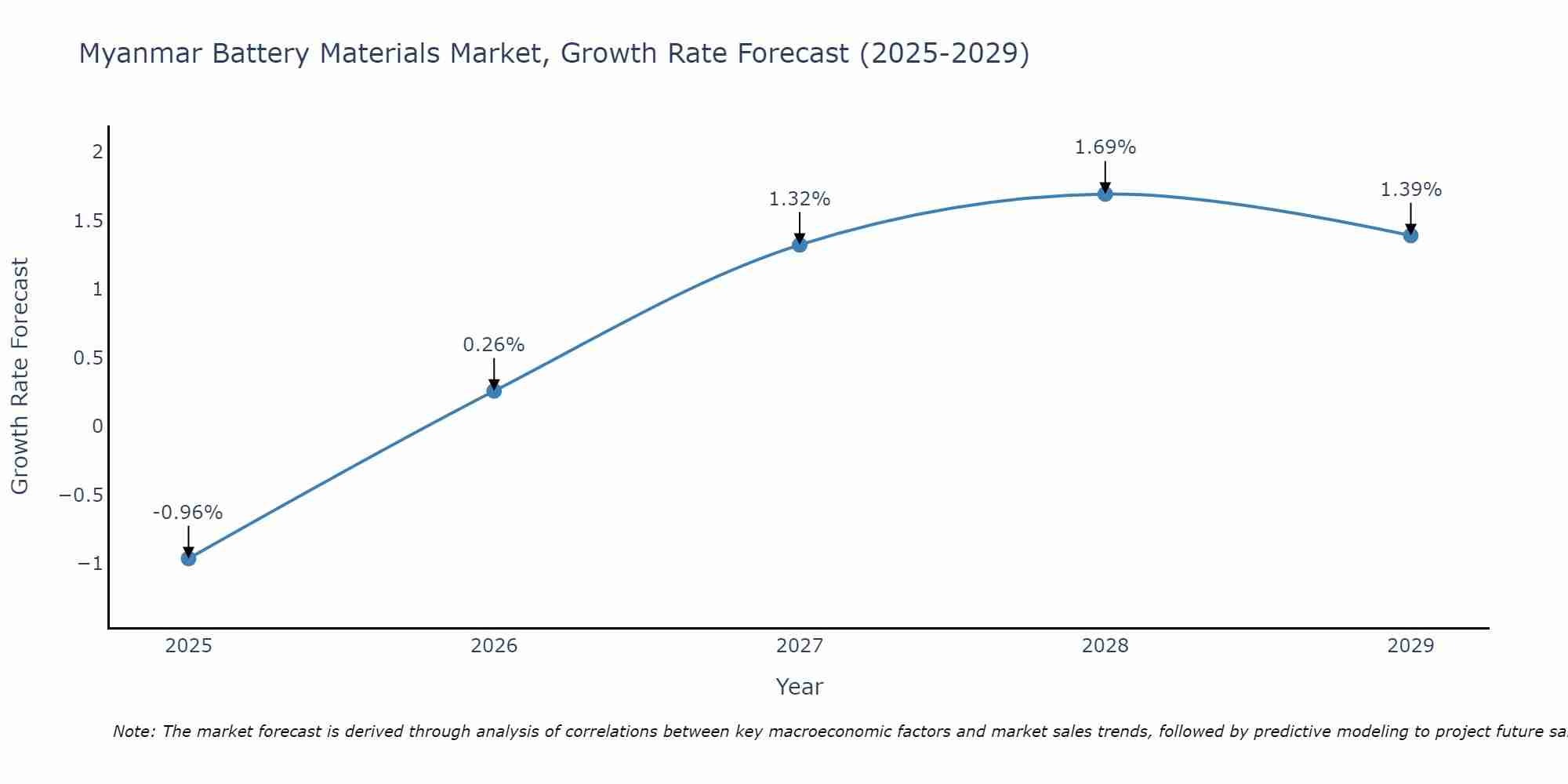
The Myanmar Battery Materials Market is projected to witness mixed growth rate patterns during 2025 to 2029. Growth accelerates to 1.69% in 2028, following an initial rate of -0.96%, before easing to 1.39% at the end of the period.
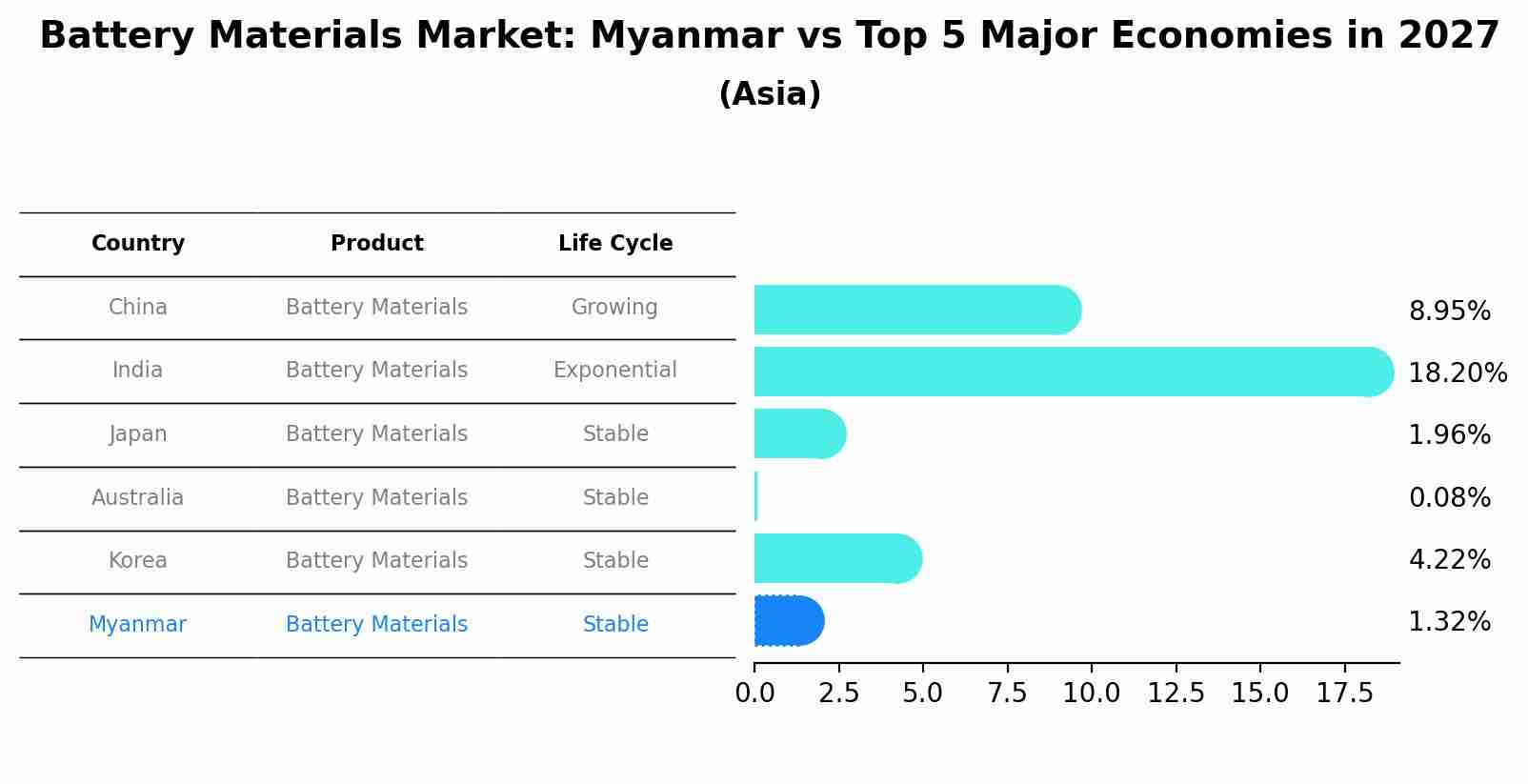
Battery Materials Market: Myanmar vs Top 5 Major Economies in 2027 (Asia)
By 2027, Myanmar's Battery Materials market is forecasted to achieve a stable growth rate of 1.32%, with China leading the Asia region, followed by India, Japan, Australia and South Korea.
Myanmar Battery Materials Market Overview
The Myanmar Battery Materials Market is witnessing notable growth driven by the increasing demand for batteries in various applications such as automotive, electronics, and energy storage. The market is primarily dominated by materials like lithium, cobalt, nickel, and graphite, which are essential components in the production of lithium-ion batteries. The rising adoption of electric vehicles and the growing focus on renewable energy sources are key factors driving the demand for battery materials in the country. Additionally, government initiatives promoting the use of electric vehicles and investment in energy storage infrastructure are further propelling market growth. However, challenges related to supply chain disruptions, environmental concerns, and regulatory issues pose potential obstacles for market expansion in Myanmar.
Myanmar Battery Materials Market Trends
The Myanmar Battery Materials Market is experiencing significant growth driven by the increasing demand for lithium-ion batteries in various industries such as automotive, electronics, and energy storage. With the rise of electric vehicles and renewable energy projects in the country, there is a growing need for battery materials like lithium, cobalt, nickel, and graphite. The government`s initiatives to promote clean energy and sustainability are further driving the market. Additionally, the entry of international battery manufacturers and investments in local battery production facilities are contributing to the market`s expansion. As a result, there is a trend towards the development of a robust battery materials supply chain in Myanmar to meet the growing demands of the market.
Myanmar Battery Materials Market Challenges
In the Myanmar Battery Materials Market, challenges primarily stem from limited access to raw materials due to economic sanctions and political instability. The country relies heavily on imports for key battery materials such as lithium, cobalt, and nickel, leading to supply chain disruptions and increased costs. Additionally, inadequate infrastructure and regulatory frameworks hinder the development of a robust battery materials industry in Myanmar. Lack of skilled labor and technology transfer further exacerbate the challenges faced by market players looking to capitalize on the growing demand for batteries in the region. Overall, navigating these obstacles requires strategic partnerships, efficient supply chain management, and regulatory reforms to foster a competitive and sustainable battery materials market in Myanmar.
Myanmar Battery Materials Market Investment Opportunities
The Myanmar battery materials market presents promising investment opportunities due to the country`s growing demand for batteries driven by the expanding electric vehicle (EV) and renewable energy sectors. Investments in lithium, cobalt, nickel, and graphite mining and processing operations can capitalize on the increasing need for these raw materials in battery production. Additionally, opportunities exist in establishing battery manufacturing facilities to cater to the domestic market as well as for export purposes. With Myanmar`s strategic location in Southeast Asia and the government`s focus on promoting sustainable energy solutions, investing in the battery materials market can offer long-term growth potential and contribute to the country`s economic development. However, investors should be mindful of regulatory frameworks, infrastructure challenges, and geopolitical risks when considering investment in this sector.
Myanmar Battery Materials Market Government Policy
Government policies related to the Myanmar Battery Materials Market focus on promoting sustainable development and environmental protection. In recent years, the government has implemented regulations aimed at promoting responsible mining practices, ensuring the proper disposal of hazardous materials, and encouraging the use of renewable energy sources in battery production. Additionally, there are efforts to attract foreign investment and promote domestic manufacturing capabilities to support the growing demand for battery materials. The government is also working on establishing partnerships with international organizations to enhance technical expertise and ensure compliance with global standards. Overall, the policies aim to create a conducive environment for the growth of the battery materials market in Myanmar while ensuring environmental sustainability and responsible resource management.
Myanmar Battery Materials Market Future Outlook
The future outlook for the Myanmar Battery Materials Market appears promising, driven by the increasing demand for batteries in various industries such as automotive, energy storage, and consumer electronics. The country`s rich natural resources, including significant deposits of minerals like lithium, cobalt, and nickel, present opportunities for local production of battery materials. As the global shift towards electric vehicles and renewable energy continues, Myanmar is poised to attract investments in battery manufacturing facilities, leading to growth in the market. However, challenges such as infrastructure development, regulatory frameworks, and geopolitical factors may impact the market`s growth trajectory. Overall, with the right strategic planning and investments, Myanmar has the potential to emerge as a key player in the battery materials market in the coming years.
Key Highlights of the Report:
- Myanmar Battery Materials Market Outlook
- Market Size of Myanmar Battery Materials Market, 2021
- Forecast of Myanmar Battery Materials Market, 2031
- Historical Data and Forecast of Myanmar Battery Materials Revenues & Volume for the Period 2018 - 2031
- Myanmar Battery Materials Market Trend Evolution
- Myanmar Battery Materials Market Drivers and Challenges
- Myanmar Battery Materials Price Trends
- Myanmar Battery Materials Porter's Five Forces
- Myanmar Battery Materials Industry Life Cycle
- Historical Data and Forecast of Myanmar Battery Materials Market Revenues & Volume By Battery Type for the Period 2018 - 2031
- Historical Data and Forecast of Myanmar Battery Materials Market Revenues & Volume By Lithium-Ion for the Period 2018 - 2031
- Historical Data and Forecast of Myanmar Battery Materials Market Revenues & Volume By Lead Acid for the Period 2018 - 2031
- Historical Data and Forecast of Myanmar Battery Materials Market Revenues & Volume By Others for the Period 2018 - 2031
- Historical Data and Forecast of Myanmar Battery Materials Market Revenues & Volume By Material for the Period 2018 - 2031
- Historical Data and Forecast of Myanmar Battery Materials Market Revenues & Volume By Lithium-Ion for the Period 2018 - 2031
- Historical Data and Forecast of Myanmar Battery Materials Market Revenues & Volume By Lead Acid for the Period 2018 - 2031
- Myanmar Battery Materials Import Export Trade Statistics
- Market Opportunity Assessment By Battery Type
- Market Opportunity Assessment By Material
- Myanmar Battery Materials Top Companies Market Share
- Myanmar Battery Materials Competitive Benchmarking By Technical and Operational Parameters
- Myanmar Battery Materials Company Profiles
- Myanmar Battery Materials Key Strategic Recommendations






































