Myanmar Contactless Payment Market Size & Growth Rate (2026-2032)
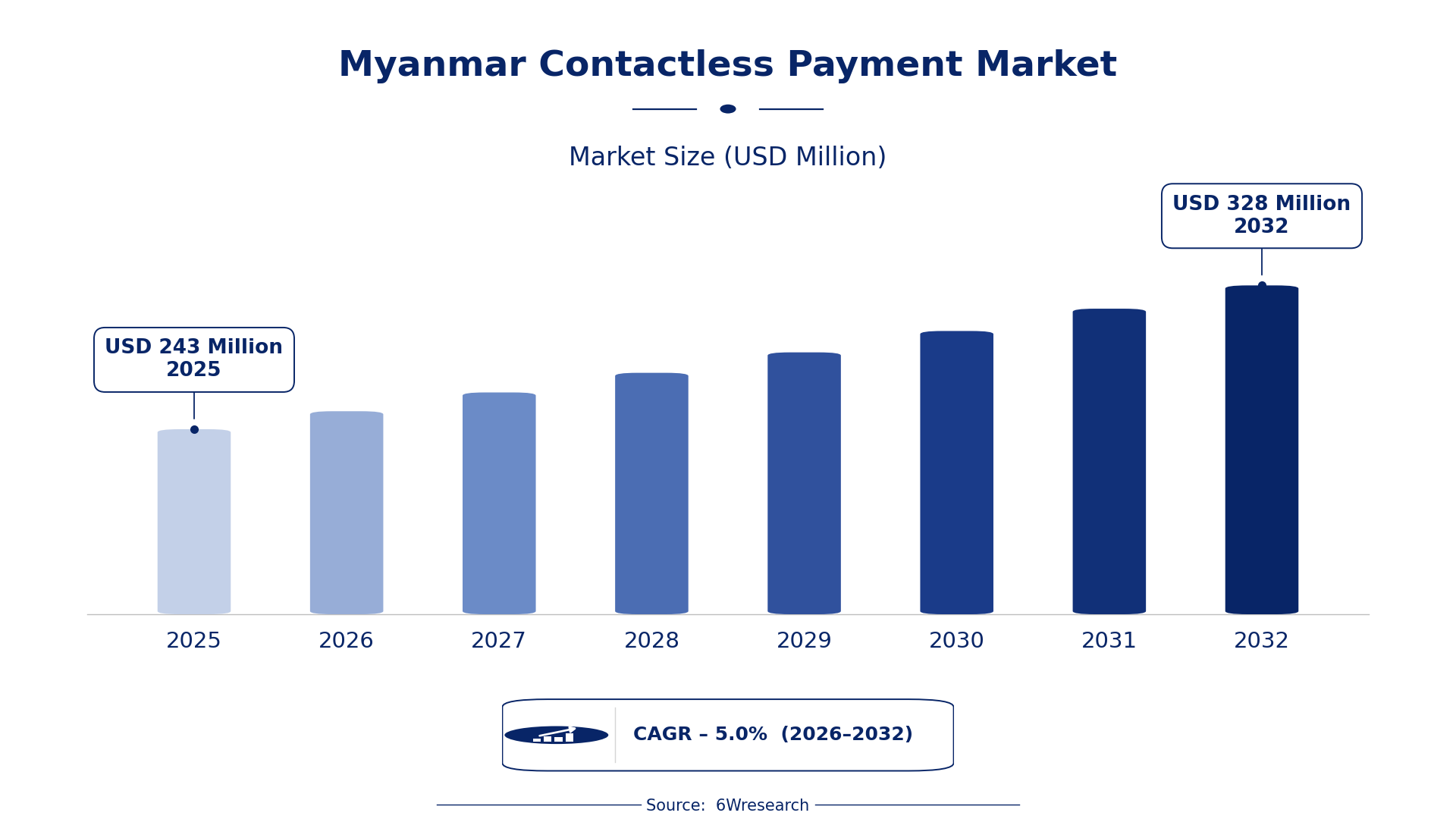
The Myanmar Contactless Payment Market was estimated at USD 243 Million in 2025 and is projected to reach USD 328 Million by 2032, growing at a CAGR of 5.0% from 2026 to 2032.
Myanmar Contactless Payment Market Synopsis
The Myanmar Contactless Payment Market is gaining momentum as consumers increasingly favor quick and secure transaction methods. This shift is amplified by the rise in smartphone usage and a growing ecosystem of digital payment solutions that cater to local needs.
The COVID-19 pandemic has acted as a catalyst, accelerating the shift towards contactless payments as safety and hygiene concerns dominate consumer preferences. Government initiatives are further supporting this transition, underscoring a collective movement towards a cashless economy.
Myanmar Contactless Payment Market Year-wise Growth Rate and Key Drivers
This graph illustrates the annual growth rates of the Myanmar Contactless Payment Market from 2021 to 2032, highlighting a steady upward trajectory and projected expansion over the forecast period.
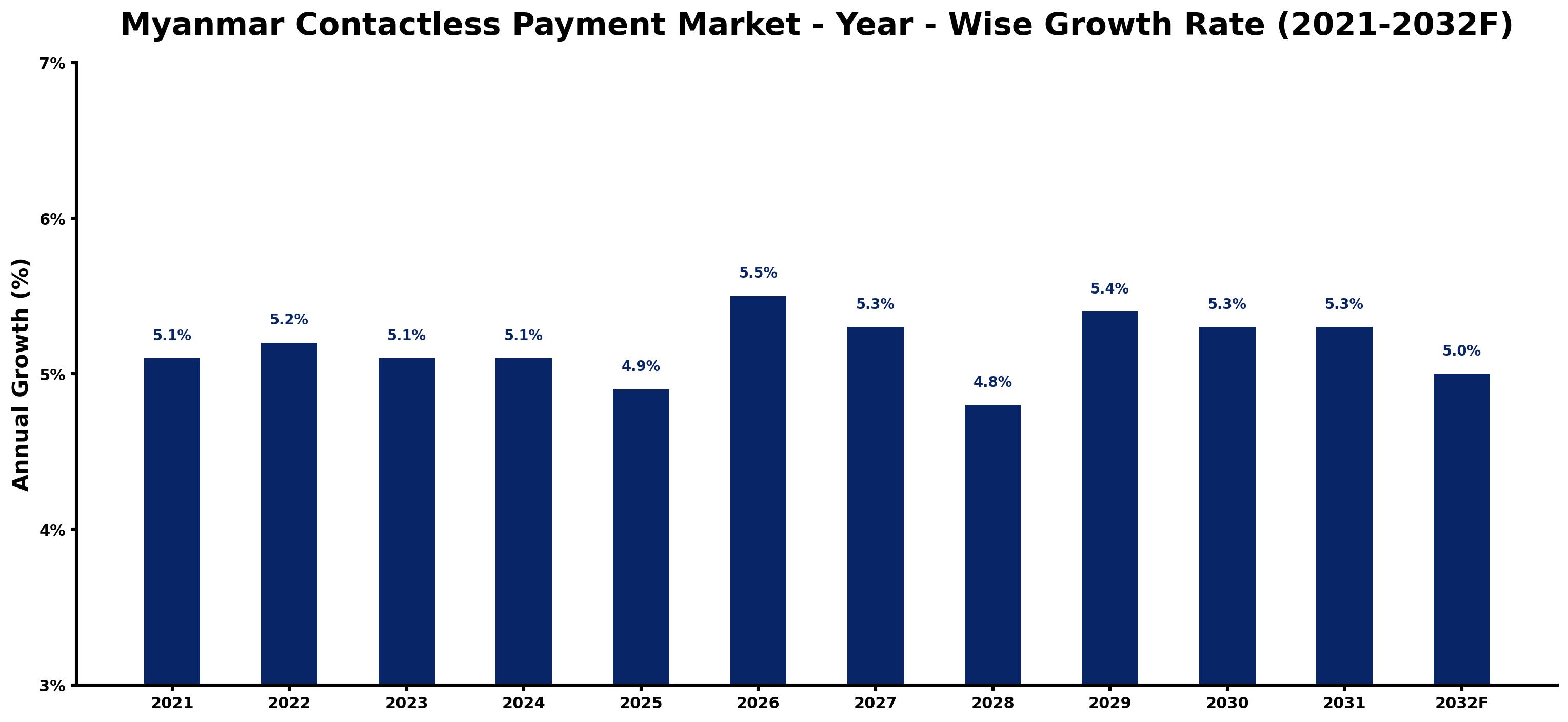
The table below presents the year‑wise growth rates along with the key drivers influencing the market
| Year | Growth Rate | Major Drivers |
| 2021 | 5.1% | Government initiatives promoting digital financial inclusion drive adoption. |
| 2022 | 5.2% | Rise in e-commerce activities boosting contactless payment demand. |
| 2023 | 5.1% | Increased consumer preference for hygiene-friendly payment methods. |
| 2024 | 5.1% | Collaboration between banks and fintech enhancing payment solutions. |
| 2025 | 4.9% | Local merchants integrating contactless payments to attract customers. |
| 2026 | 5.5% | Promotional campaigns encouraging cashless transactions across cities. |
| 2027 | 5.3% | Regulatory support for fintech innovations driving market growth. |
| 2028 | 4.8% | Increasing urbanization leading to higher digital transaction volumes. |
| 2029 | 5.4% | Surge in international remittances promoting digital payment channels. |
| 2030 | 5.3% | Rising youth population favoring tech-based payment options. |
| 2031 | 5.3% | Local startups innovating solutions for seamless payment experiences. |
| 2032 | 5.0% | Increased trust in digital wallets enhances consumer confidence. |
Note: Market size estimations and growth projections presented in this report are based on 6Wresearch's proprietary forecasting methodology, utilizing the latest available industry data, government publications, and primary research inputs.
Myanmar Contactless Payment Market Key Takeaways
Below are some of the specific key takeaways from the market, including:
- Mobile wallets and QR code payments are leading the charge in contactless adoption.
- Consumer trust is still fragile due to concerns over data security and fraud.
- Government regulations are becoming more supportive of cashless transactions.
- Infrastructure development remains a critical barrier to wider acceptance.
- The market is expected to see continuous growth driven by technological advancements.
Evaluation of Restraints in Myanmar Contactless Payment Market
Despite the promising growth trajectory, several obstacles hinder the broader adoption of contactless payments in Myanmar. A lack of widespread acceptance infrastructure means that many consumers still cannot conveniently use these payment methods. Additionally, concerns regarding data security and potential fraud continue to dampen consumer confidence. The penetration of smartphones and NFC-enabled devices remains limited in certain demographics, further restricting market reach. Regulatory challenges also present hurdles, as interoperability issues between different payment networks complicate transactions for both consumers and merchants.
Myanmar Contactless Payment Market Trends
Trends in the Myanmar Contactless Payment Market indicate a clear shift towards mobile-first solutions. QR code payments are becoming ubiquitous, especially among small and medium enterprises, as they offer an easy entry point for merchants. Additionally, the rise in e-commerce has fueled demand for contactless solutions, as consumers expect fast and secure transactions. The ongoing development of fintech solutions tailored to local needs is also driving innovation and adoption.
Myanmar Contactless Payment Market Opportunities
The opportunity landscape for the Myanmar Contactless Payment Market is expanding. Financial inclusion initiatives present a chance to integrate underbanked populations into the digital payment ecosystem. Collaborations between banks and tech companies could lead to more comprehensive payment solutions that address local market requirements. on top of that, as mobile internet access improves, there is a substantial potential for growth in contactless payment adoption across various sectors.
Government Initiatives in the Myanmar Contactless Payment Market
Government policy is playing a crucial role in shaping the Myanmar Contactless Payment Market. The regulatory environment is increasingly focused on promoting digital payment systems, which is vital for enhancing financial inclusion. By introducing standards and protocols, the government aims to create a more secure and accessible payment infrastructure.
- A national digital infrastructure upgrade programme now in its rollout phase aims to enhance connectivity and payment capabilities.
- A regulatory framework introduced in 2025 mandates security protocols for all contactless payment systems.
- Ongoing initiatives focus on promoting digital literacy to ensure all demographics can engage with contactless payment methods.
- A planned public-private initiative expected to expand merchant acceptance of contactless payments by 2027.
Future Insights of the Myanmar Contactless Payment Market
Looking ahead to 2026-2032, the Myanmar Contactless Payment Market is set to experience sustained growth. As smartphone penetration continues to rise, more consumers will adopt contactless solutions. The increasing number of merchants accepting these payment methods will also drive adoption, creating a feedback loop that further encourages consumer use. Enhanced government support and emerging technologies will likely facilitate this transition, making contactless payments a norm rather than an exception.
Myanmar Contactless Payment Market Latest Developments
In the past year, the Myanmar Contactless Payment Market has seen a surge of activity aimed at expanding payment capabilities and consumer adoption. Innovations are being rolled out to enhance user experience and security, positioning the market for substantial growth.
- A major technology vendor launched a new mobile payment app in Q1 2025, designed to simplify transactions for consumers and businesses alike.
- An initiative that began in mid-2025 aims to install QR code payment systems across various retail outlets, making it easier for consumers to transact.
- In early 2025, a partnership was formed between fintech companies to create a unified platform for contactless payments, enhancing interoperability.
- A rollout expected to begin in the second half of 2026 will introduce NFC-enabled devices at public transportation hubs, facilitating easier fare payments.
Myanmar Contactless Payment Market - Key Attractiveness of the Report
- 10 Years of Market Numbers
- Historical Data Starting from 2022 to 2025
- Base Year: 2025
- Forecast Data until 2032
- Key Performance Indicators Impacting the Market
- Major Upcoming Developments and Projects
Key Highlights of the Report:
- Myanmar Contactless Payment Market Outlook
- Market Size of Myanmar Contactless Payment Market, 2025
- Forecast of Myanmar Contactless Payment Market, 2032
- Historical Data and Forecast of Myanmar Contactless Payment Revenues & Volume for the Period 2022-2032F
- Myanmar Contactless Payment Market Trend Evolution
- Myanmar Contactless Payment Market Drivers and Challenges
- Myanmar Contactless Payment Price Trends
- Myanmar Contactless Payment Porter's Five Forces
- Myanmar Contactless Payment Industry Life Cycle
- Historical Data and Forecast of Myanmar Contactless Payment Market Revenues & Volume By Component for the Period 2022-2032F
- Historical Data and Forecast of Myanmar Contactless Payment Market Revenues & Volume By Hardware for the Period 2022-2032F
- Historical Data and Forecast of Myanmar Contactless Payment Market Revenues & Volume By Solutions for the Period 2022-2032F
- Historical Data and Forecast of Myanmar Contactless Payment Market Revenues & Volume By Services for the Period 2022-2032F
- Historical Data and Forecast of Myanmar Contactless Payment Market Revenues & Volume By Vertical for the Period 2022-2032F
- Historical Data and Forecast of Myanmar Contactless Payment Market Revenues & Volume By Retail for the Period 2022-2032F
- Historical Data and Forecast of Myanmar Contactless Payment Market Revenues & Volume By Hospitality for the Period 2022-2032F
- Historical Data and Forecast of Myanmar Contactless Payment Market Revenues & Volume By Healthcare for the Period 2022-2032F
- Historical Data and Forecast of Myanmar Contactless Payment Market Revenues & Volume By Energy and Utilities for the Period 2022-2032F
- Historical Data and Forecast of Myanmar Contactless Payment Market Revenues & Volume By Transportation and Logistics for the Period 2022-2032F
- Historical Data and Forecast of Myanmar Contactless Payment Market Revenues & Volume By BFSI for the Period 2022-2032F
- Historical Data and Forecast of Myanmar Contactless Payment Market Revenues & Volume By Others (Government, telecommunications, and education) for the Period 2022-2032F
- Myanmar Contactless Payment Import Export Trade Statistics
- Market Opportunity Assessment By Component
- Market Opportunity Assessment By Vertical
- Myanmar Contactless Payment Top Companies Market Share
- Myanmar Contactless Payment Competitive Benchmarking By Technical and Operational Parameters
- Myanmar Contactless Payment Company Profiles
- Myanmar Contactless Payment Key Strategic Recommendations






































