Myanmar Conveyor Belt Market Size Growth Rate
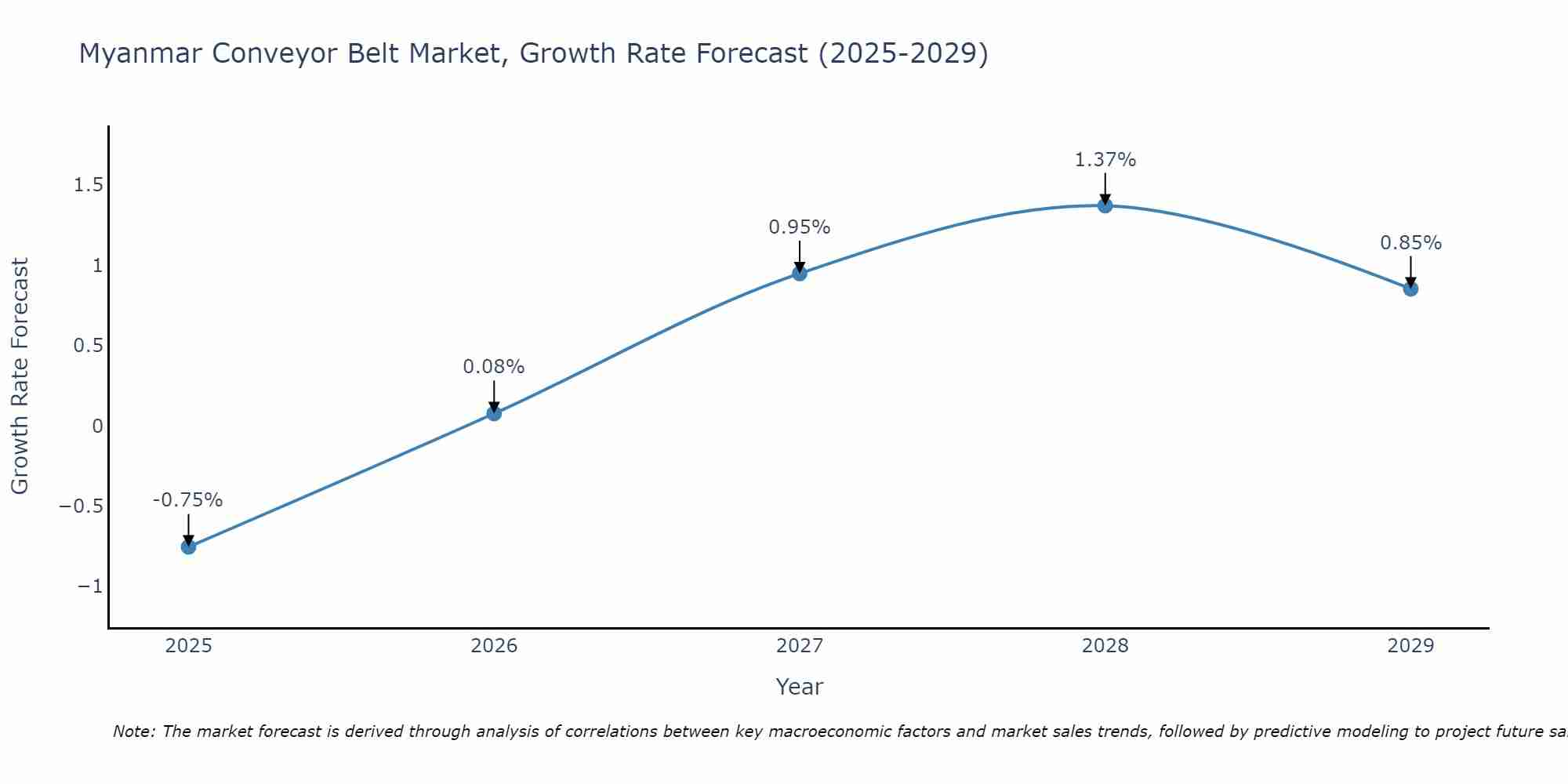
The Myanmar Conveyor Belt Market is projected to witness mixed growth rate patterns during 2025 to 2029. Growth accelerates to 1.37% in 2028, following an initial rate of -0.75%, before easing to 0.85% at the end of the period.
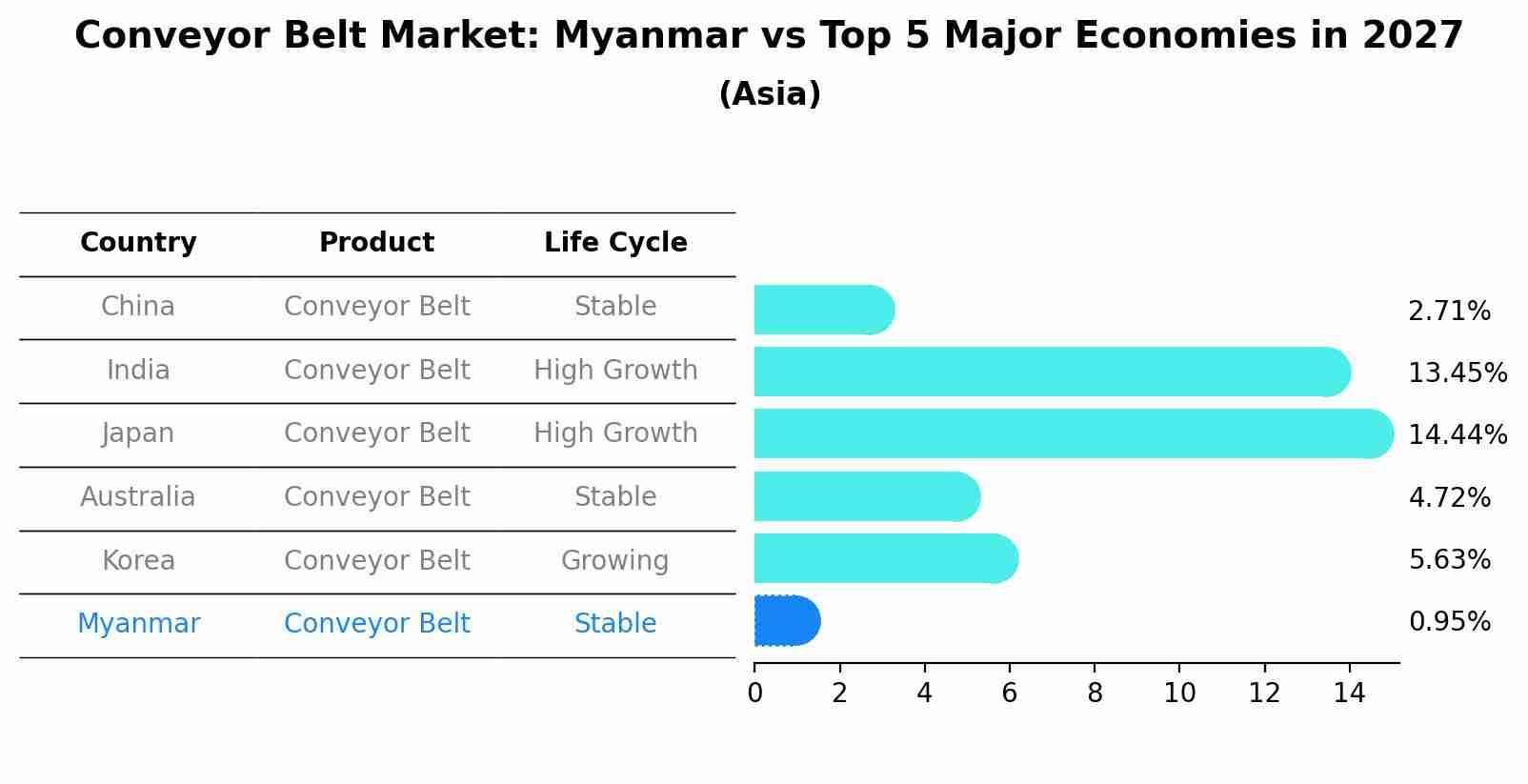
Conveyor Belt Market: Myanmar vs Top 5 Major Economies in 2027 (Asia)
The Conveyor Belt market in Myanmar is projected to grow at a stable growth rate of 0.95% by 2027, highlighting the country's increasing focus on advanced technologies within the Asia region, where China holds the dominant position, followed closely by India, Japan, Australia and South Korea, shaping overall regional demand.
Myanmar Conveyor Belt Market Overview
Conveyor belts are essential for material handling and transportation across industries such as mining, agriculture, manufacturing, and logistics. In Myanmar, the conveyor belt market is driven by industrial growth, infrastructure development, and the expansion of sectors like mining and construction. With the rising need for efficient material handling solutions, the demand for conveyor belts is growing steadily.
Drivers of the market
The conveyor belt market in Myanmar is witnessing significant growth driven by several key drivers. Firstly, the increasing industrialization and infrastructure development in sectors such as mining, manufacturing, agriculture, and logistics are driving the demand for conveyor belts. These belts play a crucial role in transporting materials, goods, and products efficiently and safely within production facilities, warehouses, and transportation networks. Additionally, the growing emphasis on automation and efficiency in material handling processes is fueling market growth by creating demand for advanced conveyor belt technologies such as automation, IoT integration, and predictive maintenance. Moreover, the rising investments in infrastructure projects, including the construction of new airports, ports, and industrial zones, are further driving market growth by creating opportunities for conveyor belt manufacturers and suppliers in Myanmar.
Challenges of the market
The conveyor belt market in Myanmar encounters various challenges, including the limited availability of skilled labor and technical expertise in conveyor belt installation and maintenance. This poses challenges for businesses seeking to implement conveyor belt systems, as they may struggle to find qualified personnel to oversee installation and ensure optimal performance. Additionally, concerns regarding reliability and durability hinder the adoption of conveyor belt solutions among some industries in Myanmar, particularly those operating in harsh or challenging environments. Moreover, the relatively small scale of industrial operations in Myanmar limits the demand for conveyor belt systems, constraining market growth and investment in the sector.
Government Policy of the market
The conveyor belt market in Myanmar is governed by regulations aimed at ensuring workplace safety, product quality, and efficient material handling operations. Government policies dictate the standards for conveyor belt manufacturing, installation, and maintenance to minimize risks such as accidents, equipment failure, and material spillage. Additionally, there are guidelines for conveyor belt usage in various industries such as mining, logistics, and agriculture, with an emphasis on performance optimization, reliability, and environmental sustainability.
Key Highlights of the Report:
- Myanmar Conveyor Belt Market Outlook
- Market Size of Myanmar Conveyor Belt Market, 2024
- Forecast of Myanmar Conveyor Belt Market, 2031
- Historical Data and Forecast of Myanmar Conveyor Belt Revenues & Volume for the Period 2021-2031
- Myanmar Conveyor Belt Market Trend Evolution
- Myanmar Conveyor Belt Market Drivers and Challenges
- Myanmar Conveyor Belt Price Trends
- Myanmar Conveyor Belt Porter's Five Forces
- Myanmar Conveyor Belt Industry Life Cycle
- Historical Data and Forecast of Myanmar Conveyor Belt Market Revenues & Volume By Material for the Period 2021-2031
- Historical Data and Forecast of Myanmar Conveyor Belt Market Revenues & Volume By Metal for the Period 2021-2031
- Historical Data and Forecast of Myanmar Conveyor Belt Market Revenues & Volume By Polymer for the Period 2021-2031
- Historical Data and Forecast of Myanmar Conveyor Belt Market Revenues & Volume By Others for the Period 2021-2031
- Historical Data and Forecast of Myanmar Conveyor Belt Market Revenues & Volume By Product for the Period 2021-2031
- Historical Data and Forecast of Myanmar Conveyor Belt Market Revenues & Volume By Flat Belt for the Period 2021-2031
- Historical Data and Forecast of Myanmar Conveyor Belt Market Revenues & Volume By Modular Belt for the Period 2021-2031
- Historical Data and Forecast of Myanmar Conveyor Belt Market Revenues & Volume By Cleated Belt for the Period 2021-2031
- Historical Data and Forecast of Myanmar Conveyor Belt Market Revenues & Volume By Installation for the Period 2021-2031
- Historical Data and Forecast of Myanmar Conveyor Belt Market Revenues & Volume By Portable for the Period 2021-2031
- Historical Data and Forecast of Myanmar Conveyor Belt Market Revenues & Volume By Stationary for the Period 2021-2031
- Historical Data and Forecast of Myanmar Conveyor Belt Market Revenues & Volume By Application for the Period 2021-2031
- Historical Data and Forecast of Myanmar Conveyor Belt Market Revenues & Volume By Light Weight for the Period 2021-2031
- Historical Data and Forecast of Myanmar Conveyor Belt Market Revenues & Volume By Medium Weight for the Period 2021-2031
- Historical Data and Forecast of Myanmar Conveyor Belt Market Revenues & Volume By Heavy Weight for the Period 2021-2031
- Historical Data and Forecast of Myanmar Conveyor Belt Market Revenues & Volume By End-user for the Period 2021-2031
- Historical Data and Forecast of Myanmar Conveyor Belt Market Revenues & Volume By Mining for the Period 2021-2031
- Historical Data and Forecast of Myanmar Conveyor Belt Market Revenues & Volume By Food & Beverage for the Period 2021-2031
- Historical Data and Forecast of Myanmar Conveyor Belt Market Revenues & Volume By Power Generation for the Period 2021-2031
- Historical Data and Forecast of Myanmar Conveyor Belt Market Revenues & Volume By Recycling for the Period 2021-2031
- Historical Data and Forecast of Myanmar Conveyor Belt Market Revenues & Volume By Supply Chain for the Period 2021-2031
- Historical Data and Forecast of Myanmar Conveyor Belt Market Revenues & Volume By General Manufacturing for the Period 2021-2031
- Historical Data and Forecast of Myanmar Conveyor Belt Market Revenues & Volume By Others for the Period 2021-2031
- Myanmar Conveyor Belt Import Export Trade Statistics
- Market Opportunity Assessment By Material
- Market Opportunity Assessment By Product
- Market Opportunity Assessment By Installation
- Market Opportunity Assessment By Application
- Market Opportunity Assessment By End-user
- Myanmar Conveyor Belt Top Companies Market Share
- Myanmar Conveyor Belt Competitive Benchmarking By Technical and Operational Parameters
- Myanmar Conveyor Belt Company Profiles
- Myanmar Conveyor Belt Key Strategic Recommendations






































