Myanmar Customer Experience Management Market Size & Growth Rate (2026-2032)
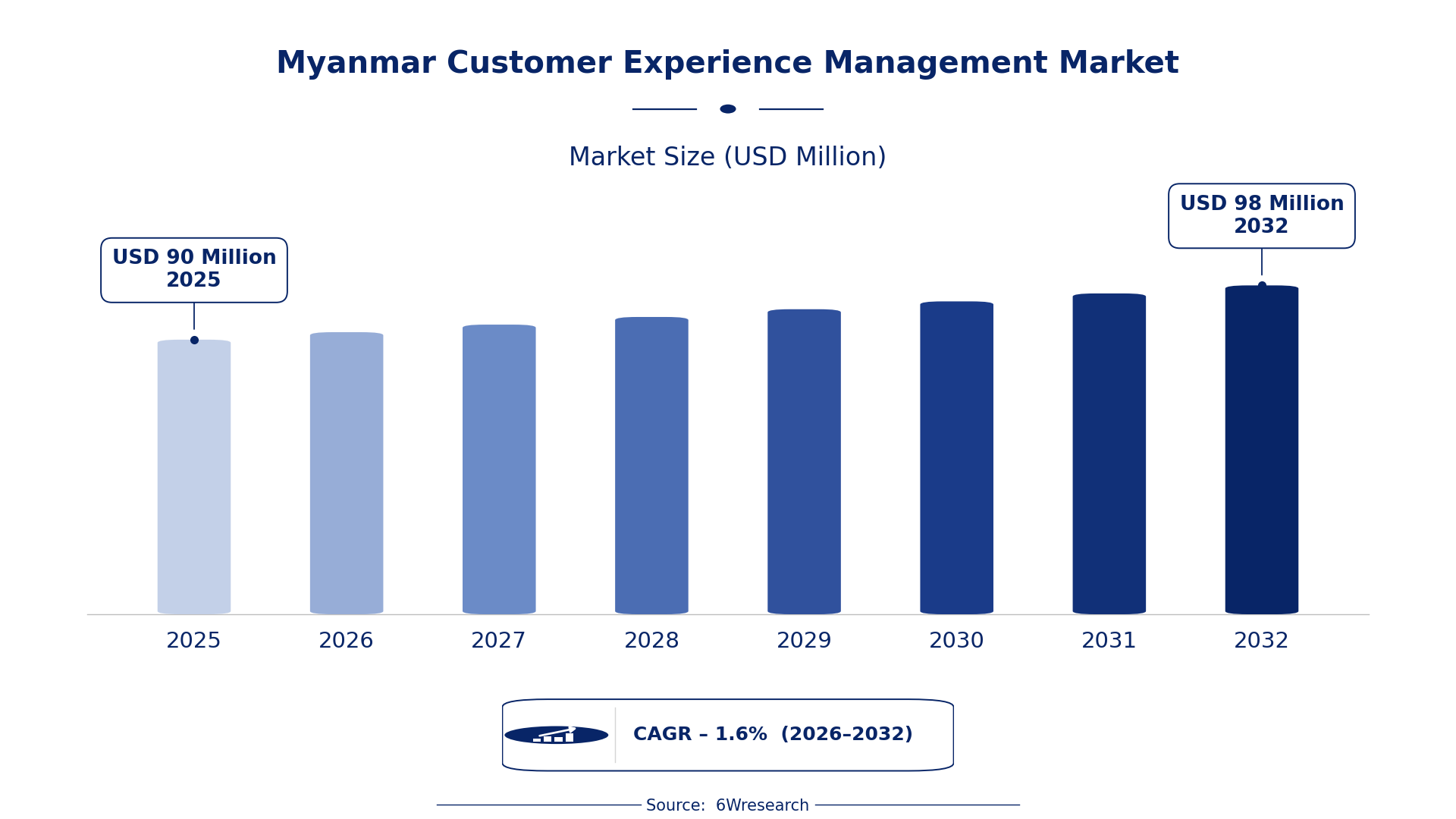
The Myanmar Customer Experience Management Market was estimated at USD 90 Million in 2025 and is projected to reach USD 98 Million by 2032, growing at a CAGR of 1.6% from 2026 to 2032.
Myanmar Customer Experience Management Market Synopsis
The demand for exceptional customer experiences in Myanmar has surged, as businesses recognize that effective customer experience management (CXM) can set them apart in a competitive market. Organizations are investing heavily in tools that help them understand customer behavior, streamline interactions, and foster loyalty.
As Myanmar's economy continues to develop, the focus on CXM is becoming increasingly crucial. Companies are adopting advanced technologies and strategies to map customer journeys, collect feedback, and enhance service delivery across various sectors, including retail and hospitality.
Myanmar Customer Experience Management Market Year-wise Growth Rate and Key Drivers
This graph illustrates the annual growth rates of the Myanmar Customer Experience Management Market from 2021 to 2032, highlighting a steady upward trajectory and projected expansion over the forecast period.
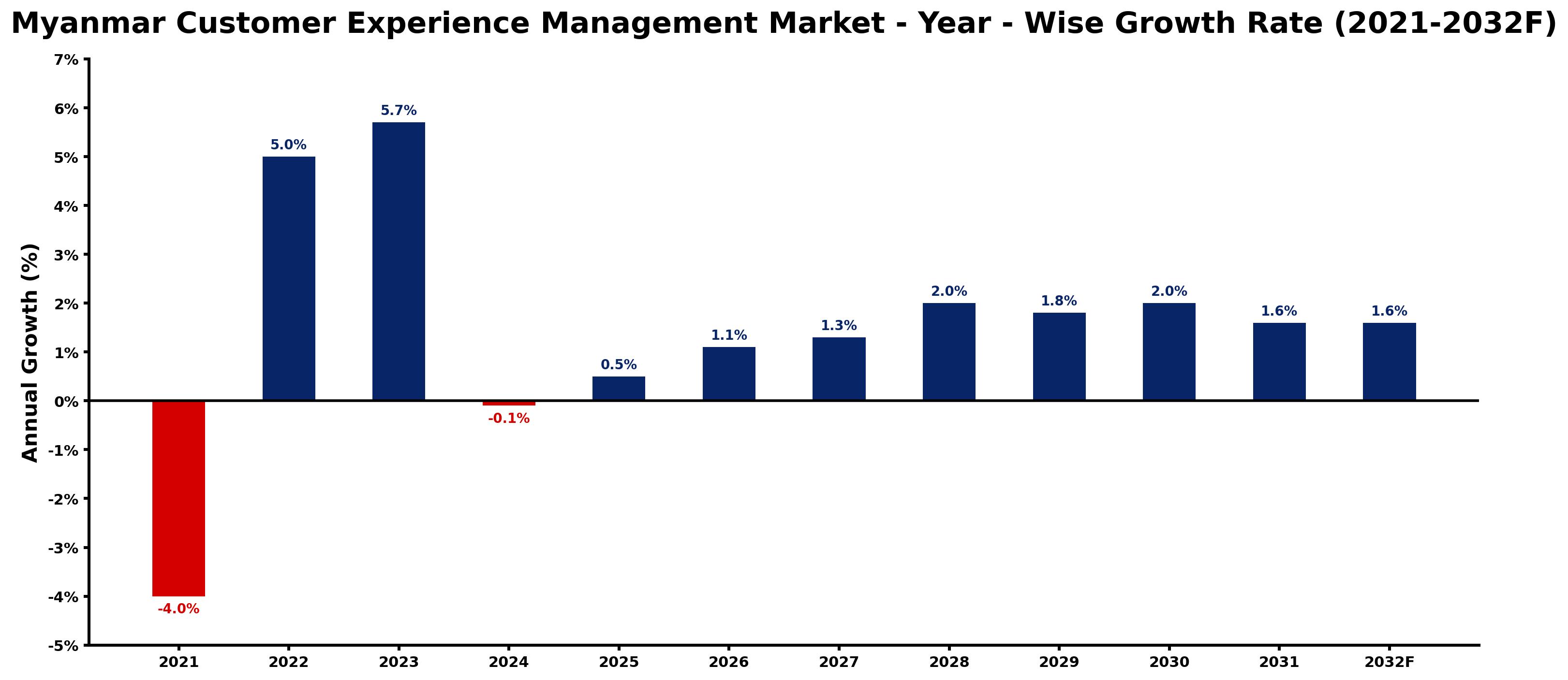
The table below presents the year‑wise growth rates along with the key drivers influencing the market
| Year | Growth Rate | Major Drivers |
| 2021 | -4.0% | Missed digital transformation initiatives due to inadequate internet access |
| 2022 | 5.0% | Increased smartphone penetration driving digital engagement. |
| 2023 | 5.7% | Growing emphasis on customer feedback in retail sector. |
| 2024 | -0.1% | Political instability hindering investment in customer experience technologies |
| 2025 | 0.5% | Government initiatives improving internet infrastructure access. |
| 2026 | 1.1% | Rise in local e-commerce leading to customer insights. |
| 2027 | 1.3% | Tourism recovery boosting hospitality customer experience focus. |
| 2028 | 2.0% | Increased competition in telecom enhancing customer service standards. |
| 2029 | 1.8% | Adoption of AI tools for customer interaction improvements. |
| 2030 | 2.0% | Emerging local startups prioritizing customer satisfaction strategies. |
| 2031 | 1.6% | Digital payment growth fostering better customer service models. |
| 2032 | 1.6% | Enhanced training programs for customer service professionals. |
Note: Market size estimations and growth projections presented in this report are based on 6Wresearch's proprietary forecasting methodology, utilizing the latest available industry data, government publications, and primary research inputs.
Myanmar Customer Experience Management Market Key Takeaways
Below are some of the specific key takeaways from the market, including:
- The recognition of CXM as a strategic differentiator is driving investment among businesses.
- Organizations are prioritizing the optimization of touchpoints to enhance customer satisfaction.
- Disparities in technology infrastructure impact the ability to provide seamless experiences.
- Government initiatives are shaping the CXM environment, promoting customer-centric practices.
- Emerging technologies are set to redefine how businesses engage with customers in Myanmar.
Evaluation of Restraints in Myanmar Customer Experience Management Market
Despite the growth potential, several factors are holding back the Myanmar CXM market. Inconsistencies in service delivery across different sectors, particularly retail and hospitality, create friction for customers. on top of that, limited access to technology and varying levels of internet connectivity across regions hinder businesses from delivering the personalized and omnichannel experiences that customers increasingly expect. These challenges require strategic attention if companies wish to enhance their customer experience capabilities.
Myanmar Customer Experience Management Market Trends
Several trends are currently shaping the Myanmar CXM market. Firstly, businesses are increasingly adopting data analytics to gain insights into customer preferences, allowing for more targeted marketing efforts. Secondly, there's a noticeable shift towards automation in customer service, with chatbots and AI-driven solutions being integrated into customer interactions. Finally, the growing importance of omnichannel strategies is compelling companies to create cohesive experiences across all platforms and touchpoints.
Myanmar Customer Experience Management Market Opportunities
Opportunities for growth in the Myanmar CXM market are abundant. Companies can capitalize on the increasing consumer demand for personalized experiences by investing in technologies that enable tailored customer interactions. Additionally, businesses that focus on building trust through transparent communication and compliance with data protection regulations are likely to foster greater customer loyalty. The ongoing digital transformation across various industries presents further avenues for CXM innovation.
Government Initiatives in the Myanmar Customer Experience Management Market
The government of Myanmar is actively promoting a customer-centric approach within the CXM market. Policies aimed at enhancing service quality and consumer rights are encouraging businesses to invest in CXM solutions. This regulatory environment is not just about compliance; it’s about fostering a culture of service excellence that resonates with evolving consumer expectations.
- A regulatory framework introduced in 2025 mandating improved service standards across key sectors.
- A national digital infrastructure upgrade program now in its rollout phase aims to enhance internet accessibility.
- Current initiatives focus on training programs for businesses to adopt customer-centric practices effectively.
- Planned public-private partnerships expected to be unveiled in 2026 to drive technological advancements in CXM.
Future Insights of the Myanmar Customer Experience Management Market
Looking ahead to 2026-2032, the Myanmar CXM market is likely to witness a shift towards more advanced, technology-driven solutions. The integration of artificial intelligence and machine learning will enable businesses to analyze customer data more effectively and anticipate needs proactively. As digital literacy improves and more consumers engage online, companies that invest in enhancing their CXM capabilities will be well-positioned to capture market share and foster loyalty.
Myanmar Customer Experience Management Market Latest Developments
In the last year, the Myanmar CXM market has seen a surge in activity as businesses adapt to changing consumer expectations. Companies are increasingly prioritizing investments in customer experience technologies, recognizing that the ability to deliver exceptional service is vital for success.
- A major technology vendor launched a new CXM platform in early 2025, aimed at enhancing customer engagement through personalized interactions.
- Ongoing partnerships between local businesses and technology providers are currently underway to implement advanced analytics for better customer insights.
- In Q2 2026, a planned rollout of a nationwide customer feedback initiative aims to standardize feedback collection across industries.
- A recently completed government-backed training program has equipped over 1,000 employees in various sectors with skills to improve customer service.
Myanmar Customer Experience Management Market - Key Attractiveness of the Report
- 10 Years of Market Numbers
- Historical Data Starting from 2022 to 2025
- Base Year: 2025
- Forecast Data until 2032
- Key Performance Indicators Impacting the Market
- Major Upcoming Developments and Projects
Key Highlights of the Report:
- Myanmar Customer Experience Management Market Outlook
- Market Size of Myanmar Customer Experience Management Market, 2025
- Forecast of Myanmar Customer Experience Management Market, 2032
- Historical Data and Forecast of Myanmar Customer Experience Management Revenues & Volume for the Period 2022-2032F
- Myanmar Customer Experience Management Market Trend Evolution
- Myanmar Customer Experience Management Market Drivers and Challenges
- Myanmar Customer Experience Management Price Trends
- Myanmar Customer Experience Management Porter's Five Forces
- Myanmar Customer Experience Management Industry Life Cycle
- Historical Data and Forecast of Myanmar Customer Experience Management Market Revenues & Volume By Component for the Period 2022-2032F
- Historical Data and Forecast of Myanmar Customer Experience Management Market Revenues & Volume By Solutions for the Period 2022-2032F
- Historical Data and Forecast of Myanmar Customer Experience Management Market Revenues & Volume By Services for the Period 2022-2032F
- Historical Data and Forecast of Myanmar Customer Experience Management Market Revenues & Volume By Vertical for the Period 2022-2032F
- Historical Data and Forecast of Myanmar Customer Experience Management Market Revenues & Volume By IT and Telecom for the Period 2022-2032F
- Historical Data and Forecast of Myanmar Customer Experience Management Market Revenues & Volume By BFSI for the Period 2022-2032F
- Historical Data and Forecast of Myanmar Customer Experience Management Market Revenues & Volume By Retail for the Period 2022-2032F
- Historical Data and Forecast of Myanmar Customer Experience Management Market Revenues & Volume By Healthcare for the Period 2022-2032F
- Historical Data and Forecast of Myanmar Customer Experience Management Market Revenues & Volume By Automotive for the Period 2022-2032F
- Historical Data and Forecast of Myanmar Customer Experience Management Market Revenues & Volume By Travel and hospitality for the Period 2022-2032F
- Historical Data and Forecast of Myanmar Customer Experience Management Market Revenues & Volume By Media and entertainment for the Period 2022-2032F
- Historical Data and Forecast of Myanmar Customer Experience Management Market Revenues & Volume By Public sector for the Period 2022-2032F
- Historical Data and Forecast of Myanmar Customer Experience Management Market Revenues & Volume By Touchpoint for the Period 2022-2032F
- Historical Data and Forecast of Myanmar Customer Experience Management Market Revenues & Volume By Websites for the Period 2022-2032F
- Historical Data and Forecast of Myanmar Customer Experience Management Market Revenues & Volume By Stores for the Period 2022-2032F
- Historical Data and Forecast of Myanmar Customer Experience Management Market Revenues & Volume By Call centers for the Period 2022-2032F
- Historical Data and Forecast of Myanmar Customer Experience Management Market Revenues & Volume By Mobile apps for the Period 2022-2032F
- Historical Data and Forecast of Myanmar Customer Experience Management Market Revenues & Volume By Social media for the Period 2022-2032F
- Historical Data and Forecast of Myanmar Customer Experience Management Market Revenues & Volume By Emails for the Period 2022-2032F
- Historical Data and Forecast of Myanmar Customer Experience Management Market Revenues & Volume By Virtual assistants for the Period 2022-2032F
- Historical Data and Forecast of Myanmar Customer Experience Management Market Revenues & Volume By Other touchpoints (loyalty programs, surveys, sales representatives, seminars, trade shows, public speaking, and training) for the Period 2022-2032F
- Historical Data and Forecast of Myanmar Customer Experience Management Market Revenues & Volume By Deployment Type for the Period 2022-2032F
- Historical Data and Forecast of Myanmar Customer Experience Management Market Revenues & Volume By On-Premises for the Period 2022-2032F
- Historical Data and Forecast of Myanmar Customer Experience Management Market Revenues & Volume By Cloud for the Period 2022-2032F
- Historical Data and Forecast of Myanmar Customer Experience Management Market Revenues & Volume By Organization Size for the Period 2022-2032F
- Historical Data and Forecast of Myanmar Customer Experience Management Market Revenues & Volume By Small and Medium Enterprises (SMEs) for the Period 2022-2032F
- Historical Data and Forecast of Myanmar Customer Experience Management Market Revenues & Volume By Large Enterprises for the Period 2022-2032F
- Myanmar Customer Experience Management Import Export Trade Statistics
- Market Opportunity Assessment By Component
- Market Opportunity Assessment By Vertical
- Market Opportunity Assessment By Touchpoint
- Market Opportunity Assessment By Deployment Type
- Market Opportunity Assessment By Organization Size
- Myanmar Customer Experience Management Top Companies Market Share
- Myanmar Customer Experience Management Competitive Benchmarking By Technical and Operational Parameters
- Myanmar Customer Experience Management Company Profiles
- Myanmar Customer Experience Management Key Strategic Recommendations






































