Myanmar Endpoint Security Market Size & Growth Rate (2026-2032)
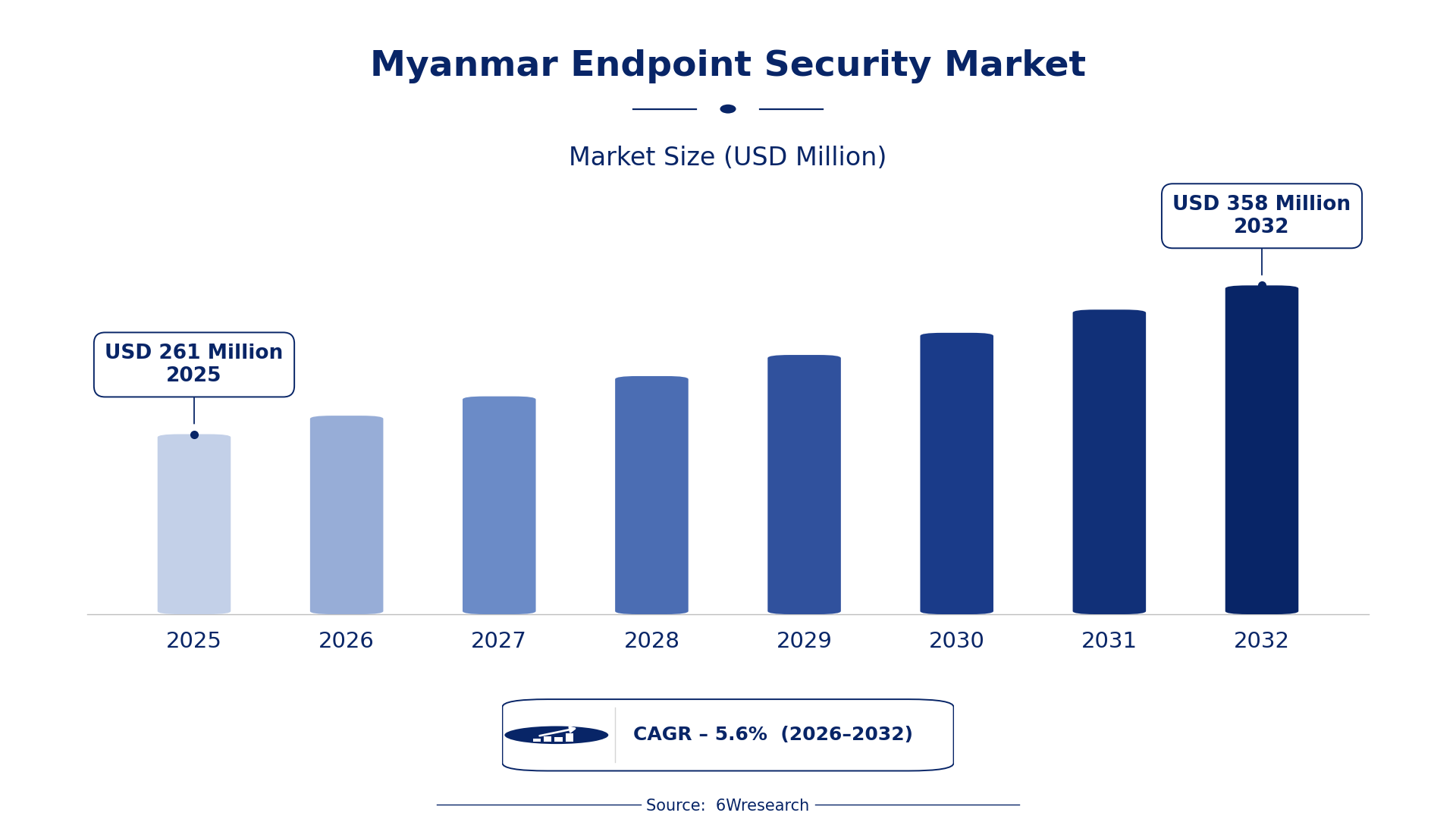
The Myanmar Endpoint Security Market was estimated at USD 261 Million in 2025 and is projected to reach USD 358 Million by 2032, growing at a CAGR of 5.6% from 2026 to 2032.
Myanmar Endpoint Security Market Synopsis
The increasing reliance on digital technologies in Myanmar has significantly amplified the focus on endpoint security. Businesses are now acutely aware of the cybersecurity threats lurking at every turn, which has prompted a surge in demand for effective security solutions to safeguard their assets.
With mobile devices, cloud services, and IoT becoming ubiquitous, the need for comprehensive endpoint protection has never been more critical. Organizations are investing in advanced technologies such as EDR systems and mobile device management platforms to combat malware and data breaches, recognizing that the stakes are higher than ever.
Myanmar Endpoint Security Market Year-wise Growth Rate and Key Drivers
This graph illustrates the annual growth rates of the Myanmar Endpoint Security Market from 2021 to 2032, highlighting a steady upward trajectory and projected expansion over the forecast period.
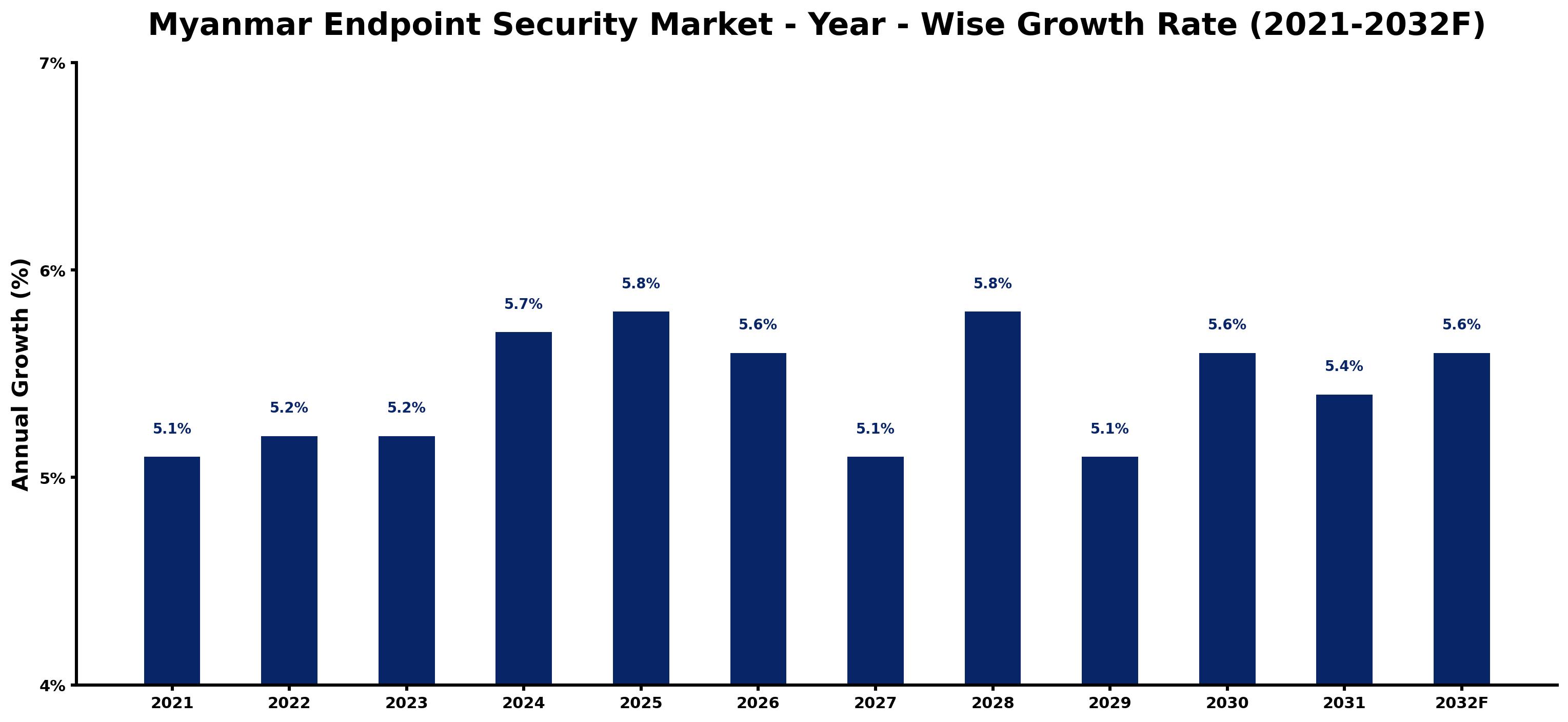
The table below presents the year‑wise growth rates along with the key drivers influencing the market
| Year | Growth Rate | Major Drivers |
| 2021 | 5.1% | Increased mobile device usage drives endpoint security demand. |
| 2022 | 5.2% | Government's cybersecurity policy enhances digital infrastructure protection. |
| 2023 | 5.2% | Rising cybersecurity threats prompt businesses to invest more. |
| 2024 | 5.7% | Launch of 5G network boosts endpoint security solutions adoption. |
| 2025 | 5.8% | Growing e-commerce sector necessitates improved data protection strategies. |
| 2026 | 5.6% | Financial sector's digitization increases focus on endpoint security. |
| 2027 | 5.1% | Regulatory compliance pressures accelerate investments in cybersecurity tools. |
| 2028 | 5.8% | Educational institutions adopt secure networks due to cyber risks. |
| 2029 | 5.1% | Increased remote work patterns heighten security awareness among firms. |
| 2030 | 5.6% | Rising incident of cyberattacks triggers company security budgets growth. |
| 2031 | 5.4% | Local tech firms partnering with global cybersecurity providers. |
| 2032 | 5.6% | Massive data breaches underscore importance of endpoint solutions. |
Note: Market size estimations and growth projections presented in this report are based on 6Wresearch's proprietary forecasting methodology, utilizing the latest available industry data, government publications, and primary research inputs.
Myanmar Endpoint Security Market Key Takeaways
Below are some of the specific key takeaways from the market, including:
- The demand for endpoint security solutions is increasing as cyber threats become more sophisticated.
- Regulatory frameworks are evolving, compelling businesses to comply with cybersecurity standards.
- Organizations are prioritizing data encryption and loss prevention strategies.
- Training and capacity-building initiatives are gaining traction to develop skilled professionals in cybersecurity.
- Investment in cloud-based security solutions is rapidly growing, driven by their scalability and cost-effectiveness.
Evaluation of Restraints in Myanmar Endpoint Security Market
Despite its growth potential, the Myanmar Endpoint Security Market faces notable obstacles. A lack of awareness regarding cybersecurity issues hampers organizations from investing adequately in essential security solutions. Many businesses still operate outdated systems, leaving them vulnerable to attacks. on top of that, the current shortage of trained cybersecurity professionals in the region complicates efforts to effectively secure endpoints. This is compounded by the still-developing regulatory landscape, which presents challenges in compliance and enforcement of data protection standards.
Myanmar Endpoint Security Market Trends
The market is witnessing a notable shift towards sophisticated threat detection and response mechanisms. Companies are increasingly seeking EDR solutions and threat intelligence capabilities to bolster their defenses. Cloud-based endpoint security is gaining traction as organizations look for flexible and cost-efficient alternatives. Alongside these technological advancements, there's a heightened focus on compliance with data protection regulations, prompting businesses to prioritize encryption and DLP strategies.
Myanmar Endpoint Security Market Opportunities
Opportunities abound in the Myanmar Endpoint Security Market, particularly as digital adoption accelerates. The rise of endpoint devices calls for tailored security solutions to counteract threats like ransomware and phishing. Businesses can profit by offering specialized endpoint protection platforms, antivirus software, and innovative encryption tools. Additionally, there's a growing demand for cybersecurity consultancy services, helping organizations enhance their security frameworks and awareness.
Government Initiatives in the Myanmar Endpoint Security Market
The Myanmar government is actively shaping the endpoint security landscape through various initiatives aimed at bolstering cybersecurity. There is a clear focus on enhancing the resilience of digital infrastructure and ensuring that organizations comply with emerging cybersecurity regulations. These efforts are essential for fostering a secure business environment, particularly as digital threats continue to evolve.
- A national cybersecurity policy was recently launched to set standards for data protection and incident reporting.
- Current initiatives include training programs to develop local cybersecurity expertise and build capacity among professionals.
- A public-private partnership is underway to improve digital infrastructure security across critical sectors.
- Upcoming regulations are expected to be introduced by 2026, mandating enhanced cybersecurity practices for businesses.
- The government is collaborating with international partners to develop a comprehensive national cybersecurity strategy.
Future Insights of the Myanmar Endpoint Security Market
Looking ahead to 2026-2032, the Myanmar Endpoint Security Market is set to expand significantly as organizations increasingly prioritize cybersecurity. The rise in digital transactions and online services will drive demand for advanced security solutions. on top of that, the integration of AI and machine learning technologies will play a crucial role in enhancing the effectiveness of endpoint security measures. As awareness of cybersecurity threats grows, businesses will continue investing in safeguarding their digital assets, ensuring a robust market trajectory.
Myanmar Endpoint Security Market Latest Developments
Recent months have seen heightened activity within the Myanmar Endpoint Security Market, as both public and private sectors respond to evolving cyber threats. The push for stronger cybersecurity frameworks and solutions is palpable, with new products and initiatives emerging to meet this demand.
- A major technology vendor launched a new endpoint protection platform in late 2025, enhancing detection capabilities against advanced threats.
- An initiative focused on enhancing cyber hygiene among small to medium enterprises began in early 2025 and remains ongoing.
- A local startup is developing a mobile device management solution expected to roll out by mid-2026.
- In Q1 2026, a collaboration between industry leaders was established to create a cybersecurity awareness campaign targeting businesses across various sectors.
- Several firms are currently upgrading their antivirus software to include behavioral analytics features, with completion expected by late 2025.
Myanmar Endpoint Security Market - Key Attractiveness of the Report
- 10 Years of Market Numbers
- Historical Data Starting from 2022 to 2025
- Base Year: 2025
- Forecast Data until 2032
- Key Performance Indicators Impacting the Market
- Major Upcoming Developments and Projects
Key Highlights of the Report:
- Myanmar Endpoint Security Market Outlook
- Market Size of Myanmar Endpoint Security Market, 2025
- Forecast of Myanmar Endpoint Security Market, 2032
- Historical Data and Forecast of Myanmar Endpoint Security Revenues & Volume for the Period 2022-2032F
- Myanmar Endpoint Security Market Trend Evolution
- Myanmar Endpoint Security Market Drivers and Challenges
- Myanmar Endpoint Security Price Trends
- Myanmar Endpoint Security Porter's Five Forces
- Myanmar Endpoint Security Industry Life Cycle
- Historical Data and Forecast of Myanmar Endpoint Security Market Revenues & Volume By Solution for the Period 2022-2032F
- Historical Data and Forecast of Myanmar Endpoint Security Market Revenues & Volume By Endpoint Protection Platform for the Period 2022-2032F
- Historical Data and Forecast of Myanmar Endpoint Security Market Revenues & Volume By Endpoint Detection for the Period 2022-2032F
- Historical Data and Forecast of Myanmar Endpoint Security Market Revenues & Volume By Response for the Period 2022-2032F
- Historical Data and Forecast of Myanmar Endpoint Security Market Revenues & Volume By Vertical for the Period 2022-2032F
- Historical Data and Forecast of Myanmar Endpoint Security Market Revenues & Volume By Healthcare for the Period 2022-2032F
- Historical Data and Forecast of Myanmar Endpoint Security Market Revenues & Volume By Retail for the Period 2022-2032F
- Historical Data and Forecast of Myanmar Endpoint Security Market Revenues & Volume By eCommerce for the Period 2022-2032F
- Historical Data and Forecast of Myanmar Endpoint Security Market Revenues & Volume By Government for the Period 2022-2032F
- Historical Data and Forecast of Myanmar Endpoint Security Market Revenues & Volume By Organization Size for the Period 2022-2032F
- Historical Data and Forecast of Myanmar Endpoint Security Market Revenues & Volume By Small and Medium-Sized Enterprises (SMEs) for the Period 2022-2032F
- Historical Data and Forecast of Myanmar Endpoint Security Market Revenues & Volume By Large Enterprises for the Period 2022-2032F
- Historical Data and Forecast of Myanmar Endpoint Security Market Revenues & Volume By Deployment Mode for the Period 2022-2032F
- Historical Data and Forecast of Myanmar Endpoint Security Market Revenues & Volume By On-premises for the Period 2022-2032F
- Historical Data and Forecast of Myanmar Endpoint Security Market Revenues & Volume By Cloud for the Period 2022-2032F
- Historical Data and Forecast of Myanmar Endpoint Security Market Revenues & Volume By Service for the Period 2022-2032F
- Historical Data and Forecast of Myanmar Endpoint Security Market Revenues & Volume By Professional Services for the Period 2022-2032F
- Historical Data and Forecast of Myanmar Endpoint Security Market Revenues & Volume By Managed Services for the Period 2022-2032F
- Myanmar Endpoint Security Import Export Trade Statistics
- Market Opportunity Assessment By Solution
- Market Opportunity Assessment By Vertical
- Market Opportunity Assessment By Organization Size
- Market Opportunity Assessment By Deployment Mode
- Market Opportunity Assessment By Service
- Myanmar Endpoint Security Top Companies Market Share
- Myanmar Endpoint Security Competitive Benchmarking By Technical and Operational Parameters
- Myanmar Endpoint Security Company Profiles
- Myanmar Endpoint Security Key Strategic Recommendations






































