Myanmar Energy Security Market Size & Growth Rate (2026-2032)
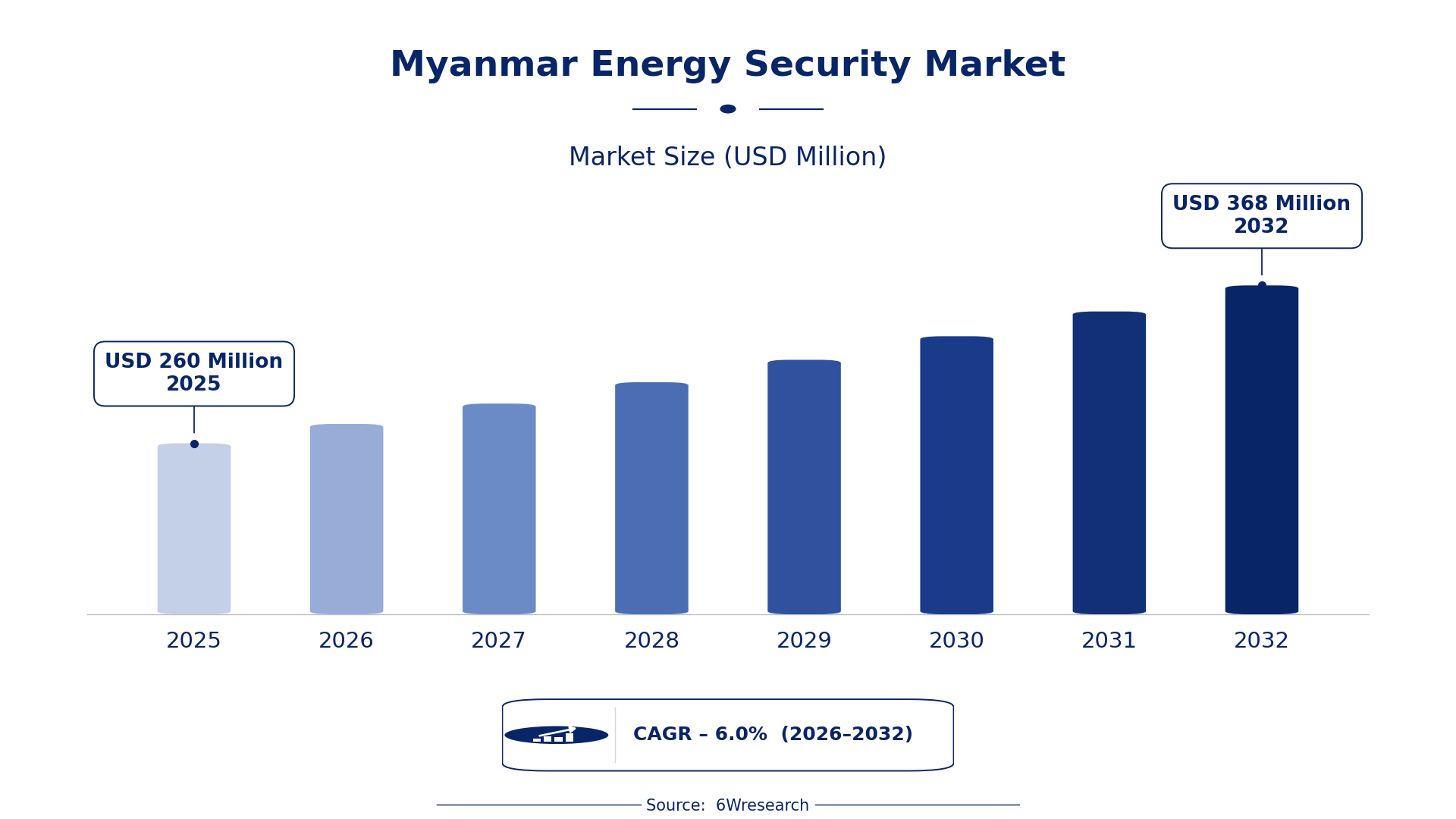
The Myanmar Energy Security Market was estimated at USD 260 Million in 2025 and is projected to reach USD 368 Million by 2032, growing at a CAGR of 6.0% from 2026 to 2032.
Myanmar Energy Security Market Synopsis
In recent years, Myanmar has experienced an urgent demand for energy, driven by rapid urbanization and economic growth. Yet, the country’s dependency on imported oil and gas highlights vulnerabilities in its energy security framework.
Looking ahead, the Myanmar Energy Security Market is at a crossroads. The government's initiatives to diversify energy sources, particularly through renewable energy projects, signal a shift towards long-term sustainability. However, the path is fraught with infrastructural and regulatory challenges that must be addressed to unlock the market's full potential.
Myanmar Energy Security Market Year-wise Growth Rate and Key Drivers
This graph illustrates the annual growth rates of the Myanmar Energy Security Market from 2021 to 2032, highlighting a steady upward trajectory and projected expansion over the forecast period.
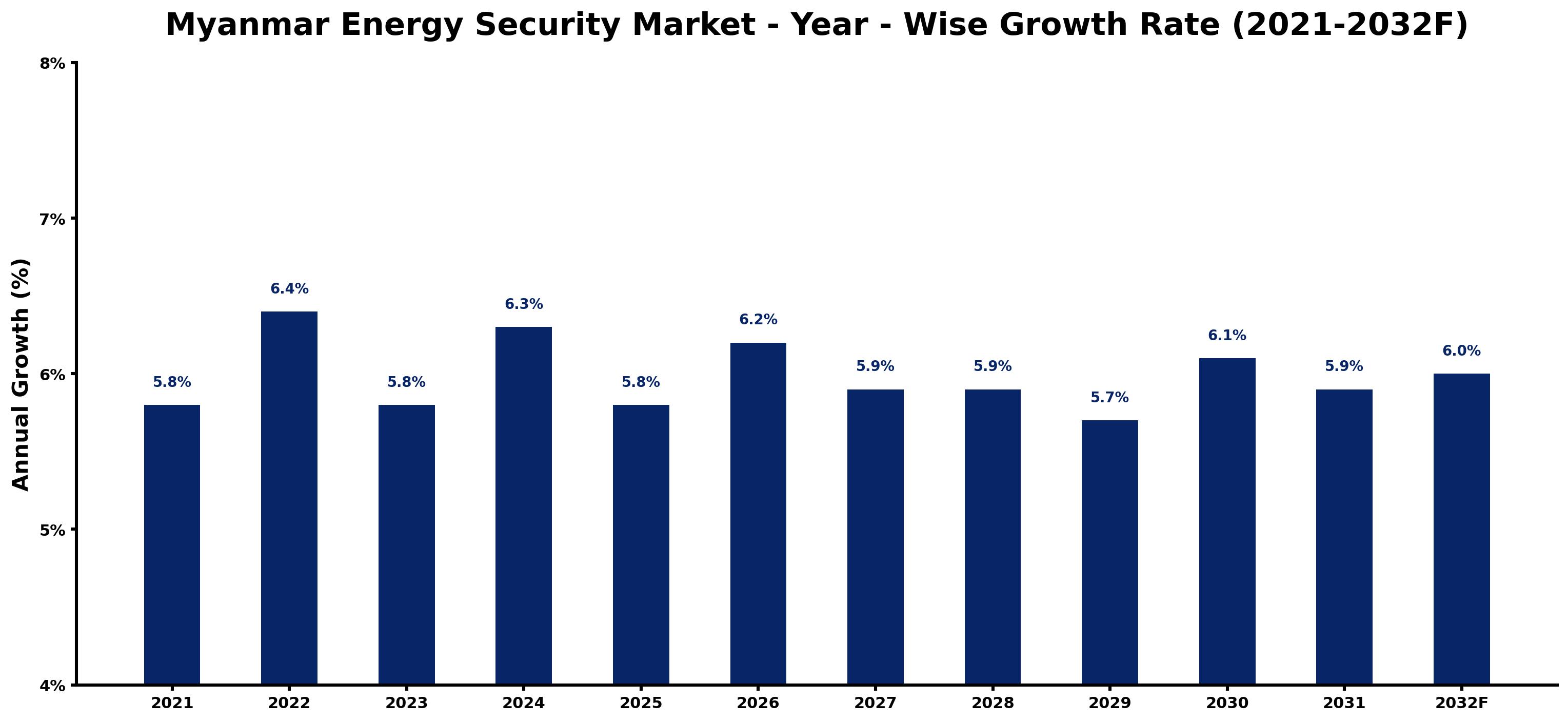
The table below presents the year‑wise growth rates along with the key drivers influencing the market
| Year | Growth Rate | Major Drivers |
| 2021 | 5.8% | Government initiatives to enhance network reliability and reach. |
| 2022 | 6.4% | Increased foreign investment in renewable energy projects. |
| 2023 | 5.8% | Launch of national energy conservation awareness campaigns. |
| 2024 | 6.3% | Implementation of new energy regulatory framework changes. |
| 2025 | 5.8% | Rising private sector participation in energy production. |
| 2026 | 6.2% | Growing interest in solar technology adoption by households. |
| 2027 | 5.9% | Surge in energy efficiency technologies driven by startups. |
| 2028 | 5.9% | Local partnerships for sustainable hydroelectric power development. |
| 2029 | 5.7% | Increased urbanization driving demand for reliable power supply. |
| 2030 | 6.1% | Government incentives for sustainable energy solutions deployment. |
| 2031 | 5.9% | Emergence of microgrid projects in underserved communities. |
| 2032 | 6.0% | Focus on reducing electricity losses in distribution networks. |
Note: Market size estimations and growth projections presented in this report are based on 6Wresearch's proprietary forecasting methodology, utilizing the latest available industry data, government publications, and primary research inputs.
Myanmar Energy Security Market Key Takeaways
Below are some of the specific key takeaways from the market, including:
- The market is projected to grow significantly, reaching USD 368 Million by 2032.
- Renewable energy sources like solar and hydropower are central to government diversification efforts.
- Foreign investments are increasingly focused on natural gas exploration and renewable energy projects.
- Infrastructure development is critical for improving energy access and efficiency across the country.
- Regulatory reforms are necessary to address current inefficiencies and attract investments.
Evaluation of Restraints in Myanmar Energy Security Market
The Myanmar Energy Security Market faces substantial hurdles that inhibit its growth. A heavy reliance on imported fossil fuels exposes the country to global price fluctuations and supply disruptions, jeopardizing its energy stability. Compounding this issue, limited infrastructure and outdated technology hinder effective energy production and distribution. on top of that, regulatory challenges and an insufficient institutional framework create barriers to investment, discouraging stakeholders from entering the market. Addressing these constraints will require coordinated policy efforts and significant investment in infrastructure and renewable resources.
Myanmar Energy Security Market Trends
The market is seeing a pronounced shift towards renewable energy as the government pushes for diversification. This trend is not only about reducing reliance on imported fuels; it’s about enhancing sustainability. Increased awareness of energy efficiency and conservation measures is also gaining traction. Foreign investments continue to rise, particularly in the natural gas sector, indicating a growing trust in Myanmar's energy potential.
Myanmar Energy Security Market Opportunities
Investors have numerous avenues for growth within the Myanmar Energy Security Market. Renewable energy projects—especially in solar, wind, and hydropower—present promising prospects. The country’s rich natural gas reserves create appealing opportunities for exploration and production partnerships. Additionally, there is an urgent need for infrastructure development, specifically in transmission and distribution networks, which can greatly enhance energy accessibility and operational efficiency.
Government Initiatives in the Myanmar Energy Security Market
The Myanmar government is actively shaping its energy security through a series of targeted initiatives. With a strong focus on reducing reliance on imported fuels and ensuring sustainable energy access, these initiatives signal the government's commitment to transforming the energy sector. Effective policies and regulatory frameworks are key to encouraging investment and innovation in this critical market.
- The National Electrification Plan launched recently aims for universal electricity access by 2030 through various solutions including off-grid systems.
- The establishment of the National Energy Management Committee is currently underway to facilitate better coordination of energy-related activities.
- Ongoing promotional efforts for renewable energy projects include favorable tax incentives for solar and hydropower initiatives.
- A planned public-private partnership is expected to expand energy infrastructure, particularly in rural areas, by 2028.
- Policy reforms focusing on regulatory transparency and investor protection are slated for introduction in the upcoming fiscal year.
Future Insights of the Myanmar Energy Security Market
The Myanmar Energy Security Market is set for notable growth in the next few years. Government reforms aimed at attracting foreign investment, along with an emphasis on renewable energy, will drive the market forward. However, the success of these initiatives will depend largely on overcoming infrastructural and regulatory challenges that currently persist. With strategic partnerships and enhanced focus on sustainability, the future looks promising for this evolving market.
Myanmar Energy Security Market Latest Developments
In the past year, the Myanmar Energy Security Market has witnessed significant activity, signaling a renewed focus on energy efficiency and renewable solutions. Increased foreign interest is evident, particularly as government policies begin to take shape. These developments reflect an understanding that the market must adapt to changing demands and expectations.
- A major technology vendor launched a new solar energy system in early 2025, aimed at enhancing off-grid power accessibility in rural regions.
- An initiative focused on upgrading natural gas production facilities began in mid-2025 and is currently ongoing, aimed at increasing output and efficiency.
- A public-private energy conservation campaign is planned for launch in the second half of 2026, focusing on consumer education and energy efficiency measures.
- Infrastructure improvements for electricity distribution networks have entered the construction phase, expected to enhance reliability by mid-2026.
- A partnership between international firms for hydropower exploration is currently being negotiated, set to finalize by late 2025.
Myanmar Energy Security Market - Key Attractiveness of the Report
- 10 Years of Market Numbers
- Historical Data Starting from 2022 to 2025
- Base Year: 2025
- Forecast Data until 2032
- Key Performance Indicators Impacting the Market
- Major Upcoming Developments and Projects
Key Highlights of the Report:
- Myanmar Energy Security Market Outlook
- Market Size of Myanmar Energy Security Market, 2025
- Forecast of Myanmar Energy Security Market, 2032
- Historical Data and Forecast of Myanmar Energy Security Revenues & Volume for the Period 2022-2032F
- Myanmar Energy Security Market Trend Evolution
- Myanmar Energy Security Market Drivers and Challenges
- Myanmar Energy Security Price Trends
- Myanmar Energy Security Porter's Five Forces
- Myanmar Energy Security Industry Life Cycle
- Historical Data and Forecast of Myanmar Energy Security Market Revenues & Volume By Power Plants for the Period 2022-2032F
- Historical Data and Forecast of Myanmar Energy Security Market Revenues & Volume By Nuclear for the Period 2022-2032F
- Historical Data and Forecast of Myanmar Energy Security Market Revenues & Volume By Thermal for the Period 2022-2032F
- Historical Data and Forecast of Myanmar Energy Security Market Revenues & Volume By Hydro for the Period 2022-2032F
- Historical Data and Forecast of Myanmar Energy Security Market Revenues & Volume By Oil for the Period 2022-2032F
- Historical Data and Forecast of Myanmar Energy Security Market Revenues & Volume By Gas for the Period 2022-2032F
- Historical Data and Forecast of Myanmar Energy Security Market Revenues & Volume By Renewable Energy for the Period 2022-2032F
- Historical Data and Forecast of Myanmar Energy Security Market Revenues & Volume By Technologies for the Period 2022-2032F
- Historical Data and Forecast of Myanmar Energy Security Market Revenues & Volume By Physical for the Period 2022-2032F
- Historical Data and Forecast of Myanmar Energy Security Market Revenues & Volume By Network Security for the Period 2022-2032F
- Myanmar Energy Security Import Export Trade Statistics
- Market Opportunity Assessment By Power Plants
- Market Opportunity Assessment By Technologies
- Myanmar Energy Security Top Companies Market Share
- Myanmar Energy Security Competitive Benchmarking By Technical and Operational Parameters
- Myanmar Energy Security Company Profiles
- Myanmar Energy Security Key Strategic Recommendations






































