Myanmar Ethane Market Size, Share & Growth Rate
The Myanmar Ethane Market was estimated at USD 284 Million in 2025 and is projected to reach USD 397 Million by 2032, growing at a CAGR of 4.9% from 2026 to 2032. This growth trajectory is fueled by the increasing demand for ethane as a key feedstock in the petrochemical sector, particularly for ethylene production. Moreover, Myanmar's strategic efforts towards industrialization and infrastructural enhancement are set to further bolster the market's development.
Myanmar Ethane Market Year-wise Growth Rate and Key Drivers
This graph highlights how the Myanmar Ethane Market has steadily grown over the years, supported by major growth factors.
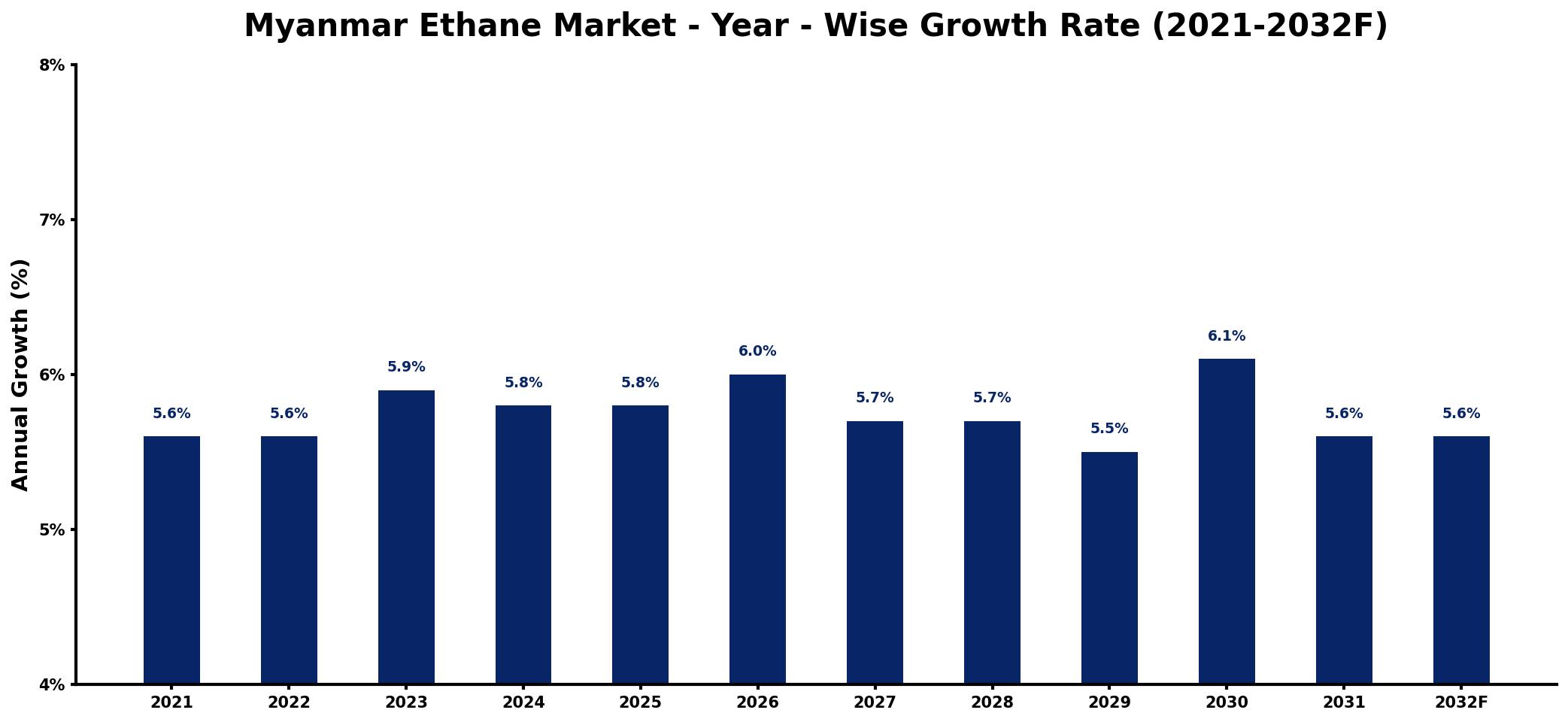
The table below presents the year‑wise growth rates along with the key drivers influencing the market
| Year | Growth Rate | Major Drivers |
| 2021 | 5.6% | Increased demand for energy applications |
| 2022 | 5.6% | Expansion of petrochemical facilities |
| 2023 | 5.9% | Growth in industrial manufacturing sectors |
| 2024 | 5.8% | Rising investments in infrastructure projects |
| 2025 | 5.8% | Increased utilization in power generation |
| 2026 | 6.0% | Higher demand from chemical industries |
| 2027 | 5.7% | Development of new transportation networks |
| 2028 | 5.7% | increased pharmaceutical industry usage |
| 2029 | 5.5% | Growing interest in renewable energy |
| 2030 | 6.1% | Boost in residential energy consumption |
| 2031 | 5.6% | Increased regulatory support for utilities |
| 2032 | 5.6% | improved raw material availability |
Note: Market size estimations and growth projections presented in this report are based on 6Wresearch's proprietary forecasting methodology, utilizing the latest available industry data, government publications, and primary research inputs.
Myanmar Ethane Market Synopsis
The Myanmar Ethane Market is currently witnessing a period of significant growth, with demand driven by diverse industries including petrochemicals and plastics. As momentum builds, the focus on expanding production capacities and enhancing industrial infrastructure will dictate the market's future landscape.
Looking ahead, the market is poised for expansion, but it faces challenges related to infrastructure and regulatory environments. Investors and stakeholders are optimistic, recognizing the potential for development as the government continues to implement favorable policies aimed at attracting foreign investment.
Myanmar Ethane Market Key Takeaways
- The market is expanding due to the rising demand for ethane in the petrochemical sector.
- Myanmar's strategic location and natural gas reserves create a competitive advantage.
- Ongoing government initiatives aim to attract foreign investments in the ethane industry.
- Infrastructure development is critical to unlocking the markets full potential.
- There are significant opportunities for establishing processing facilities and transportation networks.
Evaluation of Restraints in Myanmar Ethane Market
Despite its promising outlook, the Myanmar Ethane Market faces several restraints that could limit its growth. Key among these are the infrastructure deficiencies impacting production and distribution capabilities. Limited production capacity compared to neighboring countries creates potential supply constraints. Additionally, the uncertainty surrounding regulatory frameworks presents challenges for investors, affecting confidence in long-term commitments. Furthermore, the shortage of a skilled workforce in the region hinders the operational efficiency of existing and new facilities, necessitating targeted investments in training and development.
Myanmar Ethane Market Trends
A notable trend in the Myanmar Ethane Market is the increasing investment in processing facilities aimed at transforming ethane into value-added products. As the demand for petrochemical goods rises, the establishment of ethane cracker plants is becoming a focal point for stakeholders. Moreover, innovations in extraction and transportation technologies are shaping the efficiency of operations within the industry. The government's commitment to industrialization and the promotion of sustainable practices are further influencing these trends, setting the stage for future growth.
Myanmar Ethane Market Opportunities
The Myanmar Ethane Market holds considerable investment opportunities, particularly with the growing interest in establishing ethane processing facilities to enhance local production capabilities. Investors are encouraged to explore the development of ethane cracker plants that can significantly contribute to domestic and international demand for ethylene and related products. Additionally, there is a burgeoning need for improved infrastructure, which presents lucrative prospects for those looking to invest in transportation and storage solutions. As the government enhances its focus on attracting foreign direct investment, the market remains a strategic entry point for capitalizing on Myanmar's abundant natural resources.
Government Initiatives in the Myanmar Ethane Market
The Myanmar government has undertaken numerous initiatives to foster the development of the ethane market. Key strategies include offering incentives such as tax breaks to attract foreign investment and simplifying the regulatory approval processes for ethane-related projects. Additionally, regulations aimed at ensuring sustainable resource extraction have been introduced, which balances economic growth with environmental considerations. Furthermore, partnerships with neighboring countries are being encouraged to enhance trade relations and stimulate the ethane sector.
Future Insights of the Myanmar Ethane Market
Looking toward 2026 and beyond, the Myanmar Ethane Market is anticipated to expand significantly, spurred by the ongoing demand for petrochemical products and robust investments in infrastructure. Myanmar's abundant natural gas reserves position it favorably for growth, attracting international partnerships. However, stakeholders must remain aware of the potential risks associated with regulatory fluctuations and infrastructural gaps. By addressing these concerns and leveraging strategic initiatives, the market can unlock its full potential and drive sustainable growth.
Myanmar Ethane Market Latest Developments (2025 - 2026)
Recent developments in the Myanmar Ethane Market indicate a growing momentum towards establishing new processing facilities and enhancing existing infrastructure. The government has initiated discussions with international investors to explore collaborative projects aimed at increasing ethane production capabilities. Additionally, there has been a focus on improving supply chain efficiencies, which are crucial for meeting the rising demands from domestic and export markets. These trends suggest a proactive approach towards positioning Myanmar as a competitive player in the regional ethane market.
Myanmar Ethane Market - Key Attractiveness of the Report
- 10 Years of Market Numbers
- Historical Data Starting from 2022 to 2025
- Base Year: 2025
- Forecast Data until 2032
- Key Performance Indicators Impacting the Market
- Major Upcoming Developments and Projects
Key Highlights of the Report:
- Myanmar Ethane Market Outlook
- Market Size of Myanmar Ethane Market, 2025
- Forecast of Myanmar Ethane Market, 2032
- Historical Data and Forecast of Myanmar Ethane Revenues & Volume for the Period 2022-2032F
- Myanmar Ethane Market Trend Evolution
- Myanmar Ethane Market Drivers and Challenges
- Myanmar Ethane Price Trends
- Myanmar Ethane Porter's Five Forces
- Myanmar Ethane Industry Life Cycle
- Historical Data and Forecast of Myanmar Ethane Market Revenues & Volume By Application for the Period 2022-2032F
- Historical Data and Forecast of Myanmar Ethane Market Revenues & Volume By Ethylene Synthesis for the Period 2022-2032F
- Historical Data and Forecast of Myanmar Ethane Market Revenues & Volume By Acetic Acid Synthesis for the Period 2022-2032F
- Historical Data and Forecast of Myanmar Ethane Market Revenues & Volume By Refrigerant for the Period 2022-2032F
- Historical Data and Forecast of Myanmar Ethane Market Revenues & Volume By End-Use Industry for the Period 2022-2032F
- Historical Data and Forecast of Myanmar Ethane Market Revenues & Volume By Packaging for the Period 2022-2032F
- Historical Data and Forecast of Myanmar Ethane Market Revenues & Volume By Automotive & Transportation for the Period 2022-2032F
- Historical Data and Forecast of Myanmar Ethane Market Revenues & Volume By Construction for the Period 2022-2032F
- Historical Data and Forecast of Myanmar Ethane Market Revenues & Volume By Electricals & Electronics for the Period 2022-2032F
- Historical Data and Forecast of Myanmar Ethane Market Revenues & Volume By Healthcare for the Period 2022-2032F
- Myanmar Ethane Import Export Trade Statistics
- Market Opportunity Assessment By Application
- Market Opportunity Assessment By End-Use Industry
- Myanmar Ethane Top Companies Market Share
- Myanmar Ethane Competitive Benchmarking By Technical and Operational Parameters
- Myanmar Ethane Company Profiles
- Myanmar Ethane Key Strategic Recommendations






































