Myanmar Inflatable Pools Market Size, Share & Growth Rate
The Myanmar Inflatable Pools Market was estimated at USD 199 Million in 2025 and is projected to reach USD 274 Million by 2032, growing at a CAGR of 4.7% from 2026 to 2032. This growth trajectory is propelled by increasing urbanization and a rise in disposable incomes, which enable more households to invest in leisure activities. Moreover, the growing interest in home entertainment, especially post-pandemic, has made inflatable pools an attractive option for families seeking recreational outlets within their own backyards.
Myanmar Inflatable Pools Market Year-wise Growth Rate and Key Drivers
This graph highlights how the Myanmar Inflatable Pools Market has steadily grown over the years, supported by major growth factors.
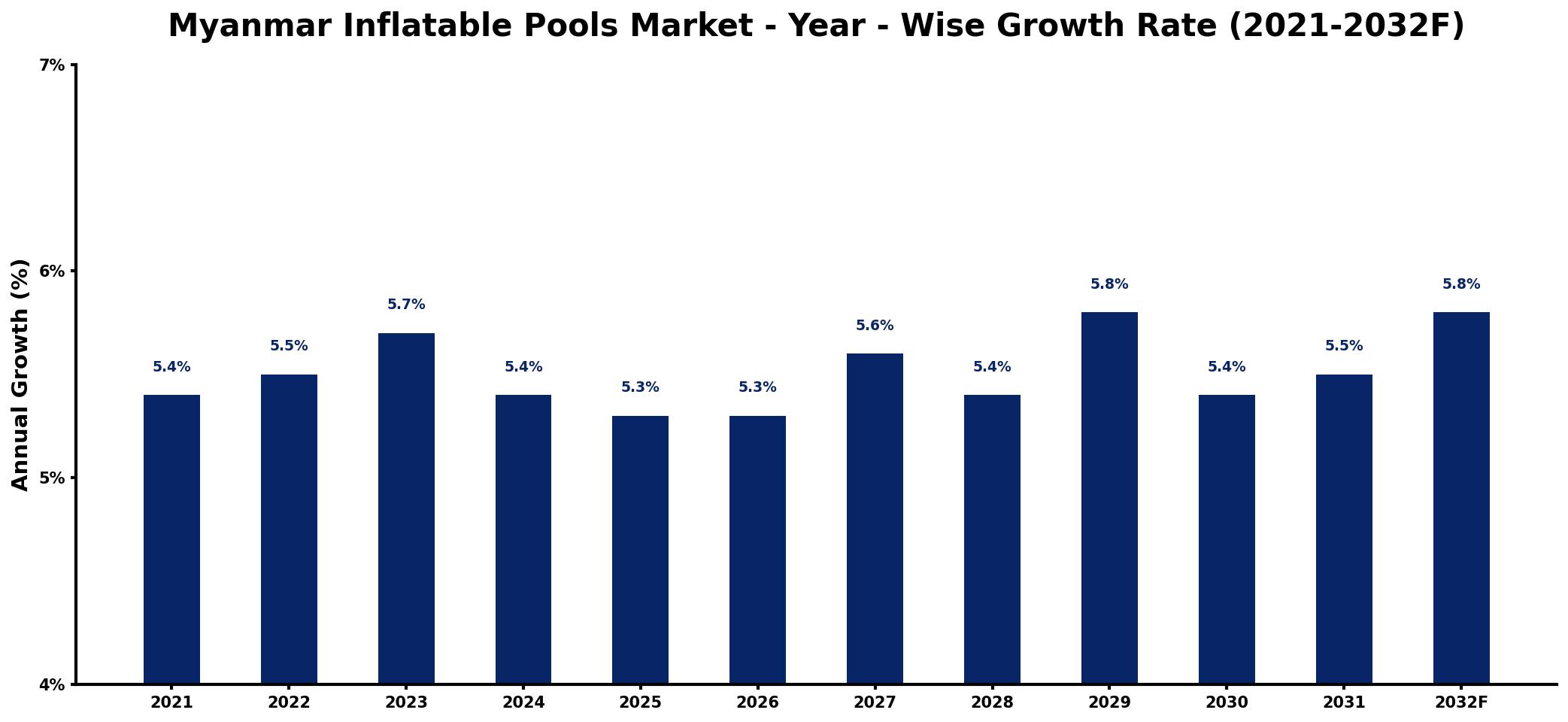
The table below presents the year‑wise growth rates along with the key drivers influencing the market
| Year | Growth Rate | Major Drivers |
| 2021 | 5.4% | Increased consumer spending on leisure |
| 2022 | 5.5% | Expansion of domestic tourism sector |
| 2023 | 5.7% | Growth in family entertainment options |
| 2024 | 5.4% | Rising popularity of backyard recreation |
| 2025 | 5.3% | Investment in outdoor leisure facilities |
| 2026 | 5.3% | Enhanced marketing strategies for fun |
| 2027 | 5.6% | Emergence of new retail channels |
| 2028 | 5.4% | Higher disposable income among households |
| 2029 | 5.8% | Increased awareness of outdoor activities |
| 2030 | 5.4% | Collaboration with hospitality industry |
| 2031 | 5.5% | Development of eco-friendly products |
| 2032 | 5.8% | Diversification of leisure product offerings |
Note: Market size estimations and growth projections presented in this report are based on 6Wresearch's proprietary forecasting methodology, utilizing the latest available industry data, government publications, and primary research inputs.
Myanmar Inflatable Pools Market Synopsis
In Myanmar, the demand for inflatable pools is significantly influenced by the desire for affordable recreational options, especially among urban families. These pools present a cost-effective alternative to traditional swimming pools, offering convenience and ease of setup for consumers who may lack the space or resources for permanent installations.
The market is currently characterized by a diverse range of products that appeal to various consumer preferences. From family-sized pools to models designed for smaller spaces, manufacturers are focusing on innovation—introducing features like integrated water sprayers and durable materials that stand up to the tropical climate, which ultimately enhances the consumer experience.
Myanmar Inflatable Pools Market Key Takeaways
- The market is on a robust growth trajectory fueled by rising urbanization and disposable incomes.
- Consumers are increasingly leaning toward home-based leisure activities, enhancing the demand for inflatable pools.
- Product innovations are focused on quality and unique features to cater to diverse preferences.
- Online sales channels are becoming essential for accessibility and convenience for consumers.
- The market faces competition from traditional swimming pools, emphasizing the need for targeted marketing strategies.
Evaluation of Restraints in Myanmar Inflatable Pools Market
Despite its promising potential, the Myanmar inflatable pools market faces several real constraints. Limited consumer awareness poses a significant challenge; many potential customers are still unfamiliar with the benefits and varieties of inflatable pools. Additionally, economic factors, including fluctuating disposable incomes, can hinder purchasing decisions. Furthermore, the underdeveloped distribution channels complicate the ability of manufacturers and retailers to reach their target markets effectively. This fragmented network may lead to delays in product availability and restrict consumer access to innovative options, ultimately impacting market growth.
Myanmar Inflatable Pools Market Trends
Current trends indicate a strong shift towards larger, more durable inflatable pools capable of accommodating family gatherings. Additionally, eco-friendly materials are gaining traction among environmentally conscious consumers, prompting manufacturers to explore sustainable practices in production. Social media and online platforms are also instrumental in shaping preferences, as visually appealing designs and features capture the interest of younger demographics, further driving market engagement.
Myanmar Inflatable Pools Market Opportunities
Investment opportunities within the Myanmar inflatable pools market are ripe for forward-thinking stakeholders. As consumer preferences shift towards budget-friendly leisure options, there is ample room for innovative products that prioritize quality and appeal to diverse demographics. Strategic partnerships with local distributors can enhance market penetration, especially in under-served regions. With the ongoing economic development in Myanmar, aligning product offerings with evolving lifestyles presents a significant avenue for growth.
Government Initiatives in the Myanmar Inflatable Pools Market
Government policies relating to the Myanmar inflatable pools market are primarily focused on ensuring product safety and quality. The Ministry of Commerce is responsible for enforcing import regulations that guarantee inflatable pools meet safety standards, thereby protecting consumers. Additionally, local manufacturers are required to adhere to specific quality control guidelines set by the Ministry of Industry. There are also regulations concerning environmental sustainability, particularly focusing on waste management associated with these products. Collectively, these initiatives are aimed at fostering a safe and competitive market environment.
Future Insights of the Myanmar Inflatable Pools Market
Looking towards 2026-2032, the Myanmar inflatable pools market is expected to experience robust growth, buoyed by a growing interest in home-based leisure activities. As urbanization progresses and disposable incomes rise, consumers will increasingly seek affordable entertainment solutions, positioning inflatable pools as a prime choice. Additionally, with the influence of social media, the appeal of inflatable pools among younger consumers will likely escalate, creating opportunities for targeted marketing and product diversification. This alignment of market dynamics suggests a promising future for investors and stakeholders alike.
Myanmar Inflatable Pools Market Latest Developments (2025 - 2026)
Recent industry developments indicate a trend towards innovative designs and features in inflatable pools, catering to evolving consumer preferences. Manufacturers are increasingly adopting sustainable practices in production, responding to the rising demand for eco-friendly options. Additionally, e-commerce platforms are seeing heightened activity as consumers shift towards online shopping for convenience and variety. Efforts to expand distribution networks are also underway, enhancing product accessibility across various regions of Myanmar.
Myanmar Inflatable Pools Market - Key Attractiveness of the Report
- 10 Years of Market Numbers
- Historical Data Starting from 2022 to 2025
- Base Year: 2025
- Forecast Data until 2032
- Key Performance Indicators Impacting the Market
- Major Upcoming Developments and Projects
Key Highlights of the Report:
- Myanmar Inflatable Pools Market Outlook
- Market Size of Myanmar Inflatable Pools Market, 2025
- Forecast of Myanmar Inflatable Pools Market, 2032
- Historical Data and Forecast of Myanmar Inflatable Pools Revenues & Volume for the Period 2022-2032F
- Myanmar Inflatable Pools Market Trend Evolution
- Myanmar Inflatable Pools Market Drivers and Challenges
- Myanmar Inflatable Pools Price Trends
- Myanmar Inflatable Pools Porter's Five Forces
- Myanmar Inflatable Pools Industry Life Cycle
- Historical Data and Forecast of Myanmar Inflatable Pools Market Revenues & Volume By Capacity for the Period 2022-2032F
- Historical Data and Forecast of Myanmar Inflatable Pools Market Revenues & Volume By Maximum 3 Individuals for the Period 2022-2032F
- Historical Data and Forecast of Myanmar Inflatable Pools Market Revenues & Volume By Maximum 6 Individuals for the Period 2022-2032F
- Historical Data and Forecast of Myanmar Inflatable Pools Market Revenues & Volume By Maximum 12 Individuals for the Period 2022-2032F
- Historical Data and Forecast of Myanmar Inflatable Pools Market Revenues & Volume By Age for the Period 2022-2032F
- Historical Data and Forecast of Myanmar Inflatable Pools Market Revenues & Volume By Up To 4 Years for the Period 2022-2032F
- Historical Data and Forecast of Myanmar Inflatable Pools Market Revenues & Volume By 5 To 10 Years for the Period 2022-2032F
- Historical Data and Forecast of Myanmar Inflatable Pools Market Revenues & Volume By 11 Years & Above for the Period 2022-2032F
- Historical Data and Forecast of Myanmar Inflatable Pools Market Revenues & Volume By Shape for the Period 2022-2032F
- Historical Data and Forecast of Myanmar Inflatable Pools Market Revenues & Volume By Round for the Period 2022-2032F
- Historical Data and Forecast of Myanmar Inflatable Pools Market Revenues & Volume By Rectangle for the Period 2022-2032F
- Historical Data and Forecast of Myanmar Inflatable Pools Market Revenues & Volume By Square for the Period 2022-2032F
- Historical Data and Forecast of Myanmar Inflatable Pools Market Revenues & Volume By Oval for the Period 2022-2032F
- Historical Data and Forecast of Myanmar Inflatable Pools Market Revenues & Volume By Others for the Period 2022-2032F
- Historical Data and Forecast of Myanmar Inflatable Pools Market Revenues & Volume By Distribution Channel for the Period 2022-2032F
- Historical Data and Forecast of Myanmar Inflatable Pools Market Revenues & Volume By Store Based for the Period 2022-2032F
- Historical Data and Forecast of Myanmar Inflatable Pools Market Revenues & Volume By Non Store Based for the Period 2022-2032F
- Myanmar Inflatable Pools Import Export Trade Statistics
- Market Opportunity Assessment By Capacity
- Market Opportunity Assessment By Age
- Market Opportunity Assessment By Shape
- Market Opportunity Assessment By Distribution Channel
- Myanmar Inflatable Pools Top Companies Market Share
- Myanmar Inflatable Pools Competitive Benchmarking By Technical and Operational Parameters
- Myanmar Inflatable Pools Company Profiles
- Myanmar Inflatable Pools Key Strategic Recommendations






































