Myanmar Personal Computers Market Size, Share & Growth Rate
The Myanmar Personal Computers Market was estimated at USD 208 Million in 2025 and is projected to reach USD 291 Million by 2032, growing at a CAGR of 4.9% from 2026 to 2032. This growth is fueled by an increasingly digital-savvy youth demographic and rising income levels, which are driving up the demand for personal technology solutions. Additionally, the shift towards remote work and the proliferation of online educational platforms are further contributing to the market's upward trajectory.
Myanmar Personal Computers Market Year-wise Growth Rate and Key Drivers
This graph highlights how the Myanmar Personal Computers Market has steadily grown over the years, supported by major growth factors.
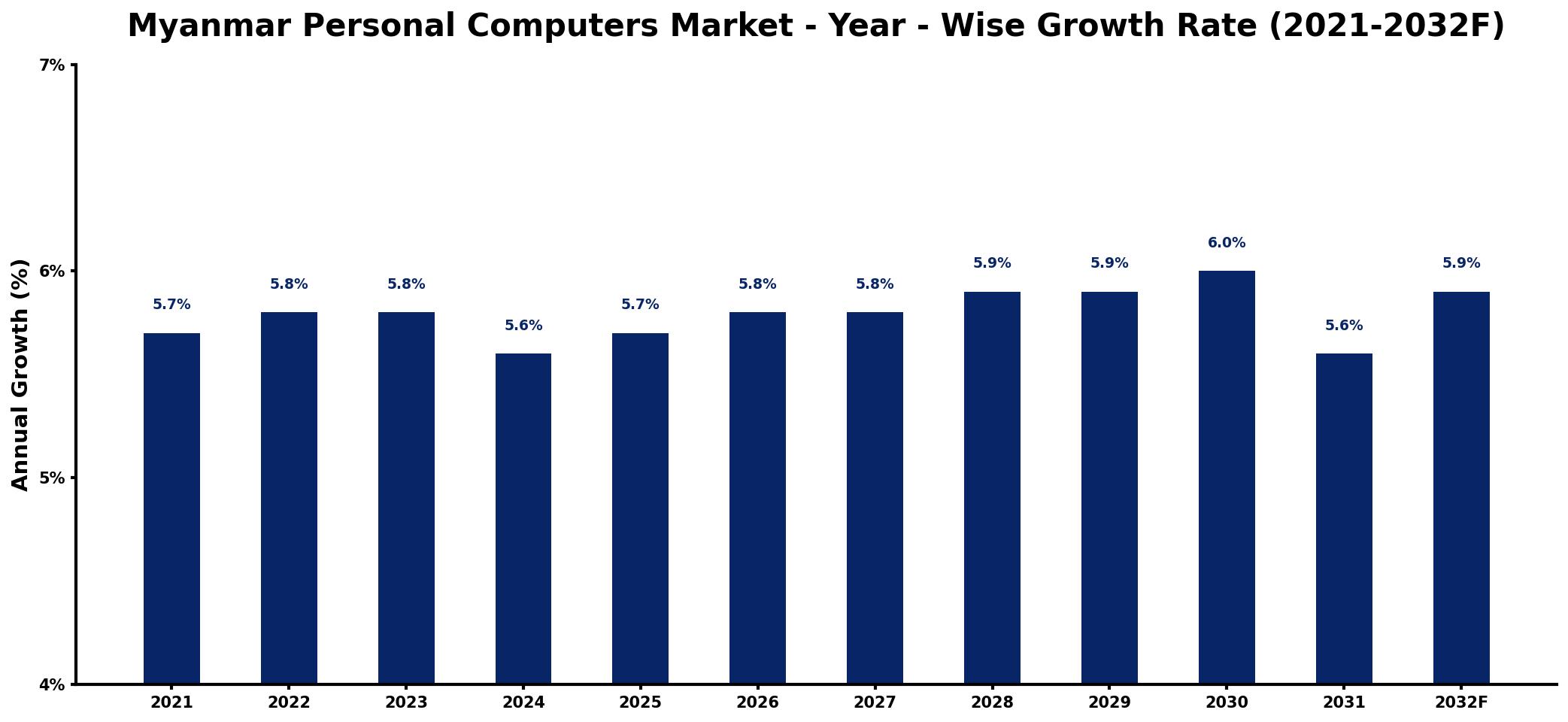
The table below presents the year‑wise growth rates along with the key drivers influencing the market
| Year | Growth Rate | Major Drivers |
| 2021 | 5.7% | Rising digital education initiatives |
| 2022 | 5.8% | Increased remote work adoption |
| 2023 | 5.8% | Growing e-commerce sector investments |
| 2024 | 5.6% | Expansion of tech infrastructure projects |
| 2025 | 5.7% | Enhanced government technology programs |
| 2026 | 5.8% | Surge in online entertainment demand |
| 2027 | 5.8% | Growth in digital content creation |
| 2028 | 5.9% | Increased smartphone integration strategies |
| 2029 | 5.9% | Development of cloud computing services |
| 2030 | 6.0% | Boost in tech startup funding |
| 2031 | 5.6% | Growing demand for cybersecurity solutions |
| 2032 | 5.9% | stronger distribution network expansion |
Note: Market size estimations and growth projections presented in this report are based on 6Wresearch's proprietary forecasting methodology, utilizing the latest available industry data, government publications, and primary research inputs.
Myanmar Personal Computers Market Synopsis
The Myanmar personal computers market is currently navigating through a phase of rapid expansion, marked by heightened consumer interest in technology. This momentum, however, is juxtaposed against structural challenges that could impede growth in the longer term. As the market evolves, both local and international brands are vying for market share, adapting to the unique needs of Myanmar's diverse consumer base.
Looking ahead, the market is anticipated to pivot further towards affordability and accessibility, particularly in urban centers where internet connectivity is improving. Nevertheless, businesses must remain cognizant of the socio-economic disparities that exist, as many potential users still face challenges in terms of access and digital literacy.
Myanmar Personal Computers Market Key Takeaways
- The market is driven by a young and increasingly affluent population that is eager to adopt new technologies.
- Remote work and online education are significant factors propelling demand for personal computers.
- Local brands are capturing market share by offering affordable options that meet the needs of budget-conscious consumers.
- Improving internet infrastructure will likely enhance market penetration rates for personal computers.
- Despite growth opportunities, challenges such as political instability and skills gaps remain pertinent.
Evaluation of Restraints in Myanmar Personal Computers Market
The Myanmar personal computers market is hindered by several key restraints that pose challenges to its growth. Limited internet connectivity in rural areas creates a digital divide, preventing a substantial portion of the population from accessing technology. Furthermore, low levels of disposable income restrict the purchasing power of many potential consumers, making it difficult for them to invest in personal computers. The market's competitiveness is another concern, as a handful of dominant players can make it challenging for new entrants to establish themselves. Political instability further complicates the regulatory environment, affecting business operations and investment decisions.
Myanmar Personal Computers Market Trends
Several trends are shaping the landscape of the Myanmar personal computers market. Notably, there is a growing preference for portable devices, such as laptops, which cater to the needs of mobile users, including students and remote workers. Additionally, entry-level laptops and budget-friendly models are gaining popularity, allowing more consumers to enter the market. Another trend is the increasing interest in high-performance gaming PCs among tech enthusiasts, signifying a diversification in consumer preferences. As digital literacy improves and internet access expands, the demand for various types of personal computers is expected to continue its upward trend.
Myanmar Personal Computers Market Opportunities
The Myanmar personal computers market presents numerous growth and investment opportunities for savvy stakeholders. With a relatively low PC penetration rate compared to other Southeast Asian nations, there is substantial room for expansion. Investors can target both consumer and business segments, particularly by developing tailored solutions that address local needs. Additionally, the governments push for digitalization indicates a supportive environment for businesses investing in technology infrastructure and education. Innovations in technology, such as cloud computing and mobile solutions, also present avenues for growth in this emerging market.
Government Initiatives in the Myanmar Personal Computers Market
Government policies aimed at fostering the personal computers market are beginning to take shape. Initiatives designed to promote local manufacturing include import regulations that encourage domestic production of electronic devices. Furthermore, tax incentives are available for companies looking to invest in computer assembly within Myanmar. Programs aimed at improving access to technology in rural communities indicate a focus on bridging the digital divide. These efforts not only aim to bolster the domestic computer industry but also seek to enhance digital literacy across diverse demographics.
Future Insights of the Myanmar Personal Computers Market
The future outlook for the Myanmar personal computers market is optimistic, propelled by increasing digitalization and a young, tech-savvy population. As businesses and individuals increasingly rely on personal computers for work, education, and leisure, demand is projected to escalate. Government initiatives to develop digital infrastructure will likely further enhance market potential. However, the market must navigate challenges such as competition from mobile devices and affordability issues. Ultimately, urban areas and younger demographics will likely lead the charge in embracing technology as Myanmar continues its journey toward digital transformation.
Myanmar Personal Computers Market Latest Developments (2025 - 2026)
Recently, the Myanmar personal computers market has seen a variety of directional shifts, particularly in consumer preferences for more affordable computing solutions. The growth of online education platforms has driven demand for laptops capable of supporting remote learning. Additionally, partnerships between technology firms and local businesses have emerged, aimed at enhancing local manufacturing capabilities. As digital literacy programs gain traction, the potential for increased PC adoption is becoming more evident, creating a more competitive environment for both established and new players in the market.
Myanmar Personal Computers Market - Key Attractiveness of the Report
- 10 Years of Market Numbers
- Historical Data Starting from 2022 to 2025
- Base Year: 2025
- Forecast Data until 2032
- Key Performance Indicators Impacting the Market
- Major Upcoming Developments and Projects
Key Highlights of the Report:
- Myanmar Personal Computers Market Outlook
- Market Size of Myanmar Personal Computers Market, 2025
- Forecast of Myanmar Personal Computers Market, 2032
- Historical Data and Forecast of Myanmar Personal Computers Revenues & Volume for the Period 2022-2032F
- Myanmar Personal Computers Market Trend Evolution
- Myanmar Personal Computers Market Drivers and Challenges
- Myanmar Personal Computers Price Trends
- Myanmar Personal Computers Porter's Five Forces
- Myanmar Personal Computers Industry Life Cycle
- Historical Data and Forecast of Myanmar Personal Computers Market Revenues & Volume By Product Type for the Period 2022-2032F
- Historical Data and Forecast of Myanmar Personal Computers Market Revenues & Volume By Desktop for the Period 2022-2032F
- Historical Data and Forecast of Myanmar Personal Computers Market Revenues & Volume By Notebook for the Period 2022-2032F
- Historical Data and Forecast of Myanmar Personal Computers Market Revenues & Volume By Workstation for the Period 2022-2032F
- Historical Data and Forecast of Myanmar Personal Computers Market Revenues & Volume By Others for the Period 2022-2032F
- Historical Data and Forecast of Myanmar Personal Computers Market Revenues & Volume By Distribution Channel for the Period 2022-2032F
- Historical Data and Forecast of Myanmar Personal Computers Market Revenues & Volume By Business-To-Business (B2B) for the Period 2022-2032F
- Historical Data and Forecast of Myanmar Personal Computers Market Revenues & Volume By Business-To-Consumer (B2C) for the Period 2022-2032F
- Historical Data and Forecast of Myanmar Personal Computers Market Revenues & Volume By Application for the Period 2022-2032F
- Historical Data and Forecast of Myanmar Personal Computers Market Revenues & Volume By Consumer for the Period 2022-2032F
- Historical Data and Forecast of Myanmar Personal Computers Market Revenues & Volume By Commercial for the Period 2022-2032F
- Historical Data and Forecast of Myanmar Personal Computers Market Revenues & Volume By Industrial for the Period 2022-2032F
- Myanmar Personal Computers Import Export Trade Statistics
- Market Opportunity Assessment By Product Type
- Market Opportunity Assessment By Distribution Channel
- Market Opportunity Assessment By Application
- Myanmar Personal Computers Top Companies Market Share
- Myanmar Personal Computers Competitive Benchmarking By Technical and Operational Parameters
- Myanmar Personal Computers Company Profiles
- Myanmar Personal Computers Key Strategic Recommendations






































