Myanmar Security Door Market Size, Share & Growth Rate
The Myanmar Security Door Market was estimated at USD 161 Million in 2025 and is projected to reach USD 222 Million by 2032, growing at a CAGR of 4.7% from 2026 to 2032. This growth trajectory is primarily driven by increasing urbanization rates, a growing middle class with a heightened emphasis on security, and government initiatives aimed at enhancing public safety. As urban areas expand and crime rates remain a concern, the demand for durable and innovative security door solutions is expected to rise significantly.
Myanmar Security Door Market Year-wise Growth Rate and Key Drivers
This graph highlights how the Myanmar Security Door Market has steadily grown over the years, supported by major growth factors.
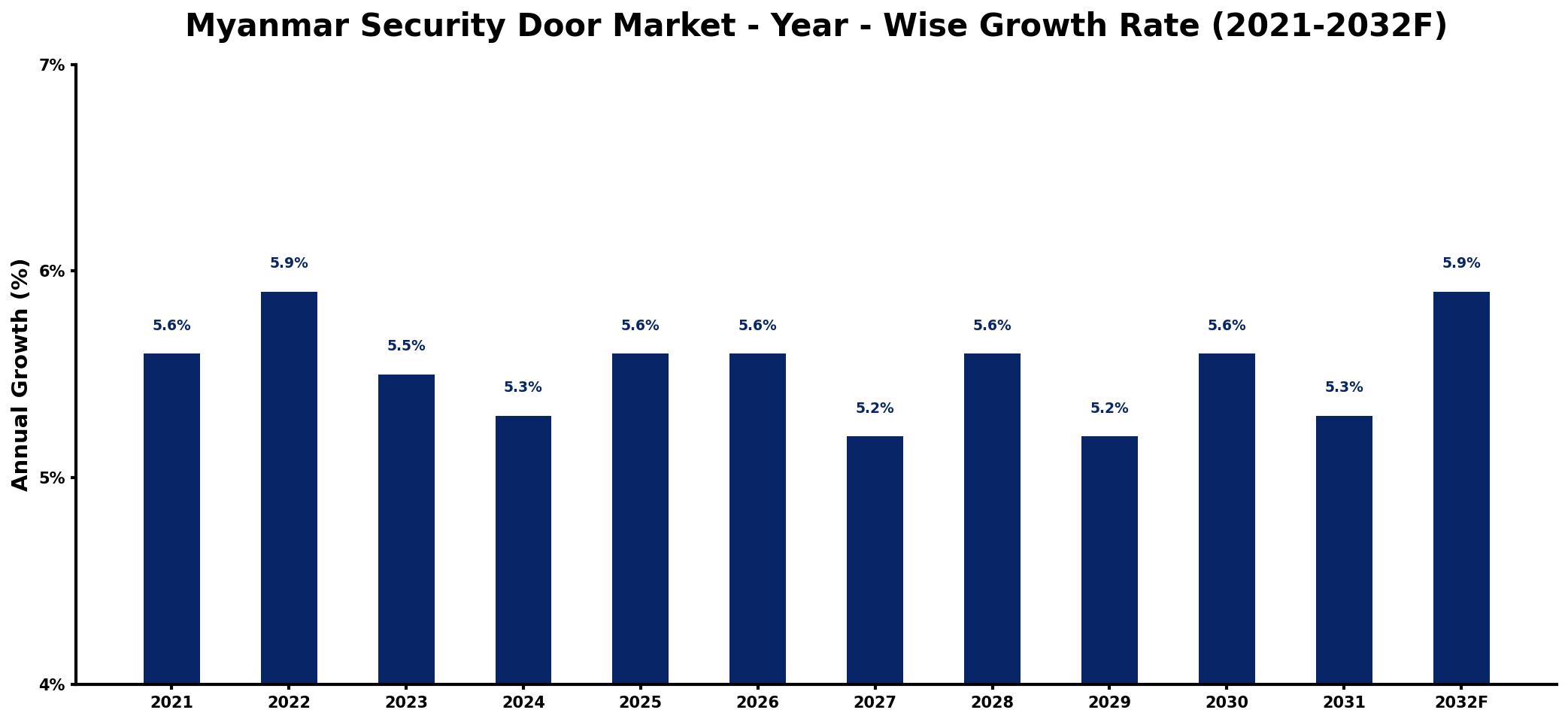
The table below presents the year‑wise growth rates along with the key drivers influencing the market
| Year | Growth Rate | Major Drivers |
| 2021 | 5.6% | Rising urban population growth |
| 2022 | 5.9% | Increased residential construction projects |
| 2023 | 5.5% | Growing focus on safety measures |
| 2024 | 5.3% | Expansion of commercial investments |
| 2025 | 5.6% | Surge in home renovation trends |
| 2026 | 5.6% | Higher disposable income levels |
| 2027 | 5.2% | Emergence of new construction technologies |
| 2028 | 5.6% | Enhanced consumer awareness initiatives |
| 2029 | 5.2% | Increased foreign direct investments |
| 2030 | 5.6% | Strengthened building regulations enforcement |
| 2031 | 5.3% | Growing demand for smart technologies |
| 2032 | 5.9% | Rise in eco-friendly construction practices |
Note: Market size estimations and growth projections presented in this report are based on 6Wresearch's proprietary forecasting methodology, utilizing the latest available industry data, government publications, and primary research inputs.
Myanmar Security Door Market Synopsis
In recent years, the Myanmar Security Door Market has seen a substantial uptick in demand, fueled by urban development and a shifting mindset toward personal and property security. As cities grow and commercial activities intensify, consumers are increasingly prioritizing robust security measures for their homes and businesses.
Steel security doors dominate the market due to their unmatched strength and resilience. However, a diverse product range—including wooden and aluminum options—caters to varying consumer preferences, enhancing overall market appeal. The rising trend of integrating technology into security solutions is further reshaping the landscape.
Myanmar Security Door Market Key Takeaways
- The market is driven by rising urbanization and increasing safety concerns among consumers.
- Steel doors lead in popularity due to their durability and resistance to break-ins.
- Technological advancements are shaping the demand for smart and multifunctional security doors.
- Investment opportunities abound in high-quality, customizable security door manufacturing.
- Government regulations support local manufacturing while ensuring safety and quality standards.
Evaluation of Restraints in Myanmar Security Door Market
While the Myanmar Security Door Market presents numerous growth opportunities, it faces notable restraints. One significant challenge is the presence of low-cost imported products, which can undermine local manufacturers. Additionally, varying manufacturing practices lead to quality inconsistencies, making it hard for consumers to recognize the value of higher-end products. Moreover, limited awareness of the advantages associated with investing in premium security doors poses an obstacle. These factors necessitate focused efforts to enhance product quality and consumer education to stimulate market growth.
Myanmar Security Door Market Trends
The security door landscape in Myanmar is evolving, with consumers now looking for doors that offer both aesthetic appeal and advanced security features. A notable trend is the integration of smart technologies such as biometric access systems and remote monitoring capabilities, catering to a tech-savvy demographic. Furthermore, durability against Myanmar's climate and the use of eco-friendly materials are becoming increasingly important, reflecting a broader global trend towards sustainability in building materials.
Myanmar Security Door Market Opportunities
The Myanmar Security Door Market offers numerous investment prospects, particularly in the manufacture of high-quality security doors equipped with advanced features. Collaboration with local builders and developers can create synergies, particularly for residential and commercial projects. Moreover, the growing demand for customizable solutions tailored to unique consumer preferences presents a significant opportunity for innovation. Technology-driven offerings, such as IoT-enabled doors for improved security management, are poised to attract both investors and consumers alike.
Government Initiatives in the Myanmar Security Door Market
The Myanmar government has instituted several policies aimed at bolstering safety and security through enhanced manufacturing standards for security doors. Regulatory frameworks require manufacturers to comply with specific safety and quality measures, which helps protect consumers. Additionally, initiatives that encourage local production through incentives are designed to boost domestic manufacturing capabilities, thus contributing to economic growth and enhancing the overall quality of security products available in the market.
Future Insights of the Myanmar Security Door Market
Looking ahead to 2026-2032, the Myanmar Security Door Market is poised for steady growth. Factors such as increasing urbanization and consumer inclination towards advanced security solutions will fuel demand. As crime rates continue to be a pressing concern, investments in both high-quality physical security and innovative technologies are expected to rise. Furthermore, the integration of smart technologies will shape future product developments, ensuring that security doors not only protect but also enhance the living and working environments of consumers.
Myanmar Security Door Market Latest Developments (2025 - 2026)
In the recent months, the Myanmar Security Door Market has seen a surge in the introduction of smart security doors featuring biometric systems and enhanced durability characteristics. The growing collaboration between manufacturers and construction firms has led to a variety of innovative solutions tailored to specific market needs. Additionally, there's been a noticeable increase in consumer awareness campaigns highlighting the benefits of investing in high-quality security doors.
Myanmar Security Door Market - Key Attractiveness of the Report
- 10 Years of Market Numbers
- Historical Data Starting from 2022 to 2025
- Base Year: 2025
- Forecast Data until 2032
- Key Performance Indicators Impacting the Market
- Major Upcoming Developments and Projects
Key Highlights of the Report:
- Myanmar Security Door Market Outlook
- Market Size of Myanmar Security Door Market, 2025
- Forecast of Myanmar Security Door Market, 2032
- Historical Data and Forecast of Myanmar Security Door Revenues & Volume for the Period 2022-2032F
- Myanmar Security Door Market Trend Evolution
- Myanmar Security Door Market Drivers and Challenges
- Myanmar Security Door Price Trends
- Myanmar Security Door Porter's Five Forces
- Myanmar Security Door Industry Life Cycle
- Historical Data and Forecast of Myanmar Security Door Market Revenues & Volume By Product Type for the Period 2022-2032F
- Historical Data and Forecast of Myanmar Security Door Market Revenues & Volume By Wood Security Door for the Period 2022-2032F
- Historical Data and Forecast of Myanmar Security Door Market Revenues & Volume By Metal Security Door for the Period 2022-2032F
- Historical Data and Forecast of Myanmar Security Door Market Revenues & Volume By Industry for the Period 2022-2032F
- Historical Data and Forecast of Myanmar Security Door Market Revenues & Volume By Individual Purchaser for the Period 2022-2032F
- Historical Data and Forecast of Myanmar Security Door Market Revenues & Volume By Corporate Buyers for the Period 2022-2032F
- Historical Data and Forecast of Myanmar Security Door Market Revenues & Volume By Channel for the Period 2022-2032F
- Historical Data and Forecast of Myanmar Security Door Market Revenues & Volume By Direct Sales for the Period 2022-2032F
- Historical Data and Forecast of Myanmar Security Door Market Revenues & Volume By Distributor for the Period 2022-2032F
- Myanmar Security Door Import Export Trade Statistics
- Market Opportunity Assessment By Product Type
- Market Opportunity Assessment By Industry
- Market Opportunity Assessment By Channel
- Myanmar Security Door Top Companies Market Share
- Myanmar Security Door Competitive Benchmarking By Technical and Operational Parameters
- Myanmar Security Door Company Profiles
- Myanmar Security Door Key Strategic Recommendations






































