Nepal Artificial Intelligence in Retail Market Size & Growth Rate (2026-2032)
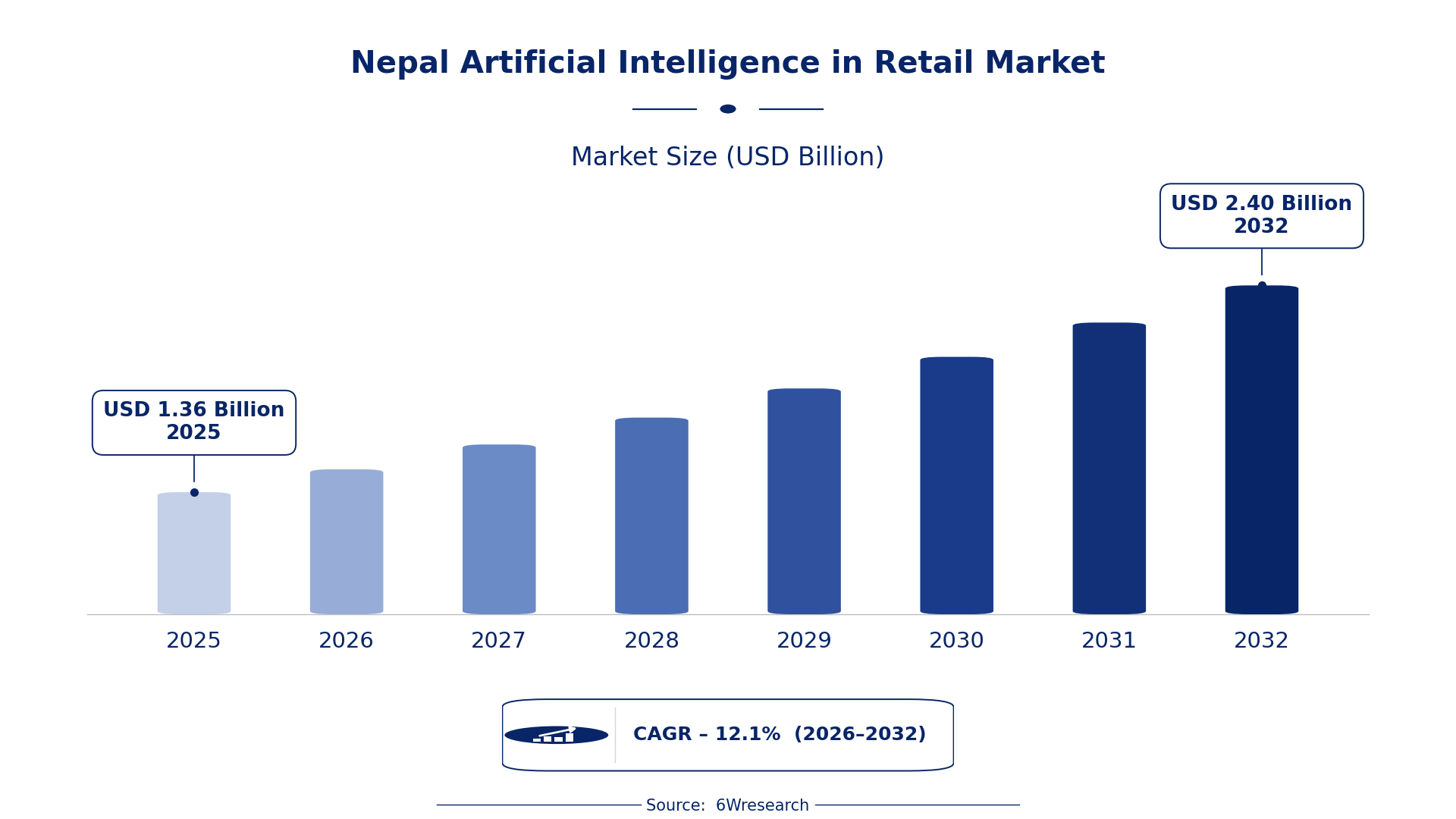
The Nepal Artificial Intelligence in Retail Market was estimated at USD 1365 Million in 2025 and is projected to reach USD 2405 Million by 2032, growing at a CAGR of 12.1% from 2026 to 2032.
Nepal Artificial Intelligence in Retail Market Synopsis
Recent momentum in the Nepal Artificial Intelligence in Retail market indicates a strong shift towards the integration of AI technologies among retailers. This trend is driven by the need to enhance customer experiences and streamline operations. As retailers increasingly embrace AI for personalized marketing and inventory management, the market is set to expand significantly.
Looking ahead, the potential for growth remains robust, particularly as e-commerce continues to gain traction in Nepal. The tech-savvy consumer base is eager for innovative shopping solutions, positioning AI as a crucial element for retailers aiming to remain competitive in a rapidly changing environment.
Nepal Artificial Intelligence in Retail Market Year-wise Growth Rate and Key Drivers
This graph illustrates the annual growth rates of the Nepal Artificial Intelligence in Retail Market from 2021 to 2032, highlighting a steady upward trajectory and projected expansion over the forecast period.
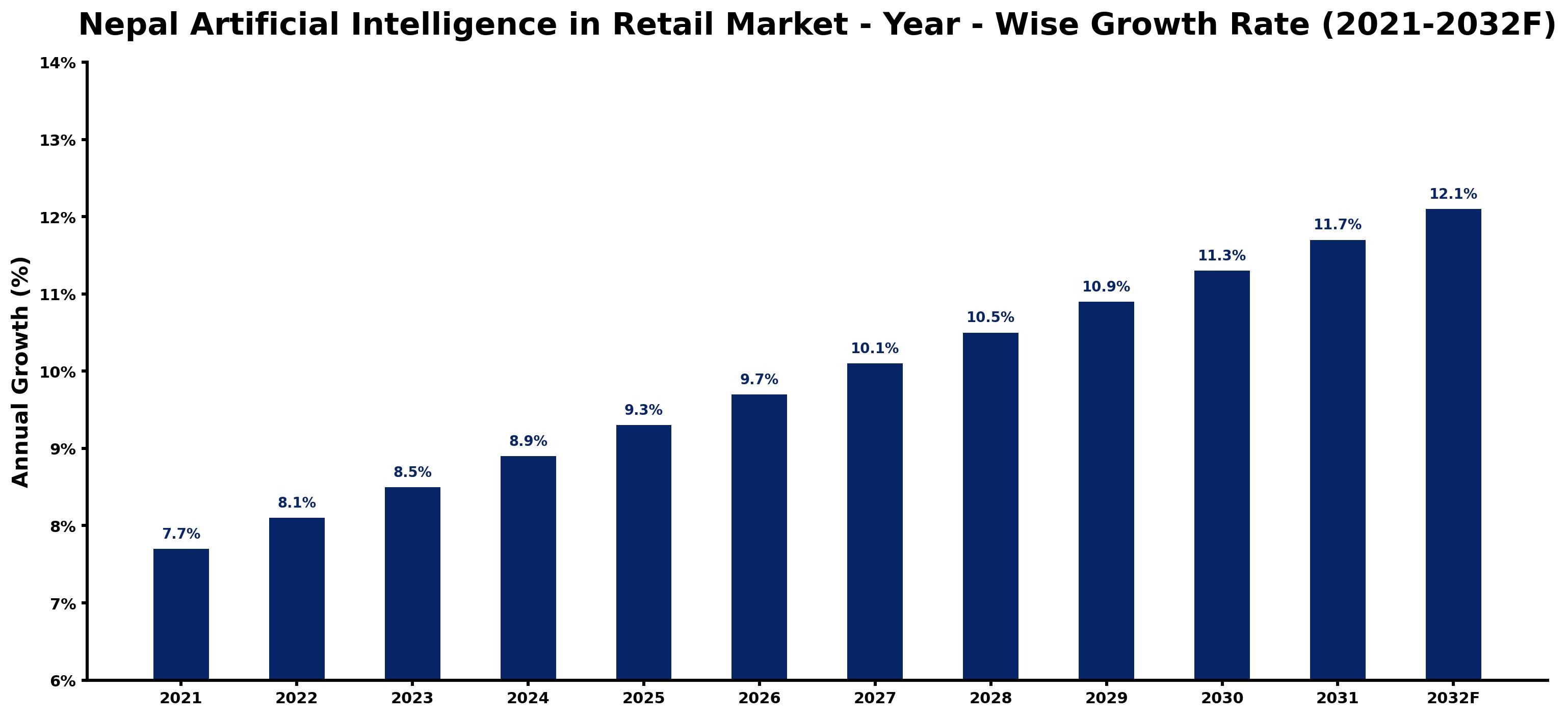
The table below presents the year‑wise growth rates along with the key drivers influencing the market
| Year | Growth Rate | Major Drivers |
| 2021 | 7.7% | E-commerce growth spurred by youth mobile penetration. |
| 2022 | 8.1% | Increased investment in AI-driven customer analytics tools. |
| 2023 | 8.5% | Rising consumer preference for tech-savvy retail solutions. |
| 2024 | 8.9% | Local startups leveraging AI for enhanced inventory management. |
| 2025 | 9.3% | Government support for tech startups in Kathmandu. |
| 2026 | 9.7% | Growing online payment adoption driving retail AI integrations. |
| 2027 | 10.1% | Emergence of AI solutions for local supply chain optimization. |
| 2028 | 10.5% | Increased smartphone usage enhancing digital shopping platforms. |
| 2029 | 10.9% | Shift towards contactless shopping experiences post-pandemic. |
| 2030 | 11.3% | Demand for AI-enhanced loyalty programs among retailers. |
| 2031 | 11.7% | Development of AI-powered chatbots for local customer service. |
| 2032 | 12.1% | Rising interest in smart retail technologies among consumers. |
Note: Market size estimations and growth projections presented in this report are based on 6Wresearch's proprietary forecasting methodology, utilizing the latest available industry data, government publications, and primary research inputs.
Nepal Artificial Intelligence in Retail Market Key Takeaways
Below are some of the specific key takeaways from the market, including:
- AI technologies are being widely adopted for personalized customer experiences and inventory management.
- The growing e-commerce sector is driving demand for AI-powered tools in Nepal.
- Challenges such as data privacy concerns and a shortage of skilled professionals need addressing.
- Investment opportunities exist for vendors developing tailored AI solutions for local retailers.
- Government initiatives are gradually fostering a more supportive environment for tech adoption.
Evaluation of Restraints in Nepal Artificial Intelligence in Retail Market
The growth of the Nepal Artificial Intelligence in Retail market faces several real constraints. A lack of awareness about AI technologies among retailers hampers broader adoption. High implementation costs further complicate matters, deterring many businesses from investing in AI solutions. on top of that, the shortage of skilled professionals in AI and data analytics limits the capabilities of retailers seeking to enhance their operations. Addressing these barriers will be crucial for the market's advancement.
Nepal Artificial Intelligence in Retail Market Trends
Several key trends are shaping the Nepal Artificial Intelligence in Retail market. Retailers are increasingly utilizing AI-powered solutions, such as chatbots and recommendation engines, to provide personalized services. The integration of AI into supply chain operations is becoming more common, helping to streamline processes and reduce costs. Demand forecasting is also gaining traction, as retailers seek to make data-driven decisions to stay competitive in the market.
Nepal Artificial Intelligence in Retail Market Opportunities
The Nepal Artificial Intelligence in Retail market is ripe with genuine growth and investment opportunities. As retailers recognize the benefits of AI technologies in enhancing customer experiences and operational efficiency, there is a growing demand for tailored solutions. Companies investing in AI for customer service, inventory management, and consumer behavior analytics can gain a significant competitive edge. The ongoing expansion of e-commerce platforms adds further potential for innovative AI applications.
Government Initiatives in the Nepal Artificial Intelligence in Retail Market
The government of Nepal is gradually creating a supportive environment for technology development, which includes the AI sector. While specific policies focused solely on AI in retail are still in their infancy, initiatives aimed at promoting digital innovation are underway. These efforts are crucial for nurturing a landscape where AI can flourish in retail, ensuring that businesses can take advantage of new technologies.
- A national digital literacy program launched in early 2025 aims to enhance understanding of AI technologies among retailers.
- Current initiatives involve collaborations between tech startups and established retailers to pilot AI solutions for customer engagement.
- Ongoing support programs encourage investment in technology, providing grants for AI research and development.
- A planned framework expected to roll out by late 2026 will address data privacy concerns related to AI in retail.
Future Insights of the Nepal Artificial Intelligence in Retail Market
As we look towards 2026-2032, the Nepal Artificial Intelligence in Retail market is expected to undergo significant transformation. With an increasing number of retailers recognizing the value of AI applications, we anticipate enhanced customer experiences and optimized operational processes. As technology advances and awareness grows, AI-powered solutions will play an essential role in driving competitiveness within the retail sector.
Nepal Artificial Intelligence in Retail Market Latest Developments
Recent developments in the Nepal Artificial Intelligence in Retail market indicate a dynamic shift towards integrating innovative technologies. Over the past 12 months, several initiatives have emerged that showcase the increasing interest in AI applications among retailers.
- A major technology vendor launched an AI-driven inventory management system in Q2 2025, aimed at reducing operational costs for retailers.
- In early 2025, a partnership between a regional retailer and an AI startup was established to develop personalized shopping experiences through enhanced data analytics.
- An ongoing initiative initiated in mid-2025 focuses on deploying AI chatbots for customer service across various retail platforms.
- A rollout of AI-based demand forecasting tools is expected to begin in the second half of 2026, enhancing decision-making capabilities for retailers.
Nepal Artificial Intelligence in Retail Market - Key Attractiveness of the Report
- 10 Years of Market Numbers
- Historical Data Starting from 2022 to 2025
- Base Year: 2025
- Forecast Data until 2032
- Key Performance Indicators Impacting the Market
- Major Upcoming Developments and Projects
Key Highlights of the Report:
- Nepal Artificial Intelligence in Retail Market Outlook
- Market Size of Nepal Artificial Intelligence in Retail Market, 2025
- Forecast of Nepal Artificial Intelligence in Retail Market, 2032
- Historical Data and Forecast of Nepal Artificial Intelligence in Retail Revenues & Volume for the Period 2022-2032F
- Nepal Artificial Intelligence in Retail Market Trend Evolution
- Nepal Artificial Intelligence in Retail Market Drivers and Challenges
- Nepal Artificial Intelligence in Retail Price Trends
- Nepal Artificial Intelligence in Retail Porter's Five Forces
- Nepal Artificial Intelligence in Retail Industry Life Cycle
- Historical Data and Forecast of Nepal Artificial Intelligence in Retail Market Revenues & Volume By Type for the Period 2022-2032F
- Historical Data and Forecast of Nepal Artificial Intelligence in Retail Market Revenues & Volume By Online for the Period 2022-2032F
- Historical Data and Forecast of Nepal Artificial Intelligence in Retail Market Revenues & Volume By Offline for the Period 2022-2032F
- Historical Data and Forecast of Nepal Artificial Intelligence in Retail Market Revenues & Volume By Service for the Period 2022-2032F
- Historical Data and Forecast of Nepal Artificial Intelligence in Retail Market Revenues & Volume By Professional for the Period 2022-2032F
- Historical Data and Forecast of Nepal Artificial Intelligence in Retail Market Revenues & Volume By Managed for the Period 2022-2032F
- Historical Data and Forecast of Nepal Artificial Intelligence in Retail Market Revenues & Volume By Technology for the Period 2022-2032F
- Historical Data and Forecast of Nepal Artificial Intelligence in Retail Market Revenues & Volume By Machine Learning for the Period 2022-2032F
- Historical Data and Forecast of Nepal Artificial Intelligence in Retail Market Revenues & Volume By Deep Learning for the Period 2022-2032F
- Historical Data and Forecast of Nepal Artificial Intelligence in Retail Market Revenues & Volume By NLP for the Period 2022-2032F
- Nepal Artificial Intelligence in Retail Import Export Trade Statistics
- Market Opportunity Assessment By Type
- Market Opportunity Assessment By Service
- Market Opportunity Assessment By Technology
- Nepal Artificial Intelligence in Retail Top Companies Market Share
- Nepal Artificial Intelligence in Retail Competitive Benchmarking By Technical and Operational Parameters
- Nepal Artificial Intelligence in Retail Company Profiles
- Nepal Artificial Intelligence in Retail Key Strategic Recommendations






































