Cosmetic Products Market: Nepal vs Top 5 Major Economies in 2027 (Asia)
By 2027, the Cosmetic Products market in Nepal is anticipated to reach a growth rate of 7.63%, as part of an increasingly competitive Asia region, where China remains at the forefront, supported by India, Japan, Australia and South Korea, driving innovations and market adoption across sectors.
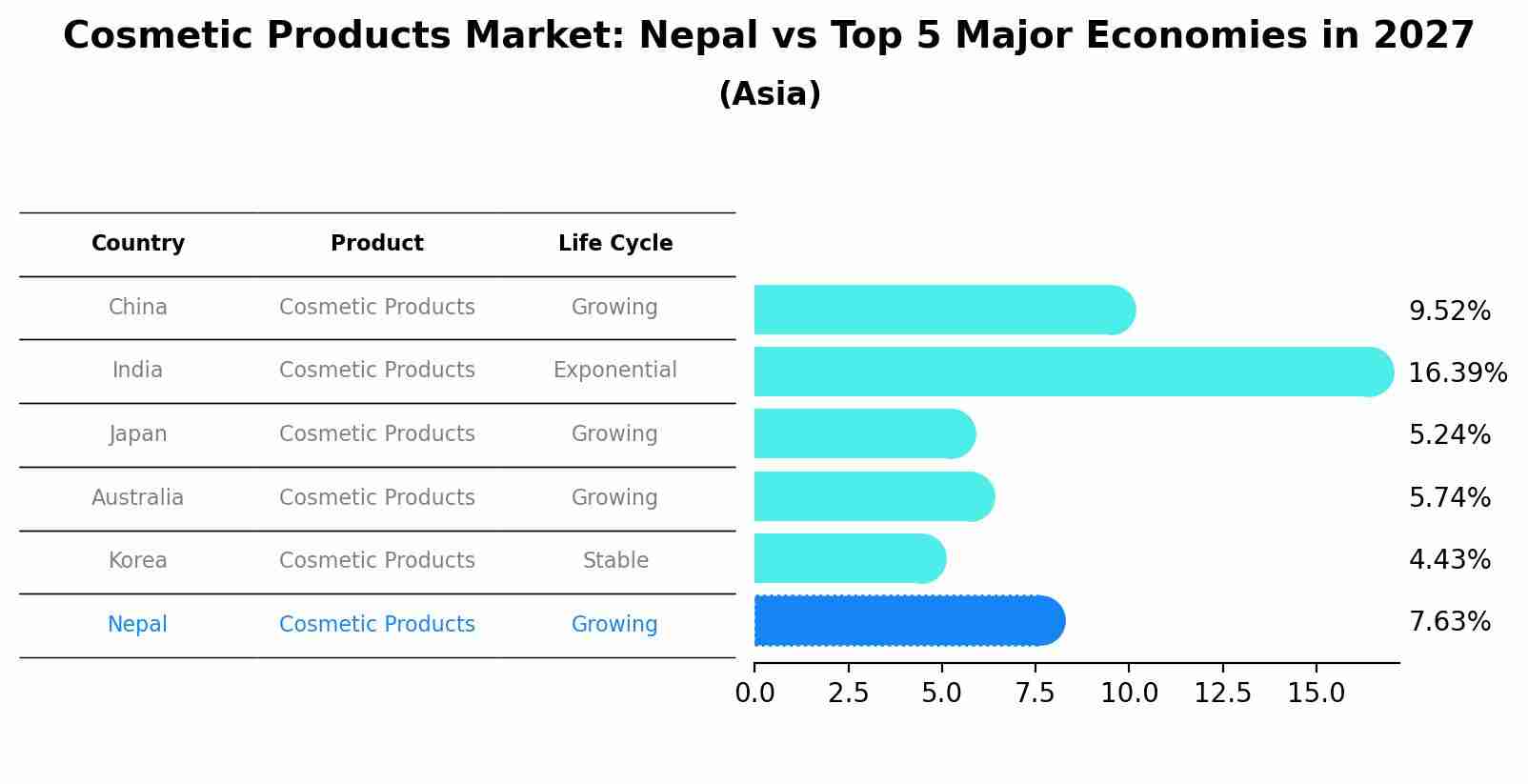
Nepal Cosmetic Products Market Growth Rate
According to 6Wresearch internal database and industry insights, the Nepal Cosmetic Products Market is expected to grow at a compound annual growth rate (CAGR) of 8% during the forecast period (2026-2032).
Topics Covered in the Nepal Cosmetic Products Market Report
The Nepal Cosmetic Products Market report thoroughly covers the market by type and distribution channel. The market report provides an unbiased and detailed analysis of ongoing market trends, opportunities/high growth areas, and market drivers, which help stakeholders devise and align their market strategies according to the current and future market dynamics.
Nepal Cosmetic Products Market Highlights
| Report Name | Nepal Cosmetic Products Market |
| Forecast Period | 2026–2032 |
| CAGR | 8% |
| Growing Sector |
Online Retailing |
Nepal Cosmetic Products Market Synopsis
Nepal Cosmetic Products Market is anticipated to experience steady expansion, backed by rising consumer awareness about personal grooming, increasing disposable income among urban populations, and the growing influence of beauty trends promoted through digital platforms and social media.
Furthermore, the increasing availability of both domestic and international cosmetic brands through organized retail channels and online marketplaces has broadened consumer access to skincare, haircare, and beauty products, which is gradually strengthening the cosmetic industry landscape across the country.
Evaluation of Growth Drivers in Nepal Cosmetic Products Market
Below mentioned are some prominent drivers and their influence on the market dynamics:
| Drivers | Primary Segments Affected | Why it Matters (Evidence) |
| Growing Urban Consumer Spending | Skin Care Products, Color Cosmetics | Increasing disposable income encourages consumers to invest in premium beauty products. |
| Expansion of Organized Retail | All Types, Supermarkets & Specialty Stores | Modern retail outlets improve product accessibility and brand visibility. |
| Rising Social Media Influence | Color Cosmetics, Skin Care | The popularity of beauty products through social media influencers increases the demand for these products, especially among the youth. |
| Increasing Product Availability | Hair Care Products, Personal Hygiene | The import of international brands increases the number of products in the market. |
| Growth of Online Retail Platforms | All Types, Internet Retailing | E-commerce platforms simplify access to cosmetic products across urban and semi-urban areas. |
Nepal Cosmetic Products Market is expected to grow at the CAGR of 8% during the forecast period of 2026-2032. Growth is supported by rising awareness about skincare and grooming, growing consumer purchasing power, and wider availability of cosmetic brands through modern retail and digital channels. Additionally, increasing influence of beauty influencers and lifestyle trends across social media platforms is encouraging younger consumers to experiment with personal care products, further strengthening the Nepal cosmetic industry outlook.
Evaluation of Restraints in Nepal Cosmetic Products Market
Below mentioned are some major restraints and their influence on the market dynamics:
| Restraints | Primary Segments Affected | What This Means (Evidence) |
| High Import Dependency | Skin Care Products, Color Cosmetics | Heavy reliance on imported cosmetics raises prices and limits affordability. |
| Limited Regulatory Monitoring | All Types, Others | Inconsistent quality standards may affect consumer trust in some cosmetic products. |
| Distribution Barriers in Rural Areas | Hair Care, Personal Hygiene | Logistics limitations reduce product availability outside urban centers. |
| Price Sensitivity Among Consumers | All Types, Supermarkets & Others | Consumers are more inclined to use affordable products instead of premium products. |
| Counterfeit Cosmetic Products | Color Cosmetics, Specialty Stores | Products entering the market might affect the reputation of the company. |
Nepal Cosmetic Products Market Challenges
Despite the consequences of ongoing expansion, the Nepal Cosmetic Products Market growth encounters multiple structural challenges such as strong dependency on imported cosmetic brands, limited domestic manufacturing capabilities, and distribution barriers across rural regions of the country.
Furthermore, price sensitivity among consumers, concerns regarding counterfeit beauty products, and inconsistent regulatory monitoring of cosmetic quality can reduce consumer confidence and slow market expansion, which collectively create operational complexities for both domestic suppliers and international cosmetic brands operating in Nepal.
Nepal Cosmetic Products Market Trends
A key trend in the Nepal cosmetic products industry is the increasing demand for herbal, organic, and cruelty-free products. Social media promotion and e-commerce sites drive sales, and customized beauty products and luxury products are becoming increasingly popular.
Furthermore, the demand for anti-aging and men's grooming products is changing traditional cosmetic product offerings, thus increasing market reach in various consumer segments.
Investment Opportunities in the Nepal Cosmetic Products Market
There are considerable investment opportunities in the Nepal cosmetic product market, and some of them include premium skincare products, herbal and organic cosmetic products, men's grooming products, and e-commerce sites. Partnerships with global players, leveraging the botanical resources of Nepal, and penetrating tier-2 and tier-3 cities are strategic opportunities.
Expanding export capabilities and domestic production, launching advanced product lines, and integrating digital marketing approaches can increase Nepal cosmetic product market revenue. In addition, rising consciousness about hygiene and personal care among rural consumers provide unleveraged market potential for stakeholders.
Top 5 Leading Players in the Nepal Cosmetic Products Market
Key companies contributing to the Nepal Cosmetic Products Market share include:
1. L'Oréal S.A.
| Company Name | L'Oréal S.A. |
|---|---|
| Established Year | 1909 |
| Headquarters | Clichy, France |
| Official Website | Click Here |
L'Oréal manufactures skincare, haircare, and cosmetic products that are widely distributed through retail stores and beauty outlets worldwide, and its diverse product portfolio supports growing consumer demand for premium beauty and personal care products in developing cosmetic markets.
2. Unilever PLC
| Company Name | Unilever PLC |
|---|---|
| Established Year | 1929 |
| Headquarters | London, United Kingdom |
| Official Website | Click Here |
Unilever supplies a wide range of personal care and cosmetic products including skincare, deodorants, and hygiene items, and its strong brand portfolio and retail distribution network contribute significantly to expanding cosmetic product accessibility in emerging consumer markets.
3. Procter & Gamble Co.
| Company Name | Procter & Gamble Co. |
|---|---|
| Established Year | 1837 |
| Headquarters | Ohio, United States |
| Official Website | Click Here |
Procter & Gamble offers several globally recognized beauty and personal care brands including skincare and haircare products, and its innovation-driven product development and strong marketing strategies strengthen its presence in personal care markets across developing economies.
4. Shiseido Company Limited
| Company Name | Shiseido Company Limited |
|---|---|
| Established Year | 1872 |
| Headquarters | Tokyo, Japan |
| Official Website | Click Here |
Shiseido develops premium skincare and cosmetic products and is known for its research-driven beauty solutions, which combine advanced cosmetic science with high-quality ingredients to address evolving consumer beauty preferences across international markets.
5. Beiersdorf AG
| Company Name | Beiersdorf AG |
|---|---|
| Established Year | 1882 |
| Headquarters | Hamburg, Germany |
| Official Website | Click Here |
Beiersdorf manufactures skincare and personal care products including globally recognized brands that focus on skin health and dermatological care, supporting increasing consumer demand for effective and trusted cosmetic products in emerging beauty markets.
Government Regulations Introduced in the Nepal Cosmetic Products Market
According to Nepalese Government Data, The Nepal Cosmetic Products Market is shaped by rules from the Department of Drug Administration and the Cosmetic Product Regulation framework launched in 2017this helps control how cosmetics are imported, registered, and meet quality standards. This framework also sets standards for product safety and ensures only approved items enter the market.
The Ministry of Health and Population run public education efforts to promote safe cosmetic use, while improving checks on imported beauty products. In addition, the Ministry of Health and Population has implemented awareness initiatives related to safe cosmetic usage while strengthening inspection procedures for imported beauty products to ensure consumer safety and product authenticity.
Future Insights of the Nepal Cosmetic Products Market
In the years to come, the Nepal Cosmetic Products Market is expected to show a promising growth outlook due to the increasing consumer base within urban areas, awareness about skincare routines, and availability of beauty products through organized retail as well as online sales. Besides, the rising popularity of natural beauty products, expansion of specialty cosmetic stores, and continuous growth in digital marketing and influencer-driven brand promotion are expected to further proliferate Nepal Cosmetic Products Market growth in the coming years.
Market Segmentation Analysis
The report offers a comprehensive study of the subsequent market segments and their leading categories:
Skin Care Products to Dominate the Market– By Type
According to Saurabh, Senior Research Analyst, 6Wresearch, Skin Care Products are expected to hold the leading position in the Nepal Cosmetic Products Market owing to increasing consumer awareness regarding skincare routines and the growing demand for moisturizers, cleansers, and sun protection products.
Consumers across urban regions are increasingly prioritizing skin health and preventive skincare solutions, which has driven strong demand for creams, serums, and facial care products, thereby strengthening the dominance of skincare products in the cosmetic product segment across Nepal.
Specialty Stores to Dominate the Market– By Distribution Channel
Specialty Stores segment is expected to have a significant share in the Nepal Cosmetic Products Market during the forecast period due to their capacity to provide customers with a variety of branded cosmetic products and personalized beauty advice.
These stores also allow consumers to physically examine products before purchasing, which builds consumer trust and encourages higher spending on premium cosmetic brands in urban shopping areas.
Key Attractiveness of the Report
- 10 Years of Market Numbers.
- Historical Data Starting from 2022 to 2025.
- Base Year: 2025.
- Forecast Data until 2032.
- Key Performance Indicators Impacting the Market.
- Major Upcoming Developments and Projects.
Key Highlights of the Report:
- Nepal Cosmetic Products Market Outlook
- Market Size of Nepal Cosmetic Products Market, 2025
- Forecast of Nepal Cosmetic Products Market, 2032
- Historical Data and Forecast of Nepal Cosmetic Products Revenues & Volume for the Period 2022-2032
- Nepal Cosmetic Products Market Trend Evolution
- Nepal Cosmetic Products Market Drivers and Challenges
- Nepal Cosmetic Products Price Trends
- Nepal Cosmetic Products Porter's Five Forces
- Nepal Cosmetic Products Industry Life Cycle
- Historical Data and Forecast of Nepal Cosmetic Products Market Revenues & Volume By Type for the Period 2022-2032
- Historical Data and Forecast of Nepal Cosmetic Products Market Revenues & Volume By Skin Care Products for the Period 2022-2032
- Historical Data and Forecast of Nepal Cosmetic Products Market Revenues & Volume By Color Cosmetics for the Period 2022-2032
- Historical Data and Forecast of Nepal Cosmetic Products Market Revenues & Volume By Hair Care Products for the Period 2022-2032
- Historical Data and Forecast of Nepal Cosmetic Products Market Revenues & Volume By Fragrance And Deodorants for the Period 2022-2032
- Historical Data and Forecast of Nepal Cosmetic Products Market Revenues & Volume By Sun Care Products for the Period 2022-2032
- Historical Data and Forecast of Nepal Cosmetic Products Market Revenues & Volume By Soaps, Bath, & Shower Products for the Period 2022-2032
- Historical Data and Forecast of Nepal Cosmetic Products Market Revenues & Volume By Oral Hygiene Products for the Period 2022-2032
- Historical Data and Forecast of Nepal Skin Care Products Cosmetic Products Market Revenues & Volume By Personal Hygiene Products for the Period 2022-2032
- Historical Data and Forecast of Nepal Cosmetic Products Market Revenues & Volume By Distribution Channel for the Period 2022-2032
- Historical Data and Forecast of Nepal Cosmetic Products Market Revenues & Volume By Supermarkets for the Period 2022-2032
- Historical Data and Forecast of Nepal Cosmetic Products Market Revenues & Volume By Pharmacy & Drug Stores for the Period 2022-2032
- Historical Data and Forecast of Nepal Cosmetic Products Market Revenues & Volume By Department Stores for the Period 2022-2032
- Historical Data and Forecast of Nepal Cosmetic Products Market Revenues & Volume By Direct Selling for the Period 2022-2032
- Historical Data and Forecast of Nepal Cosmetic Products Market Revenues & Volume By Specialty Stores for the Period 2022-2032
- Historical Data and Forecast of Nepal Cosmetic Products Market Revenues & Volume By Beauty Salons for the Period 2022-2032
- Historical Data and Forecast of Nepal Cosmetic Products Market Revenues & Volume By Internet Retailing for the Period 2022-2032
- Historical Data and Forecast of Nepal Cosmetic Products Market Revenues & Volume By Others for the Period 2022-2032
- Nepal Cosmetic Products Import Export Trade Statistics
- Market Opportunity Assessment By Type
- Market Opportunity Assessment By Distribution Channel
- Nepal Cosmetic Products Top Companies Market Share
- Nepal Cosmetic Products Competitive Benchmarking By Technical and Operational Parameters
- Nepal Cosmetic Products Company Profiles
- Nepal Cosmetic Products Key Strategic Recommendations
Market Covered
The report provides a detailed analysis of the following market segments:
By Type
- Skin Care Products
- Color Cosmetics
- Hair Care Products
- Fragrance And Deodorants
- Sun Care Products
- Soaps, Bath, & Shower Products
- Oral Hygiene Products
- Personal Hygiene Products
By Distribution Channel
- Supermarkets
- Pharmacy & Drug Stores
- Department Stores
- Direct Selling
- Specialty Stores
- Beauty Salons
- Internet Retailing
- Others






































