Nepal Octopus Market Size Growth Rate
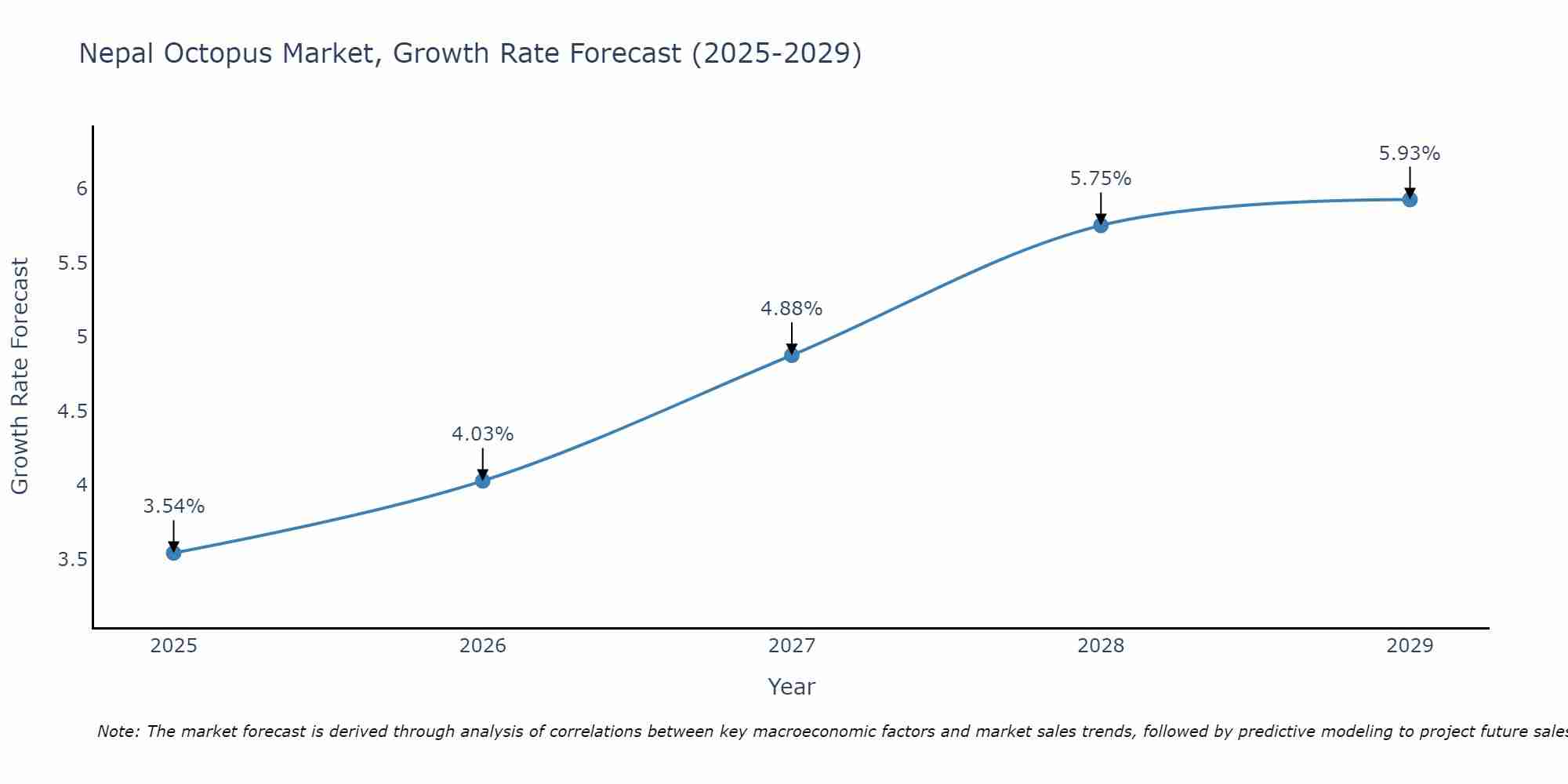
The Nepal Octopus Market is likely to experience consistent growth rate gains over the period 2025 to 2029. Commencing at 3.54% in 2025, growth builds up to 5.93% by 2029.
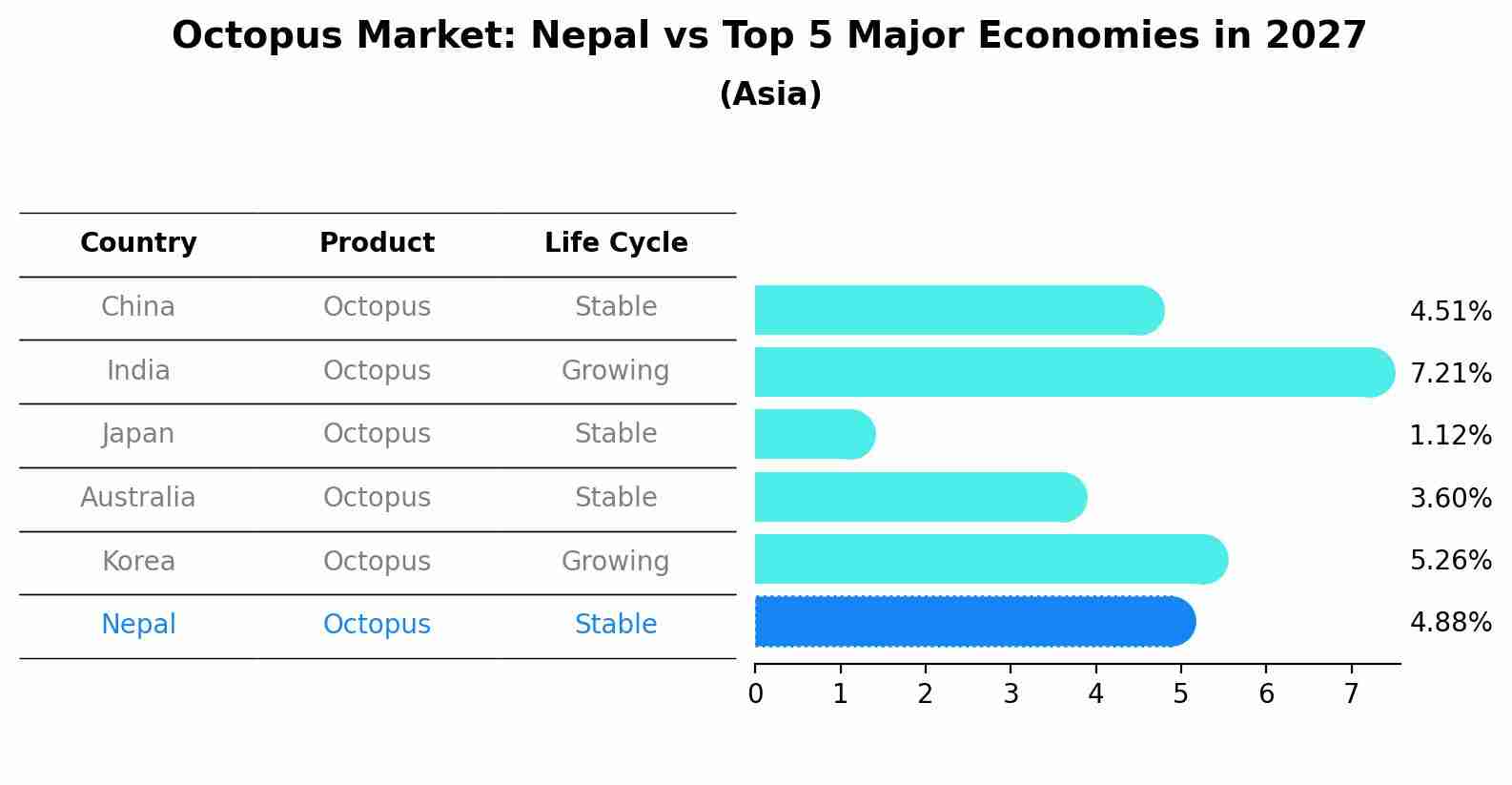
Octopus Market: Nepal vs Top 5 Major Economies in 2027 (Asia)
By 2027, Nepal's Octopus market is forecasted to achieve a stable growth rate of 4.88%, with China leading the Asia region, followed by India, Japan, Australia and South Korea.
Nepal Octopus Market Synopsis
The Nepal Octopus Market is a burgeoning sector within the country`s seafood industry, driven by increasing consumer demand for exotic and high-quality marine products. While octopus is not traditionally a staple in Nepali cuisine, its popularity is on the rise due to influences from global culinary trends and a growing interest in diverse seafood options. The market is primarily supplied by imports from countries like Japan and South Korea, as local octopus fishing is limited. However, there is potential for domestic aquaculture development to meet the rising demand. Key players in the Nepal Octopus Market include seafood importers, wholesalers, and restaurants catering to adventurous diners seeking new and unique dining experiences. As the market continues to grow, there are opportunities for market expansion, product innovation, and sustainable sourcing practices to meet consumer preferences and regulatory standards.
Nepal Octopus Market Trends
The Nepal octopus market is experiencing a growing demand for sustainable and ethically sourced seafood products. Consumers are becoming more conscious of the environmental impact of their food choices, leading to an increased interest in responsibly harvested octopus. Additionally, there is a rising trend of incorporating octopus in creative and fusion dishes in restaurants and home cooking. The market is also seeing a higher demand for convenience seafood products, such as pre-cooked or frozen octopus, to cater to the busy lifestyles of consumers. With a focus on quality, sustainability, and culinary innovation, the Nepal octopus market is evolving to meet the changing preferences and demands of consumers.
Nepal Octopus Market Challenges
In the Nepal Octopus Market, one of the main challenges faced is the limited supply of octopus due to overfishing and environmental factors. This results in fluctuating prices and inconsistent availability, making it difficult for businesses to maintain a stable supply chain. Additionally, the lack of proper infrastructure for storage and transportation further complicates the distribution process, leading to potential quality issues and product spoilage. The market also faces challenges related to regulations and compliance, as the octopus fishing industry may not be well-regulated, impacting sustainability and traceability efforts. Overall, addressing these challenges will require collaboration among stakeholders, including fishermen, suppliers, and government authorities, to ensure a sustainable and thriving octopus market in Nepal.
Nepal Octopus Market Investment Opportunities
The Nepal Octopus Market presents various investment opportunities for both domestic and international investors. With the growing popularity of octopus as a delicacy in the region, there is potential for investment in aquaculture farms specializing in octopus farming to meet the increasing demand. Additionally, investing in processing facilities for cleaning, packaging, and distributing octopus products can be lucrative. Furthermore, there is room for investment in marketing and promoting Nepali octopus products to target new markets and increase export potential. Collaborating with local fishermen and communities to sustainably source octopus can also create opportunities for ethical and environmentally conscious investment in this burgeoning market. Overall, the Nepal Octopus Market offers diverse avenues for investment with the potential for growth and profitability.
Jordan Agar Market Government Policies
The Nepal government has implemented various policies related to the octopus market to ensure sustainable fishing practices and conservation of marine resources. These policies include setting catch limits and quotas for octopus fishing, establishing designated marine protected areas to safeguard octopus habitats, promoting sustainable fishing techniques such as selective fishing gear, and enforcing strict regulations to combat illegal fishing activities. Additionally, the government has implemented measures to monitor and regulate the octopus market supply chain to prevent overexploitation and ensure fair trade practices. Overall, these policies aim to preserve the octopus population, protect marine ecosystems, and support the long-term viability of the Nepal octopus market.
Nepal Octopus Market Future Outlook
The future outlook for the Nepal Octopus Market appears promising with potential growth opportunities. Increasing consumer interest in exotic and diverse seafood options, coupled with a growing trend of culinary exploration, is expected to drive demand for octopus in the region. Additionally, the rising popularity of Asian cuisine and the influx of tourists seeking unique dining experiences could further boost the market. However, challenges such as sourcing sustainable and high-quality octopus supplies, distribution logistics, and price volatility may impact market growth. To capitalize on the growing demand, stakeholders in the Nepal Octopus Market should focus on enhancing supply chain efficiency, promoting sustainable fishing practices, and exploring innovative marketing strategies to differentiate their offerings and capture a larger market share.
Key Highlights of the Report:
- Nepal Octopus Market Outlook
- Market Size of Nepal Octopus Market, 2024
- Forecast of Nepal Octopus Market, 2031
- Historical Data and Forecast of Nepal Octopus Revenues & Volume for the Period 2021 - 2031
- Nepal Octopus Market Trend Evolution
- Nepal Octopus Market Drivers and Challenges
- Nepal Octopus Price Trends
- Nepal Octopus Porter's Five Forces
- Nepal Octopus Industry Life Cycle
- Historical Data and Forecast of Nepal Octopus Market Revenues & Volume By Product Type for the Period 2021 - 2031
- Historical Data and Forecast of Nepal Octopus Market Revenues & Volume By Fresh for the Period 2021 - 2031
- Historical Data and Forecast of Nepal Octopus Market Revenues & Volume By Processed for the Period 2021 - 2031
- Historical Data and Forecast of Nepal Octopus Market Revenues & Volume By Application for the Period 2021 - 2031
- Historical Data and Forecast of Nepal Octopus Market Revenues & Volume By Commercial for the Period 2021 - 2031
- Historical Data and Forecast of Nepal Octopus Market Revenues & Volume By Food and Beverage for the Period 2021 - 2031
- Historical Data and Forecast of Nepal Octopus Market Revenues & Volume By Distribution Channel for the Period 2021 - 2031
- Historical Data and Forecast of Nepal Octopus Market Revenues & Volume By Direct for the Period 2021 - 2031
- Historical Data and Forecast of Nepal Octopus Market Revenues & Volume By Indirect for the Period 2021 - 2031
- Nepal Octopus Import Export Trade Statistics
- Market Opportunity Assessment By Product Type
- Market Opportunity Assessment By Application
- Market Opportunity Assessment By Distribution Channel
- Nepal Octopus Top Companies Market Share
- Nepal Octopus Competitive Benchmarking By Technical and Operational Parameters
- Nepal Octopus Company Profiles
- Nepal Octopus Key Strategic Recommendations






































