Nepal Oil & Gas Pumps Market Size, Share & Growth Rate
The Nepal Oil & Gas Pumps Market was estimated at USD 370 Million in 2025 and is projected to reach USD 509 Million by 2032, growing at a CAGR of 4.7% from 2026 to 2032. This growth is fueled by an increasing demand for petroleum products, driven in part by industrialization and urbanization trends across the country. As the government invests in oil and gas infrastructure, the need for efficient and reliable pumping solutions continues to intensify, further propelling market expansion.
Nepal Oil & Gas Pumps Market Year-wise Growth Rate and Key Drivers
This graph highlights how the Nepal Oil & Gas Pumps Market has steadily grown over the years, supported by major growth factors.
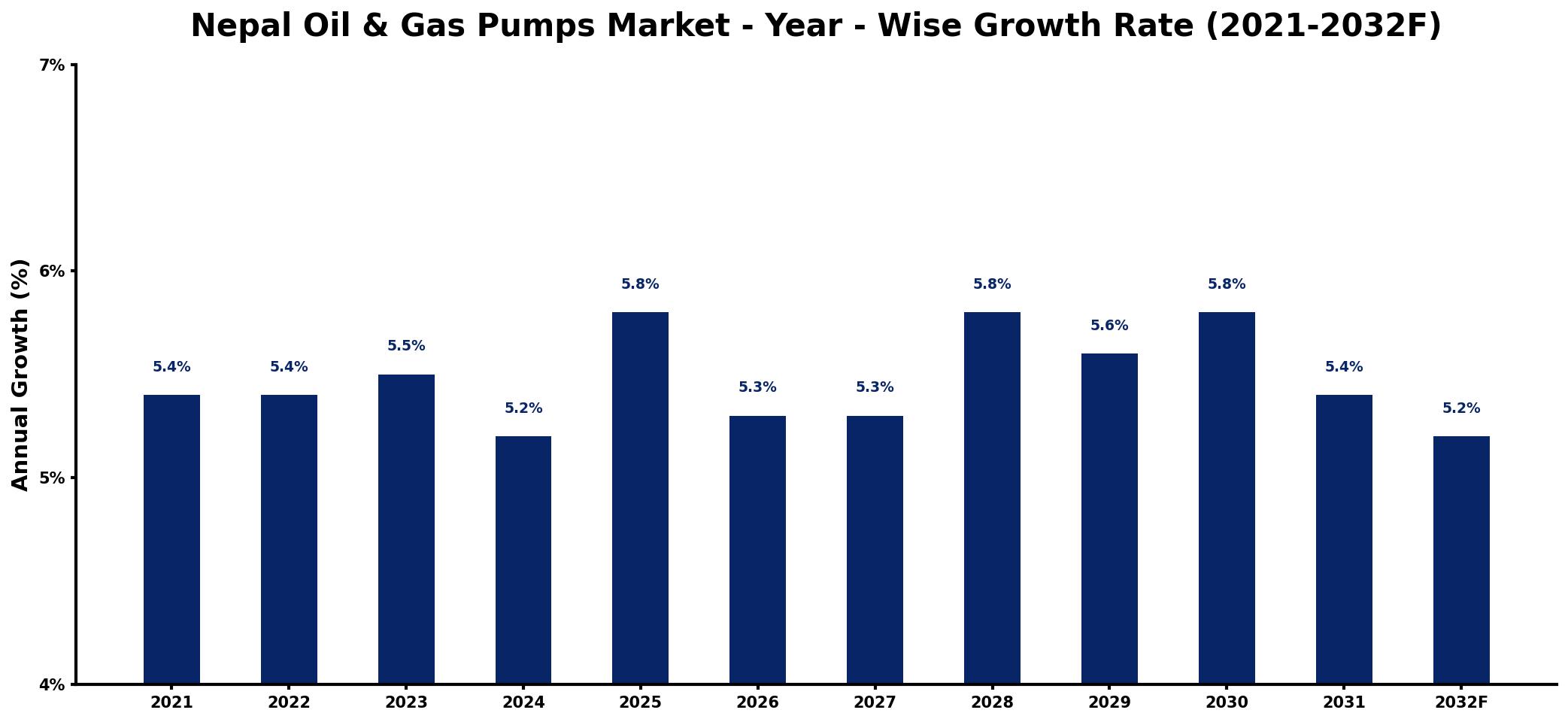
The table below presents the year‑wise growth rates along with the key drivers influencing the market
| Year | Growth Rate | Major Drivers |
| 2021 | 5.4% | Rising transportation sector demand |
| 2022 | 5.4% | Increased urban infrastructure projects |
| 2023 | 5.5% | Expansion of logistics networks |
| 2024 | 5.2% | Growing renewable energy investments |
| 2025 | 5.8% | Boost in industrial production activities |
| 2026 | 5.3% | Higher consumer spending trends |
| 2027 | 5.3% | Emergence of new industrial applications |
| 2028 | 5.8% | Strengthened cross-border trade agreements |
| 2029 | 5.6% | Advancements in technology adoption |
| 2030 | 5.8% | stronger distribution network expansion |
| 2031 | 5.4% | Increased foreign direct investments |
| 2032 | 5.2% | Development of regional supply chains |
Note: Market size estimations and growth projections presented in this report are based on 6Wresearch's proprietary forecasting methodology, utilizing the latest available industry data, government publications, and primary research inputs.
Nepal Oil & Gas Pumps Market Synopsis
The Nepal Oil & Gas Pumps Market is currently on an upward trajectory, spurred by significant government investments aimed at enhancing energy infrastructure. The market landscape comprises a diverse array of pump technologies, including centrifugal, positive displacement, and submersible pumps, tailored to meet the specific demands of the sector.
In recent years, market dynamics have shifted towards sustainability and energy efficiency, prompting manufacturers to innovate with advanced technologies. The integration of automation and smart systems in pumping operations reflects a broader trend towards optimizing performance while minimizing environmental impact, making the market an intriguing space for both local and international players.
- Market growth is propelled by government investments in oil and gas infrastructure.
- Technological advancements are leading to more energy-efficient pump solutions.
- The shift towards digitalization and automation enhances operational efficiency.
- Collaboration with local entities is vital for market entry and expansion.
- Regulatory frameworks ensure safety and quality standards, impacting operational dynamics.
Despite its growth potential, the Nepal Oil & Gas Pumps Market faces significant challenges. One of the primary restraints is the inadequacy of infrastructure for the storage and transportation of petroleum products, which complicates supply chain logistics and inflates costs. Moreover, a complex regulatory environment with strict licensing requirements often stifles new entrants, limiting competition. Political instability and regulatory fluctuations contribute to an unpredictable investment landscape, thus creating hurdles for long-term planning. The market's dependence on imported petroleum products makes it susceptible to global oil price volatility, further complicating operational consistency and planning.
Currently, the Nepal Oil & Gas Pumps Market is witnessing a notable trend towards energy-efficient and environmentally friendly technologies. Companies are focusing on pump designs that minimize energy consumption and operational costs, aligning with global sustainability goals. Additionally, digital solutions are becoming increasingly integrated into pump systems, facilitating better monitoring and control. The rise of smart pump systems equipped with variable frequency drives further exemplifies the industry's commitment to innovation and efficiency.
The investment landscape in the Nepal Oil & Gas Pumps Market is bright, driven by the nation's expanding energy demands and ongoing infrastructure projects. There is a rising requirement for efficient pumping solutions across various segments, including exploration, production, and distribution. Investors have a unique opportunity to supply advanced technologies, such as diaphragm and gear pumps, that meet emerging market needs. Embracing innovative, energy-efficient solutions not only addresses current demand but also aligns with national sustainability initiatives, making this market ripe for strategic investment.
The Nepalese government has enacted several policies to support and regulate the Oil & Gas Pumps Market. These include establishing quality standards and safety measures for pump products, creating licensing frameworks for operators, and implementing pricing controls to prevent market distortions. The emphasis on promoting renewable energy and energy efficiency further underscores the governments commitment to sustainable practices. Additionally, transparency initiatives aim to foster a competitive environment, ensuring that businesses operate fairly and consumers' interests are protected.
Looking ahead to 2026-2032, the Nepal Oil & Gas Pumps Market is set to continue its growth trajectory, supported by ongoing infrastructure development and increased industrial activity. The demand for advanced pumping technologies will rise as the country seeks to enhance its operational efficiency and energy production capabilities. Innovation will play a pivotal role, with market players investing heavily in research and development to offer sustainable solutions that meet both economic and environmental standards. Overall, the future appears promising, with ample opportunities for growth as the sector matures.
Recent developments in the Nepal Oil & Gas Pumps Market indicate a strong push towards modernization, with many companies exploring partnerships focused on advanced technology integration. Additionally, there has been a notable increase in local manufacturing initiatives aimed at reducing dependency on imports. As the government continues to refine its regulatory framework, market participants are adapting to align with new standards and practices, ensuring long-term sustainability and compliance in their operations.
- 10 Years of Market Numbers
- Historical Data Starting from 2022 to 2025
- Base Year: 2025
- Forecast Data until 2032
- Key Performance Indicators Impacting the Market
- Major Upcoming Developments and Projects
Key Highlights of the Report:
- Nepal Oil & Gas Pumps Market Outlook
- Market Size of Nepal Oil & Gas Pumps Market, 2025
- Forecast of Nepal Oil & Gas Pumps Market, 2032
- Historical Data and Forecast of Nepal Oil & Gas Pumps Revenues & Volume for the Period 2022-2032F
- Nepal Oil & Gas Pumps Market Trend Evolution
- Nepal Oil & Gas Pumps Market Drivers and Challenges
- Nepal Oil & Gas Pumps Price Trends
- Nepal Oil & Gas Pumps Porter's Five Forces
- Nepal Oil & Gas Pumps Industry Life Cycle
- Historical Data and Forecast of Nepal Oil & Gas Pumps Market Revenues & Volume By Type for the Period 2022-2032F
- Historical Data and Forecast of Nepal Oil & Gas Pumps Market Revenues & Volume By Submersible Pumps for the Period 2022-2032F
- Historical Data and Forecast of Nepal Oil & Gas Pumps Market Revenues & Volume By Non-submersible Pumps for the Period 2022-2032F
- Historical Data and Forecast of Nepal Oil & Gas Pumps Market Revenues & Volume By Pump Type for the Period 2022-2032F
- Historical Data and Forecast of Nepal Oil & Gas Pumps Market Revenues & Volume By Centrifugal Pump for the Period 2022-2032F
- Historical Data and Forecast of Nepal Oil & Gas Pumps Market Revenues & Volume By Positive Displacement Pump for the Period 2022-2032F
- Historical Data and Forecast of Nepal Oil & Gas Pumps Market Revenues & Volume By Cryogenic Pump for the Period 2022-2032F
- Historical Data and Forecast of Nepal Oil & Gas Pumps Market Revenues & Volume By Application for the Period 2022-2032F
- Historical Data and Forecast of Nepal Oil & Gas Pumps Market Revenues & Volume By Upstream for the Period 2022-2032F
- Historical Data and Forecast of Nepal Oil & Gas Pumps Market Revenues & Volume By Midstream for the Period 2022-2032F
- Historical Data and Forecast of Nepal Oil & Gas Pumps Market Revenues & Volume By Downstream for the Period 2022-2032F
- Nepal Oil & Gas Pumps Import Export Trade Statistics
- Market Opportunity Assessment By Type
- Market Opportunity Assessment By Pump Type
- Market Opportunity Assessment By Application
- Nepal Oil & Gas Pumps Top Companies Market Share
- Nepal Oil & Gas Pumps Competitive Benchmarking By Technical and Operational Parameters
- Nepal Oil & Gas Pumps Company Profiles
- Nepal Oil & Gas Pumps Key Strategic Recommendations






































