Nepal Publishing Market Summary
The nepal publishing market was estimated at USD 291 Million in 2025 and is projected to reach USD 381 Million by 2032, growing at a CAGR of 4.6% from 2026 to 2032.
Nepal Publishing Market Year-wise Growth Rate and Key Drivers
This graph highlights how the Nepal Publishing Market has steadily grown over the past five years, supported by major growth factors.
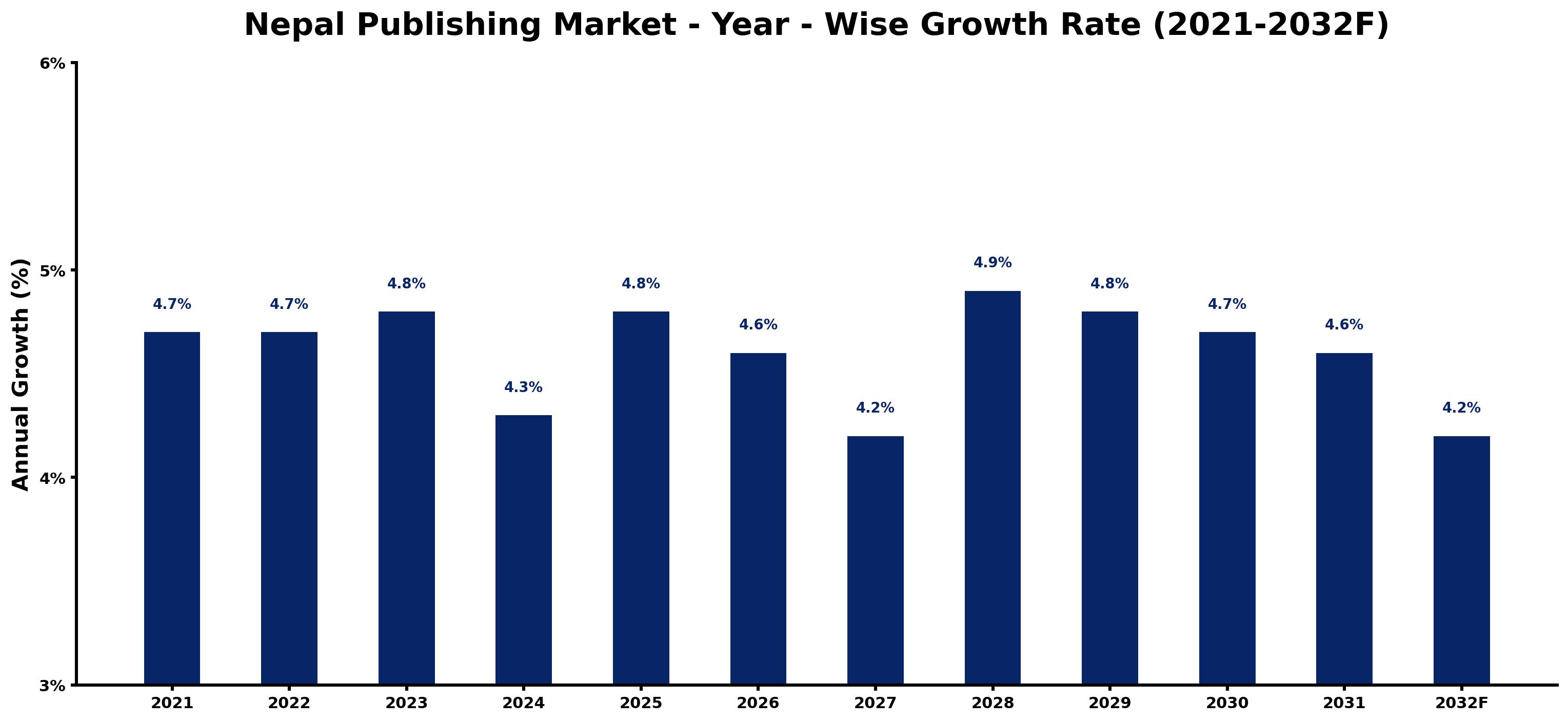
The table below presents the year wise growth rates along with the key drivers influencing the market
| Year | Growth Rate | Major Drivers |
| 2021 | 4.7% | The pandemic has accelerated digital reading, enhancing online publishing platforms significantly. |
| 2022 | 4.7% | Local authors gained prominence, leading to a surge in regional literature sales. |
| 2023 | 4.8% | Schools increasingly adopt e-learning, boosting demand for educational publishing materials. |
| 2024 | 4.3% | Cultural festivals and book fairs are revitalizing interest in printed books significantly. |
| 2025 | 4.8% | Young adult fiction is capturing a larger market share, appealing to the youth demographic. |
| 2026 | 4.6% | E-book sales are expected to double, reflecting changing consumer reading habits. |
| 2027 | 4.2% | Expanding internet access in rural areas fosters growth for digital publishing sectors. |
| 2028 | 4.9% | Collaboration with global publishers enhances content diversity and market reach effectively. |
| 2029 | 4.8% | The rise of independent bookstores supports local authors, revitalizing community engagement. |
| 2030 | 4.7% | Traditional publishing houses adapt, embracing hybrid models for greater market flexibility. |
| 2031 | 4.6% | Sustainable publishing practices are becoming a priority, attracting environmentally conscious consumers. |
| 2032 | 4.2% | Niche genres are flourishing, catering to diverse interests within the growing readership base. |
Note - Market size estimations and growth projections presented in this report are based on 6Wresearch's advanced forecasting approach, validated with industry datasets as of June 2026.
Nepal Publishing Market Synopsis
The Nepal Publishing Market is projected to reach 4.6% and witness significant growth during the forecast period (2026-2032). This burgeoning industry is characterized by a diverse range of publishing activities, encompassing both traditional and digital mediums. The market addresses the varied literary and educational needs of the Nepali population, producing an array of materials including books, magazines, newspapers, and academic resources in languages such as Nepali and English. The ongoing shift towards digital publishing, coupled with the sustained emphasis on education, positions the Nepal Publishing Market as a key sector for future development.
Nepal Publishing Market Growth Drivers
Several factors are propelling growth in the Nepal Publishing Market. A rising literacy rate across the nation is leading to increased demand for educational materials, particularly textbooks and supplementary learning resources. This demand is fueled by the government's commitment to enhancing education system effectiveness.
- The push towards digitalization has resulted in a growing acceptance of e-books and online publishing platforms, making it easier for publishers to reach a wider audience.
- There is a marked interest in promoting local language literature, offering opportunities for publishers to cater to the cultural and linguistic diversity of Nepal.
- Investments in infrastructure, although limited, are gradually improving distribution channels and accessibility to modern printing technology.
- Increased social media presence is enabling independent authors and self-publishing to thrive, contributing to the diversification of content available in the market.
- The rise in educational initiatives by NGOs and governmental bodies interested in literacy and education is creating additional demand for relevant publishing materials.
Nepal Publishing Market Trends and Opportunities
The Nepal Publishing Market is witnessing significant trends that are reshaping its landscape. The digital transformation of publishing is one of the most notable trends, with an increasing number of publishers investing in e-books and online platforms. This shift is indicative of a broader consumer preference for convenience and accessibility in accessing content.
- Educational content remains at the forefront of publishing, with persistent demand for high-quality textbooks driven by national educational policies.
- Local language publishing is gaining momentum, offering opportunities for the celebration and preservation of Nepali culture and literature.
- Self-publishing is on the rise, supported by the availability of online tools and platforms that simplify the publishing process for independent authors.
- The integration of technology in education is encouraging the development of interactive and multimedia content, which is becoming increasingly sought after.
- There's a growing trend towards sustainability in publishing, with more publishers considering eco-friendly practices in printing and production.
Nepal Publishing Market Challenges and Restraints
Despite the promising attributes of the Nepal Publishing Market, various challenges hinder its overall growth. One of the most significant obstacles is the limited distribution channels that make it difficult for publishers to reach remote areas, where access to books is crucial.
- Low literacy rates in certain regions continue to impede the potential market size, limiting the readership base for educational materials.
- The prevalence of piracy poses a severe threat to revenue streams for publishers, diminishing the financial viability of many publishing ventures.
- Competition from digital content providers and online platforms is growing, capturing consumer attention and shifting reading habits away from traditional publishing.
- A lack of sufficient investments in modern printing technology can hinder the quality and efficiency of published materials.
- The relatively small purchasing power among the population affects overall market demand, leading to challenges in pricing strategies.
Nepal Publishing Market Government Investment and Initiatives
Government policy plays an essential role in shaping the Nepal Publishing Market. The government has implemented a range of initiatives aimed at promoting local content, protecting intellectual property, and bolstering the growth of the publishing sector. Key initiatives include funding programs that support the development of educational materials tailored for local audiences.
- Regulations have been established to safeguard copyright and protect against the infringement of intellectual property rights, ensuring that publishers receive fair compensation.
- Support for local authors is evident, with grants and incentives designed to encourage writing and publishing in various languages.
- Training programs initiated by the government aim to enhance the skills of individuals working in the publishing industry, fostering professional growth.
- Infrastructure improvements, though gradual, are being prioritized to address distribution challenges and enhance access to publishing resources.
- The government continues to emphasize literacy and education through its policies, further underpinning the potential growth of the publishing sector.
Nepal Publishing Market Latest Developments (May 2025 - June 2026)
In the period from May 2025 to June 2026, the Nepal Publishing Market has witnessed key developments that indicate an evolving industry landscape. The growth in digital publishing has continued, with several publishing houses launching e-book platforms and mobile applications to cater to a tech-savvy audience.
- There has been an increased focus on educational publishing, with new collaborations between educational institutions and publishers to produce tailored content for diverse learning needs.
- Local literature is gaining visibility, with more publications showcasing Nepali authors and stories, thereby enriching the cultural tapestry of the market.
- COVID-19 recovery efforts have led to an uptick in reading as a leisure activity, driving demand for both print and digital materials.
- Public awareness initiatives aimed at promoting reading habits have been implemented, significantly impacting the demand for published works.
- Technological advancements in printing and production processes have begun to be adopted, enhancing the quality and efficiency of the publishing operations.
Nepal Publishing Market - Key Attractiveness of the Report
- 10 Years of Market Numbers
- Historical Data Starting from 2022 to 2025
- Base Year: 2025
- Forecast Data until 2032
- Key Performance Indicators Impacting the Market
- Major Upcoming Developments and Projects
Key Highlights of the Report:
- Nepal Publishing Market Outlook
- Market Size of Nepal Publishing Market, 2025
- Forecast of Nepal Publishing Market, 2032F
- Historical Data and Forecast of Nepal Publishing Revenues & Volume for the Period 2022-2032F
- Nepal Publishing Market Trend Evolution
- Nepal Publishing Market Drivers and Challenges
- Nepal Publishing Price Trends
- Nepal Publishing Porter's Five Forces
- Nepal Publishing Industry Life Cycle
- Historical Data and Forecast of Nepal Publishing Market Revenues & Volume By Types for the Period 2022-2032F
- Historical Data and Forecast of Nepal Publishing Market Revenues & Volume By Newspaper for the Period 2022-2032F
- Historical Data and Forecast of Nepal Publishing Market Revenues & Volume By Journals for the Period 2022-2032F
- Historical Data and Forecast of Nepal Publishing Market Revenues & Volume By Catalogues for the Period 2022-2032F
- Historical Data and Forecast of Nepal Publishing Market Revenues & Volume By Magazine for the Period 2022-2032F
- Historical Data and Forecast of Nepal Publishing Market Revenues & Volume By Books for the Period 2022-2032F
- Historical Data and Forecast of Nepal Publishing Market Revenues & Volume By E-Books for the Period 2022-2032F
- Historical Data and Forecast of Nepal Publishing Market Revenues & Volume By Platform for the Period 2022-2032F
- Historical Data and Forecast of Nepal Publishing Market Revenues & Volume By Digital? for the Period 2022-2032F
- Historical Data and Forecast of Nepal Publishing Market Revenues & Volume By Paper for the Period 2022-2032F
- Nepal Publishing Import Export Trade Statistics
- Market Opportunity Assessment By Types
- Market Opportunity Assessment By Platform
- Nepal Publishing Top Companies Market Share
- Nepal Publishing Competitive Benchmarking By Technical and Operational Parameters
- Nepal Publishing Company Profiles
- Nepal Publishing Key Strategic Recommendations






































