Nepal Rum Market Size, Share & Growth Rate
The Nepal Rum Market was estimated at USD 495 Million in 2025 and is projected to reach USD 694 Million by 2032, growing at a CAGR of 4.9% from 2026 to 2032. This positive trajectory is driven by a surge in consumer interest for premium and craft rums, particularly among younger demographics who are increasingly experimenting with unique flavors and blends. Furthermore, the expanding tourism sector and local distilleries leveraging traditional Nepali ingredients are further propelling market growth.
Nepal Rum Market Year-wise Growth Rate and Key Drivers
This graph highlights how the Nepal Rum Market has steadily grown over the years, supported by major growth factors.
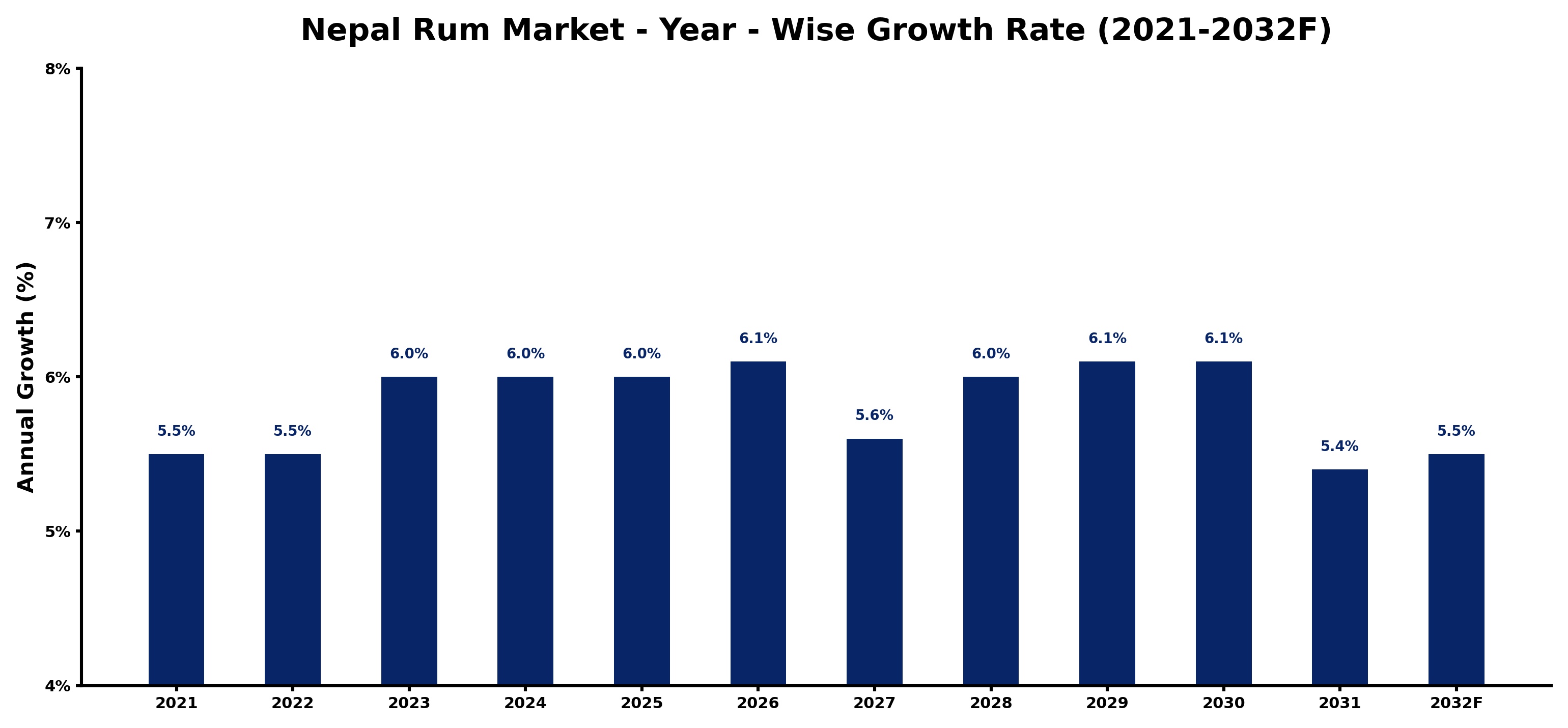
The table below presents the year‑wise growth rates along with the key drivers influencing the market
| Year | Growth Rate | Major Drivers |
| 2021 | 5.5% | Increasing smart city development projects |
| 2022 | 5.5% | Expansion of commercial construction activities |
| 2023 | 6.0% | Growing renewable energy integration projects |
| 2024 | 6.0% | Increasing industrial automation investments |
| 2025 | 6.0% | Rapid growth in telecom and data center sectors |
| 2026 | 6.1% | Expansion of manufacturing activities |
| 2027 | 5.6% | Increasing industrial automation investments |
| 2028 | 6.0% | Rising electricity demand across industries |
| 2029 | 6.1% | Expansion of manufacturing activities |
| 2030 | 6.1% | Increasing industrial infrastructure investments |
| 2031 | 5.4% | Increasing industrial automation investments |
| 2032 | 5.5% | Government infrastructure modernization initiatives |
Note - Market size estimations and growth projections presented in this report are based on 6Wresearch’s advanced forecasting approach, validated with industry datasets as of June 2026.
Nepal Rum Market Synopsis
The most significant force currently shaping the Nepal Rum Market is the increasing demand for premium and craft offerings. Consumers are more discerning than ever, seeking spirits that provide not only superior quality but also unique flavor experiences that celebrate local culture and ingredients.
Moreover, the trend towards flavored rums is gaining momentum, as brands innovate to cater to diverse palates. With the rise of sustainability concerns, consumers are actively looking for ethically produced options, making it imperative for brands to prioritize environmental responsibility alongside quality.
Nepal Rum Market Key Takeaways
- Rising interest in premium rums is driving market growth, particularly among younger consumers.
- Flavored and craft rums are increasingly popular, attracting a broader consumer base.
- Sustainability and ethical production practices are vital for brand preference.
- The tourism sector's growth is contributing significantly to rum consumption patterns.
- Local ingredients are being leveraged to create distinctive rum varieties, enhancing market differentiation.
Evaluation of Restraints in Nepal Rum Market
Despite its promising growth, the Nepal Rum Market faces several notable restraints. Limited consumer awareness of rum, especially in comparison to other spirits like whiskey and vodka, hampers its potential. Additionally, competition from imported brands, often perceived as higher quality, poses a challenge for domestic producers. The heavy taxation on alcoholic beverages further inflates prices, affecting market accessibility. Finally, distribution issues in rural areas complicate the reach of local products, requiring strategic solutions for effective market penetration.
Nepal Rum Market Trends
A marked trend in the Nepal Rum Market is the increasing inclination towards flavored rums, such as those infused with local fruits and spices. This innovation not only caters to diverse taste preferences but also encourages brand experimentation. Additionally, the rise of cocktail culture among the youth is propelling rum-based beverages into mainstream popularity. The focus on sustainability is also becoming an essential trend, with consumers gravitating towards brands that demonstrate a commitment to ethical sourcing and production practices.
Nepal Rum Market Opportunities
Investment opportunities abound in the Nepal Rum Market, particularly in premium and craft segments. There is potential for growth through the development of authentic rums that utilize local ingredients and traditional production methods. Collaborations with local artisans or distillers can also yield unique offerings that resonate with both domestic and international consumers. Furthermore, as tourism continues to flourish, positioning brands within the hospitality sector can enhance visibility and reach.
Government Initiatives in the Nepal Rum Market
Government policies in the Nepal Rum Market are primarily focused on regulating production and ensuring quality standards. Taxes and duties on rum production and imports are enforced to control consumption and generate revenue. Licensing requirements for producers help maintain product safety and quality, while advertising regulations aim to prevent misleading promotions. Such measures are designed to promote responsible consumption while simultaneously supporting the growth of the domestic rum industry.
Future Insights of the Nepal Rum Market
Looking ahead to 2026-2032, the Nepal Rum Market is anticipated to continue its upward trajectory, fueled by increasing disposable income and evolving consumer preferences towards premium spirits. The local rum industry's potential for export could unlock additional growth avenues, particularly as international interest in unique Nepali products grows. However, strategic marketing, product innovation, and a firm commitment to sustainability will be essential to navigate challenges posed by regulatory barriers and competition.
Nepal Rum Market Latest Developments (May 2025 - June 2026)
The Nepal Rum Market has recently seen a surge in brands launching innovative rum products that highlight local flavors and ingredients. Various distilleries are also expanding their marketing efforts to enhance consumer education about rum, aiming to elevate its status among Nepalese spirits. Additionally, local producers are increasingly focusing on sustainability initiatives, such as eco-friendly packaging and sourcing, which align with growing consumer preferences for ethical products.
Nepal Rum Market - Key Attractiveness of the Report
- 10 Years of Market Numbers
- Historical Data Starting from 2022 to 2025
- Base Year: 2025
- Forecast Data until 2032
- Key Performance Indicators Impacting the Market
- Major Upcoming Developments and Projects
Key Highlights of the Report:
- Nepal Rum Market Outlook
- Market Size of Nepal Rum Market, 2025
- Forecast of Nepal Rum Market, 2032
- Historical Data and Forecast of Nepal Rum Revenues & Volume for the Period 2022-2032F
- Nepal Rum Market Trend Evolution
- Nepal Rum Market Drivers and Challenges
- Nepal Rum Price Trends
- Nepal Rum Porter's Five Forces
- Nepal Rum Industry Life Cycle
- Historical Data and Forecast of Nepal Rum Market Revenues & Volume By Type for the Period 2022-2032F
- Historical Data and Forecast of Nepal Rum Market Revenues & Volume By Golden for the Period 2022-2032F
- Historical Data and Forecast of Nepal Rum Market Revenues & Volume By Dark for the Period 2022-2032F
- Historical Data and Forecast of Nepal Rum Market Revenues & Volume By White for the Period 2022-2032F
- Historical Data and Forecast of Nepal Rum Market Revenues & Volume By Spiced for the Period 2022-2032F
- Historical Data and Forecast of Nepal Rum Market Revenues & Volume By Distribution Channel for the Period 2022-2032F
- Historical Data and Forecast of Nepal Rum Market Revenues & Volume By On-trade for the Period 2022-2032F
- Historical Data and Forecast of Nepal Rum Market Revenues & Volume By Off-trade for the Period 2022-2032F
- Nepal Rum Import Export Trade Statistics
- Market Opportunity Assessment By Type
- Market Opportunity Assessment By Distribution Channel
- Nepal Rum Top Companies Market Share
- Nepal Rum Competitive Benchmarking By Technical and Operational Parameters
- Nepal Rum Company Profiles
- Nepal Rum Key Strategic Recommendations






































