Nepal Secondhand Apparel Market Size, Share & Growth Rate
The Nepal Secondhand Apparel Market was estimated at USD 719 Million in 2025 and is projected to reach USD 1041 Million by 2032, growing at a CAGR of 5.4% from 2026 to 2032. This promising trajectory is driven primarily by a cultural shift towards thrift shopping and heightened consumer awareness regarding sustainability. As consumers increasingly seek affordable and unique fashion options, the demand for secondhand apparel continues to gain momentum in urban and rural areas alike.
Nepal Secondhand Apparel Market Year-wise Growth Rate and Key Drivers
This graph highlights how the Nepal Secondhand Apparel Market has steadily grown over the years, supported by major growth factors.
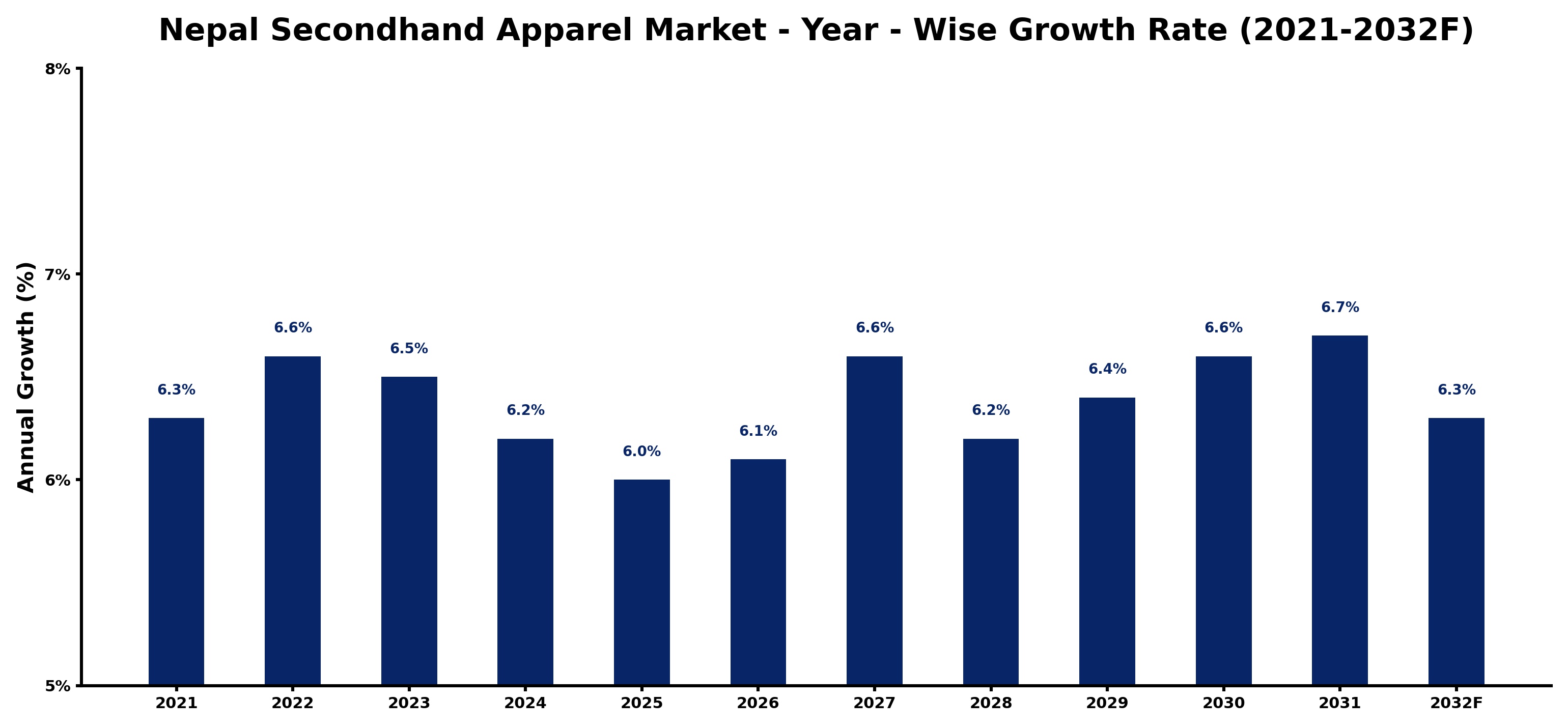
The table below presents the year‑wise growth rates along with the key drivers influencing the market
| Year | Growth Rate | Major Drivers |
| 2021 | 6.3% | Increasing industrial automation investments |
| 2022 | 6.6% | Growing renewable energy integration projects |
| 2023 | 6.5% | Expansion of commercial construction activities |
| 2024 | 6.2% | Increasing smart city development projects |
| 2025 | 6.0% | Increasing adoption of advanced technologies |
| 2026 | 6.1% | Expansion of transportation and logistics networks |
| 2027 | 6.6% | Growing renewable energy integration projects |
| 2028 | 6.2% | Growing urbanization and commercial development |
| 2029 | 6.4% | Growing urbanization and commercial development |
| 2030 | 6.6% | Increasing industrial automation investments |
| 2031 | 6.7% | Growing renewable energy integration projects |
| 2032 | 6.3% | Expansion of commercial construction activities |
Note - Market size estimations and growth projections presented in this report are based on 6Wresearch’s advanced forecasting approach, validated with industry datasets as of June 2026.
Nepal Secondhand Apparel Market Synopsis
Recently, the Nepal secondhand apparel market has experienced an upswing fueled by the rise of sustainable fashion practices. This growth contrasts sharply with past perceptions of secondhand clothing as inferior, as many consumers now recognize the value in pre-owned items. Looking ahead, the market is set to expand further, particularly as online platforms become more prevalent, enabling easier access to diverse secondhand options.
Moreover, an increased focus on reducing textile waste and fostering a circular economy is shifting consumer attitudes toward thrift shopping. As environmental consciousness continues to penetrate broader demographics, the appeal of secondhand clothing is expected to resonate even more, making this market a critical component of Nepal's future fashion landscape.
Nepal Secondhand Apparel Market Key Takeaways
- The market is experiencing robust growth due to rising environmental awareness and sustainability trends.
- Affordability and unique offerings are attracting a diverse customer base, including younger fashion enthusiasts.
- Online platforms and social media are facilitating wider access and engagement with secondhand apparel.
- Government regulations impact the import of secondhand clothing, aiming to balance local industry protection with consumer needs.
- Opportunities abound for investors willing to engage with this evolving market through innovative strategies.
Evaluation of Restraints in Nepal Secondhand Apparel Market
Despite the promising landscape, the Nepal secondhand apparel market faces significant challenges. A key restraint is the lack of stringent regulations that can lead to the influx of counterfeit and low-quality products. This situation is exacerbated by a general perception of secondhand items as inferior to new clothing, which undermines consumer confidence. Additionally, logistical inefficiencies, such as inadequate distribution networks and storage facilities, hinder market growth and operational efficiency. Addressing these issues through enhanced regulations and better infrastructure will be crucial for unlocking the market's full potential.
Nepal Secondhand Apparel Market Trends
Current trends within the Nepal secondhand apparel market highlight a growing consumer preference for sustainable and ethical fashion choices. The increasing influence of social media is also reshaping how consumers discover and engage with secondhand clothing, making it not only a budget-friendly alternative but also a trendsetting avenue. Additionally, the popularity of curated thrift shops that offer a selective range of high-quality items is gaining traction, attracting discerning shoppers seeking unique pieces.
Nepal Secondhand Apparel Market Opportunities
Investors looking for growth opportunities in the Nepal secondhand apparel market can explore several avenues. Establishing or expanding physical and online thrift stores presents a promising opportunity, especially in urban centers. Investing in logistics and technology can enhance distribution efficiency and customer experience. Furthermore, collaborations with local thrift shops and engagement with popular fashion influencers can significantly boost visibility. Promoting the environmental benefits of secondhand shopping can also resonate with a more eco-conscious consumer base, driving long-term market success.
Government Initiatives in the Nepal Secondhand Apparel Market
The Nepali government has implemented several policies to manage the secondhand apparel market effectively. These include the imposition of import tariffs and restrictions on the volume of secondhand clothing allowed into the country. Such measures aim to safeguard the domestic textile industry while still catering to consumer demand for affordable clothing options. Additionally, regulations regarding quality standards and labeling have been introduced to ensure consumer safety, thereby promoting a more regulated and trustworthy market environment.
Future Insights of the Nepal Secondhand Apparel Market
Looking towards 2026-2032, the Nepal secondhand apparel market is expected to continue on its growth trajectory. Increasing environmental consciousness, coupled with a desire for unique and budget-friendly fashion, will likely sustain consumer interest in secondhand offerings. The evolution of online platforms will further facilitate access to a diverse range of products, enabling consumers to embrace pre-owned fashion without compromising quality. Overall, the market is set to become a staple in the Nepali fashion landscape, reflecting broader global shifts toward sustainable consumer practices.
Nepal Secondhand Apparel Market Latest Developments (May 2025 - June 2026)
In recent months, the Nepal secondhand apparel market has seen a noticeable increase in the establishment of online thrift platforms, which are gaining popularity among consumers. These platforms are enhancing accessibility and encouraging a more significant segment of the population to consider secondhand clothing as a viable option. Additionally, community-driven initiatives promoting sustainable fashion practices are beginning to emerge, reflecting a cultural shift toward more conscious consumer behavior.
Nepal Secondhand Apparel Market - Key Attractiveness of the Report
- 10 Years of Market Numbers
- Historical Data Starting from 2022 to 2025
- Base Year: 2025
- Forecast Data until 2032
- Key Performance Indicators Impacting the Market
- Major Upcoming Developments and Projects
Key Highlights of the Report:
- Nepal Secondhand Apparel Market Outlook
- Market Size of Nepal Secondhand Apparel Market, 2025
- Forecast of Nepal Secondhand Apparel Market, 2032
- Historical Data and Forecast of Nepal Secondhand Apparel Revenues & Volume for the Period 2022-2032F
- Nepal Secondhand Apparel Market Trend Evolution
- Nepal Secondhand Apparel Market Drivers and Challenges
- Nepal Secondhand Apparel Price Trends
- Nepal Secondhand Apparel Porter's Five Forces
- Nepal Secondhand Apparel Industry Life Cycle
- Historical Data and Forecast of Nepal Secondhand Apparel Market Revenues & Volume By Sector for the Period 2022-2032F
- Historical Data and Forecast of Nepal Secondhand Apparel Market Revenues & Volume By Resale for the Period 2022-2032F
- Historical Data and Forecast of Nepal Secondhand Apparel Market Revenues & Volume By Traditional Thrift Stores and Donations for the Period 2022-2032F
- Historical Data and Forecast of Nepal Secondhand Apparel Market Revenues & Volume By Product Type for the Period 2022-2032F
- Historical Data and Forecast of Nepal Secondhand Apparel Market Revenues & Volume By Dresses & Tops for the Period 2022-2032F
- Historical Data and Forecast of Nepal Secondhand Apparel Market Revenues & Volume By Shirts & T-shirts for the Period 2022-2032F
- Historical Data and Forecast of Nepal Secondhand Apparel Market Revenues & Volume By Sweaters, Coats & Jackets for the Period 2022-2032F
- Historical Data and Forecast of Nepal Secondhand Apparel Market Revenues & Volume By Jeans & Pants for the Period 2022-2032F
- Historical Data and Forecast of Nepal Secondhand Apparel Market Revenues & Volume By Others for the Period 2022-2032F
- Historical Data and Forecast of Nepal Secondhand Apparel Market Revenues & Volume By Target Population for the Period 2022-2032F
- Historical Data and Forecast of Nepal Secondhand Apparel Market Revenues & Volume By Men for the Period 2022-2032F
- Historical Data and Forecast of Nepal Secondhand Apparel Market Revenues & Volume By Women for the Period 2022-2032F
- Historical Data and Forecast of Nepal Secondhand Apparel Market Revenues & Volume By Kids for the Period 2022-2032F
- Historical Data and Forecast of Nepal Secondhand Apparel Market Revenues & Volume By Sales Channel for the Period 2022-2032F
- Historical Data and Forecast of Nepal Secondhand Apparel Market Revenues & Volume By Wholesalers/Distributors for the Period 2022-2032F
- Historical Data and Forecast of Nepal Secondhand Apparel Market Revenues & Volume By Hypermarkets/Supermarkets for the Period 2022-2032F
- Historical Data and Forecast of Nepal Secondhand Apparel Market Revenues & Volume By Multi-brand Stores for the Period 2022-2032F
- Historical Data and Forecast of Nepal Secondhand Apparel Market Revenues & Volume By Independent Small Stores for the Period 2022-2032F
- Historical Data and Forecast of Nepal Secondhand Apparel Market Revenues & Volume By Departmental Stores for the Period 2022-2032F
- Historical Data and Forecast of Nepal Secondhand Apparel Market Revenues & Volume By Online Retailers for the Period 2022-2032F
- Historical Data and Forecast of Nepal Secondhand Apparel Market Revenues & Volume By Others for the Period 2022-2032F
- Nepal Secondhand Apparel Import Export Trade Statistics
- Market Opportunity Assessment By Sector
- Market Opportunity Assessment By Product Type
- Market Opportunity Assessment By Target Population
- Market Opportunity Assessment By Sales Channel
- Nepal Secondhand Apparel Top Companies Market Share
- Nepal Secondhand Apparel Competitive Benchmarking By Technical and Operational Parameters
- Nepal Secondhand Apparel Company Profiles
- Nepal Secondhand Apparel Key Strategic Recommendations






































