Netherlands Aggregates Market Top 5 Importing Countries and Market Competition (HHI) Analysis
The Netherlands continues to import significant quantities of aggregates, with top suppliers in 2024 being Germany, Norway (excluding Svalbard and Jan Mayen), UK, Belgium, and Metropolitan France. The market is characterized by high concentration, as indicated by the Herfindahl-Hirschman Index (HHI) remaining at elevated levels in 2024. The compound annual growth rate (CAGR) from 2020 to 2024 stands at 1.61%, while the growth rate from 2023 to 2024 surged by an impressive 23.21%. This signifies a strong demand for aggregates in the Netherlands and highlights the country`s reliance on imports to meet its requirements.
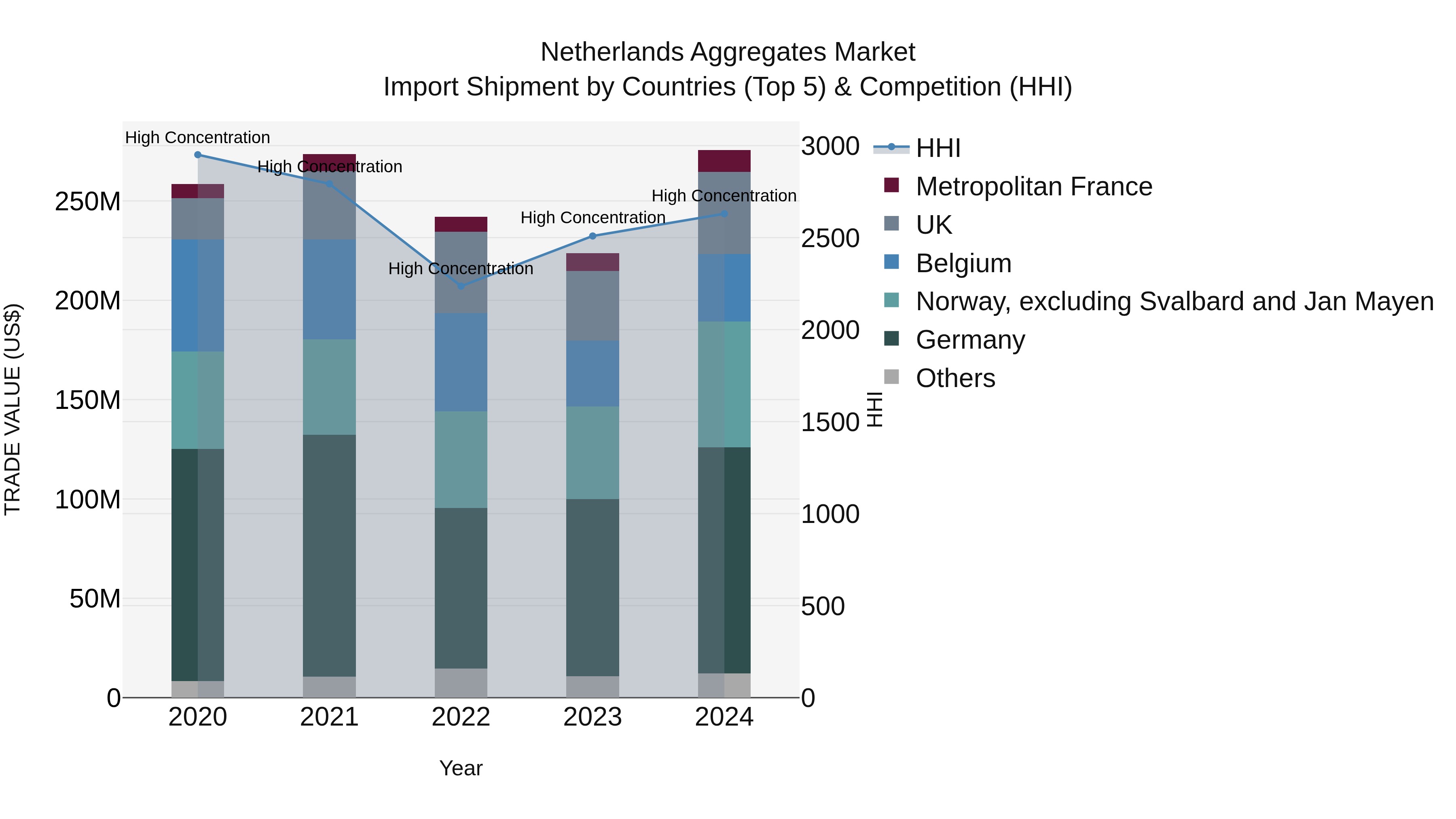
Netherlands Aggregates Market Overview
The Netherlands aggregates market is characterized by a steady demand for construction materials such as sand, gravel, and crushed stone. The sector is driven by infrastructure development projects, urbanization, and the construction of residential and commercial buildings. Major players in the market include HeidelbergCement, CRH, and LafargeHolcim, alongside several local suppliers. Sustainability and environmental concerns are increasingly influencing the market, leading to a growing emphasis on recycled aggregates and the use of alternative materials. Government regulations promoting sustainable construction practices further shape the market landscape. Overall, the Netherlands aggregates market is expected to continue growing, driven by ongoing construction activities and the increasing focus on environmentally friendly solutions.
Netherlands Aggregates Market Trends
In the Netherlands aggregates market, sustainability and circular economy practices are becoming increasingly important trends. There is a growing emphasis on using recycled aggregates and alternative materials in construction projects to reduce environmental impact and promote resource efficiency. Additionally, there is a rising demand for high-quality aggregates with specific properties to meet the requirements of various construction applications. Digitalization and technology adoption are also shaping the market, with companies investing in advanced equipment for efficient production and logistics operations. Overall, the Netherlands aggregates market is moving towards a more sustainable and technology-driven future to meet the evolving needs of the construction industry while addressing environmental concerns.
Netherlands Aggregates Market Challenges
In the Netherlands aggregates market, challenges primarily revolve around sustainability and environmental concerns. The industry is facing pressure to reduce carbon emissions and minimize the environmental impact of quarrying and transportation activities. Limited availability of suitable raw materials and the need for responsible sourcing are also significant challenges. Additionally, there is a growing demand for recycled aggregates, pushing companies to invest in recycling technologies and processes. Competition from alternative materials and fluctuating raw material prices further add to the complexities faced by players in the Netherlands aggregates market. Overall, the industry must navigate these challenges while striving to meet the increasing demand for construction materials in a sustainable and environmentally conscious manner.
Netherlands Aggregates Market Investment Opportunities
In the Netherlands aggregates market, there are several investment opportunities worth exploring. With the country`s focus on sustainable development and infrastructure projects, there is a growing demand for high-quality construction aggregates such as sand, gravel, and crushed stone. Investing in aggregate production facilities or distribution networks could prove to be lucrative, especially considering the ongoing construction projects in the country. Additionally, innovations in the sector such as the use of recycled aggregates or the adoption of advanced technologies for extraction and processing could offer competitive advantages to investors. Collaborating with construction companies or government agencies involved in infrastructure development projects could also provide strategic opportunities for growth and expansion in the Netherlands aggregates market.
Netherlands Aggregates Market Government Policy
The Netherlands government has implemented policies to regulate the aggregates market, focusing on sustainable extraction, resource efficiency, and environmental protection. The government has set strict guidelines for quarry operations, requiring companies to obtain permits and adhere to environmental impact assessments. There are also regulations in place to promote the use of recycled aggregates in construction projects to reduce the reliance on natural resources. Additionally, the government encourages innovation in aggregates production techniques to minimize environmental impact and promote circular economy principles. Overall, the Netherlands government aims to balance the economic benefits of the aggregates industry with sustainable practices to protect the environment and natural resources for future generations.
Netherlands Aggregates Market Future Outlook
The future outlook for the Netherlands aggregates market appears positive, driven by ongoing infrastructure development projects, urbanization trends, and the increasing focus on sustainable construction practices. The government`s investments in transportation, housing, and energy sectors are expected to boost demand for aggregates used in construction activities. Additionally, the growing emphasis on circular economy principles and the adoption of recycled aggregates are likely to shape the market landscape in the coming years. Technological advancements, such as the use of digital tools for efficient resource management and optimization of production processes, are also anticipated to play a significant role in driving growth and improving operational efficiency within the aggregates industry in the Netherlands.
Key Highlights of the Report:
- Netherlands Aggregates Market Outlook
- Market Size of Netherlands Aggregates Market, 2024
- Forecast of Netherlands Aggregates Market, 2031
- Historical Data and Forecast of Netherlands Aggregates Revenues & Volume for the Period 2021-2031
- Netherlands Aggregates Market Trend Evolution
- Netherlands Aggregates Market Drivers and Challenges
- Netherlands Aggregates Price Trends
- Netherlands Aggregates Porter's Five Forces
- Netherlands Aggregates Industry Life Cycle
- Historical Data and Forecast of Netherlands Aggregates Market Revenues & Volume By Product Type for the Period 2021-2031
- Historical Data and Forecast of Netherlands Aggregates Market Revenues & Volume By Crushed Stone for the Period 2021-2031
- Historical Data and Forecast of Netherlands Aggregates Market Revenues & Volume By Sand for the Period 2021-2031
- Historical Data and Forecast of Netherlands Aggregates Market Revenues & Volume By Gravel for the Period 2021-2031
- Historical Data and Forecast of Netherlands Aggregates Market Revenues & Volume By Recycled Aggregates for the Period 2021-2031
- Historical Data and Forecast of Netherlands Aggregates Market Revenues & Volume By Application for the Period 2021-2031
- Historical Data and Forecast of Netherlands Aggregates Market Revenues & Volume By Construction Materials for the Period 2021-2031
- Historical Data and Forecast of Netherlands Aggregates Market Revenues & Volume By Road Construction for the Period 2021-2031
- Historical Data and Forecast of Netherlands Aggregates Market Revenues & Volume By Concrete Production for the Period 2021-2031
- Historical Data and Forecast of Netherlands Aggregates Market Revenues & Volume By Landscaping for the Period 2021-2031
- Historical Data and Forecast of Netherlands Aggregates Market Revenues & Volume By End User for the Period 2021-2031
- Historical Data and Forecast of Netherlands Aggregates Market Revenues & Volume By Construction Industry for the Period 2021-2031
- Historical Data and Forecast of Netherlands Aggregates Market Revenues & Volume By Residential for the Period 2021-2031
- Historical Data and Forecast of Netherlands Aggregates Market Revenues & Volume By Commercial for the Period 2021-2031
- Netherlands Aggregates Import Export Trade Statistics
- Market Opportunity Assessment By Product Type
- Market Opportunity Assessment By Application
- Market Opportunity Assessment By End User
- Netherlands Aggregates Top Companies Market Share
- Netherlands Aggregates Competitive Benchmarking By Technical and Operational Parameters
- Netherlands Aggregates Company Profiles
- Netherlands Aggregates Key Strategic Recommendations






































