Netherlands Artificial Flowers Market Size (2020-2030)
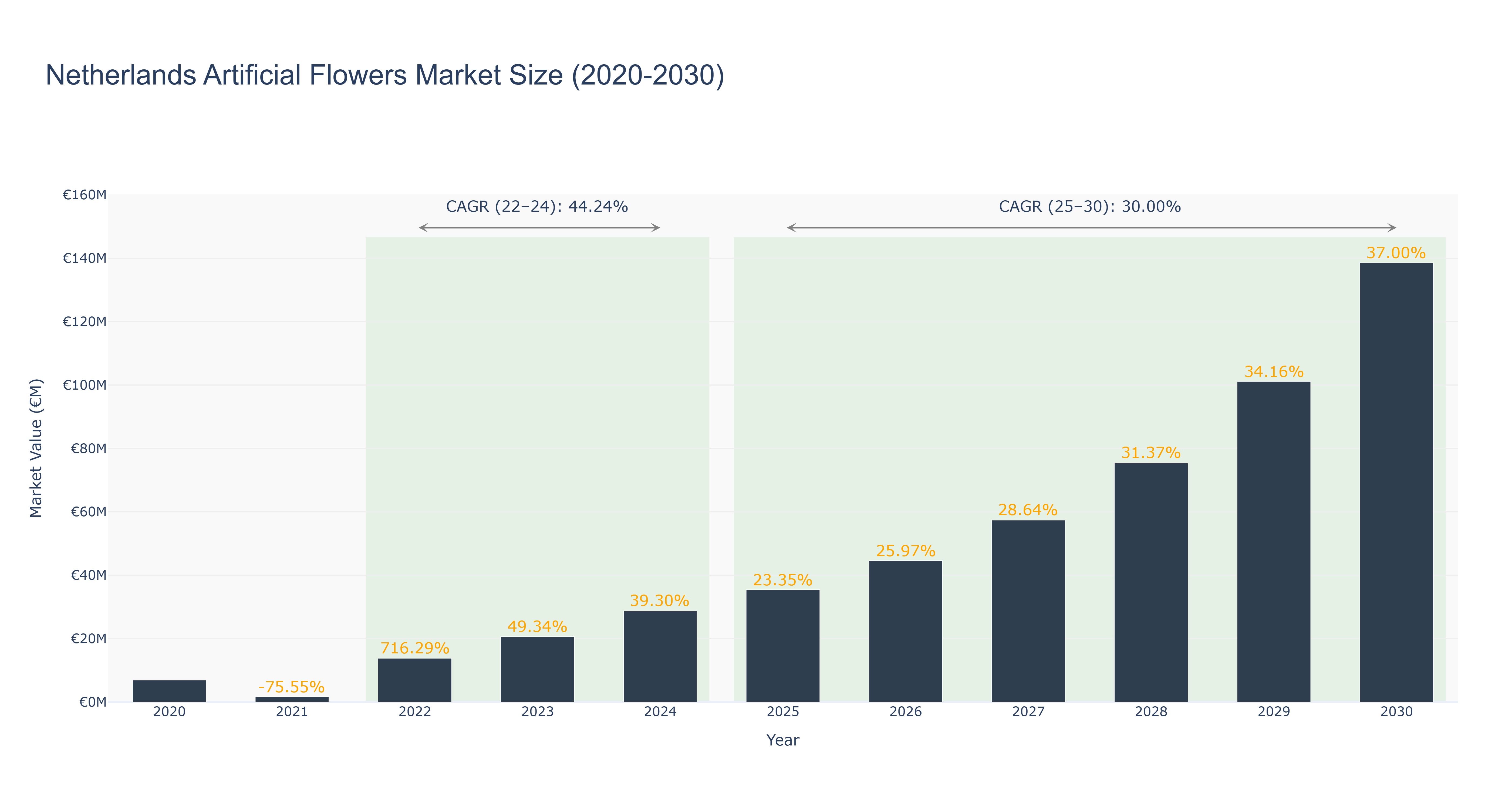
Netherlands Artificial Flowers Market has shown a significant growth trajectory. The market size peaked at €138.55 million in 2030, with a notable increase in size observed from 2020 (€6.91 million) to 2024 (€28.70 million). The forecasted market size from 2025 to 2030 is expected to continue this upward trend, driven by a CAGR of 30.0% between 2025-30. The CAGR for the period 2022-24 was 44.24%, indicating a rapid growth phase. This growth can be attributed to increasing consumer preference for artificial flowers due to their durability and low maintenance requirements, along with a growing trend towards sustainable and eco-friendly products in the floral industry. Looking ahead, the market is poised for further expansion with upcoming collaborations between local artisans and international designers to introduce innovative and unique artificial flower designs, catering to evolving consumer preferences.
Netherlands Artificial Flowers Market: Production & Trade Performance (2019-2025)
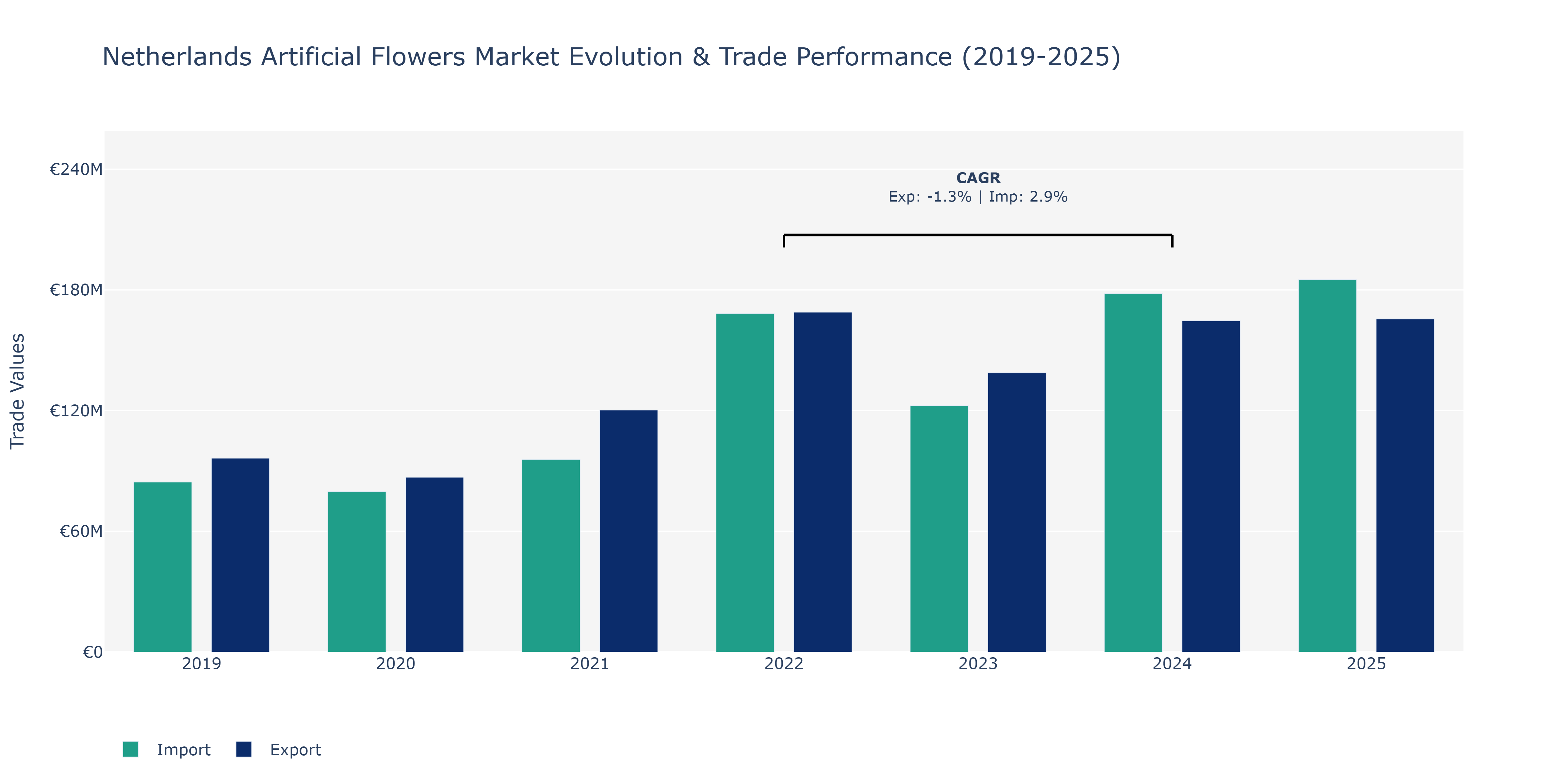
The Netherlands Artificial Flowers Market witnessed fluctuating trends in both Exports and Imports over the specified years. From 2019 to 2020, Exports decreased from €96.36 million to €86.91 million, while Imports declined from €84.53 million to €79.72 million. In 2021, there was a notable surge in Exports to €120.28 million and Imports to €95.76 million, indicating increased demand or production capacity. The peak points were reached in 2025 with Exports at €165.56 million and Imports at €185.10 million. The growth in Imports outpacing Exports suggests a shift in market dynamics, potentially due to changes in consumer preferences or manufacturing capabilities. Factors such as technological advancements in artificial flower production, evolving design trends, and increasing environmental awareness influencing consumer choices may have contributed to these market fluctuations, aligning with the global trend towards sustainable and aesthetically pleasing artificial floral products.
Key Highlights of the Report:
- Netherlands Artificial Flowers Market Outlook
- Market Size of Netherlands Artificial Flowers Market, 2024
- Forecast of Netherlands Artificial Flowers Market, 2031
- Historical Data and Forecast of Netherlands Artificial Flowers Revenues & Volume for the Period 2021-2031
- Netherlands Artificial Flowers Market Trend Evolution
- Netherlands Artificial Flowers Market Drivers and Challenges
- Netherlands Artificial Flowers Price Trends
- Netherlands Artificial Flowers Porter`s Five Forces
- Netherlands Artificial Flowers Industry Life Cycle
- Historical Data and Forecast of Netherlands Artificial Flowers Market Revenues & Volume By Material Type for the Period 2021-2031
- Historical Data and Forecast of Netherlands Artificial Flowers Market Revenues & Volume By Clay & Porcelain for the Period 2021-2031
- Historical Data and Forecast of Netherlands Artificial Flowers Market Revenues & Volume By Cotton & Silk for the Period 2021-2031
- Historical Data and Forecast of Netherlands Artificial Flowers Market Revenues & Volume By Leather & Nylon for the Period 2021-2031
- Historical Data and Forecast of Netherlands Artificial Flowers Market Revenues & Volume By Paper & Wax for the Period 2021-2031
- Historical Data and Forecast of Netherlands Artificial Flowers Market Revenues & Volume By Plastic & Polyester for the Period 2021-2031
- Historical Data and Forecast of Netherlands Artificial Flowers Market Revenues & Volume By Application for the Period 2021-2031
- Historical Data and Forecast of Netherlands Artificial Flowers Market Revenues & Volume By Commercial for the Period 2021-2031
- Historical Data and Forecast of Netherlands Artificial Flowers Market Revenues & Volume By Residential for the Period 2021-2031
- Netherlands Artificial Flowers Import Export Trade Statistics
- Market Opportunity Assessment By Material Type
- Market Opportunity Assessment By Application
- Netherlands Artificial Flowers Top Companies Market Share
- Netherlands Artificial Flowers Competitive Benchmarking By Technical and Operational Parameters
- Netherlands Artificial Flowers Company Profiles
- Netherlands Artificial Flowers Key Strategic Recommendations






































