Netherlands Automatic Coffee Machines Market (2026-2032) | Analysis, Competitive Landscape, Value, Industry, Size & Revenue, Growth, Companies, Outlook, Segmentation, Forecast, Trends, Share
Market Forecast By Product (Automatic espresso coffee machines, Automatic capsule coffee machine, Automatic bean to cup coffee machines, Automatic instant coffee machines, Others), By Type (Fully automatic coffee machine, Super-automatic coffee machine, Semi-automatic coffee machine), By Component (Pump, Boiler, Coffee bean grinder, Piston), By End-User (Office use, Commercial use, Home use, Coffee Caf, Others) And Competitive Landscape
| Product Code: ETC8532279 | Publication Date: Sep 2024 | Updated Date: Apr 2026 | Product Type: Market Research Report | |
| Publisher: 6Wresearch | Author: Sumit Sagar | No. of Pages: 75 | No. of Figures: 35 | No. of Tables: 20 |
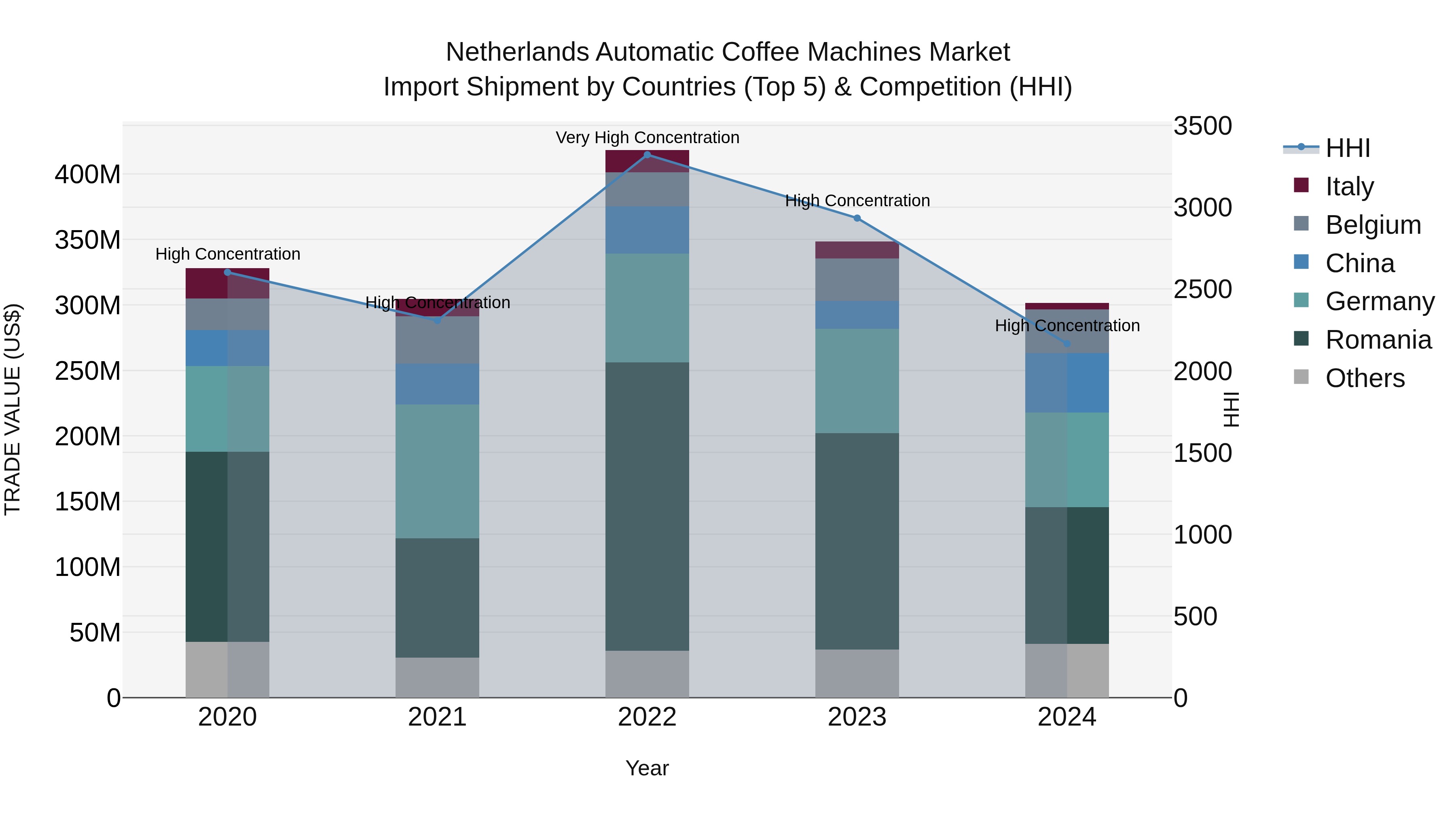
Netherlands Automatic Coffee Machines Market Top 5 Importing Countries and Market Competition (HHI) Analysis
The Netherlands continued to show high concentration in automatic coffee machines imports in 2024, with top exporting countries being Romania, Germany, China, Belgium, and Metropolitan France. Despite a negative CAGR of -2.08% from 2020 to 2024, the market experienced a sharp decline with a growth rate of -13.46% in 2024 compared to the previous year. This indicates a challenging landscape for the automatic coffee machines market in the Netherlands, highlighting the need for strategic adjustments and innovations in the industry to drive future growth.
Netherlands Automatic Coffee Machines Market Growth Rate
According to 6Wresearch internal database and industry insights, the Netherlands Automatic Coffee Machines Market is growing at a compound annual growth rate (CAGR) of 7.2% during the forecast period (2026-2032).
Topics Covered in the Netherlands Automatic Coffee Machines Market Report
The Netherlands Automatic Coffee Machines Market report thoroughly covers the market by product types, machine types, components, and end-users. The report provides an unbiased and detailed analysis of ongoing market trends, opportunities/high growth areas, and market drivers, which would help stakeholders devise and align their market strategies according to the current and future market dynamics.
Netherlands Automatic Coffee Machines Market Highlights
| Report Name | Netherlands Automatic Coffee Machines Market |
| Forecast period | 2026-2032 |
| CAGR | 7.2% |
| Growing Sector | Commercial sectors |
Netherlands Automatic Coffee Machines Market Synopsis
The Netherlands Automatic Coffee Machines Market will grow as customers want premium coffee machines and coffee culture is expanding in the region. The demand for automatic coffee machines is also increasing among businesses and offices, while technological advancements are enhancing the functionality of coffee machines. The expansion of this market is driven by rising disposable income and growing interest in home brewing. There is a growing demand for energy-efficient and eco-friendly coffee machines due to growing sustainability trends.
Evaluation of Growth Drivers in the Netherlands Automatic Coffee Machines Market
Below mentioned are some growth drivers and their impact on market dynamics:
| Drivers | Primary Segments Affected | Why It Matters |
| Technological Advancements | By Product (Automatic espresso machines, Automatic capsule coffee machines) | Enhances the convenience, taste, and overall experience of brewing coffee. |
| Rising Coffee Culture | By End-User (Office use, Coffee Caf) | Increases the demand for high-quality coffee machines in commercial and home settings. |
| Home Brewing Trend | By Type (Fully automatic coffee machine) | Increases sales in the home-use market due to growing interest in personal coffee brewing. |
| Sustainability Focus | By Component (Coffee bean grinder, Pump) | Encourages brands to adopt eco-friendly practices, enhancing market appeal. |
| Economic Growth | By End-User (Commercial use) | Boosts demand for coffee machines in offices, restaurants, and other commercial spaces. |
Netherlands Automatic Coffee Machines Market is expected to grow robustly, at a CAGR of 7.2% during the forecast period of 2026-2032. The Netherlands Automatic Coffee Machines Market receives its primary market drivers from two factors which include the rising coffee culture together with customer demand for premium home brewing equipment. The implementation of smart technologies together with mobile application support enhances user interaction which results in market expansion. The growing sustainability movement drives consumers to choose coffee machines which consume less energy and produce environmentally friendly results. The increasing popularity of online shopping together with the trend of consumers wanting high-quality coffee experiences at home and work environments has created higher demand for automatic coffee machines.
Evaluation of Restraints in the Netherlands Automatic Coffee Machines Market
Below mentioned are some major restraints and their influence on market dynamics:
| Restraints | Primary Segments Affected | What This Means |
| High Initial Cost | By Type (Super-automatic coffee machine) | Restricts market penetration for budget-conscious consumers. |
| Maintenance Costs | By Component (Pump, Boiler) | Can limit long-term appeal due to the cost of repair and maintenance. |
| Competition from Alternative Brewing Methods | By Product (Automatic capsule coffee machine) | Reduces demand for high-end automatic machines as alternatives like capsules rise. |
| Technical Complexity | By Type (Semi-automatic coffee machine) | Many consumers find difficulty in using high-tech machinery. |
| Limited Consumer Awareness | By End-User (Home use) | Low awareness of advanced coffee machines may limit market growth in some regions. |
Netherlands Automatic Coffee Machines Market Challenges
The Netherlands Automatic Coffee Machines Market faces challenges as premium models have high initial costs which restrict price-sensitive consumers from accessing these products. The technical complexity of specific machines makes them difficult to use for people who lack technical expertise. The market faces competition from affordable capsule-based coffee machines which offer greater user convenience. The requirement for routine maintenance together with the high likelihood of needing repairs in sophisticated coffee machines creates barriers that prevent customers from making permanent purchases of these products.
Netherlands Automatic Coffee Machines Market Trends
Some major trends contributing to the Netherlands Automatic Coffee Machines Market Growth are:
- Increase in Coffee Culture & Home Brewing: Growing consumer preference for convenient brewing solutions from the comfort of their homes is increasing the demand for automatic coffee machines.
- Sustainability Focus: Growing government initiatives and increasing consumer awareness regarding environmental concerns is increasing the demand for energy-efficient coffee machines.
- Technological Advancements in Coffee Machines: The consumers are demanding more of remote operation and customized brewing technology due to growing demand for automatic coffee machines.
Investment Opportunities in the Netherlands Automatic Coffee Machines Market
Here are some investment opportunities in the Netherlands Automatic Coffee Machines Industry:
- Smart & Connected Coffee Machines: Growing consumer demand for advanced coffee solutions is driving the need for coffee machine having remote brewing capabilities and app connectivity systems.
- Sustainable Coffee Machine Manufacturing: More investments can be made upon making sustainable coffee machines due to growing consumer preference for environmentally friendly products.
- E-commerce Platforms for Coffee Machines: Online retail platforms are also fostering the market expansion by providing ease of accessibility, wide range product offerings and competitive pricing to the consumers.
Top 5 Leading Players in the Netherlands Automatic Coffee Machines Market
Here are some top companies contributing to the Netherlands Automatic Coffee Machines Market Share:
1. Philips (Koninklijke Philips N.V.)
| Company Name | Philips (Koninklijke Philips N.V.) |
| Headquarters | Amsterdam, Netherlands |
| Established | 1891 |
| Website | Click Here |
As a homegrown Dutch giant, Philips holds a dominant position in the local mid-market segment. Their LatteGo series is a top-seller in the Netherlands, praised for its "tubeless" milk system that appeals to the Dutch preference for easy maintenance.
2. De'Longhi (De'Longhi S.p.A.)
| Company Name | De'Longhi (De'Longhi S.p.A.) |
| Headquarters | Treviso, Italy (Strong Benelux presence) |
| Established | 1902 |
| Website | Click Here |
De'Longhi is a primary competitor in the Dutch premium segment, known for its Italian heritage and design-forward appliances. In 2026, the company has seen significant growth in the Netherlands with its Dinamica Plus and Eletta Explore models.
3. JURA (JURA Elektroapparate AG)
| Company Name | JURA (JURA Elektroapparate AG) |
| Headquarters | Niederbuchsiten, Switzerland (JURA Nederland B.V. in Zoetermeer) |
| Established | 1931 |
| Website | Click Here |
JURA is the leading luxury player in the Netherlands, exclusively focusing on high-end automatic specialty coffee machines. Operating through specialized dealers and high-end boutiques, JURA is the preferred choice for Dutch coffee enthusiasts and professional home offices.
4. Siemens (BSH Hausgeräte GmbH)
| Company Name | Siemens (BSH Hausgeräte GmbH) |
| Headquarters | Munich, Germany (Strong presence via BSH Huishoudapparaten in Hoofddorp) |
| Established | 1847 |
| Website | Click Here |
Siemens is a powerhouse in the Dutch market for high-tech, integrated kitchen solutions. Their EQ series (EQ.900, EQ.700) is highly popular for its "baristaMode" and ultra-quiet ceramic grinders. Siemens captures a significant share of the Dutch "Smart Home" market, as their machines integrate seamlessly with the Home Connect ecosystem.
5. Sage Appliances (Breville Group)
| Company Name | Sage Appliances (Breville Group) |
| Headquarters | Sydney, Australia (European HQ in Netherlands) |
| Established | 1932 |
| Website | Click Here |
Sage (known as Breville outside Europe) has rapidly ascended in the Netherlands by bridging the gap between manual barista skills and full automation. They are The Oracle™ and The Barista Touch™ Impress series are unique in the market, offering "assisted manual" features that appeal to the growing "Prosumer" demographic in cities like Amsterdam and Utrecht.
Government Regulations Introduced in the Netherlands Automatic Coffee Machines Market
According to the Dutch government data, the organization established multiple regulations which support energy-efficient appliance development through their requirement of energy-efficient appliances. The European Union Ecodesign Directive establishes regulations which prompt manufacturers to implement energy-efficient technologies that allow new coffee machines to operate within defined power consumption thresholds. The regulations have led to increased sales of energy-saving automatic coffee machines in the Netherlands because they support the nation's environmental sustainability goals.
Future Insights of the Netherlands Automatic Coffee Machines Market
The Netherlands Automatic Coffee Machines Market will experience positive growth throughout its projected timeline. The growth will be driven by three factors which include the expansion of coffee culture, increasing consumer demand for sustainable eco-friendly products and the development of advanced smart coffee machine technology. The user experience in coffee machines will keep improving through IoT integrations while government regulations that promote energy-efficient products will drive market growth. The market will experience positive growth as of two factors which include the rising e-commerce sales and the increasing popularity of home brewing.
Market Segmentation Analysis
The report offers a comprehensive study of the subsequent market segments and their leading categories.
Automatic Capsule Coffee Machines to Dominate the Market – By Product
According to Guneet Kaur, Senior Research Analyst at 6Wresearch, automatic capsule coffee machines dominate the market due to their convenience, easy use, and consistent brewing quality. Their popularity is rising among consumers who prefer quick, high-quality coffee in home and office settings.
Fully Automatic Coffee Machines to Dominate the Market – By Type
The leading market position of fully automatic coffee machines comes from their simple operation and multiple brewing options and their ability to save time for users. The machines produce high-quality coffee as they require only minimal work from users which makes them more attractive to customers who want quick access to premium coffee at their homes and workplaces.
Coffee Bean Grinder to Dominate the Market – By Component
Coffee bean grinders dominate the component market as they serve a critical function that maintains the freshness and aroma of coffee. The rising need for machines exists as people now prefer freshly ground coffee beans which produce superior flavors through automatic coffee brewing systems.
Commercial Use to Dominate the Market – By End-User
The commercial sector dominates the market as cafes and restaurants and offices present increasing demand. The commercial sector needs to produce high volumes of coffee while maintaining exceptional quality standards which drives this segment's development as of growing coffee culture.
Key attractiveness of the Report
- 10 Years Market Numbers
- Historical Data Starting from 2022 to 2025
- Base Year: 2025
- Forecast Data until 2032
- Key Performance Indicators Impacting the Market
- Major Upcoming Developments and Projects
Key Highlights of the Report:
- Netherlands Automatic Coffee Machines Market Outlook
- Market Size of Netherlands Automatic Coffee Machines Market, 2025
- Forecast of Netherlands Automatic Coffee Machines Market, 2032
- Historical Data and Forecast of Netherlands Automatic Coffee Machines Revenues & Volume for the Period 2022 - 2032
- Netherlands Automatic Coffee Machines Market Trend Evolution
- Netherlands Automatic Coffee Machines Market Drivers and Challenges
- Netherlands Automatic Coffee Machines Price Trends
- Netherlands Automatic Coffee Machines Porter's Five Forces
- Netherlands Automatic Coffee Machines Industry Life Cycle
- Historical Data and Forecast of Netherlands Automatic Coffee Machines Market Revenues & Volume By Product for the Period 2022 - 2032
- Historical Data and Forecast of Netherlands Automatic Coffee Machines Market Revenues & Volume By Automatic espresso coffee machines for the Period 2022 - 2032
- Historical Data and Forecast of Netherlands Automatic Coffee Machines Market Revenues & Volume By Automatic capsule coffee machine for the Period 2022 - 2032
- Historical Data and Forecast of Netherlands Automatic Coffee Machines Market Revenues & Volume By Automatic bean to cup coffee machines for the Period 2022 - 2032
- Historical Data and Forecast of Netherlands Automatic Coffee Machines Market Revenues & Volume By Automatic instant coffee machines for the Period 2022 - 2032
- Historical Data and Forecast of Netherlands Automatic Coffee Machines Market Revenues & Volume By Others for the Period 2022 - 2032
- Historical Data and Forecast of Netherlands Automatic Coffee Machines Market Revenues & Volume By Type for the Period 2022 - 2032
- Historical Data and Forecast of Netherlands Automatic Coffee Machines Market Revenues & Volume By Fully automatic coffee machine for the Period 2022 - 2032
- Historical Data and Forecast of Netherlands Automatic Coffee Machines Market Revenues & Volume By Super-automatic coffee machine for the Period 2022 - 2032
- Historical Data and Forecast of Netherlands Automatic Coffee Machines Market Revenues & Volume By Semi-automatic coffee machine for the Period 2022 - 2032
- Historical Data and Forecast of Netherlands Automatic Coffee Machines Market Revenues & Volume By Component for the Period 2022 - 2032
- Historical Data and Forecast of Netherlands Automatic Coffee Machines Market Revenues & Volume By Pump for the Period 2022 - 2032
- Historical Data and Forecast of Netherlands Automatic Coffee Machines Market Revenues & Volume By Boiler for the Period 2022 - 2032
- Historical Data and Forecast of Netherlands Automatic Coffee Machines Market Revenues & Volume By Coffee bean grinder for the Period 2022 - 2032
- Historical Data and Forecast of Netherlands Automatic Coffee Machines Market Revenues & Volume By Piston for the Period 2022 - 2032
- Historical Data and Forecast of Netherlands Automatic Coffee Machines Market Revenues & Volume By End-User for the Period 2022 - 2032
- Historical Data and Forecast of Netherlands Automatic Coffee Machines Market Revenues & Volume By Office use for the Period 2022 - 2032
- Historical Data and Forecast of Netherlands Automatic Coffee Machines Market Revenues & Volume By Commercial use for the Period 2022 - 2032
- Historical Data and Forecast of Netherlands Automatic Coffee Machines Market Revenues & Volume By Home use for the Period 2022 - 2032
- Historical Data and Forecast of Netherlands Automatic Coffee Machines Market Revenues & Volume By Coffee Caf for the Period 2022 - 2032
- Historical Data and Forecast of Netherlands Automatic Coffee Machines Market Revenues & Volume By Others for the Period 2022 - 2032
- Netherlands Automatic Coffee Machines Import Export Trade Statistics
- Market Opportunity Assessment By Product
- Market Opportunity Assessment By Type
- Market Opportunity Assessment By Component
- Market Opportunity Assessment By End-User
- Netherlands Automatic Coffee Machines Top Companies Market Share
- Netherlands Automatic Coffee Machines Competitive Benchmarking By Technical and Operational Parameters
- Netherlands Automatic Coffee Machines Company Profiles
- Netherlands Automatic Coffee Machines Key Strategic Recommendations
Netherlands Automatic Coffee Machines Market (2026-2032): FAQs
High initial costs, maintenance costs, and competition from capsule machines are some of the primary challenges.
Advances in smart technology and app-controlled machines are enhancing the consumer coffee experience.
Growth is driven by increasing coffee culture, technological innovations, and growing disposable income among consumers.
The Netherlands Automatic Coffee Machines Market is projected to grow at a CAGR of 7.2% during the forecast period of 2026-2032.
6Wresearch actively monitors the Netherlands Automatic Coffee Machines Market and publishes its comprehensive annual report, highlighting emerging trends, growth drivers, revenue analysis, and forecast outlook. Our insights help businesses to make data-backed strategic decisions with ongoing market dynamics. Our analysts track relevent industries related to the Netherlands Automatic Coffee Machines Market, allowing our clients with actionable intelligence and reliable forecasts tailored to emerging regional needs.
Yes, we provide customisation as per your requirements. To learn more, feel free to contact us on sales@6wresearch.com
1 Executive Summary |
2 Introduction |
2.1 Key Highlights of the Report |
2.2 Report Description |
2.3 Market Scope & Segmentation |
2.4 Research Methodology |
2.5 Assumptions |
3 Netherlands Automatic Coffee Machines Market Overview |
3.1 Netherlands Country Macro Economic Indicators |
3.2 Netherlands Automatic Coffee Machines Market Revenues & Volume, 2022 & 2032F |
3.3 Netherlands Automatic Coffee Machines Market - Industry Life Cycle |
3.4 Netherlands Automatic Coffee Machines Market - Porter's Five Forces |
3.5 Netherlands Automatic Coffee Machines Market Revenues & Volume Share, By Product, 2022 & 2032F |
3.6 Netherlands Automatic Coffee Machines Market Revenues & Volume Share, By Type, 2022 & 2032F |
3.7 Netherlands Automatic Coffee Machines Market Revenues & Volume Share, By Component, 2022 & 2032F |
3.8 Netherlands Automatic Coffee Machines Market Revenues & Volume Share, By End-User, 2022 & 2032F |
4 Netherlands Automatic Coffee Machines Market Dynamics |
4.1 Impact Analysis |
4.2 Market Drivers |
4.2.1 Increasing demand for convenience and time-saving solutions in coffee preparation |
4.2.2 Growing trend of premiumization and customization in coffee consumption |
4.2.3 Technological advancements leading to improved features and functionalities of automatic coffee machines |
4.3 Market Restraints |
4.3.1 High initial cost of automatic coffee machines |
4.3.2 Limited awareness and penetration of automatic coffee machines in certain consumer segments |
5 Netherlands Automatic Coffee Machines Market Trends |
6 Netherlands Automatic Coffee Machines Market, By Types |
6.1 Netherlands Automatic Coffee Machines Market, By Product |
6.1.1 Overview and Analysis |
6.1.2 Netherlands Automatic Coffee Machines Market Revenues & Volume, By Product, 2022 - 2032F |
6.1.3 Netherlands Automatic Coffee Machines Market Revenues & Volume, By Automatic espresso coffee machines, 2022 - 2032F |
6.1.4 Netherlands Automatic Coffee Machines Market Revenues & Volume, By Automatic capsule coffee machine, 2022 - 2032F |
6.1.5 Netherlands Automatic Coffee Machines Market Revenues & Volume, By Automatic bean to cup coffee machines, 2022 - 2032F |
6.1.6 Netherlands Automatic Coffee Machines Market Revenues & Volume, By Automatic instant coffee machines, 2022 - 2032F |
6.1.7 Netherlands Automatic Coffee Machines Market Revenues & Volume, By Others, 2022 - 2032F |
6.2 Netherlands Automatic Coffee Machines Market, By Type |
6.2.1 Overview and Analysis |
6.2.2 Netherlands Automatic Coffee Machines Market Revenues & Volume, By Fully automatic coffee machine, 2022 - 2032F |
6.2.3 Netherlands Automatic Coffee Machines Market Revenues & Volume, By Super-automatic coffee machine, 2022 - 2032F |
6.2.4 Netherlands Automatic Coffee Machines Market Revenues & Volume, By Semi-automatic coffee machine, 2022 - 2032F |
6.3 Netherlands Automatic Coffee Machines Market, By Component |
6.3.1 Overview and Analysis |
6.3.2 Netherlands Automatic Coffee Machines Market Revenues & Volume, By Pump, 2022 - 2032F |
6.3.3 Netherlands Automatic Coffee Machines Market Revenues & Volume, By Boiler, 2022 - 2032F |
6.3.4 Netherlands Automatic Coffee Machines Market Revenues & Volume, By Coffee bean grinder, 2022 - 2032F |
6.3.5 Netherlands Automatic Coffee Machines Market Revenues & Volume, By Piston, 2022 - 2032F |
6.4 Netherlands Automatic Coffee Machines Market, By End-User |
6.4.1 Overview and Analysis |
6.4.2 Netherlands Automatic Coffee Machines Market Revenues & Volume, By Office use, 2022 - 2032F |
6.4.3 Netherlands Automatic Coffee Machines Market Revenues & Volume, By Commercial use, 2022 - 2032F |
6.4.4 Netherlands Automatic Coffee Machines Market Revenues & Volume, By Home use, 2022 - 2032F |
6.4.5 Netherlands Automatic Coffee Machines Market Revenues & Volume, By Coffee Caf, 2022 - 2032F |
6.4.6 Netherlands Automatic Coffee Machines Market Revenues & Volume, By Others, 2022 - 2032F |
7 Netherlands Automatic Coffee Machines Market Import-Export Trade Statistics |
7.1 Netherlands Automatic Coffee Machines Market Export to Major Countries |
7.2 Netherlands Automatic Coffee Machines Market Imports from Major Countries |
8 Netherlands Automatic Coffee Machines Market Key Performance Indicators |
8.1 Average selling price (ASP) of automatic coffee machines |
8.2 Number of new product launches in the automatic coffee machines market |
8.3 Customer satisfaction scores for automatic coffee machines |
9 Netherlands Automatic Coffee Machines Market - Opportunity Assessment |
9.1 Netherlands Automatic Coffee Machines Market Opportunity Assessment, By Product, 2022 & 2032F |
9.2 Netherlands Automatic Coffee Machines Market Opportunity Assessment, By Type, 2022 & 2032F |
9.3 Netherlands Automatic Coffee Machines Market Opportunity Assessment, By Component, 2022 & 2032F |
9.4 Netherlands Automatic Coffee Machines Market Opportunity Assessment, By End-User, 2022 & 2032F |
10 Netherlands Automatic Coffee Machines Market - Competitive Landscape |
10.1 Netherlands Automatic Coffee Machines Market Revenue Share, By Companies, 2025 |
10.2 Netherlands Automatic Coffee Machines Market Competitive Benchmarking, By Operating and Technical Parameters |
11 Company Profiles |
12 Recommendations |
13 Disclaimer |
Global Go To Market Strategy - 2030
Export potential enables firms to identify high-growth global markets with greater confidence by combining advanced trade intelligence with a structured quantitative methodology. The framework analyzes emerging demand trends and country-level import patterns while integrating macroeconomic and trade datasets such as GDP and population forecasts, bilateral import–export flows, tariff structures, elasticity differentials between developed and developing economies, geographic distance, and import demand projections. Using weighted trade values from 2020–2024 as the base period to project country-to-country export potential for 2030, these inputs are operationalized through calculated drivers such as gravity model parameters, tariff impact factors, and projected GDP per-capita growth. Through an analysis of hidden potentials, demand hotspots, and market conditions that are most favorable to success, this method enables firms to focus on target countries, maximize returns, and global expansion with data, backed by accuracy.
By factoring in the projected importer demand gap that is currently unmet and could be potential opportunity, it identifies the potential for the Exporter (Country) among 190 countries, against the general trade analysis, which identifies the biggest importer or exporter.
To discover high-growth global markets and optimize your business strategy:
Click Here
Pricing
- Single User License$ 1,995
- Department License$ 2,400
- Site License$ 3,120
- Global License$ 3,795

Leadership Perspectives from Industry Events
Search
Thought Leadership and Analyst Meet





Our Clients








6WResearch In News
- India Export Attractiveness Tracker 2026
- India Air Conditioner Market Set for Strong Rebound in 2026 After Weather-Led Correction and GST-Driven Recovery: 6Wresearch
- ADAS in India: How Automatic Emergency Braking, Blind Spot Detection & Driver Monitoring are Transforming Road Safety
- Doha a strategic location for EV manufacturing hub: IPA Qatar
- Demand for luxury TVs surging in the GCC, says Samsung
- Empowering Growth: The Thriving Journey of Bangladesh’s Cable Industry
Latest Reports
- Nicaragua RPG Gaming Market (2026-2032)
- New Zealand RPG Gaming Market (2026-2032)
- Netherlands RPG Gaming Market (2026-2032)
- Nauru RPG Gaming Market (2026-2032)
- Namibia RPG Gaming Market (2026-2032)
- Mozambique RPG Gaming Market (2026-2032)
- Montenegro RPG Gaming Market (2026-2032)
- Mongolia RPG Gaming Market (2026-2032)
- Monaco RPG Gaming Market (2026-2032)
- Micronesia RPG Gaming Market (2026-2032)
Industry Events and Analyst Meet

EV India Expo 2026

HIMTEX 2026

India Refining Summit 2026

India EV Show 2026

EV tech India Expo 2026
Whitepaper
- Middle East & Africa Commercial Security Market Click here to view more.
- Middle East & Africa Fire Safety Systems & Equipment Market Click here to view more.
- GCC Drone Market Click here to view more.
- Middle East Lighting Fixture Market Click here to view more.
- GCC Physical & Perimeter Security Market Click here to view more.


