Netherlands Bicycle Lights Market Size (2020-2030)
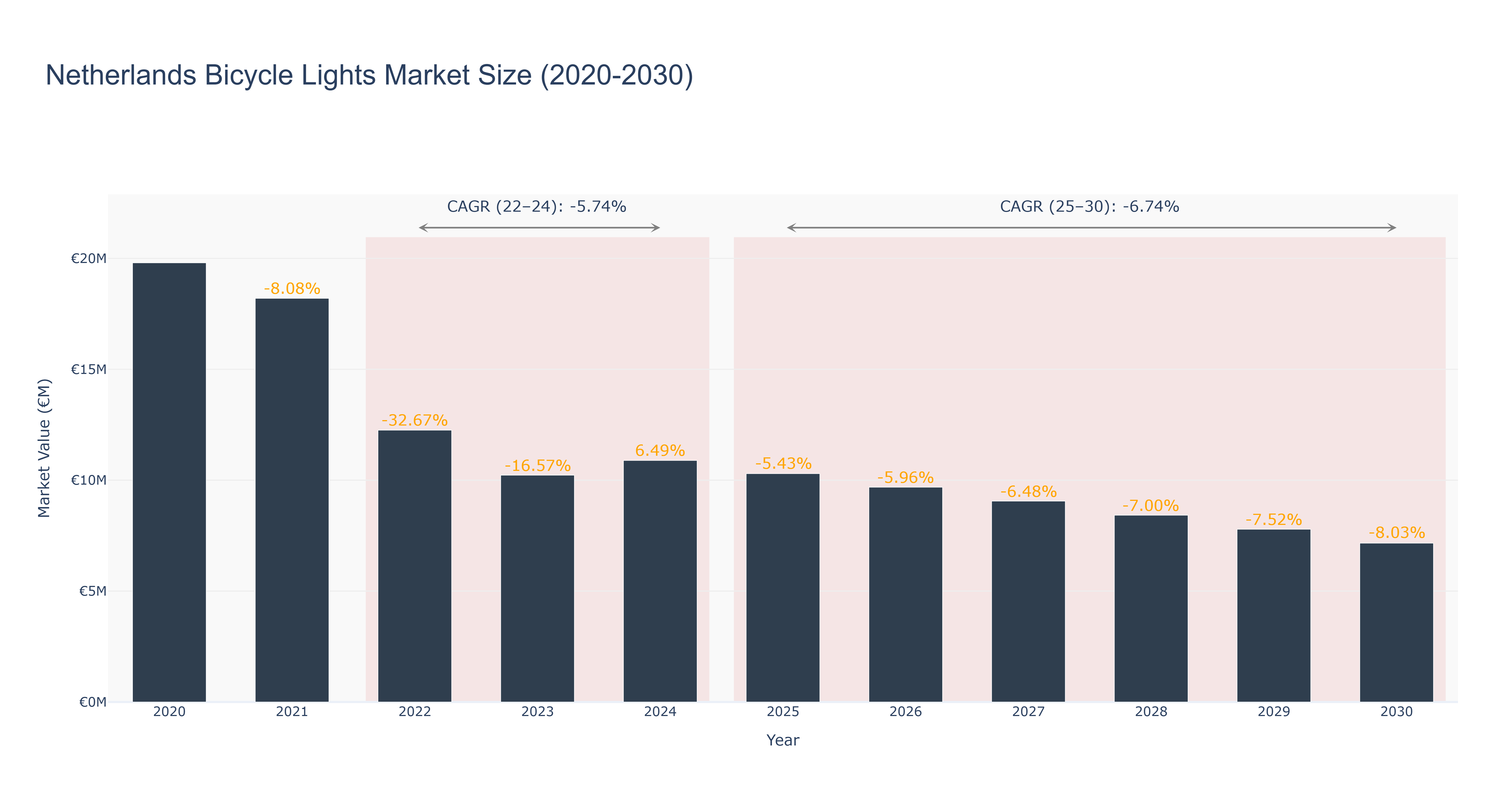
The Netherlands Bicycle Lights Market experienced a peak market size of €19.80 million in 2020, followed by a notable decline to €12.25 million in 2022, and further down to €10.22 million in 2023, reflecting an actual CAGR of -5.74% from 2022 to 2024. This downturn can be attributed to factors such as decreased bicycle usage during the pandemic and increased competition from alternative lighting solutions. Looking ahead, the forecasted period from 2025 to 2030 indicates a continued contraction in the market, with projected sizes decreasing from €10.30 million in 2025 to €7.16 million by 2030, resulting in a CAGR of -6.74%. The persistent decline suggests challenges related to market saturation and evolving consumer preferences. While no specific upcoming projects have been identified, macro drivers such as sustainability trends and potential regulatory changes may influence future demand for bicycle lighting solutions in the Netherlands.
Netherlands Bicycle Lights Market: Production & Trade Performance (2019-2025)
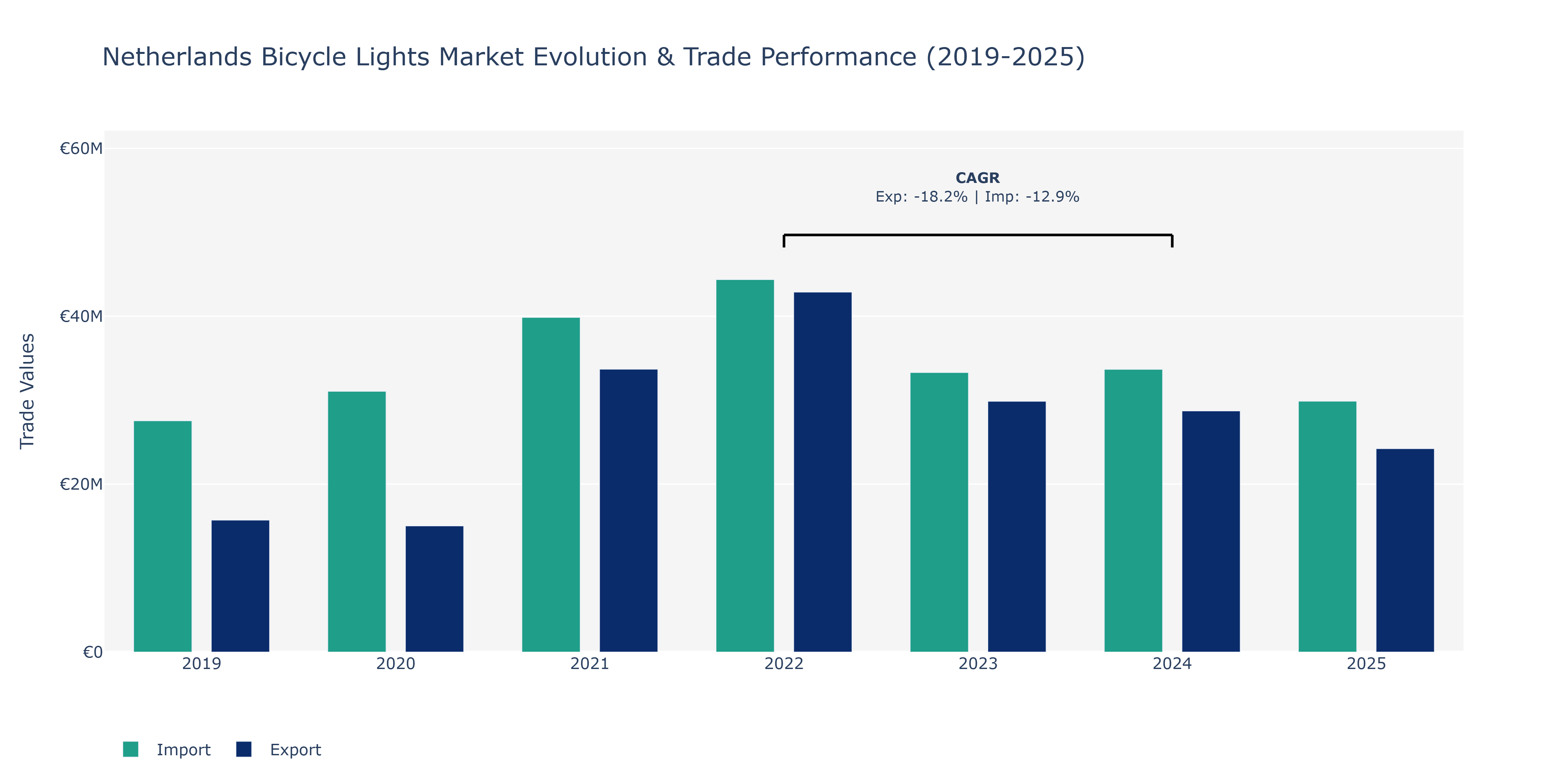
The Netherlands Bicycle Lights Market exhibited fluctuations in both Exports and Imports during the period under review. In 2019, Exports stood at approximately €15.71 million, experiencing a slight decline to around €15.02 million in 2020. However, a significant uptick was observed in 2021, with Exports reaching about €33.69 million, showcasing a strong growth trend. This growth trend continued in 2022, with Exports hitting around €42.87 million, before declining in the following years. Imports followed a similar pattern, increasing from about €27.55 million in 2019 to around €44.36 million in 2022, before dropping in subsequent years. The fluctuations in both Exports and Imports can be attributed to various factors such as changes in consumer demand, global economic conditions, and trade policies impacting the bicycle lights market in the Netherlands. Real-world developments like shifting consumer preferences towards sustainable transportation solutions and advancements in bicycle lighting technology could have influenced these market trends.
Key Highlights of the Report:
- Netherlands Bicycle Lights Market Outlook
- Market Size of Netherlands Bicycle Lights Market, 2025
- Forecast of Netherlands Bicycle Lights Market, 2032
- Historical Data and Forecast of Netherlands Bicycle Lights Revenues & Volume for the Period 2022 - 2032F
- Netherlands Bicycle Lights Market Trend Evolution
- Netherlands Bicycle Lights Market Drivers and Challenges
- Netherlands Bicycle Lights Price Trends
- Netherlands Bicycle Lights Porter`s Five Forces
- Netherlands Bicycle Lights Industry Life Cycle
- Historical Data and Forecast of Netherlands Bicycle Lights Market Revenues & Volume By Product Type for the Period 2022 - 2032F
- Historical Data and Forecast of Netherlands Bicycle Lights Market Revenues & Volume By Headlight for the Period 2022 - 2032F
- Historical Data and Forecast of Netherlands Bicycle Lights Market Revenues & Volume By Taillight for the Period 2022 - 2032F
- Historical Data and Forecast of Netherlands Bicycle Lights Market Revenues & Volume By Application for the Period 2022 - 2032F
- Historical Data and Forecast of Netherlands Bicycle Lights Market Revenues & Volume By Mountain Bicycle for the Period 2022 - 2032F
- Historical Data and Forecast of Netherlands Bicycle Lights Market Revenues & Volume By Road Bicycle for the Period 2022 - 2032F
- Historical Data and Forecast of Netherlands Bicycle Lights Market Revenues & Volume By Commuting Bicycle for the Period 2022 - 2032F
- Netherlands Bicycle Lights Import Export Trade Statistics
- Market Opportunity Assessment By Product Type
- Market Opportunity Assessment By Application
- Netherlands Bicycle Lights Top Companies Market Share
- Netherlands Bicycle Lights Competitive Benchmarking By Technical and Operational Parameters
- Netherlands Bicycle Lights Company Profiles
- Netherlands Bicycle Lights Key Strategic Recommendations






































