Cheese Market: Netherlands vs Top 5 Major Economies in 2027 (Europe)
By 2027, the Cheese market in Netherlands is anticipated to reach a growth rate of 4.61%, as part of an increasingly competitive Europe region, where Germany remains at the forefront, supported by United Kingdom, France, Italy and Russia, driving innovations and market adoption across sectors.
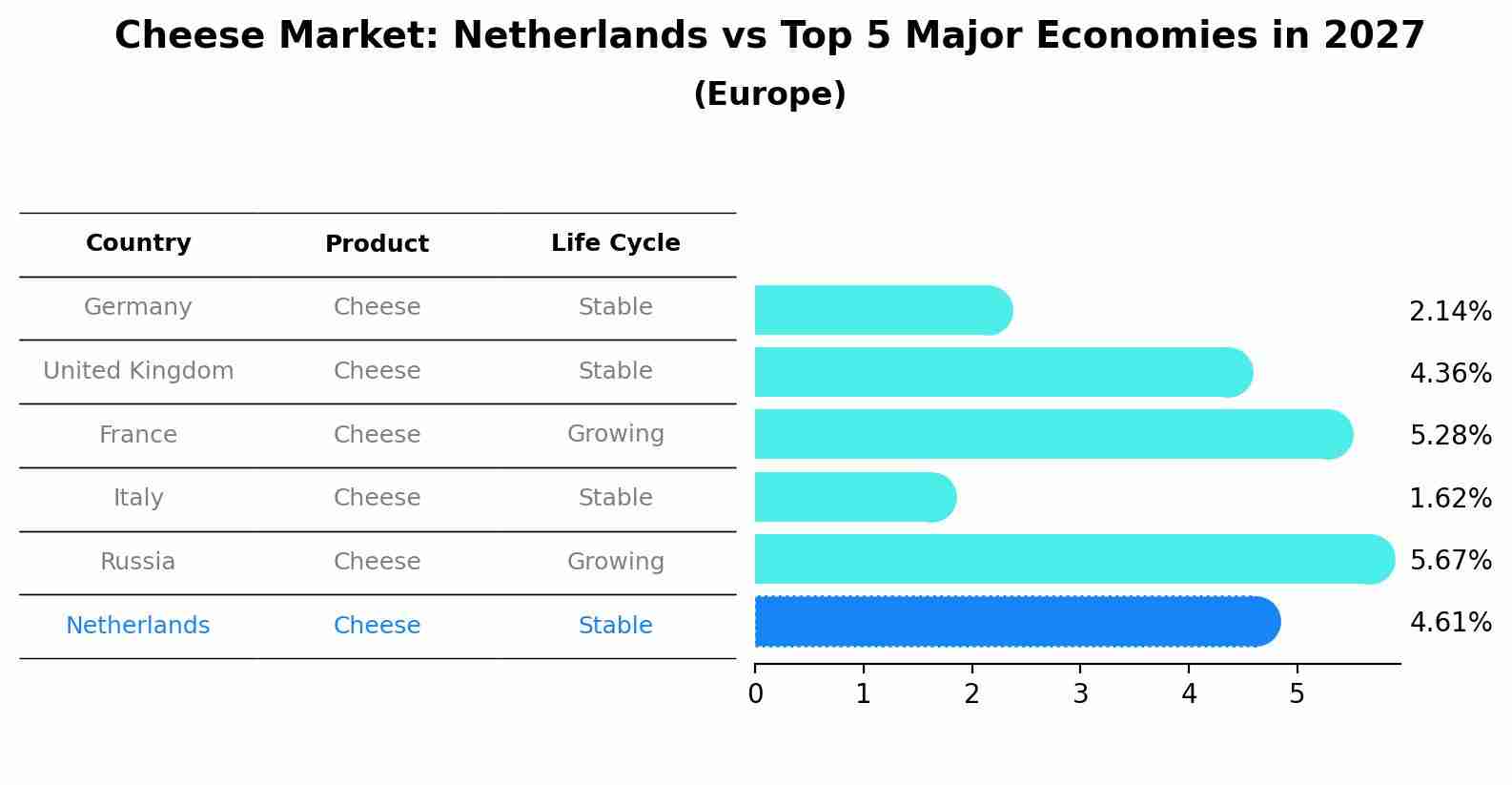
Netherlands Cheese Market Growth Rate
According to 6Wresearch internal database and industry insights, the Netherlands Cheese Market is projected to grow at a compound annual growth rate (CAGR) of 6.6% during the forecast period (2026–2032).
Five-Year Growth Trajectory of the Netherlands Cheese Market with Core Drivers
Below mentioned are the evaluation of year-wise growth rate along with key drivers:
| Years | Est. Annual Growth (%) | Growth Drivers |
| 2021 | 4.2 | Increasing demand for premium and specialty cheeses. |
| 2022 | 4.5 | Growth of cheese varieties in cafes and restaurants. |
| 2023 | 4.7 | Rise in demand for convenient processed cheese products. |
| 2024 | 4.9 | Expansion of cheese offerings in supermarkets and food specialty stores. |
| 2025 | 5.1 | Increased consumer spending and demand for high-quality cheese. |
Topics Covered in the Netherlands Cheese Market Report
The Netherlands Cheese Market report thoroughly covers the market by types, distribution channels, and source. It provides an unbiased and detailed analysis of ongoing market trends, opportunities, and market drivers, which would help stakeholders align their strategies with current and future market dynamics.
Netherlands Cheese Market Highlights
| Report Name | Netherlands Cheese Market |
| Forecast period | 2026–2032 |
| CAGR | 6.6% |
| Growing Sector | Food & Beverage |
Netherlands Cheese Market Synopsis
The Netherlands Cheese Market is witnessing a surge in the recent years due to the country's long-standing tradition in dairy production and an increase in the demand for both traditional and innovative cheese products. The country comprises high-quality cheese, especially cow-milk-based varieties, which dominate the domestic and export markets. The market growth has been driven majorly by some significant factors, such as rising disposable incomes and expanding retail infrastructure.
Evaluation of Growth Drivers in the Netherlands Cheese Market
Below mentioned are some prominent drivers and their influence on market dynamics:
| Drivers | Primary Segment Affected | Why It Matters (Evidence) |
| Growing Consumer Preference for Premium Products | Natural & Processed Cheese | Increased demand for high-quality, particularly specialty cheeses such as aged and artisanal varieties. |
| Export Demand & Trade Reach | Natural & Processed Cheese, Various Products | Strong export trade, particularly to other European markets and the U.S.. |
| Innovation in Cheese Varieties | Specialty Products, Processed Cheese | Growing interest in new flavors, such as flavored cheeses and convenient products like cheese snacks. |
| Expanding Retail & Distribution Networks | Hypermarkets, Supermarkets, Food Specialty Stores | The rise of modern retail outlets makes a variety of cheese products more accessible to consumers. |
| Agricultural Efficiency & Local Production Capacity | Cow Milk Cheeses | Efficient dairy farming and cheese production support both local demand and export opportunities. |
Netherlands Cheese Market Size is expected to grow steadily at a CAGR of 6.6% between 2026 and 2032. Here are several factors that are estimated to boost the market growth in the coming years, such as a rise in the domestic consumption and an increase in the demand for both traditional and processed cheeses. Specialty and artisanal cheeses are gaining popularity, as they offer unique flavors and textures, which attract consumers who are seeking premium and gourmet options. Additionally, with the rising expansion of retail and modern distribution channels, the sale of convenience-oriented and processed cheese products is increasing. Along with this, innovations are being made in cheese flavors, formats, and product variety, which helps attract both traditional consumers and younger. Furthermore, strong export demand and international trade contribute to the market’s growth, bolstering the Netherlands' cheese industry.
Evaluation of Restraints in the Netherlands Cheese Market
Below mentioned are some major restraints and their influence on the market dynamics:
| Restraints | Primary Segment Affected | What This Means (Evidence) |
| Competition from Dairy Alternatives | Cheese Products | The demand for conventional dairy cheeses may get reduced with the rising popularity of plant-based dairy alternatives. |
| Price Volatility of Raw Materials | Producers, Consumers | Production costs and retail prices may affected and varied due to price fluctuations in the cost of milk and other raw materials. |
| Market Saturation in Mature Domestic Market | Natural & Processed Cheese | With high per capita cheese consumption, the market may face challenges in expanding at a faster rate. |
| Health Concerns Related to Dairy Products | Consumers, Retailers | Growing health consciousness regarding dairy consumption, particularly in relation to fat content. |
| Stringent Regulatory Environment | All Segments | Stricter food safety regulations and standards for dairy products can impact production and distribution. |
Netherlands Cheese Market Challenges
However, the market faces some challenges that need to be addressed. These challenges are high dependence on milk and dairy imports and fluctuations in dairy prices. Increasing competition from plant-based dairy alternatives is another major challenge. In addition, some health concerns are associated with dairy products, which may limit the cheese production.
Netherlands Cheese Market Trends
Several notable trends are shaping the Netherlands Cheese Market dynamics:
- Specialty Cheese Demand: Increasing consumer interest in specialty cheeses, including aged, artisanal, and gourmet varieties.
- Rise of Processed Cheese Products: Convenience-focused products, such as cheese snacks, spreads, and ready-to-eat cheese items, are gaining popularity.
- Health-Conscious Cheese Varieties: Growing demand for low-fat, low-sodium, and lactose-free cheese options to cater to health-conscious consumers.
- Sustainability Focus: The shift towards sustainably produced cheese, including organic cheese varieties and those produced with reduced environmental impact.
- Plant-Based Cheese Alternatives: The rise of vegan cheese options as more consumers opt for plant-based diets.
Investment Opportunities in the Netherlands Cheese Industry
Some notable investment opportunities in the Netherlands Cheese Industry are:
- Sustainably Produced Cheese: Investment in sustainable and organic cheese production to meet the growing demand for eco-friendly and ethically sourced products.
- Convenient Cheese Products: Opportunities in the growing market for processed and ready-to-eat cheese products, such as cheese sticks, spreads, and snacks.
- Premium Cheese Production: Investment in premium cheese production, including unique and high-quality varieties that appeal to upscale consumers.
- Plant-Based Cheese: Capitalizing on the rise of plant-based diets by offering a wider range of dairy-free cheese alternatives.
- Cheese Export Expansion: Expanding the reach of Dutch cheese products to emerging markets and strengthening the export infrastructure.
Top 5 Leading Players in the Netherlands Cheese Market
Below is the list of prominent companies leading in the Netherlands Cheese Market:
1. FrieslandCampina
| Company Name | FrieslandCampina |
|---|---|
| Established Year | 1877 |
| Headquarters | Amersfoort, Netherlands |
| Official Website | Click Here |
FrieslandCampina is one of the largest dairy cooperatives in the world, offering a wide range of cheese products including Gouda and other specialty cheeses.
2. Royal A-Ware
| Company Name | Royal A-Ware |
|---|---|
| Established Year | 1956 |
| Headquarters | Heerenveen, Netherlands |
| Official Website | Click Here |
Royal A-Ware is a major Dutch cheese manufacturer, known for producing both traditional and innovative cheese products. They are heavily involved in sustainable dairy farming.
3. Cono Kaasmakers
| Company Name | Cono Kaasmakers |
|---|---|
| Established Year | 1901 |
| Headquarters | Edam, Netherlands |
| Official Website | Click Here |
Cono Kaasmakers is a prominent Dutch cheese producer known for its high-quality Edam and Gouda cheeses. The company focuses on artisanal production methods and sustainability.
4. Emmi Nederland
| Company Name | Emmi Nederland |
|---|---|
| Established Year | 1907 |
| Headquarters | Utrecht, Netherlands |
| Official Website | Click Here |
Emmi Nederland is part of the global Emmi Group and is a significant player in the Dutch cheese market. The company offers a wide variety of cheeses, including specialty and traditional cheeses.
5. Beemster Cheese
| Company Name | Beemster Cheese |
|---|---|
| Established Year | 1901 |
| Headquarters | Beemster, Netherlands |
| Official Website | Click Here |
Beemster Cheese is well-known for its premium, traditional Dutch cheeses, particularly its Beemster Gouda.
Government Regulations Introduced in the Netherlands Cheese Market
According to Dutch government data, market has been performing better in the country, as it is being governed by several key rules that ensure food safety, quality, and standards. The market operates under the European Union’s food safety framework, which is transposed into Dutch law through the Commodities Act. Cheese producers and distributors must compliance to the HACCP (Hazard Analysis Critical Control Point) system, which focuses on hygiene, traceability, storage, transport, and processing. Additionally, there are some regulatory standards introduced outlined in EU milk and dairy legislation. Which covers classification, permissible ingredients, and processing methods. And dairy products, including cheese, must meet these standards. Imported cheeses must comply with strict import regulations, including health certifications and adherence to EU safety standards.
Future Insights of the Netherlands Cheese Market
The Netherlands cheese market future seems optimistic owing to various factors, such as rising consumer interest in premium cheeses and increasing popularity of unique flavor profiles and innovative cheese varieties. A strong domestic demand as well as continued export opportunities. At the same time, regulatory and sustainability challenges, particularly concerning environmental policies related to dairy farming are likely to encourage more sustainable practices in the production process.
Market Segmentation Analysis
The report offers a comprehensive study of the following market segments and their leading categories:
By Type – Natural Cheese Segment Dominates the Market
According to Swani Singh, Senior Research Analyst, 6Wresearch, the natural cheese segment is expected to dominate the Netherlands Cheese Market, driven by the country's strong tradition of producing high-quality, cow-milk-based cheeses. This includes classic varieties such as Edam, Gouda, and Leyden. These cheeses are staples in both domestic consumption and international exports.
By Product – Mozzarella Expected to Lead the Market
Mozzarella is the leading product in the Netherlands Cheese Market, driven by its widespread use in pizza, sandwiches, and other culinary applications. Its versatility and demand across both domestic and export markets ensure its dominance.
By Source – Cow Milk Leads the Market
Cow milk remains the dominant source for cheese production in the Netherlands, accounting for the majority of cheese production. The established dairy farming industry in the country supports the large-scale production of cow-milk cheeses such as Gouda, Edam, and Leyden.
By Distribution Channel – Supermarkets Segment Expected to Dominate the Market
Supermarkets are expected to continue to dominate the Netherlands Cheese Market, offering a wide variety of cheese products for consumers. The growing number of supermarkets and hypermarkets in the Netherlands, combined with a shift toward convenience, fuels the demand for retail cheese.
Key Attractiveness of the Report
- 10 Years Market Numbers
- Historical Data (2022–2025)
- Base Year: 2025
- Forecast Data: 2032
- Key Performance Indicators impacting the market
- Major Upcoming Developments and Projects
Key Highlights of the Report:
- Netherlands Cheese Market Outlook
- Market Size of Netherlands Cheese Market, 2025
- Forecast of Netherlands Cheese Market, 2032
- Historical Data and Forecast of Netherlands Cheese Revenues & Volume for the Period 2022-2032
- Netherlands Cheese Market Trend Evolution
- Netherlands Cheese Market Drivers and Challenges
- Netherlands Cheese Price Trends
- Netherlands Cheese Porter`s Five Forces
- Netherlands Cheese Industry Life Cycle
- Historical Data and Forecast of Netherlands Cheese Market Revenues & Volume By Type for the Period 2022-2032
- Historical Data and Forecast of Netherlands Cheese Market Revenues & Volume By Natural for the Period 2022-2032
- Historical Data and Forecast of Netherlands Cheese Market Revenues & Volume By Processed for the Period 2022-2032
- Historical Data and Forecast of Netherlands Cheese Market Revenues & Volume By Product for the Period 2022-2032
- Historical Data and Forecast of Netherlands Cheese Market Revenues & Volume By Mozzarella for the Period 2022-2032
- Historical Data and Forecast of Netherlands Cheese Market Revenues & Volume By Cheddar for the Period 2022-2032
- Historical Data and Forecast of Netherlands Cheese Market Revenues & Volume By Feta for the Period 2022-2032
- Historical Data and Forecast of Netherlands Cheese Market Revenues & Volume By Parmesan for the Period 2022-2032
- Historical Data and Forecast of Netherlands Cheese Market Revenues & Volume By Roquefort for the Period 2022-2032
- Historical Data and Forecast of Netherlands Cheese Market Revenues & Volume By Others for the Period 2022-2032
- Historical Data and Forecast of Netherlands Cheese Market Revenues & Volume By Source for the Period 2022-2032
- Historical Data and Forecast of Netherlands Cheese Market Revenues & Volume By Cow Milk for the Period 2022-2032
- Historical Data and Forecast of Netherlands Cheese Market Revenues & Volume By Sheep Milk for the Period 2022-2032
- Historical Data and Forecast of Netherlands Cheese Market Revenues & Volume By Goat Milk for the Period 2022-2032
- Historical Data and Forecast of Netherlands Cheese Market Revenues & Volume By Buffalo for the Period 2022-2032
- Historical Data and Forecast of Netherlands Cheese Market Revenues & Volume By Distribution Channel for the Period 2022-2032
- Historical Data and Forecast of Netherlands Cheese Market Revenues & Volume By Hypermarkets for the Period 2022-2032
- Historical Data and Forecast of Netherlands Cheese Market Revenues & Volume By Supermarkets for the Period 2022-2032
- Historical Data and Forecast of Netherlands Cheese Market Revenues & Volume By Food Specialty Stores for the Period 2022-2032
- Historical Data and Forecast of Netherlands Cheese Market Revenues & Volume By Convenience Stores for the Period 2022-2032
- Historical Data and Forecast of Netherlands Cheese Market Revenues & Volume By Others for the Period 2022-2032
- Netherlands Cheese Import Export Trade Statistics
- Market Opportunity Assessment By Type
- Market Opportunity Assessment By Product
- Market Opportunity Assessment By Source
- Market Opportunity Assessment By Distribution Channel
- Netherlands Cheese Top Companies Market Share
- Netherlands Cheese Competitive Benchmarking By Technical and Operational Parameters
- Netherlands Cheese Company Profiles
- Netherlands Cheese Key Strategic Recommendations
Market Covered
The report offers a comprehensive study of the following market segments:
By Type
- Natural
- Processed
By Product
- Mozzarella
- Cheddar
- Feta
- Parmesan
- Roquefort
- Others
By Source
- Cow Milk
- Sheep Milk
- Goat Milk
- Buffalo
By Distribution Channel
- Hypermarkets
- Supermarkets
- Food Specialty Stores
- Convenience Stores
- Others






































