Netherlands Cornmeal Market Top 5 Importing Countries and Market Competition (HHI) Analysis
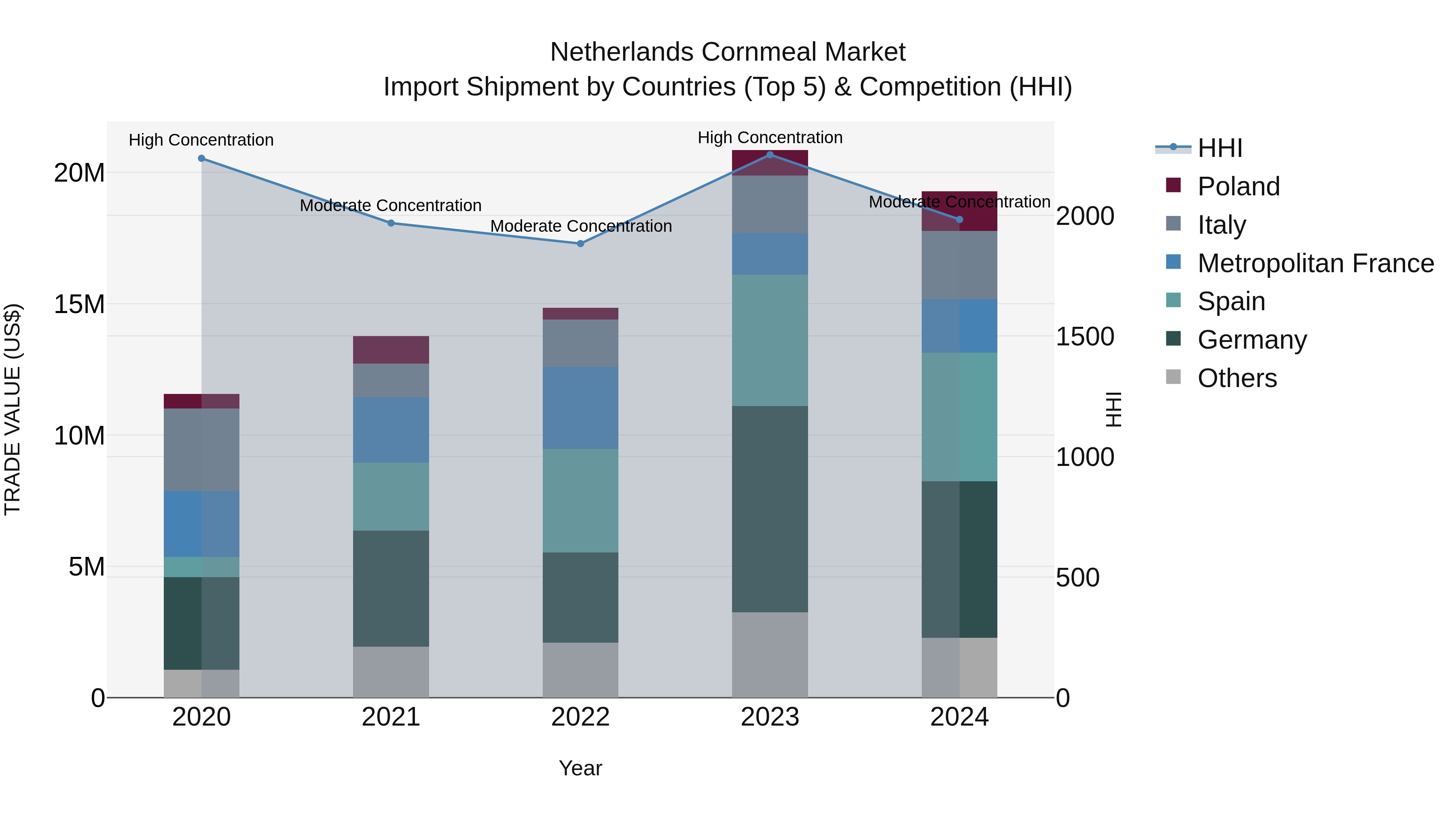
Netherlands experienced a shift in cornmeal import sources in 2024, with Germany, Spain, Italy, Metropolitan France, and Poland leading the way. The market showed a notable decrease in concentration levels from 2023 to 2024, moving from high to moderate concentration. Despite a slight decline in growth rate from 2023 to 2024, the compound annual growth rate (CAGR) for the period of 2020-2024 remained strong at 13.63%. This suggests a stable and growing market for cornmeal imports in the Netherlands, with diversified sources contributing to its supply chain resilience.
Netherlands Cornmeal Market Overview
The Netherlands cornmeal market is characterized by steady demand driven by the country`s diverse culinary landscape. Cornmeal, often used in traditional Dutch dishes like cornbread and porridge, is also popular in international cuisines such as Mexican and Italian. The market is supported by the country`s strong agricultural sector, ensuring a consistent supply of high-quality corn for processing. Health-conscious consumers are increasingly turning to cornmeal as a gluten-free alternative to wheat flour, further boosting its popularity. Key players in the market include both domestic producers and international suppliers, offering a range of cornmeal products to cater to different consumer preferences. As the demand for diverse and healthy food options continues to rise, the Netherlands cornmeal market is poised for steady growth in the coming years.
Netherlands Cornmeal Market Trends
In the Netherlands, the cornmeal market is experiencing a growing demand due to the increasing popularity of gluten-free and plant-based diets among consumers. Health-conscious individuals are turning to cornmeal as a versatile and nutritious alternative to traditional wheat-based products. Additionally, the rise of international cuisines, such as Mexican and South American dishes that often use cornmeal as a key ingredient, is driving further market growth. Manufacturers are responding to these trends by introducing innovative cornmeal products, such as organic and non-GMO options, as well as ready-to-use mixes for convenience. Sustainability and transparency in sourcing are also becoming important factors for consumers, leading to a shift towards ethically sourced and environmentally friendly cornmeal products in the market.
Netherlands Cornmeal Market Challenges
In the Netherlands, the cornmeal market faces challenges such as competition from other grains like wheat and rice, which are more commonly consumed in the region. Additionally, consumer preferences for traditional Dutch foods may limit the demand for cornmeal-based products. The limited availability of locally sourced corn and the reliance on imports can also impact the pricing and supply chain of cornmeal in the market. Moreover, changing dietary trends towards healthier and gluten-free options present a challenge for cornmeal products that may be perceived as less healthy or less versatile. To address these challenges, companies in the Netherlands cornmeal market may need to innovate by introducing new product variations, enhancing marketing strategies to educate consumers about the benefits of cornmeal, and exploring sustainable sourcing practices to differentiate themselves in the market.
Netherlands Cornmeal Market Investment Opportunities
In the Netherlands, the cornmeal market presents several investment opportunities for savvy investors. With the increasing consumer demand for gluten-free and plant-based products, there is a growing market for cornmeal-based products such as cornbread, polenta, and corn tortillas. Investing in food manufacturing companies that specialize in cornmeal products or in agricultural businesses that grow corn can be lucrative. Additionally, there is a trend towards healthier eating habits, leading to a potential market for organic and non-GMO cornmeal products. Collaborating with local farmers to cultivate corn sustainably and ethically could also be a promising investment opportunity. Overall, the Netherlands cornmeal market offers diverse possibilities for investment that cater to the evolving consumer preferences and market trends.
Netherlands Cornmeal Market Government Policy
In the Netherlands, government policies related to the cornmeal market primarily focus on food safety regulations, agricultural subsidies, and trade agreements. The Dutch government strictly regulates the production, labeling, and distribution of cornmeal to ensure consumer safety and quality standards are met. Additionally, agricultural subsidies are provided to corn farmers to support the industry and maintain a stable supply of cornmeal in the market. The Netherlands also participates in trade agreements, such as the EU Common Agricultural Policy, which influence the import and export of cornmeal, as well as tariffs and quotas. Overall, government policies in the Netherlands aim to promote a competitive and sustainable cornmeal market while ensuring food safety and supporting domestic corn production.
Netherlands Cornmeal Market Future Outlook
The future outlook for the Netherlands cornmeal market appears promising, driven by several factors. The increasing awareness of the health benefits of cornmeal, such as being gluten-free and high in fiber, is expected to boost its demand among health-conscious consumers. Additionally, the growing popularity of international cuisines using cornmeal as a key ingredient, such as Italian polenta and Mexican cornbread, is likely to drive market growth. Furthermore, the rising trend of home baking and cooking during the COVID-19 pandemic has led to increased consumption of cornmeal for making various dishes at home. With a focus on innovation and product development to cater to evolving consumer preferences, the Netherlands cornmeal market is anticipated to witness steady growth in the coming years.
Key Highlights of the Report:
- Netherlands Cornmeal Market Outlook
- Market Size of Netherlands Cornmeal Market,2024
- Forecast of Netherlands Cornmeal Market, 2031
- Historical Data and Forecast of Netherlands Cornmeal Revenues & Volume for the Period 2021-2031
- Netherlands Cornmeal Market Trend Evolution
- Netherlands Cornmeal Market Drivers and Challenges
- Netherlands Cornmeal Price Trends
- Netherlands Cornmeal Porter's Five Forces
- Netherlands Cornmeal Industry Life Cycle
- Historical Data and Forecast of Netherlands Cornmeal Market Revenues & Volume By Type for the Period 2021-2031
- Historical Data and Forecast of Netherlands Cornmeal Market Revenues & Volume By Yellow Cornmeal for the Period 2021-2031
- Historical Data and Forecast of Netherlands Cornmeal Market Revenues & Volume By White Cornmeal for the Period 2021-2031
- Historical Data and Forecast of Netherlands Cornmeal Market Revenues & Volume By Blue Cornmeal for the Period 2021-2031
- Historical Data and Forecast of Netherlands Cornmeal Market Revenues & Volume By Others for the Period 2021-2031
- Historical Data and Forecast of Netherlands Cornmeal Market Revenues & Volume By Processing Method for the Period 2021-2031
- Historical Data and Forecast of Netherlands Cornmeal Market Revenues & Volume By Stone-Ground for the Period 2021-2031
- Historical Data and Forecast of Netherlands Cornmeal Market Revenues & Volume By Steel-Ground for the Period 2021-2031
- Historical Data and Forecast of Netherlands Cornmeal Market Revenues & Volume By Organic for the Period 2021-2031
- Historical Data and Forecast of Netherlands Cornmeal Market Revenues & Volume By Others for the Period 2021-2031
- Historical Data and Forecast of Netherlands Cornmeal Market Revenues & Volume By Application for the Period 2021-2031
- Historical Data and Forecast of Netherlands Cornmeal Market Revenues & Volume By Bakery for the Period 2021-2031
- Historical Data and Forecast of Netherlands Cornmeal Market Revenues & Volume By Snacks for the Period 2021-2031
- Historical Data and Forecast of Netherlands Cornmeal Market Revenues & Volume By Industrial Use for the Period 2021-2031
- Historical Data and Forecast of Netherlands Cornmeal Market Revenues & Volume By Others for the Period 2021-2031
- Historical Data and Forecast of Netherlands Cornmeal Market Revenues & Volume By End User for the Period 2021-2031
- Historical Data and Forecast of Netherlands Cornmeal Market Revenues & Volume By Households for the Period 2021-2031
- Historical Data and Forecast of Netherlands Cornmeal Market Revenues & Volume By Restaurants for the Period 2021-2031
- Historical Data and Forecast of Netherlands Cornmeal Market Revenues & Volume By Food Manufacturers for the Period 2021-2031
- Historical Data and Forecast of Netherlands Cornmeal Market Revenues & Volume By Others for the Period 2021-2031
- Historical Data and Forecast of Netherlands Cornmeal Market Revenues & Volume By Distribution Channel for the Period 2021-2031
- Historical Data and Forecast of Netherlands Cornmeal Market Revenues & Volume By Retail for the Period 2021-2031
- Historical Data and Forecast of Netherlands Cornmeal Market Revenues & Volume By Wholesale for the Period 2021-2031
- Historical Data and Forecast of Netherlands Cornmeal Market Revenues & Volume By Direct Sales for the Period 2021-2031
- Historical Data and Forecast of Netherlands Cornmeal Market Revenues & Volume By Others for the Period 2021 - 2029
- Netherlands Cornmeal Import Export Trade Statistics
- Market Opportunity Assessment By Type
- Market Opportunity Assessment By Processing Method
- Market Opportunity Assessment By Application
- Market Opportunity Assessment By End User
- Market Opportunity Assessment By Distribution Channel
- Netherlands Cornmeal Top Companies Market Share
- Netherlands Cornmeal Competitive Benchmarking By Technical and Operational Parameters
- Netherlands Cornmeal Company Profiles
- Netherlands Cornmeal Key Strategic Recommendations






































