Netherlands Flavoured Tea Market Top 5 Importing Countries and Market Competition (HHI) Analysis
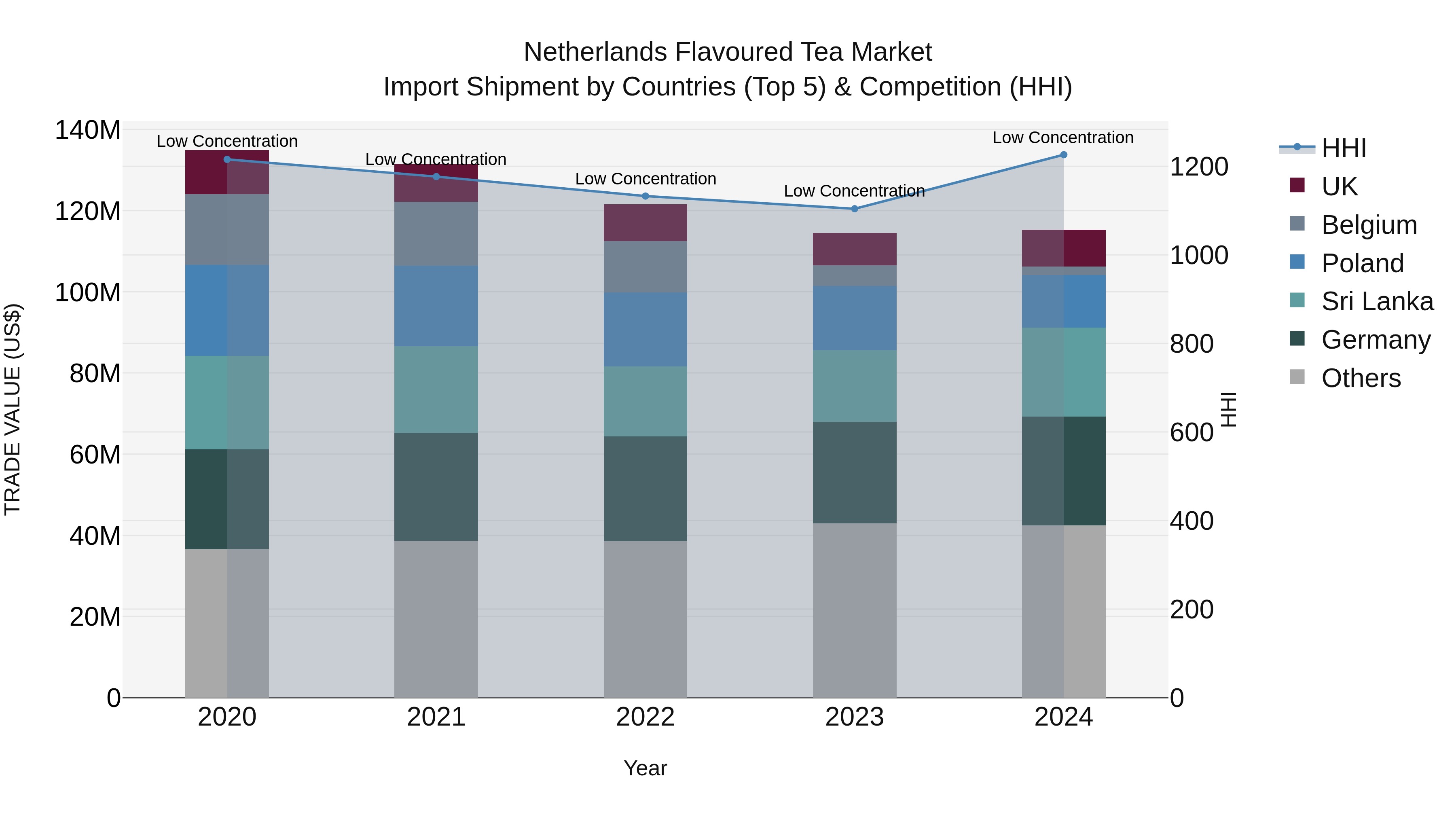
In 2024, Netherlands saw a diverse range of countries exporting flavoured tea, with Germany, Sri Lanka, Poland, UK, and India leading the pack. Despite the variety of sources, the market remained relatively unconcentrated with a low Herfindahl-Hirschman Index (HHI). The compound annual growth rate (CAGR) from 2020 to 2024 experienced a decline of -3.86%, indicating a challenging period for the industry. However, there was a slight uptick in growth from 2023 to 2024, with a growth rate of 0.69%, hinting at potential opportunities for the flavoured tea market in the Netherlands.
Key Highlights of the Report:
- Netherlands Flavoured Tea Market Outlook
- Market Size of Netherlands Flavoured Tea Market, 2025
- Forecast of Netherlands Flavoured Tea Market, 2032
- Historical Data and Forecast of Netherlands Flavoured Tea Revenues & Volume for the Period 2022 - 2032
- Netherlands Flavoured Tea Market Trend Evolution
- Netherlands Flavoured Tea Market Drivers and Challenges
- Netherlands Flavoured Tea Price Trends
- Netherlands Flavoured Tea Porter's Five Forces
- Netherlands Flavoured Tea Industry Life Cycle
- Historical Data and Forecast of Netherlands Flavoured Tea Market Revenues & Volume By Type for the Period 2022 - 2032
- Historical Data and Forecast of Netherlands Flavoured Tea Market Revenues & Volume By Loose Leaf Tea for the Period 2022 - 2032
- Historical Data and Forecast of Netherlands Flavoured Tea Market Revenues & Volume By CTC Tea for the Period 2022 - 2032
- Historical Data and Forecast of Netherlands Flavoured Tea Market Revenues & Volume By Flavour for the Period 2022 - 2032
- Historical Data and Forecast of Netherlands Flavoured Tea Market Revenues & Volume By Fruits for the Period 2022 - 2032
- Historical Data and Forecast of Netherlands Flavoured Tea Market Revenues & Volume By Flower for the Period 2022 - 2032
- Historical Data and Forecast of Netherlands Flavoured Tea Market Revenues & Volume By Herbs and Spices for the Period 2022 - 2032
- Historical Data and Forecast of Netherlands Flavoured Tea Market Revenues & Volume By Packaging format for the Period 2022 - 2032
- Historical Data and Forecast of Netherlands Flavoured Tea Market Revenues & Volume By Packed for the Period 2022 - 2032
- Historical Data and Forecast of Netherlands Flavoured Tea Market Revenues & Volume By Loose for the Period 2022 - 2032
- Historical Data and Forecast of Netherlands Flavoured Tea Market Revenues & Volume By Product Type for the Period 2022 - 2032
- Historical Data and Forecast of Netherlands Flavoured Tea Market Revenues & Volume By Black Tea for the Period 2022 - 2032
- Historical Data and Forecast of Netherlands Flavoured Tea Market Revenues & Volume By Green Tea for the Period 2022 - 2032
- Historical Data and Forecast of Netherlands Flavoured Tea Market Revenues & Volume By Herbal Tea for the Period 2022 - 2032
- Historical Data and Forecast of Netherlands Flavoured Tea Market Revenues & Volume By Oolong Tea for the Period 2022 - 2032
- Historical Data and Forecast of Netherlands Flavoured Tea Market Revenues & Volume By Distribution Channel for the Period 2022 - 2032
- Historical Data and Forecast of Netherlands Flavoured Tea Market Revenues & Volume By Online and Offline for the Period 2022 - 2032
- Historical Data and Forecast of Netherlands Flavoured Tea Market Revenues & Volume By Supermarkets/Hypermarkets for the Period 2022 - 2032
- Netherlands Flavoured Tea Import Export Trade Statistics
- Market Opportunity Assessment By Type
- Market Opportunity Assessment By Flavour
- Market Opportunity Assessment By Packaging format
- Market Opportunity Assessment By Product Type
- Market Opportunity Assessment By Distribution Channel
- Netherlands Flavoured Tea Top Companies Market Share
- Netherlands Flavoured Tea Competitive Benchmarking By Technical and Operational Parameters
- Netherlands Flavoured Tea Company Profiles
- Netherlands Flavoured Tea Key Strategic Recommendations






































