Netherlands Fruit Pulp Market Top 5 Importing Countries and Market Competition (HHI) Analysis
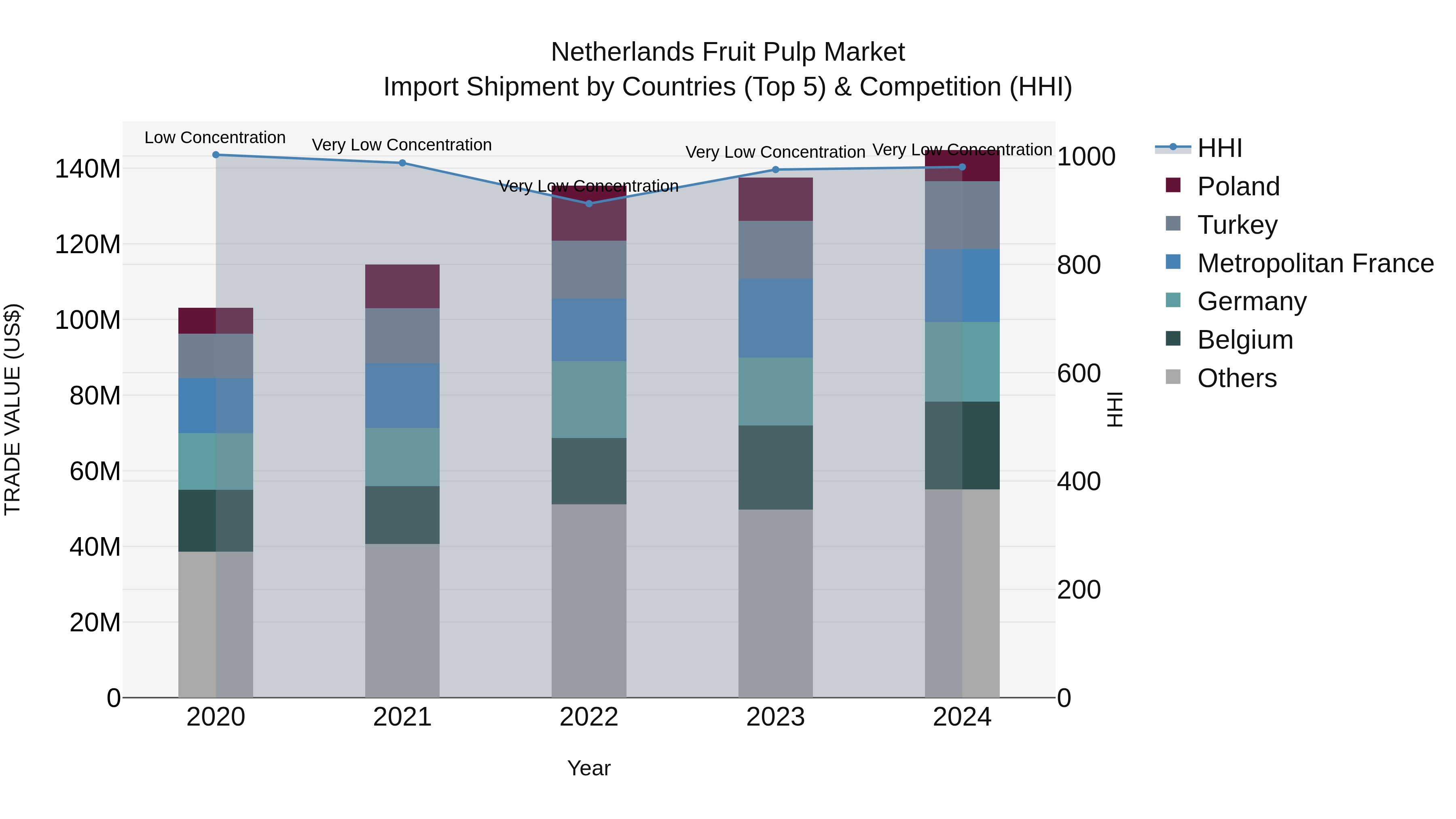
The Netherlands continues to be a key destination for fruit pulp imports in 2024, with top suppliers including Belgium, Germany, Metropolitan France, Turkey, and Spain. Despite the diverse sources, the market remains highly competitive, as indicated by the low Herfindahl-Hirschman Index (HHI) concentration. The strong compound annual growth rate (CAGR) of 8.87% from 2020 to 2024 reflects sustained market expansion, while the 5.27% growth rate in 2024 signals continued momentum. This data suggests a healthy and dynamic market for fruit pulp imports in the Netherlands, driven by a variety of suppliers and consistent growth trends.
Key Highlights of the Report:
- Netherlands Fruit Pulp Market Outlook
- Market Size of Netherlands Fruit Pulp Market, 2025
- Forecast of Netherlands Fruit Pulp Market, 2032
- Historical Data and Forecast of Netherlands Fruit Pulp Revenues & Volume for the Period 2022 - 2032F
- Netherlands Fruit Pulp Market Trend Evolution
- Netherlands Fruit Pulp Market Drivers and Challenges
- Netherlands Fruit Pulp Price Trends
- Netherlands Fruit Pulp Porter`s Five Forces
- Netherlands Fruit Pulp Industry Life Cycle
- Historical Data and Forecast of Netherlands Fruit Pulp Market Revenues & Volume By Fruit Type for the Period 2022 - 2032F
- Historical Data and Forecast of Netherlands Fruit Pulp Market Revenues & Volume By Mango for the Period 2022 - 2032F
- Historical Data and Forecast of Netherlands Fruit Pulp Market Revenues & Volume By Strawberry for the Period 2022 - 2032F
- Historical Data and Forecast of Netherlands Fruit Pulp Market Revenues & Volume By Apple for the Period 2022 - 2032F
- Historical Data and Forecast of Netherlands Fruit Pulp Market Revenues & Volume By Guava for the Period 2022 - 2032F
- Historical Data and Forecast of Netherlands Fruit Pulp Market Revenues & Volume By Berries for the Period 2022 - 2032F
- Historical Data and Forecast of Netherlands Fruit Pulp Market Revenues & Volume By Citrus Fruits for the Period 2022 - 2032F
- Historical Data and Forecast of Netherlands Fruit Pulp Market Revenues & Volume By Others for the Period 2022 - 2032F
- Historical Data and Forecast of Netherlands Fruit Pulp Market Revenues & Volume By Form for the Period 2022 - 2032F
- Historical Data and Forecast of Netherlands Fruit Pulp Market Revenues & Volume By Liquid for the Period 2022 - 2032F
- Historical Data and Forecast of Netherlands Fruit Pulp Market Revenues & Volume By Powder for the Period 2022 - 2032F
- Historical Data and Forecast of Netherlands Fruit Pulp Market Revenues & Volume By Application for the Period 2022 - 2032F
- Historical Data and Forecast of Netherlands Fruit Pulp Market Revenues & Volume By Food and Beverages for the Period 2022 - 2032F
- Historical Data and Forecast of Netherlands Fruit Pulp Market Revenues & Volume By Distribution for the Period 2022 - 2032F
- Historical Data and Forecast of Netherlands Fruit Pulp Market Revenues & Volume By E-Commerce for the Period 2022 - 2032F
- Historical Data and Forecast of Netherlands Fruit Pulp Market Revenues & Volume By Convenience Stores for the Period 2022 - 2032F
- Historical Data and Forecast of Netherlands Fruit Pulp Market Revenues & Volume By Supermarkets/Hypermarkets for the Period 2022 - 2032F
- Historical Data and Forecast of Netherlands Fruit Pulp Market Revenues & Volume By Specialty Stores for the Period 2022 - 2032F
- Historical Data and Forecast of Netherlands Fruit Pulp Market Revenues & Volume By Others for the Period 2022 - 2032F
- Netherlands Fruit Pulp Import Export Trade Statistics
- Market Opportunity Assessment By Fruit Type
- Market Opportunity Assessment By Form
- Market Opportunity Assessment By Application
- Market Opportunity Assessment By Distribution
- Netherlands Fruit Pulp Top Companies Market Share
- Netherlands Fruit Pulp Competitive Benchmarking By Technical and Operational Parameters
- Netherlands Fruit Pulp Company Profiles
- Netherlands Fruit Pulp Key Strategic Recommendations






































