Netherlands Heavy Fuel Oil Market Top 5 Importing Countries and Market Competition (HHI) Analysis
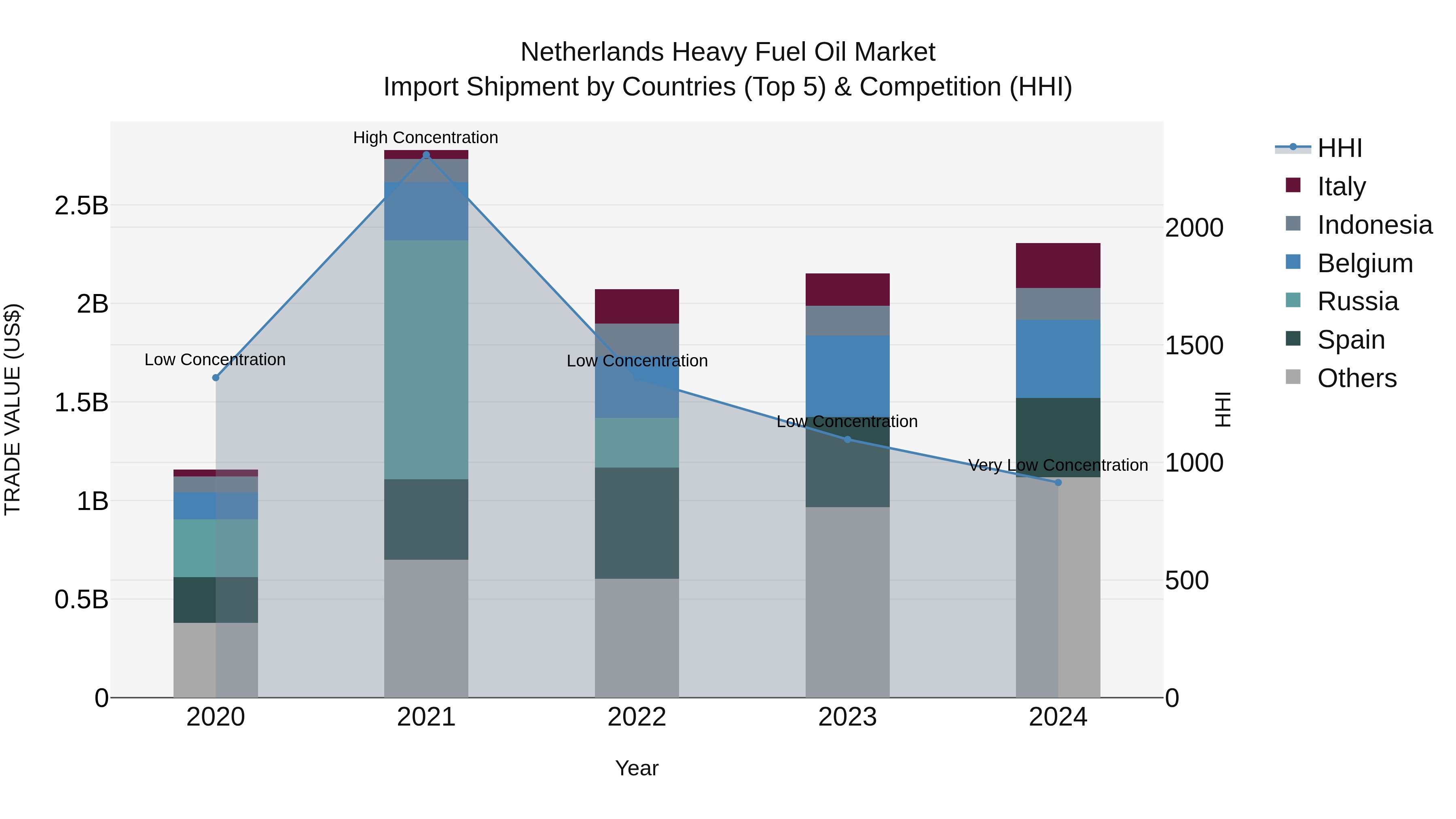
The Netherlands heavy fuel oil import market saw significant diversification in 2024, with Spain, Belgium, Italy, Indonesia, and Metropolitan France emerging as the top exporting countries. The market exhibited very low concentration, indicating a broader range of sources for imports. The impressive CAGR of 18.83% from 2020 to 2024 highlights the sector`s robust growth, with a notable growth rate of 7.12% from 2023 to 2024. This data suggests a dynamic and expanding market landscape for heavy fuel oil imports in the Netherlands.
Netherlands Heavy Fuel Oil Market Overview
The Netherlands heavy fuel oil market is influenced by several factors, including global oil prices, government regulations, and environmental concerns. As a major player in the maritime industry, the demand for heavy fuel oil is driven by shipping companies using it as a cost-effective fuel source for their vessels. However, with increasing pressure to reduce emissions and transition to cleaner energy sources, the market is facing challenges. The Dutch government`s push towards sustainable energy and stricter regulations on emissions from ships operating in Dutch waters are impacting the demand for heavy fuel oil. As a result, there is a growing interest in alternative fuels and technologies in the Netherlands, such as LNG and biofuels, which are expected to gradually replace heavy fuel oil in the future.
Netherlands Heavy Fuel Oil Market Trends
In the Netherlands heavy fuel oil market, we are seeing a shift towards cleaner and more sustainable energy sources due to increasing environmental regulations and a growing awareness of climate change. This trend is driving a decrease in the demand for heavy fuel oil, particularly in industries such as shipping and power generation. Companies are increasingly investing in alternative fuels such as LNG and biofuels to reduce their carbon footprint and comply with stricter emissions standards. Additionally, there is a growing interest in energy efficiency technologies and solutions to optimize fuel consumption and reduce operating costs. Overall, the heavy fuel oil market in the Netherlands is experiencing a transition towards greener and more environmentally friendly energy options.
Netherlands Heavy Fuel Oil Market Challenges
In the Netherlands heavy fuel oil market, challenges include increasing environmental regulations driving the shift towards cleaner energy sources, such as natural gas and renewable options. This transition poses a threat to the demand for heavy fuel oil, leading to potential oversupply and pricing pressures for companies operating in the sector. Additionally, geopolitical factors and global market dynamics can impact the availability and pricing of heavy fuel oil, further complicating the market landscape. Companies in the Netherlands heavy fuel oil market must navigate these challenges by investing in cleaner technologies, diversifying their energy sources, and adapting to the evolving regulatory environment to remain competitive in the long term.
Netherlands Heavy Fuel Oil Market Investment Opportunities
In the Netherlands heavy fuel oil market, there are several investment opportunities available for investors looking to capitalize on the energy sector. One potential opportunity lies in investing in companies that specialize in the production, distribution, and trading of heavy fuel oil. Additionally, with the increasing global focus on renewable energy sources, investing in companies that are transitioning towards cleaner energy alternatives such as LNG or biofuels could prove to be a lucrative option. Furthermore, investing in infrastructure projects that support the transportation and storage of heavy fuel oil within the Netherlands can also be a strategic investment choice. Overall, closely monitoring market trends, regulatory developments, and technological advancements in the energy sector will be key to identifying profitable investment opportunities in the Netherlands heavy fuel oil market.
Netherlands Heavy Fuel Oil Market Government Policy
The Netherlands has implemented several government policies related to the heavy fuel oil market. In 2019, the Dutch government announced a ban on the use of heavy fuel oil for inland shipping as part of efforts to reduce emissions and improve air quality. This ban is set to take effect in 2020 for smaller ships and by 2025 for larger vessels. Additionally, the Netherlands is a signatory to the International Maritime Organization`s sulfur emission regulations, which aim to reduce sulfur emissions from ships by limiting the sulfur content in marine fuels. These policies reflect the government`s commitment to promoting sustainable practices in the maritime industry and addressing environmental concerns related to heavy fuel oil use in the Netherlands.
Netherlands Heavy Fuel Oil Market Future Outlook
The future outlook for the Netherlands heavy fuel oil market is expected to face challenges as the country transitions towards cleaner energy sources in line with global efforts to reduce carbon emissions. With the implementation of stricter environmental regulations and the growing emphasis on sustainability, there is likely to be a decline in the demand for heavy fuel oil in the Netherlands. This shift towards cleaner fuels such as natural gas, renewable energy sources, and electrification in the transportation sector will impact the heavy fuel oil market in the country. Companies operating in this market will need to adapt their strategies to align with the changing regulatory landscape and consumer preferences for more environmentally friendly energy options.
Key Highlights of the Report:
- Netherlands Heavy Fuel Oil Market Outlook
- Market Size of Netherlands Heavy Fuel Oil Market,2024
- Forecast of Netherlands Heavy Fuel Oil Market, 2031
- Historical Data and Forecast of Netherlands Heavy Fuel Oil Revenues & Volume for the Period 2021-2031
- Netherlands Heavy Fuel Oil Market Trend Evolution
- Netherlands Heavy Fuel Oil Market Drivers and Challenges
- Netherlands Heavy Fuel Oil Price Trends
- Netherlands Heavy Fuel Oil Porter's Five Forces
- Netherlands Heavy Fuel Oil Industry Life Cycle
- Historical Data and Forecast of Netherlands Heavy Fuel Oil Market Revenues & Volume By Application for the Period 2021-2031
- Historical Data and Forecast of Netherlands Heavy Fuel Oil Market Revenues & Volume By Marine for the Period 2021-2031
- Historical Data and Forecast of Netherlands Heavy Fuel Oil Market Revenues & Volume By Power Generation for the Period 2021-2031
- Historical Data and Forecast of Netherlands Heavy Fuel Oil Market Revenues & Volume By Industrial Heating for the Period 2021-2031
- Historical Data and Forecast of Netherlands Heavy Fuel Oil Market Revenues & Volume By Manufacturing for the Period 2021-2031
- Historical Data and Forecast of Netherlands Heavy Fuel Oil Market Revenues & Volume By Residential Heating for the Period 2021 - 2029
- Historical Data and Forecast of Netherlands Heavy Fuel Oil Market Revenues & Volume By End use for the Period 2021-2031
- Historical Data and Forecast of Netherlands Heavy Fuel Oil Market Revenues & Volume By Shipping Industry for the Period 2021-2031
- Historical Data and Forecast of Netherlands Heavy Fuel Oil Market Revenues & Volume By Electricity Generation for the Period 2021-2031
- Historical Data and Forecast of Netherlands Heavy Fuel Oil Market Revenues & Volume By Manufacturing Industry for the Period 2021-2031
- Historical Data and Forecast of Netherlands Heavy Fuel Oil Market Revenues & Volume By Cement Industry for the Period 2021-2031
- Historical Data and Forecast of Netherlands Heavy Fuel Oil Market Revenues & Volume By Type for the Period 2021-2031
- Historical Data and Forecast of Netherlands Heavy Fuel Oil Market Revenues & Volume By Straight Run Fuel Oil for the Period 2021-2031
- Historical Data and Forecast of Netherlands Heavy Fuel Oil Market Revenues & Volume By Residuums for the Period 2021-2031
- Historical Data and Forecast of Netherlands Heavy Fuel Oil Market Revenues & Volume By Blend Fuels for the Period 2021-2031
- Historical Data and Forecast of Netherlands Heavy Fuel Oil Market Revenues & Volume By Geographic Supply Chain for the Period 2021-2031
- Historical Data and Forecast of Netherlands Heavy Fuel Oil Market Revenues & Volume By Production for the Period 2021-2031
- Historical Data and Forecast of Netherlands Heavy Fuel Oil Market Revenues & Volume By Refining for the Period 2021-2031
- Historical Data and Forecast of Netherlands Heavy Fuel Oil Market Revenues & Volume By Trading for the Period 2021-2031
- Netherlands Heavy Fuel Oil Import Export Trade Statistics
- Market Opportunity Assessment By Application
- Market Opportunity Assessment By End use
- Market Opportunity Assessment By Type
- Market Opportunity Assessment By Geographic Supply Chain
- Netherlands Heavy Fuel Oil Top Companies Market Share
- Netherlands Heavy Fuel Oil Competitive Benchmarking By Technical and Operational Parameters
- Netherlands Heavy Fuel Oil Company Profiles
- Netherlands Heavy Fuel Oil Key Strategic Recommendations






































