Netherlands Ilmenite Market Top 5 Importing Countries and Market Competition (HHI) Analysis
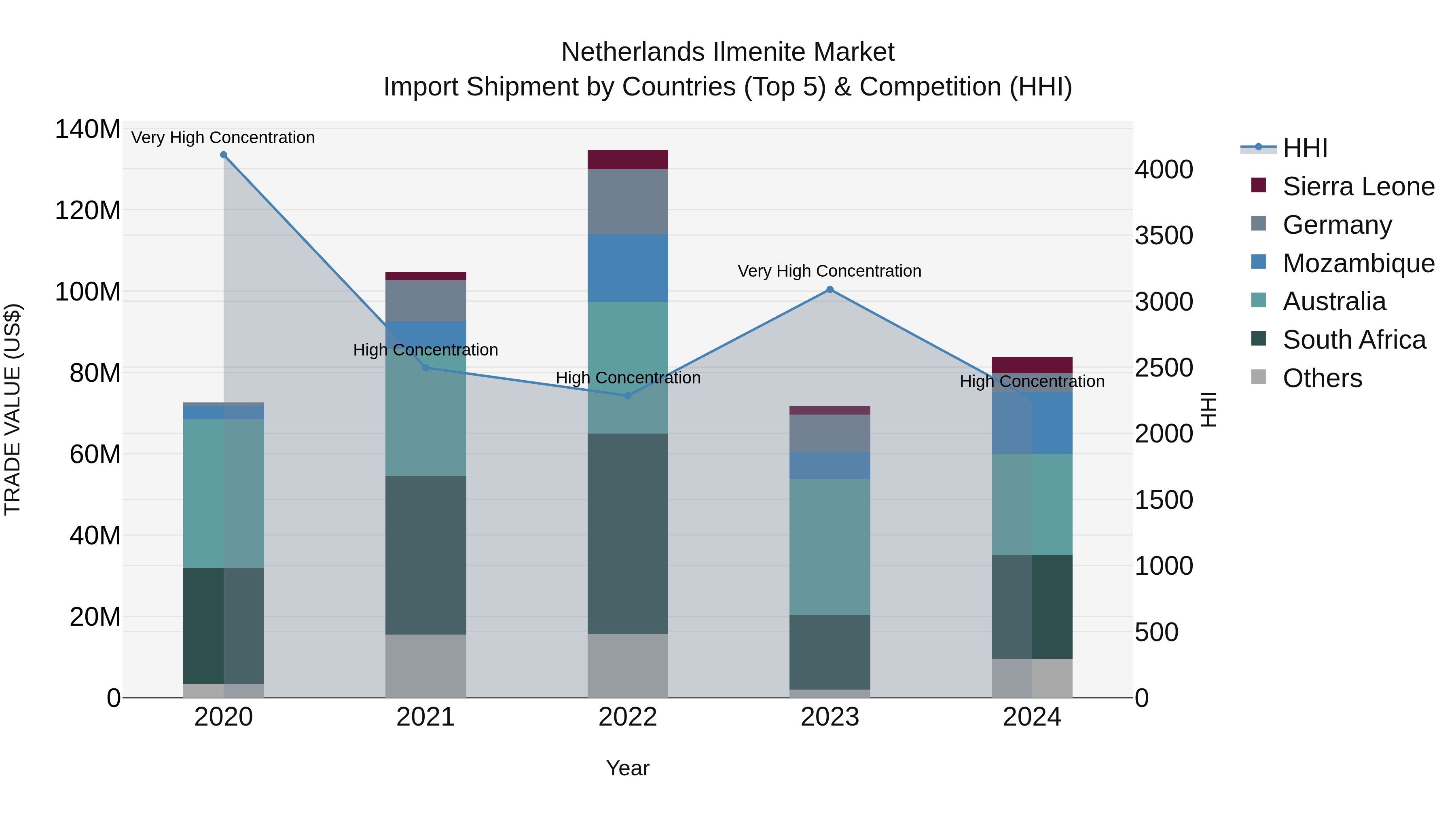
The Netherlands continued to be a key destination for ilmenite imports in 2024, with top exporters including South Africa, Australia, Mozambique, Kenya, and Germany. The market experienced a shift from very high concentration in 2023 to high concentration in 2024, indicating a more competitive landscape. The compound annual growth rate (CAGR) from 2020 to 2024 stood at 3.62%, with a notable growth rate of 16.77% from 2023 to 2024, reflecting a strong upward trend in ilmenite import shipments to the Netherlands.
Netherlands Ilmenite Market Market Overview
The Netherlands ilmenite market is characterized by steady growth due to the increasing demand for titanium dioxide pigment in various industries such as paints, plastics, and paper. Ilmenite is the primary source of titanium dioxide, and the Netherlands is a major importer of this mineral for processing into the pigment. The market is also influenced by the growing emphasis on sustainable and environmentally friendly practices, leading to a shift towards using ilmenite sourced from ethical and responsible mining operations. Key players in the Netherlands ilmenite market include mining companies, manufacturers, and suppliers who cater to the diverse needs of the end-user industries. The market is expected to continue growing as the demand for titanium dioxide pigment remains strong in the country`s industrial sector.
Netherlands Ilmenite Market Trends
In the Netherlands, the ilmenite market is experiencing a growing demand due to its wide range of applications in industries such as paints, plastics, and titanium dioxide production. With the increasing focus on sustainable practices, there is a rising interest in utilizing ilmenite as a feedstock for renewable energy technologies and carbon capture processes. Additionally, the market is seeing a shift towards sourcing ilmenite from environmentally responsible and ethically sourced suppliers, driving the demand for certified sustainable ilmenite products. As the Netherlands aims to reduce its carbon footprint and promote green initiatives, the ilmenite market is likely to witness further growth in the coming years, with a strong emphasis on sustainability and ethical sourcing practices.
Netherlands Ilmenite Market Challenges
In the Netherlands ilmenite market, one of the main challenges is the increasing competition from other countries that have lower production costs. This can put pressure on local ilmenite producers to lower their prices in order to remain competitive, which can potentially impact their profitability. Another challenge is the fluctuation in global demand for ilmenite, which can lead to volatility in prices and affect the overall market stability. Additionally, environmental regulations in the Netherlands can also pose challenges for ilmenite producers in terms of compliance and sustainability practices. Overall, navigating these competitive, demand-driven, and regulatory challenges requires strategic planning and adaptation for players in the Netherlands ilmenite market.
Netherlands Ilmenite Market Investment Opportunities
In the Netherlands, the ilmenite market presents promising investment opportunities due to the increasing demand for titanium dioxide, which is a key product derived from ilmenite. As a critical component in various industries such as paints, plastics, and paper, ilmenite is sought after for its white pigment properties and its use in producing titanium metal. Investors can consider opportunities in mining and extraction operations to capitalize on the growing demand for ilmenite. Additionally, advancements in technology for processing ilmenite into high-value titanium products present avenues for investment in research and development. With the Netherlands` strategic location and access to global markets, investing in the ilmenite market could offer long-term profitability and growth potential.
Netherlands Ilmenite Market Government Policy
The government policies related to the Netherlands ilmenite market primarily focus on environmental sustainability and promoting responsible mining practices. The Dutch government has implemented regulations to ensure that ilmenite mining activities adhere to strict environmental standards, with a particular emphasis on minimizing the impact on local ecosystems and communities. Additionally, there is a push towards promoting transparency in the supply chain to prevent any illegal or unethical practices. The government also supports initiatives that encourage the use of ilmenite in sustainable applications, such as renewable energy and green technology. Overall, the Netherlands government is actively working towards creating a more sustainable and ethical ilmenite market within the country.
Netherlands Ilmenite Market Future Outlook
The future outlook for the Netherlands ilmenite market appears to be promising due to increasing demand from various industries such as paints, plastics, and paper. The market is expected to witness steady growth driven by the rising use of ilmenite as a pigment in the manufacturing of paints and coatings. Additionally, the growing focus on sustainable practices and environmentally friendly products is likely to drive the demand for ilmenite as it is considered a more eco-friendly alternative to other pigments. Furthermore, technological advancements in the ilmenite extraction process are expected to improve efficiency and reduce production costs, which could further boost market growth in the coming years. Overall, the Netherlands ilmenite market is anticipated to experience positive growth trends in the foreseeable future.
Key Highlights of the Report:
- Netherlands Ilmenite Market Outlook
- Market Size of Netherlands Ilmenite Market,2024
- Forecast of Netherlands Ilmenite Market, 2031
- Historical Data and Forecast of Netherlands Ilmenite Revenues & Volume for the Period 2021-2031
- Netherlands Ilmenite Market Trend Evolution
- Netherlands Ilmenite Market Drivers and Challenges
- Netherlands Ilmenite Price Trends
- Netherlands Ilmenite Porter's Five Forces
- Netherlands Ilmenite Industry Life Cycle
- Historical Data and Forecast of Netherlands Ilmenite Market Revenues & Volume By Product Type for the Period 2021-2031
- Historical Data and Forecast of Netherlands Ilmenite Market Revenues & Volume By Rutile Ilmenite for the Period 2021-2031
- Historical Data and Forecast of Netherlands Ilmenite Market Revenues & Volume By Leucoxene Ilmenite for the Period 2021-2031
- Historical Data and Forecast of Netherlands Ilmenite Market Revenues & Volume By High-Ti Ilmenite for the Period 2021-2031
- Historical Data and Forecast of Netherlands Ilmenite Market Revenues & Volume By Low-Ti Ilmenite for the Period 2021-2031
- Historical Data and Forecast of Netherlands Ilmenite Market Revenues & Volume By Upgraded Ilmenite for the Period 2021 - 2029
- Historical Data and Forecast of Netherlands Ilmenite Market Revenues & Volume By Application for the Period 2021-2031
- Historical Data and Forecast of Netherlands Ilmenite Market Revenues & Volume By Titanium Dioxide Pigments for the Period 2021-2031
- Historical Data and Forecast of Netherlands Ilmenite Market Revenues & Volume By Welding Electrodes for the Period 2021-2031
- Historical Data and Forecast of Netherlands Ilmenite Market Revenues & Volume By Ceramics Production for the Period 2021-2031
- Historical Data and Forecast of Netherlands Ilmenite Market Revenues & Volume By Steel & Alloy Manufacturing for the Period 2021-2031
- Historical Data and Forecast of Netherlands Ilmenite Market Revenues & Volume By Water Purification for the Period 2021 - 2029
- Historical Data and Forecast of Netherlands Ilmenite Market Revenues & Volume By End User for the Period 2021-2031
- Historical Data and Forecast of Netherlands Ilmenite Market Revenues & Volume By Paints & Coatings Industry for the Period 2021-2031
- Historical Data and Forecast of Netherlands Ilmenite Market Revenues & Volume By Aerospace & Defense for the Period 2021-2031
- Historical Data and Forecast of Netherlands Ilmenite Market Revenues & Volume By Automotive Industry for the Period 2021-2031
- Historical Data and Forecast of Netherlands Ilmenite Market Revenues & Volume By Chemical Industry for the Period 2021-2031
- Historical Data and Forecast of Netherlands Ilmenite Market Revenues & Volume By Electronics & Semiconductors for the Period 2021 - 2029
- Historical Data and Forecast of Netherlands Ilmenite Market Revenues & Volume By Sales Channel for the Period 2021-2031
- Historical Data and Forecast of Netherlands Ilmenite Market Revenues & Volume By Direct Procurement for the Period 2021-2031
- Historical Data and Forecast of Netherlands Ilmenite Market Revenues & Volume By Distributors for the Period 2021-2031
- Historical Data and Forecast of Netherlands Ilmenite Market Revenues & Volume By Online Sales for the Period 2021-2031
- Historical Data and Forecast of Netherlands Ilmenite Market Revenues & Volume By Bulk Buyers for the Period 2021-2031
- Historical Data and Forecast of Netherlands Ilmenite Market Revenues & Volume By Retailers for the Period 2021 - 2029
- Historical Data and Forecast of Netherlands Ilmenite Market Revenues & Volume By Processing Method for the Period 2021-2031
- Historical Data and Forecast of Netherlands Ilmenite Market Revenues & Volume By Chloride Process for the Period 2021-2031
- Historical Data and Forecast of Netherlands Ilmenite Market Revenues & Volume By Sulfate Process for the Period 2021-2031
- Historical Data and Forecast of Netherlands Ilmenite Market Revenues & Volume By Synthetic Rutile Process for the Period 2021-2031
- Historical Data and Forecast of Netherlands Ilmenite Market Revenues & Volume By Smelting Process for the Period 2021 - 2029
- Historical Data and Forecast of Netherlands Ilmenite Market Revenues & Volume By Thermal Upgrading for the Period 2021 - 2029
- Netherlands Ilmenite Import Export Trade Statistics
- Market Opportunity Assessment By Product Type
- Market Opportunity Assessment By Application
- Market Opportunity Assessment By End User
- Market Opportunity Assessment By Sales Channel
- Market Opportunity Assessment By Processing Method
- Netherlands Ilmenite Top Companies Market Share
- Netherlands Ilmenite Competitive Benchmarking By Technical and Operational Parameters
- Netherlands Ilmenite Company Profiles
- Netherlands Ilmenite Key Strategic Recommendations






































