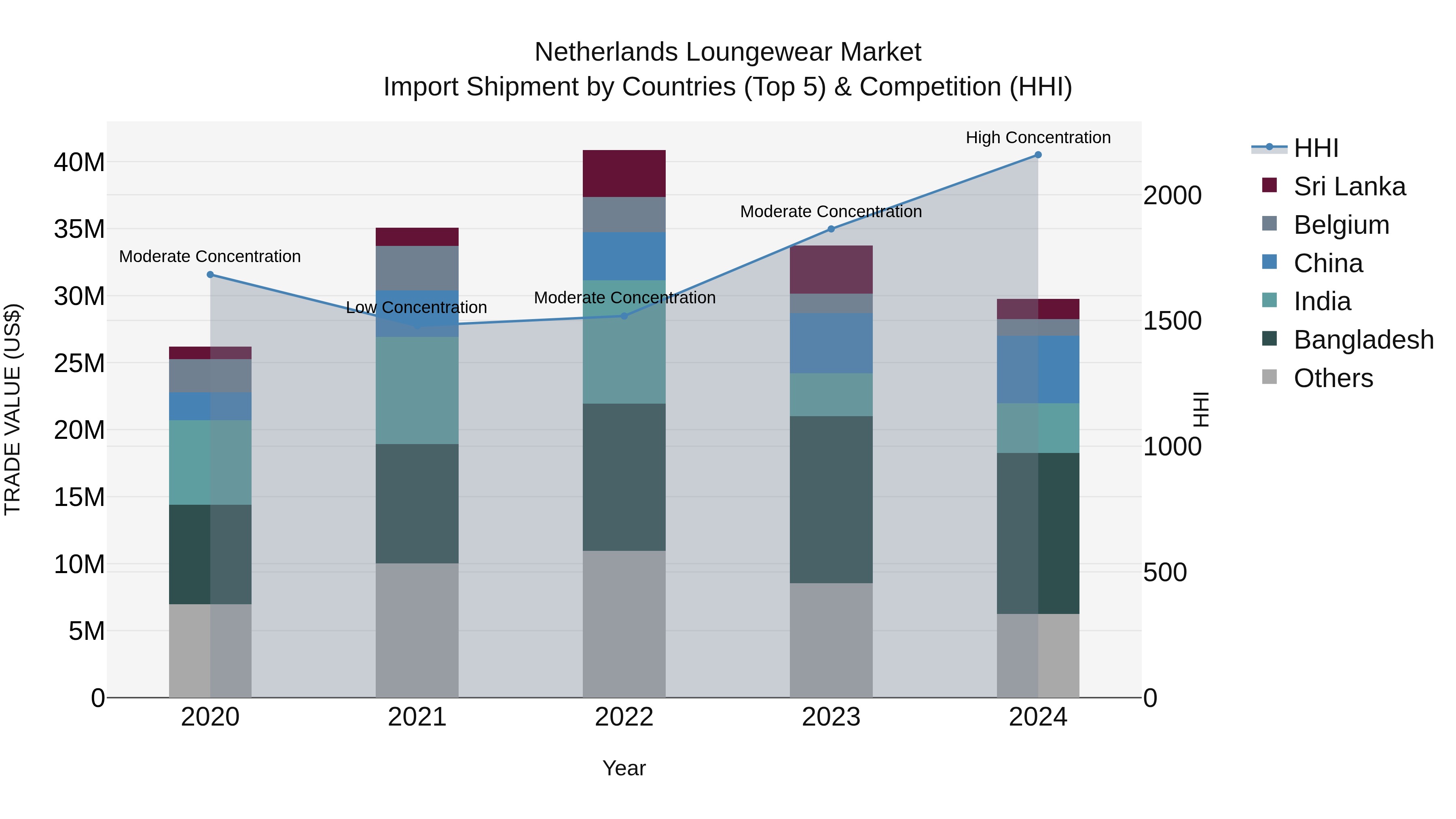
Netherlands Loungewear Market Import Shipment by Countries (Top 5) & Competition (HHI)
The Netherlands saw a significant shift in loungewear import sources in 2024, with top exporters being Bangladesh, China, India, Germany, and Sri Lanka. The market witnessed a notable increase in concentration levels from moderate to high, indicating a more focused supplier base. Despite a slight decline in growth rate in 2024, the compound annual growth rate (CAGR) from 2020 to 2024 remained positive at 3.26%. This suggests continued stability and potential for further development in the loungewear import market in the Netherlands.
Netherlands Loungewear Market Synopsis
The Netherlands loungewear market is experiencing steady growth, driven by the increasing consumer preference for comfortable and versatile clothing options. With a focus on quality fabrics and stylish designs, loungewear brands in the Netherlands are catering to the demand for both home and leisurewear. The market is characterized by a wide range of offerings, including loungewear sets, joggers, hoodies, and pajamas, with a growing emphasis on sustainability and ethical production practices. Dutch consumers are increasingly valuing loungewear as a key fashion staple, contributing to the market`s expansion. Key players in the Netherlands loungewear market include established brands as well as emerging sustainable and boutique labels, reflecting a diverse and competitive landscape with opportunities for further innovation and growth.
Netherlands Loungewear Market Trends
The Netherlands loungewear market is experiencing a surge in demand due to the increasing emphasis on comfort and relaxation in daily wear. With the rise of remote work and the popularity of stay-at-home activities, consumers are seeking comfortable yet stylish loungewear options. This trend has created opportunities for brands to innovate with sustainable materials, inclusive sizing, and versatile designs that can transition from lounging at home to running errands. Additionally, the growing focus on wellness and self-care has led to a demand for loungewear pieces that promote relaxation and mindfulness. Collaborations between loungewear brands and influencers or celebrities are also driving consumer interest in this market. Overall, there is potential for brands to capitalize on the Netherlands loungewear market by offering high-quality, trend-forward loungewear options that cater to the evolving needs and preferences of consumers.
Netherlands Loungewear Market Challenges
In the Netherlands loungewear market, one of the key challenges is the increasing competition from both domestic and international brands offering similar products. This heightened competition puts pressure on loungewear companies to differentiate themselves through unique designs, quality materials, and sustainable practices while also maintaining competitive pricing. Additionally, the fluctuating consumer preferences and fashion trends require loungewear brands to stay agile and constantly innovate to meet changing demands. Another challenge is the impact of the COVID-19 pandemic, which has disrupted supply chains, shifted consumer behaviors, and led to economic uncertainty, all of which have affected the loungewear market. To succeed in this competitive landscape, companies must adapt to these challenges by focusing on innovation, sustainability, and consumer-centric strategies.
Netherlands Loungewear Market Investment Opportunities
The Netherlands loungewear market is being driven by several key factors. Firstly, the shift towards a more casual and comfortable lifestyle, especially accelerated by the remote working trend, has increased the demand for loungewear as versatile and stylish clothing options. Additionally, the growing focus on wellness and self-care among consumers has led to an increased preference for cozy and soft fabrics in loungewear. The rise of social media influencers and celebrities promoting loungewear as fashion staples has also contributed to the market growth, influencing consumer purchasing decisions. Furthermore, the impact of the COVID-19 pandemic has further boosted the loungewear market in the Netherlands, as more people are spending time at home and seeking comfortable yet trendy clothing options.
Netherlands Loungewear Market Government Policie
The Netherlands government does not have specific policies directly targeting the loungewear market. However, general consumer protection laws, labeling requirements, and environmental regulations apply to loungewear products sold in the country. The Dutch government places a strong emphasis on sustainability and ethical production practices, which can impact loungewear manufacturers and retailers operating in the market. Furthermore, the government has implemented initiatives to promote fair labor practices and transparency in supply chains, which could also influence the loungewear industry in the Netherlands. Overall, while there are no specific policies exclusively focused on the loungewear market, businesses in this sector must adhere to existing regulations related to consumer rights, sustainability, and ethical standards set forth by the Dutch government.
Netherlands Loungewear Market Future Outlook
The future outlook for the Netherlands loungewear market appears promising as the demand for comfortable and stylish clothing continues to grow. Factors such as the increasing trend of remote working, emphasis on self-care and wellness, and a shift towards casual and versatile attire are expected to drive the market`s growth. Additionally, with the rise of e-commerce platforms making it easier for consumers to shop online, the loungewear market is likely to experience further expansion. Market players focusing on sustainability, inclusivity, and innovative designs are anticipated to gain a competitive edge in meeting the evolving preferences of consumers. Overall, the Netherlands loungewear market is poised for steady growth in the coming years, presenting opportunities for brands to capitalize on the growing demand for cozy and fashionable loungewear options.
Key Highlights of the Report:
- Netherlands Loungewear Market Outlook
- Market Size of Netherlands Loungewear Market, 2024
- Forecast of Netherlands Loungewear Market, 2031
- Historical Data and Forecast of Netherlands Loungewear Revenues & Volume for the Period 2021- 2031
- Netherlands Loungewear Market Trend Evolution
- Netherlands Loungewear Market Drivers and Challenges
- Netherlands Loungewear Price Trends
- Netherlands Loungewear Porter's Five Forces
- Netherlands Loungewear Industry Life Cycle
- Historical Data and Forecast of Netherlands Loungewear Market Revenues & Volume By Material for the Period 2021- 2031
- Historical Data and Forecast of Netherlands Loungewear Market Revenues & Volume By Cotton for the Period 2021- 2031
- Historical Data and Forecast of Netherlands Loungewear Market Revenues & Volume By Wool for the Period 2021- 2031
- Historical Data and Forecast of Netherlands Loungewear Market Revenues & Volume By Silk for the Period 2021- 2031
- Historical Data and Forecast of Netherlands Loungewear Market Revenues & Volume By End User for the Period 2021- 2031
- Historical Data and Forecast of Netherlands Loungewear Market Revenues & Volume By Female for the Period 2021- 2031
- Historical Data and Forecast of Netherlands Loungewear Market Revenues & Volume By Male for the Period 2021- 2031
- Historical Data and Forecast of Netherlands Loungewear Market Revenues & Volume By Kids for the Period 2021- 2031
- Historical Data and Forecast of Netherlands Loungewear Market Revenues & Volume By Distribution Channel for the Period 2021- 2031
- Historical Data and Forecast of Netherlands Loungewear Market Revenues & Volume By Store-Based for the Period 2021- 2031
- Historical Data and Forecast of Netherlands Loungewear Market Revenues & Volume By Non-Store-Based for the Period 2021- 2031
- Netherlands Loungewear Import Export Trade Statistics
- Market Opportunity Assessment By Material
- Market Opportunity Assessment By End User
- Market Opportunity Assessment By Distribution Channel
- Netherlands Loungewear Top Companies Market Share
- Netherlands Loungewear Competitive Benchmarking By Technical and Operational Parameters
- Netherlands Loungewear Company Profiles
- Netherlands Loungewear Key Strategic Recommendations






































