Netherlands Pcb Market Top 5 Importing Countries and Market Competition (HHI) Analysis
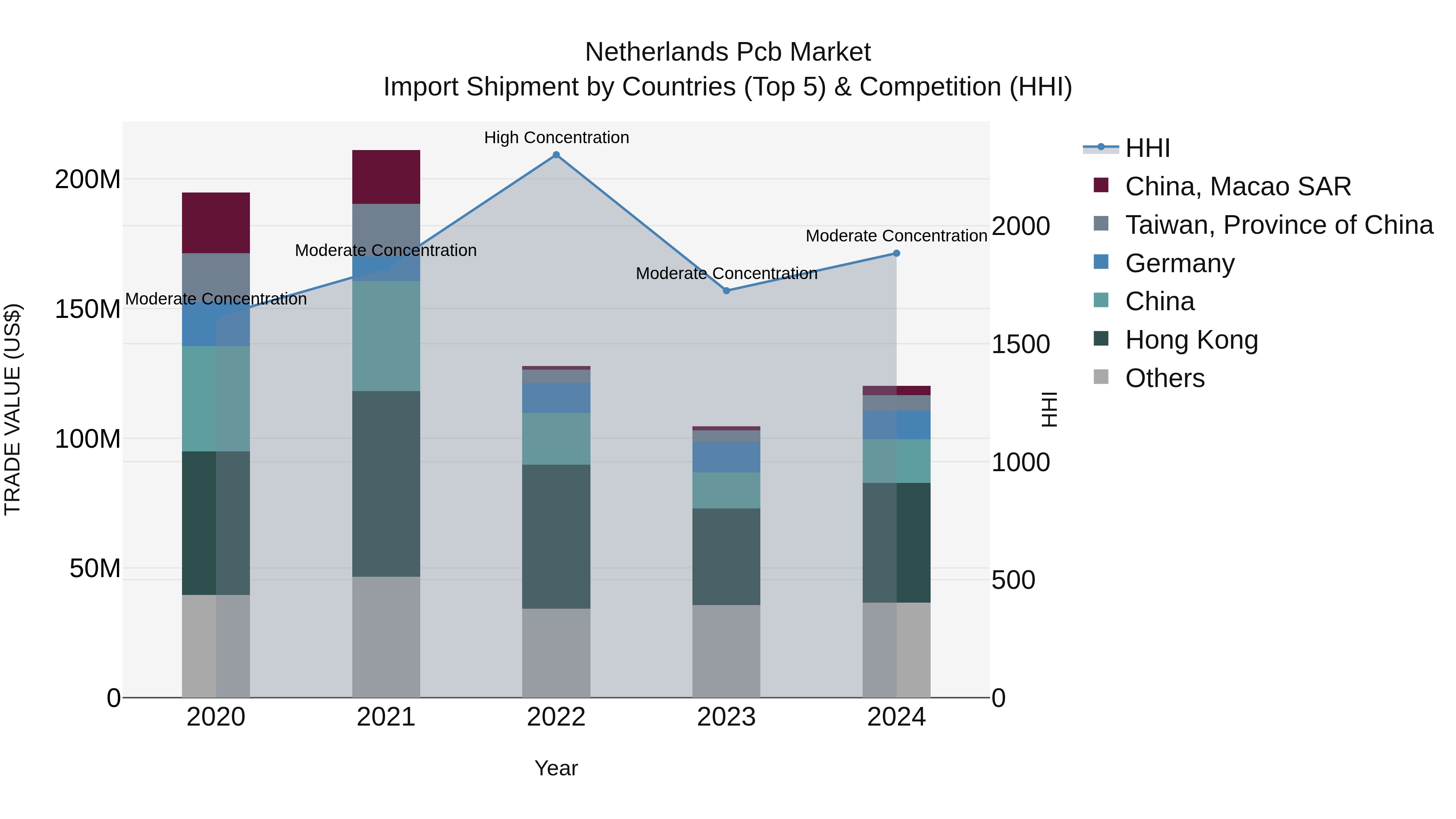
In 2024, Netherlands saw significant PCB import shipments from top exporting countries including Hong Kong, China, Germany, Metropolitan France, and Taiwan. The market remained moderately concentrated with a stable HHI index. Despite a negative CAGR from 2020 to 2024, the growth rate in 2024 showed a positive trend at 14.98%. This indicates potential opportunities and market dynamics in the PCB import sector in the Netherlands, highlighting the importance of monitoring trends and developments in the coming years.
Netherlands Pcb Market Overview
The Netherlands PCB market is characterized by a strong presence of electronic manufacturing services (EMS) providers and a growing demand for technologically advanced printed circuit boards. The market is driven by sectors such as automotive, telecommunications, and industrial electronics, with a focus on high-quality, reliable PCBs for various applications. Key trends in the market include the increasing adoption of flexible and rigid-flex PCBs, as well as the rise of IoT devices and smart technology driving demand for smaller, more complex PCBs. The Netherlands PCB market is also influenced by stringent regulations regarding environmental sustainability and the use of lead-free materials in PCB manufacturing. Overall, the market is poised for steady growth, with opportunities for innovation and collaboration between PCB manufacturers and end-user industries.
Netherlands Pcb Market Trends
The Netherlands PCB market is experiencing several key trends. Firstly, there is a growing demand for smaller and more complex PCB designs to support the development of innovative technologies like Internet of Things (IoT) devices and wearables. Additionally, there is a shift towards environmentally friendly and sustainable PCB materials and manufacturing processes to meet regulatory requirements and consumer preferences for eco-friendly products. Outsourcing PCB production to low-cost manufacturing countries is also a prevalent trend among Dutch companies to reduce production costs and remain competitive in the global market. Lastly, the increasing adoption of automation and digitalization in PCB manufacturing processes is helping to improve efficiency, reduce lead times, and enhance overall product quality in the Netherlands PCB market.
Netherlands Pcb Market Challenges
In the Netherlands PCB market, some key challenges include increasing competition from low-cost manufacturers in other countries, driving price pressure and impacting profit margins for local companies. Additionally, there are concerns regarding environmental regulations and sustainability practices, as PCB manufacturing can involve hazardous materials and waste disposal issues. Another challenge is the rapidly evolving technology landscape, which requires constant investment in research and development to keep up with advancements and meet the changing demands of customers. Lastly, the shortage of skilled labor in the PCB industry poses a significant challenge for companies in the Netherlands, as finding and retaining qualified employees with the necessary expertise and experience can be difficult, hindering growth and innovation in the sector.
Netherlands Pcb Market Investment Opportunities
The Netherlands PCB (Printed Circuit Board) market offers a range of investment opportunities due to the country`s strong presence in the electronics industry. With a focus on innovation and sustainability, Dutch companies are increasingly adopting PCBs in various applications such as automotive, healthcare, and telecommunications. Investing in PCB manufacturing companies in the Netherlands can be lucrative, especially those specializing in advanced technologies like flexible and rigid-flex PCBs. Additionally, as the demand for smart devices and IoT (Internet of Things) products continues to grow, there is a rising need for high-quality PCBs in the market. Partnering with Dutch PCB manufacturers or investing in research and development initiatives within the sector can provide investors with a promising opportunity to capitalize on the expanding electronics market in the Netherlands.
Netherlands Pcb Market Government Policy
In the Netherlands, government policies related to the PCB (printed circuit board) market focus on environmental protection and sustainability. The Dutch government has implemented regulations to restrict the use of hazardous substances in PCB manufacturing processes, in line with the European Union`s Restriction of Hazardous Substances (RoHS) directive. Additionally, there are initiatives to promote the recycling and proper disposal of PCBs to minimize their environmental impact. The government also supports research and development efforts to improve the efficiency and sustainability of PCB production processes. Overall, the Netherlands` policies aim to ensure that the PCB market complies with environmental standards and contributes to a more sustainable economy.
Netherlands Pcb Market Future Outlook
The future outlook for the Netherlands PCB market appears promising, driven by factors such as the increasing demand for electronic devices across various industries including automotive, healthcare, and consumer electronics. The adoption of advanced technologies like IoT, AI, and 5G is expected to fuel the growth of PCBs in the country. Moreover, initiatives promoting sustainability and environmental consciousness are likely to drive the demand for eco-friendly PCB materials and manufacturing processes. The Netherlands` strategic location in Europe and its well-established electronics manufacturing sector also position it favorably for growth in the PCB market. However, challenges such as supply chain disruptions, fluctuating raw material prices, and competition from other global markets may impact the market`s growth trajectory. Overall, the Netherlands PCB market is poised for expansion, supported by technological advancements and evolving industry requirements.
Key Highlights of the Report:
- Netherlands PCB Market Outlook
- Market Size of Netherlands PCB Market,2024
- Forecast of Netherlands PCB Market, 2031
- Historical Data and Forecast of Netherlands PCB Revenues & Volume for the Period 2021-2031
- Netherlands PCB Market Trend Evolution
- Netherlands PCB Market Drivers and Challenges
- Netherlands PCB Price Trends
- Netherlands PCB Porter's Five Forces
- Netherlands PCB Industry Life Cycle
- Historical Data and Forecast of Netherlands PCB Market Revenues & Volume By Type for the Period 2021-2031
- Historical Data and Forecast of Netherlands PCB Market Revenues & Volume By Single-Sided PCB for the Period 2021-2031
- Historical Data and Forecast of Netherlands PCB Market Revenues & Volume By Double-Sided PCB for the Period 2021-2031
- Historical Data and Forecast of Netherlands PCB Market Revenues & Volume By Multi-Layer PCB for the Period 2021-2031
- Historical Data and Forecast of Netherlands PCB Market Revenues & Volume By Rigid PCB for the Period 2021-2031
- Historical Data and Forecast of Netherlands PCB Market Revenues & Volume By Flexible PCB for the Period 2021 - 2029
- Historical Data and Forecast of Netherlands PCB Market Revenues & Volume By Material for the Period 2021-2031
- Historical Data and Forecast of Netherlands PCB Market Revenues & Volume By FR4 for the Period 2021-2031
- Historical Data and Forecast of Netherlands PCB Market Revenues & Volume By Polyimide for the Period 2021-2031
- Historical Data and Forecast of Netherlands PCB Market Revenues & Volume By PTFE for the Period 2021-2031
- Historical Data and Forecast of Netherlands PCB Market Revenues & Volume By Metal Core for the Period 2021-2031
- Historical Data and Forecast of Netherlands PCB Market Revenues & Volume By Composite for the Period 2021 - 2029
- Historical Data and Forecast of Netherlands PCB Market Revenues & Volume By Application for the Period 2021-2031
- Historical Data and Forecast of Netherlands PCB Market Revenues & Volume By Consumer Electronics for the Period 2021-2031
- Historical Data and Forecast of Netherlands PCB Market Revenues & Volume By Automotive Electronics for the Period 2021-2031
- Historical Data and Forecast of Netherlands PCB Market Revenues & Volume By Communication Systems for the Period 2021-2031
- Historical Data and Forecast of Netherlands PCB Market Revenues & Volume By Medical Devices for the Period 2021-2031
- Historical Data and Forecast of Netherlands PCB Market Revenues & Volume By Industrial Equipment for the Period 2021 - 2029
- Historical Data and Forecast of Netherlands PCB Market Revenues & Volume By End User for the Period 2021-2031
- Historical Data and Forecast of Netherlands PCB Market Revenues & Volume By Automotive for the Period 2021-2031
- Historical Data and Forecast of Netherlands PCB Market Revenues & Volume By Aerospace for the Period 2021-2031
- Historical Data and Forecast of Netherlands PCB Market Revenues & Volume By IT & Telecom for the Period 2021-2031
- Historical Data and Forecast of Netherlands PCB Market Revenues & Volume By Healthcare for the Period 2021-2031
- Historical Data and Forecast of Netherlands PCB Market Revenues & Volume By Industrial for the Period 2021 - 2029
- Historical Data and Forecast of Netherlands PCB Market Revenues & Volume By Technology for the Period 2021-2031
- Historical Data and Forecast of Netherlands PCB Market Revenues & Volume By Surface-Mount Technology for the Period 2021-2031
- Historical Data and Forecast of Netherlands PCB Market Revenues & Volume By Through-Hole Technology for the Period 2021-2031
- Historical Data and Forecast of Netherlands PCB Market Revenues & Volume By Embedded Components for the Period 2021-2031
- Historical Data and Forecast of Netherlands PCB Market Revenues & Volume By Flexible Circuits for the Period 2021 - 2029
- Historical Data and Forecast of Netherlands PCB Market Revenues & Volume By AI-Integrated Boards for the Period 2021 - 2029
- Netherlands PCB Import Export Trade Statistics
- Market Opportunity Assessment By Type
- Market Opportunity Assessment By Material
- Market Opportunity Assessment By Application
- Market Opportunity Assessment By End User
- Market Opportunity Assessment By Technology
- Netherlands PCB Top Companies Market Share
- Netherlands PCB Competitive Benchmarking By Technical and Operational Parameters
- Netherlands PCB Company Profiles
- Netherlands PCB Key Strategic Recommendations






































