Netherlands Plastic Container Market Top 5 Importing Countries and Market Competition (HHI) Analysis
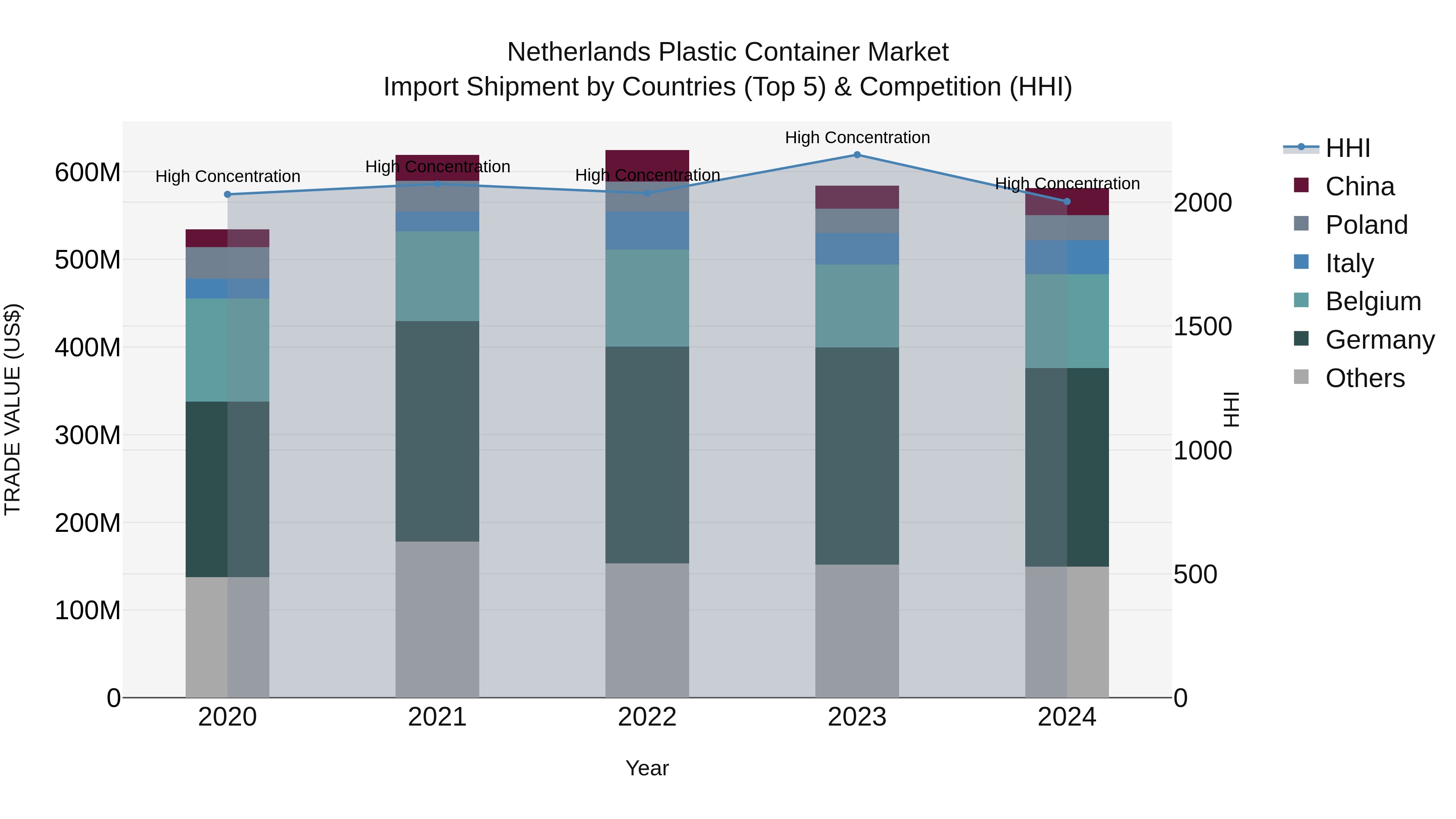
In 2024, the Netherlands continued to see significant plastic container imports, with top exporters being Germany, Belgium, Italy, China, and Poland. High concentration levels, as indicated by the Herfindahl-Hirschman Index (HHI), persisted in the market. With a compound annual growth rate (CAGR) of 2.13% from 2020 to 2024, the industry showed steady expansion. However, a slight decline in growth rate of -0.49% from 2023 to 2024 suggests a potential shift in market dynamics that importers and stakeholders should monitor closely.
Netherlands Plastic Container Market Overview
The plastic container market in the Netherlands is experiencing steady growth driven by factors such as increasing demand for convenience packaging, growing awareness about sustainability, and a rise in e-commerce activities. The market offers a wide range of plastic containers including bottles, jars, tubs, and custom packaging solutions catering to various industries such as food and beverage, personal care, pharmaceuticals, and household products. Key players in the market include RPC Group, Jokey Group, and Retal Industries among others, offering innovative and eco-friendly packaging solutions to meet consumer preferences. The Netherlands` strict recycling regulations and emphasis on reducing plastic waste are propelling the market towards more sustainable practices, with a shift towards recyclable and biodegradable materials being observed. Overall, the plastic container market in the Netherlands is poised for further growth with a focus on environmentally friendly packaging solutions.
Netherlands Plastic Container Market Trends
The Netherlands plastic container market is experiencing a shift towards sustainable and eco-friendly solutions, driven by increasing consumer awareness and government regulations aimed at reducing plastic waste. Manufacturers are investing in innovative materials such as biodegradable plastics and recycled materials to meet the demand for more sustainable packaging options. There is also a growing emphasis on lightweight and durable designs to improve transportation efficiency and reduce carbon footprint. Additionally, the rise of e-commerce and online shopping has led to a greater need for convenient and secure packaging solutions, driving the demand for plastic containers with features like resealable lids and tamper-evident seals. Overall, the market is moving towards a more environmentally conscious and technologically advanced direction to meet the evolving needs of consumers and businesses.
Netherlands Plastic Container Market Challenges
In the Netherlands plastic container market, one of the major challenges faced is the increasing pressure to reduce plastic waste and improve sustainability practices. This is driven by growing environmental concerns and regulatory changes aimed at reducing plastic pollution. Companies in the market are facing the need to innovate and develop more eco-friendly packaging solutions while also ensuring cost-effectiveness and maintaining product quality. Additionally, there is a shift in consumer preferences towards more sustainable and recyclable packaging options, requiring market players to adapt their offerings to meet these changing demands. Competition within the market is also intense, with companies vying to differentiate themselves through sustainable practices and innovative technologies to stay ahead in the evolving landscape of the plastic container industry.
Netherlands Plastic Container Market Investment Opportunities
In the Netherlands, there are several investment opportunities in the plastic container market driven by factors such as the increasing demand for sustainable packaging solutions and the growing awareness of environmental issues. One potential investment opportunity lies in the development and production of biodegradable or recyclable plastic containers to cater to the eco-conscious consumer segment. Additionally, investing in innovative technologies for manufacturing lightweight yet durable plastic containers could provide a competitive edge in the market. Collaborating with retailers and e-commerce platforms to offer customized packaging solutions for different industries can also be a lucrative investment avenue. Overall, the Netherlands` plastic container market presents opportunities for investors to capitalize on the shift towards more sustainable packaging solutions and innovative product offerings.
Netherlands Plastic Container Market Government Policy
The Netherlands has implemented several government policies aimed at regulating the plastic container market. The country has established a deposit-refund system for plastic bottles, where consumers pay a small deposit at the point of purchase and receive a refund when they return the bottle for recycling. Additionally, there are strict recycling targets set by the government to promote the circular economy and reduce plastic waste. The Netherlands has also banned the use of certain single-use plastics and has implemented extended producer responsibility (EPR) schemes to hold manufacturers accountable for the disposal and recycling of plastic containers. These policies aim to increase recycling rates, reduce plastic pollution, and promote sustainable practices within the plastic container market.
Netherlands Plastic Container Market Future Outlook
The future outlook for the Netherlands plastic container market looks promising, driven by factors such as increasing demand from end-user industries like food and beverage, pharmaceuticals, and personal care. The market is expected to witness steady growth due to the rising focus on sustainable packaging solutions and the convenience offered by plastic containers. Additionally, advancements in technology leading to the development of innovative and eco-friendly plastic materials are likely to fuel market expansion. Regulatory initiatives aimed at reducing plastic waste and promoting recycling efforts will also play a significant role in shaping the future of the market. Overall, the Netherlands plastic container market is poised for growth, with opportunities for companies to capitalize on the evolving consumer preferences and sustainability trends.
Key Highlights of the Report:
- Netherlands Plastic Container Market Outlook
- Market Size of Netherlands Plastic Container Market,2024
- Forecast of Netherlands Plastic Container Market, 2031
- Historical Data and Forecast of Netherlands Plastic Container Revenues & Volume for the Period 2021-2031
- Netherlands Plastic Container Market Trend Evolution
- Netherlands Plastic Container Market Drivers and Challenges
- Netherlands Plastic Container Price Trends
- Netherlands Plastic Container Porter's Five Forces
- Netherlands Plastic Container Industry Life Cycle
- Historical Data and Forecast of Netherlands Plastic Container Market Revenues & Volume By Type for the Period 2021-2031
- Historical Data and Forecast of Netherlands Plastic Container Market Revenues & Volume By Rigid for the Period 2021-2031
- Historical Data and Forecast of Netherlands Plastic Container Market Revenues & Volume By Flexible for the Period 2021-2031
- Historical Data and Forecast of Netherlands Plastic Container Market Revenues & Volume By Material Type for the Period 2021-2031
- Historical Data and Forecast of Netherlands Plastic Container Market Revenues & Volume By PET, HDPE, PP, PVC for the Period 2021-2031
- Historical Data and Forecast of Netherlands Plastic Container Market Revenues & Volume By HDPE for the Period 2021-2031
- Historical Data and Forecast of Netherlands Plastic Container Market Revenues & Volume By PP for the Period 2021-2031
- Historical Data and Forecast of Netherlands Plastic Container Market Revenues & Volume By PVC for the Period 2021-2031
- Historical Data and Forecast of Netherlands Plastic Container Market Revenues & Volume By End User for the Period 2021-2031
- Historical Data and Forecast of Netherlands Plastic Container Market Revenues & Volume By Food & Beverage for the Period 2021-2031
- Historical Data and Forecast of Netherlands Plastic Container Market Revenues & Volume By Pharmaceuticals for the Period 2021-2031
- Historical Data and Forecast of Netherlands Plastic Container Market Revenues & Volume By Cosmetics for the Period 2021-2031
- Historical Data and Forecast of Netherlands Plastic Container Market Revenues & Volume By Household Products for the Period 2021-2031
- Historical Data and Forecast of Netherlands Plastic Container Market Revenues & Volume By Application for the Period 2021-2031
- Historical Data and Forecast of Netherlands Plastic Container Market Revenues & Volume By Packaging, Storage for the Period 2021-2031
- Historical Data and Forecast of Netherlands Plastic Container Market Revenues & Volume By Industrial Goods for the Period 2021-2031
- Historical Data and Forecast of Netherlands Plastic Container Market Revenues & Volume By Chemicals for the Period 2021-2031
- Historical Data and Forecast of Netherlands Plastic Container Market Revenues & Volume By Medical Supplies for the Period 2021-2031
- Netherlands Plastic Container Import Export Trade Statistics
- Market Opportunity Assessment By Type
- Market Opportunity Assessment By Material Type
- Market Opportunity Assessment By End User
- Market Opportunity Assessment By Application
- Netherlands Plastic Container Top Companies Market Share
- Netherlands Plastic Container Competitive Benchmarking By Technical and Operational Parameters
- Netherlands Plastic Container Company Profiles
- Netherlands Plastic Container Key Strategic Recommendations






































