Netherlands Table Olives Market Import Shipment by Countries (Top 5) & Competition (HHI)
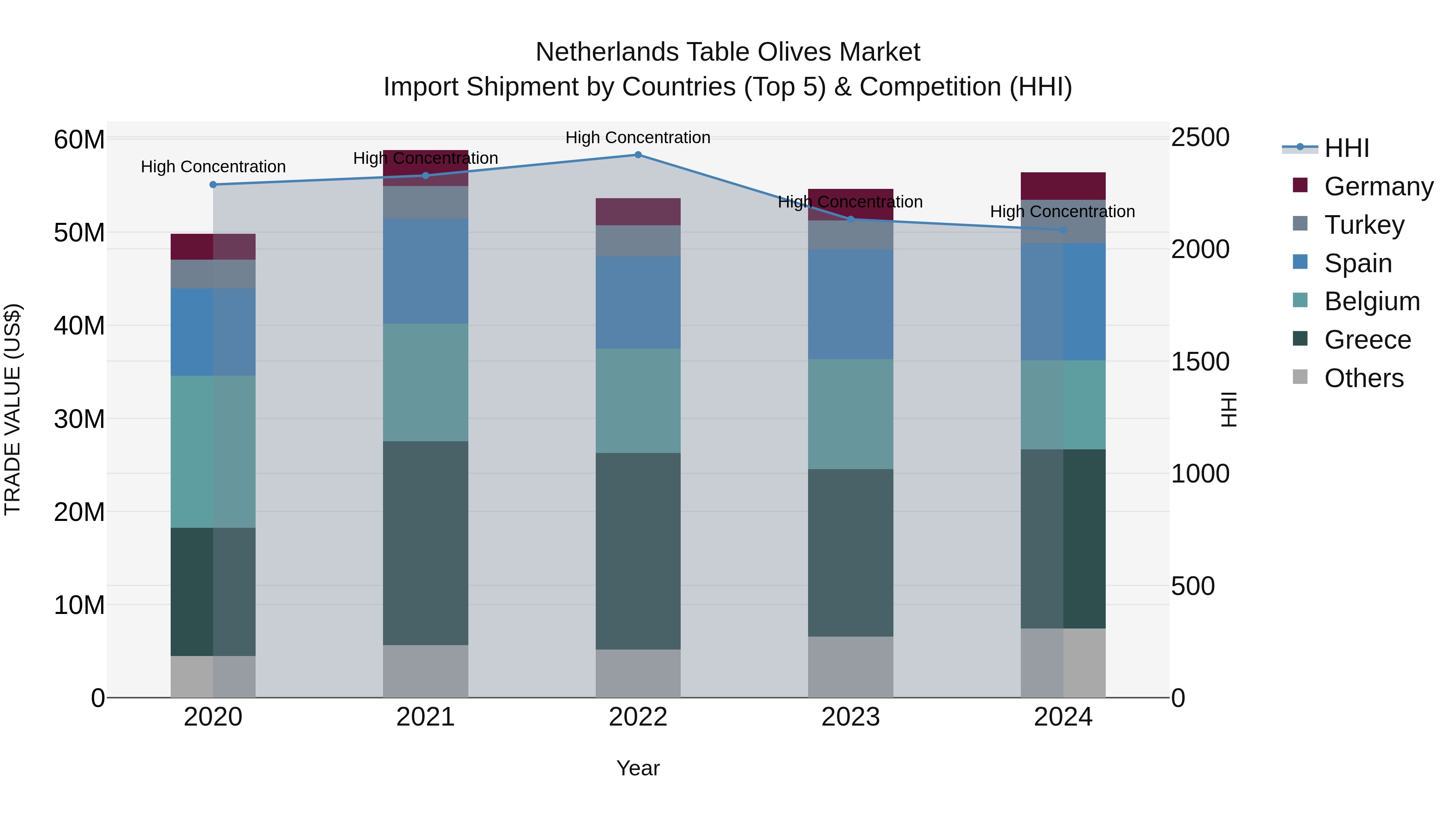
The Netherlands continued to be a major hub for table olive imports in 2024, with key suppliers including Greece, Spain, Belgium, Turkey, and Germany. The market displayed a high level of concentration, as indicated by the Herfindahl-Hirschman Index (HHI). The compound annual growth rate (CAGR) from 2020 to 2024 stood at a steady 3.16%, with a notable growth rate of 3.3% from 2023 to 2024. These trends suggest a stable and growing market for table olives in the Netherlands, driven by strong partnerships with key exporting countries.
Netherlands Table Olives Market Synopsis
The Netherlands Table Olives Market is characterized by a growing demand for high-quality, diverse olives among consumers. The market offers a wide range of table olive varieties, including green, black, and specialty stuffed olives, catering to various taste preferences. Key market trends include a rising interest in healthy eating habits, leading to increased consumption of olives as a nutritious snack or ingredient in Mediterranean dishes. The market is driven by factors such as convenience, flavor innovation, and a focus on sustainability and traceability in the supply chain. Major players in the market compete based on product quality, packaging innovation, and marketing strategies to attract consumers. Overall, the Netherlands Table Olives Market presents opportunities for product development and differentiation to meet evolving consumer preferences and trends.
Netherlands Table Olives Market Trends
The Netherlands Table Olives Market is experiencing a growing demand for healthier snack options, driving the consumption of table olives as a nutritious and flavorful choice. Consumers are increasingly seeking products that are natural, organic, and sustainably produced, presenting opportunities for producers to cater to this trend through transparent sourcing and eco-friendly practices. The market is also witnessing a rise in the popularity of specialty and premium table olives, such as marinated varieties or unique flavor combinations, offering a chance for differentiation and premium pricing strategies. With the increasing focus on Mediterranean diets and the growing awareness of the health benefits of olives, there is potential for further market expansion through product diversification, innovative packaging, and targeted marketing campaigns to attract health-conscious consumers.
Netherlands Table Olives Market Challenges
In the Netherlands Table Olives Market, some challenges include competition from other snack options, such as nuts and dried fruits, which may limit consumer demand for table olives. Additionally, there is a growing concern among consumers regarding the environmental impact of olive production and transportation, leading to a preference for locally sourced products. Another challenge is the relatively high price point of table olives compared to other snack options, which can deter price-sensitive consumers. Furthermore, fluctuations in global olive production due to factors like weather conditions and disease outbreaks can impact the availability and pricing of table olives in the market. Overall, addressing these challenges requires industry players to innovate in product offerings, sustainability practices, pricing strategies, and supply chain management to remain competitive in the Netherlands Table Olives Market.
Netherlands Table Olives Market Investment Opportunities
The Netherlands Table Olives Market is primarily driven by factors such as increasing consumer awareness about the health benefits of table olives, growing demand for Mediterranean cuisine, and the rising trend of snacking on healthy and natural foods. The market is also influenced by the expanding retail sector, which provides a wider distribution network for table olives. Additionally, the focus on sustainability and organic products is driving the preference for high-quality, locally sourced table olives among consumers. Innovations in packaging and flavor varieties are further stimulating market growth by attracting a broader consumer base. Overall, the increasing preference for healthy, flavorful, and convenient food options is propelling the growth of the table olives market in the Netherlands.
Netherlands Table Olives Market Government Polices
The Netherlands government has implemented various policies related to the Table Olives Market, including regulations on food safety, labeling requirements, and import/export standards to ensure consumer protection and market transparency. The government closely monitors the production and processing of table olives to maintain high quality and safety standards, which in turn helps to build consumer trust in the market. Additionally, there are set guidelines and regulations in place to promote fair trade practices and prevent fraud within the industry. Import and export regulations are also enforced to facilitate international trade while ensuring compliance with international standards. Overall, the Netherlands government`s policies aim to support the sustainable growth of the Table Olives Market while prioritizing consumer health and market integrity.
Netherlands Table Olives Market Future Outlook
The future outlook for the Netherlands Table Olives Market appears positive, driven by increasing consumer awareness of the health benefits associated with table olives. Growing demand for Mediterranean cuisine and the rising trend of healthy snacking are expected to boost market growth. Additionally, the Netherlands` reputation for high-quality food products and its strong distribution network are likely to support the market expansion. As consumers continue to prioritize natural and organic food options, there is a growing opportunity for innovative product offerings in the table olives segment, such as flavored varieties and convenient packaging formats. Overall, the market is projected to experience steady growth in the coming years, with a focus on product quality, sustainability, and diverse flavor profiles key to capturing consumer interest and driving sales.
Key Highlights of the Report:
- Netherlands Table Olives Market Outlook
- Market Size of Netherlands Table Olives Market, 2024
- Forecast of Netherlands Table Olives Market, 2031
- Historical Data and Forecast of Netherlands Table Olives Revenues & Volume for the Period 2021- 2031
- Netherlands Table Olives Market Trend Evolution
- Netherlands Table Olives Market Drivers and Challenges
- Netherlands Table Olives Price Trends
- Netherlands Table Olives Porter's Five Forces
- Netherlands Table Olives Industry Life Cycle
- Historical Data and Forecast of Netherlands Table Olives Market Revenues & Volume By Type for the Period 2021- 2031
- Historical Data and Forecast of Netherlands Table Olives Market Revenues & Volume By Black Olive for the Period 2021- 2031
- Historical Data and Forecast of Netherlands Table Olives Market Revenues & Volume By Green Olive for the Period 2021- 2031
- Historical Data and Forecast of Netherlands Table Olives Market Revenues & Volume By Application for the Period 2021- 2031
- Historical Data and Forecast of Netherlands Table Olives Market Revenues & Volume By Online Store for the Period 2021- 2031
- Historical Data and Forecast of Netherlands Table Olives Market Revenues & Volume By Supermarket for the Period 2021- 2031
- Historical Data and Forecast of Netherlands Table Olives Market Revenues & Volume By Convenience Store for the Period 2021- 2031
- Historical Data and Forecast of Netherlands Table Olives Market Revenues & Volume By Other for the Period 2021- 2031
- Netherlands Table Olives Import Export Trade Statistics
- Market Opportunity Assessment By Type
- Market Opportunity Assessment By Application
- Netherlands Table Olives Top Companies Market Share
- Netherlands Table Olives Competitive Benchmarking By Technical and Operational Parameters
- Netherlands Table Olives Company Profiles
- Netherlands Table Olives Key Strategic Recommendations






































