New Zealand Kegs Market Top 5 Importing Countries and Market Competition (HHI) Analysis
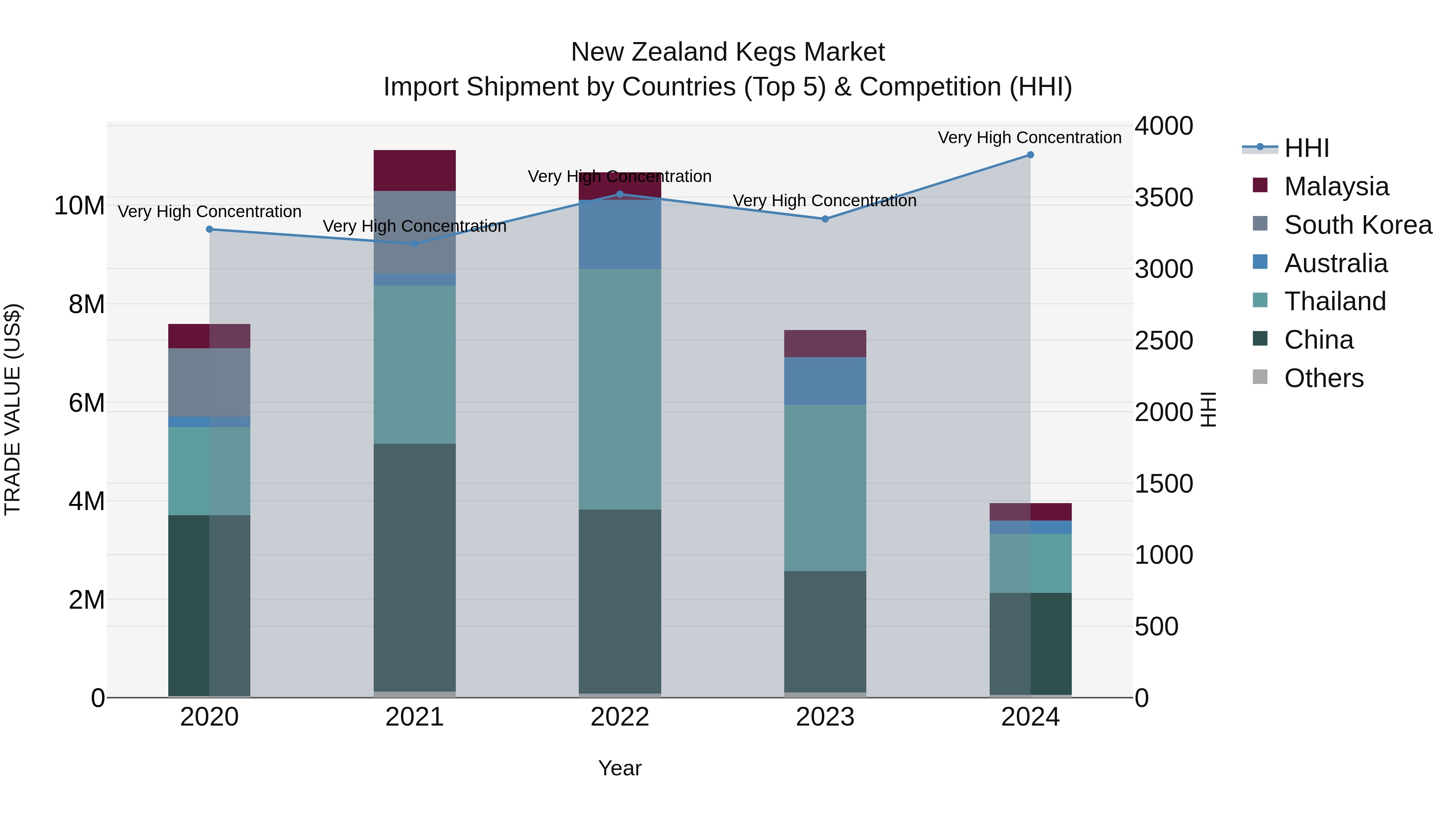
New Zealand`s keg import market in 2024 continues to be dominated by key players such as China, Thailand, Malaysia, Australia, and the USA. The high concentration levels indicate a competitive landscape, with the Herfindahl-Hirschman Index (HHI) remaining notably high. However, the market experienced a significant decline in both the compound annual growth rate (CAGR) from 2020 to 2024 at -15.08% and the growth rate from 2023 to 2024 at -47.13%. This suggests a challenging environment for keg importers in New Zealand, necessitating strategic adaptations to navigate the evolving market dynamics.
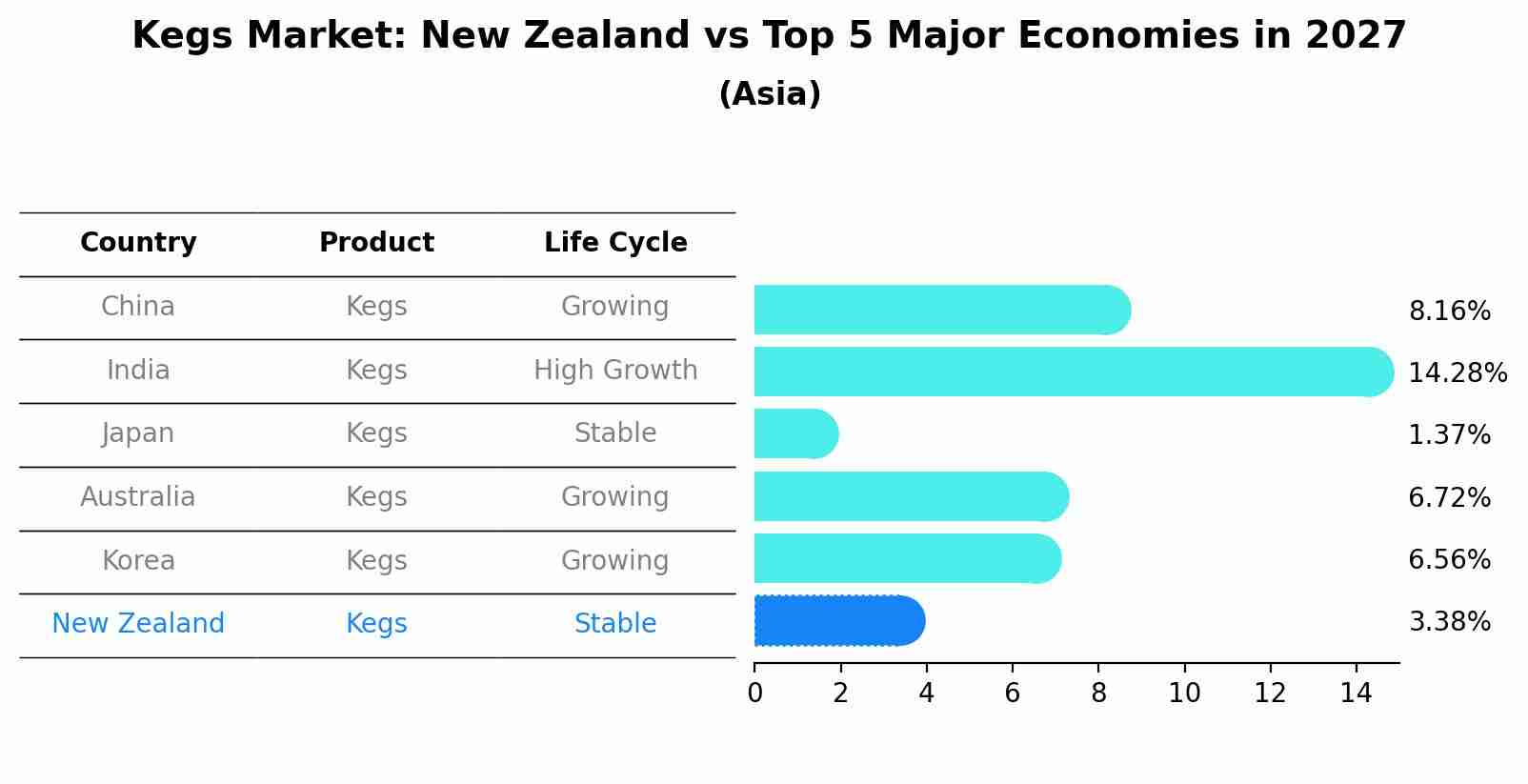
Kegs Market: New Zealand vs Top 5 Major Economies in 2027 (Asia)
By 2027, New Zealand's Kegs market is forecasted to achieve a stable growth rate of 3.38%, with China leading the Asia region, followed by India, Japan, Australia and South Korea.
New Zealand Kegs Market Overview
The kegs market in New Zealand is driven by the thriving beverage industry, particularly craft beer. The demand for high-quality, durable kegs is growing among breweries and beverage distributors.
Drivers of the market
The kegs market in New Zealand is influenced by the growing beverage industry, particularly the craft beer and cider segments. Kegs are essential for storing and transporting beverages, maintaining their freshness and quality. The increasing number of microbreweries and the rising popularity of draft beer contribute to market growth. Additionally, the use of kegs in the hospitality industry for events and on-premise consumption further drives demand.
Challenges of the market
The Kegs market in New Zealand faces challenges associated with changing consumption patterns and preferences, particularly in the alcoholic beverage industry. With the rise of craft breweries and microbreweries, keg suppliers must adapt to diverse customer demands while ensuring efficient logistics and quality control. Moreover, regulatory compliance and environmental sustainability considerations add complexity to the market landscape.
Government Policy of the market
Government policies supporting the beverage industry and sustainable packaging solutions drive the kegs market. Initiatives promoting recycling and reducing packaging waste are significant.
Key Highlights of the Report:
- New Zealand Kegs Market Outlook
- Market Size of New Zealand Kegs Market, 2024
- Forecast of New Zealand Kegs Market, 2031
- Historical Data and Forecast of New Zealand Kegs Revenues & Volume for the Period 2021-2031
- New Zealand Kegs Market Trend Evolution
- New Zealand Kegs Market Drivers and Challenges
- New Zealand Kegs Price Trends
- New Zealand Kegs Porter`s Five Forces
- New Zealand Kegs Industry Life Cycle
- Historical Data and Forecast of New Zealand Kegs Market Revenues & Volume By Material for the Period 2021-2031
- Historical Data and Forecast of New Zealand Kegs Market Revenues & Volume By Plastic for the Period 2021-2031
- Historical Data and Forecast of New Zealand Kegs Market Revenues & Volume By Tin for the Period 2021-2031
- Historical Data and Forecast of New Zealand Kegs Market Revenues & Volume By Stainless Steel for the Period 2021-2031
- Historical Data and Forecast of New Zealand Kegs Market Revenues & Volume By Capacity for the Period 2021-2031
- Historical Data and Forecast of New Zealand Kegs Market Revenues & Volume By Up to 20 Liter for the Period 2021-2031
- Historical Data and Forecast of New Zealand Kegs Market Revenues & Volume By 20 Liter to 40 Liter for the Period 2021-2031
- Historical Data and Forecast of New Zealand Kegs Market Revenues & Volume By 40 Liter to 60 Liter for the Period 2021-2031
- Historical Data and Forecast of New Zealand Kegs Market Revenues & Volume By Above 60 Liter for the Period 2021-2031
- Historical Data and Forecast of New Zealand Kegs Market Revenues & Volume By End Use for the Period 2021-2031
- Historical Data and Forecast of New Zealand Kegs Market Revenues & Volume By Alcoholic Beverages for the Period 2021-2031
- Historical Data and Forecast of New Zealand Kegs Market Revenues & Volume By Non-Alcoholic Beverages for the Period 2021-2031
- Historical Data and Forecast of New Zealand Kegs Market Revenues & Volume By Cooking Oil for the Period 2021-2031
- Historical Data and Forecast of New Zealand Kegs Market Revenues & Volume By Chemicals for the Period 2021-2031
- Historical Data and Forecast of New Zealand Kegs Market Revenues & Volume By Others for the Period 2021-2031
- Historical Data and Forecast of New Zealand Kegs Market Revenues & Volume By Distribution Channel for the Period 2021-2031
- Historical Data and Forecast of New Zealand Kegs Market Revenues & Volume By Supermarket/Hypermarket for the Period 2021-2031
- Historical Data and Forecast of New Zealand Kegs Market Revenues & Volume By Commercial Liquor Store for the Period 2021-2031
- Historical Data and Forecast of New Zealand Kegs Market Revenues & Volume By Others for the Period 2021-2031
- New Zealand Kegs Import Export Trade Statistics
- Market Opportunity Assessment By Material
- Market Opportunity Assessment By Capacity
- Market Opportunity Assessment By End Use
- Market Opportunity Assessment By Distribution Channel
- New Zealand Kegs Top Companies Market Share
- New Zealand Kegs Competitive Benchmarking By Technical and Operational Parameters
- New Zealand Kegs Company Profiles
- New Zealand Kegs Key Strategic Recommendations






































