Niger Flour Market Size Growth Rate
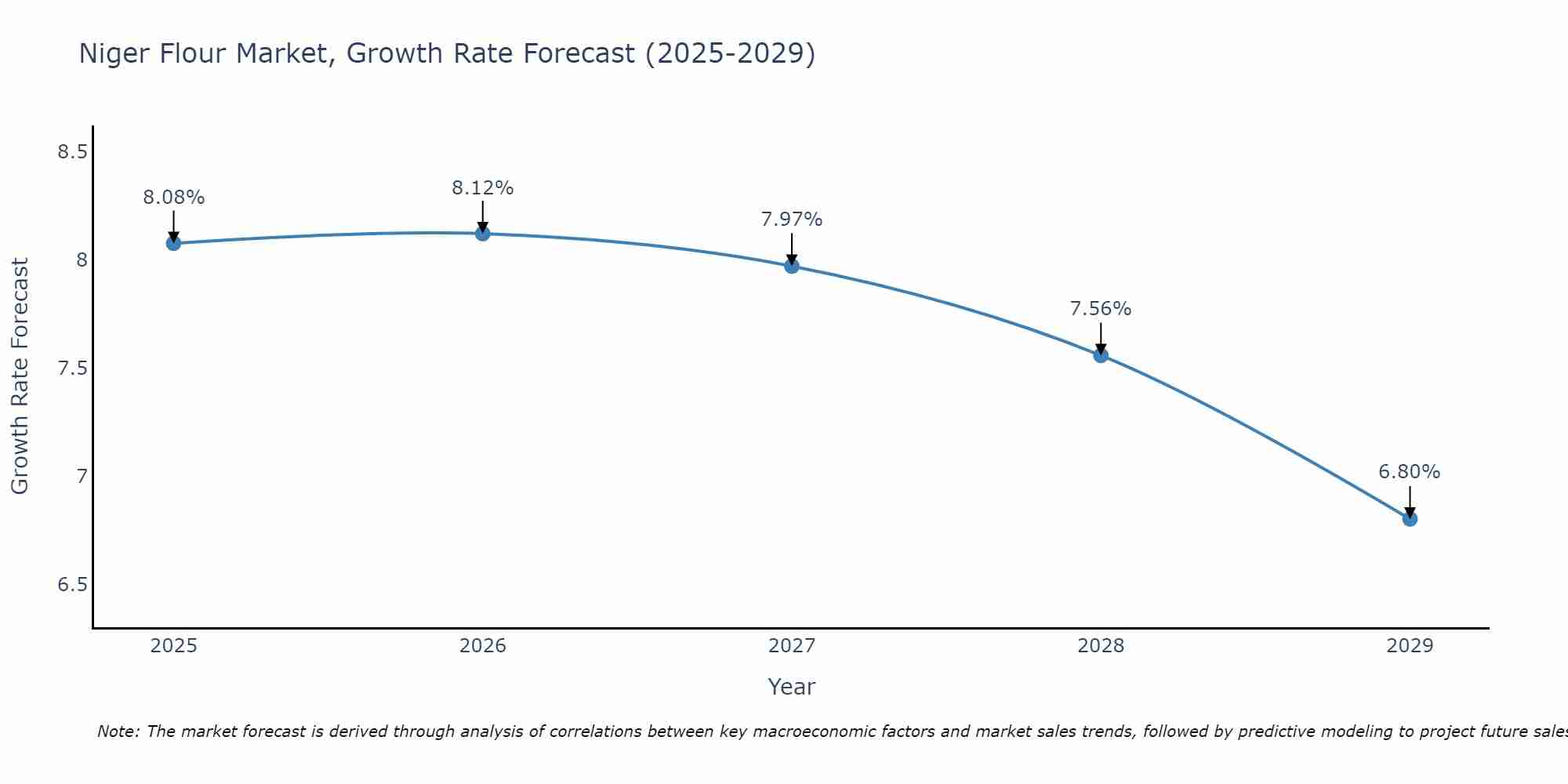
The Niger Flour Market is projected to witness mixed growth rate patterns during 2025 to 2029. Growth accelerates to 8.12% in 2026, following an initial rate of 8.08%, before easing to 6.80% at the end of the period.
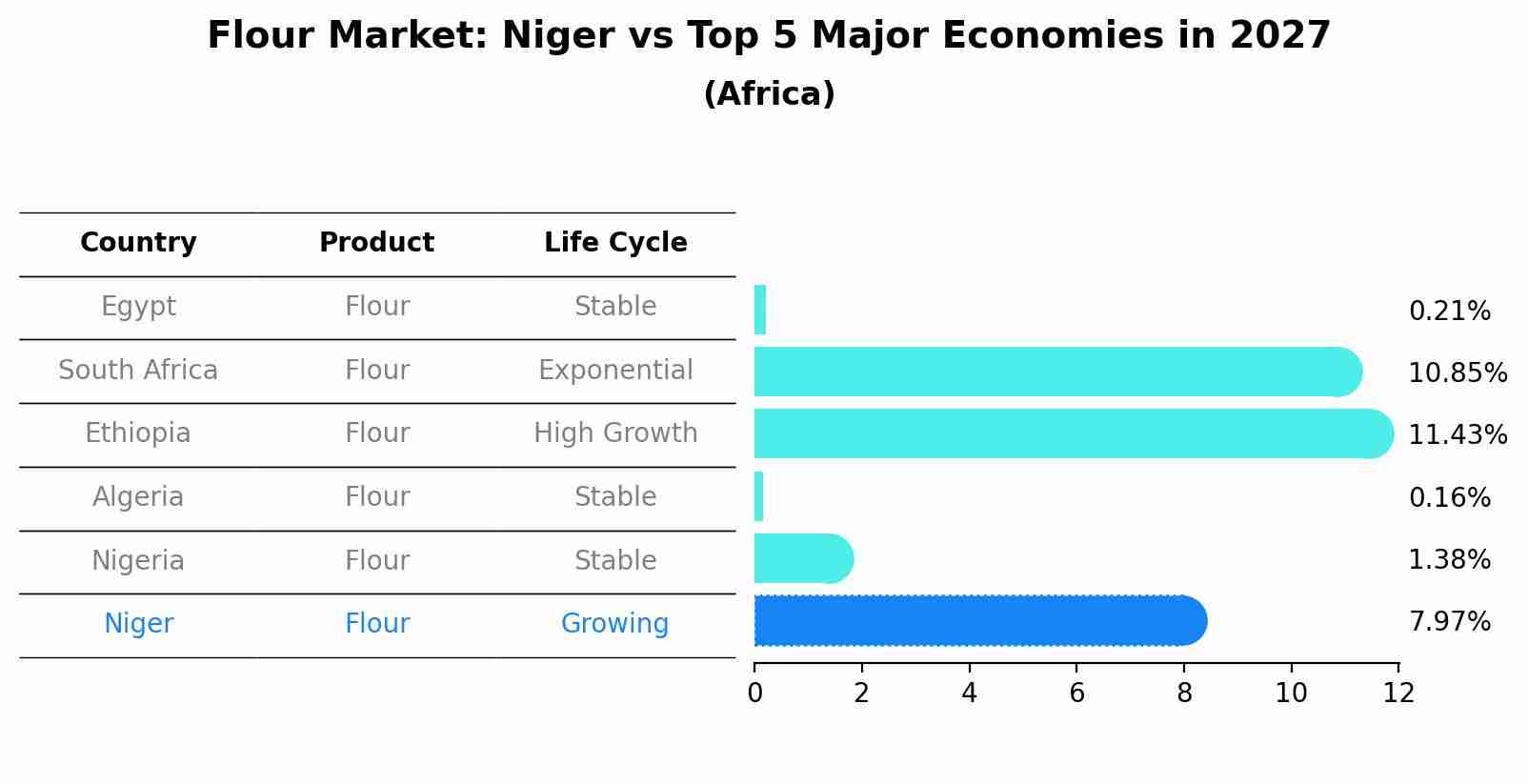
Flour Market: Niger vs Top 5 Major Economies in 2027 (Africa)
The Flour market in Niger is projected to grow at a growing growth rate of 7.97% by 2027, highlighting the country's increasing focus on advanced technologies within the Africa region, where Egypt holds the dominant position, followed closely by South Africa, Ethiopia, Algeria and Nigeria, shaping overall regional demand.
Niger Flour Market Growth Rate
According to 6Wresearch internal database and industry insights, The Niger Flour Market is projected to grow at a compound annual growth rate (CAGR) of 8.8% during the forecast period (2025–2029).
Niger Flour Market Highlights
| Report Name | Niger Flour Market |
| Forecast period | 2025-2029 |
| CAGR | 8.8% |
| Growing Sector | Bread & Bakery and Packaged Food Processing |
Five-Year Growth Trajectory of the Niger Flour Market with Core Drivers
Below mentioned are the evaluation of year-wise growth rate along with key drivers:
| Years | Est. Annual Growth | Growth Drivers |
| 2020 | 2.4 | Flour consumption maintained through rural cooperatives and local bakeries despite lack of imports. |
| 2021 | 3.1 | Retail advancement in Niamey and Maradi augmented the branded flour visibility. |
| 2022 | 3.4 | Enriched wheat inflows from neighboring Nigeria stabilized supply. |
| 2023 | 4.2 | Increase bakery and instant noodles sectors solidified industrial flour needs. |
| 2024 | 4.5 | Rising fortification adoption and government-led food security initiatives drove market performance. |
Topics Covered in the Niger Flour Market Report
The Niger Flour Market report thoroughly covers the market by raw material, applications, and technology. The market report provides an unbiased and detailed analysis of ongoing market trends, opportunities/high growth areas, and market drivers, which would help stakeholders to devise and align their market strategies according to the current and future market dynamics.
Niger Flour Market Synopsis
Niger Flour Market is anticipated to get major growth due to increasing household consumption, rising bakery sector, and government focus on food fortification and domestic processing. Flour, produced primarily from wheat and maize, serves as a staple for a broad range of applications, consisting of bakery, noodles, and biscuits. Growing allocation of money in milling infrastructure, along with favorable government policies to enrich food processing, are contributing to market growth.
Evaluation of Growth Drivers in the Niger Flour Market
Below mentioned are some prominent drivers and their influence to the market dynamics:
| Drivers | Primary Segments Affected | Why It Matters (Evidence) |
| Rising Urbanization and Retail Development | Bread & Bakery, Wafers & Biscuits | Increase in modern retail outlets in Niamey and Zinder augments the accessibility of branded flour products. |
| Government Food Security Programs | All Applications | The “3N Initiative” (Les Nigériens Nourrissent les Nigériens) increases domestic processing capacity and encouraging small flour mills. |
| Growth of Bakery and Fast-Food Outlets | Bread & Bakery, Noodles & Pasta | Rising need from bakeries and noodle manufacturers bolsters bulk flour requirements. |
| Adoption of Fortified and Packaged Flour | Bread & Bakery, Animal Feed | Increasing nutritional awareness and government regulations encourage fortified flour production. |
| Technological Upgrades in Milling | Dry Technology | Modern milling machinery and better sieving systems enriches yield and quality consistency. |
The Niger Flour Market size is projected to grow at the CAGR of 8.8% during the forecast period of 2025–2029. The rising demand for fortified flour and steady growth in bakery and fast-food applications are major contributors to market expansion. Additionally, enhancement in the production efficiency and enrich the overall competitiveness of the Niger Flour Industry owing to the increasing participation of private investors and regional partnerships in modern milling and packaging facilities.
Evaluation of Restraints in the Niger Flour Market
Below mentioned are some major restraints and their influence to the market dynamics:
| Restraint | Primary Segments Affected | What This Means (Evidence) |
| Dependence on Imported Wheat | Wheat-based Products | Cost volatility in global wheat markets directly affects local flour pricing and supply stability. |
| High Energy and Logistics Costs | Industrial & SME Mills | Increasing fuel and electricity expenses increase operating prices, decreasing small mill profitability. |
| Limited Access to Finance for SMEs | Local Processors | Restricted credit availability constraints capacity expansion and equipment advancement. |
| Inconsistent Infrastructure | All Segments | Poor road connectivity delays raw material inflows and finished goods distribution. |
| Climatic Variations Affecting Grain Availability | Maize & Other Local Inputs | Irregular rainfall impacts local maize and millet yields, creating raw material shortages. |
Niger Flour Market Challenges
Despite the market’s expansion, Niger Flour Market goes through challenges such as reliability on imported wheat, underdeveloped logistics infrastructure, and inconsistent access to financing for mill upgrades. Small-scale processors face difficulty adopting modern milling technology and creating uniform product quality. Furthermore, the industry is impacted by high energy price and volatility in cross-border supply chains, which affect cost stability and market competitiveness.
Niger Flour Market Trends
Several prominent trends reshaping the market growth include:
- Rise of Fortified and Health-Oriented Flour: Rising consumer knowledge about nutrition has led to increased need for fortified and vitamin-enriched flour products.
- Adoption of Efficient Milling Technology: Introduction of roller milling and automated blending systems augments flour consistency and extraction efficiency.
- Growth in Packaged Retail Products: Advanced packaging and smaller SKUs are increasing reach in both rural and urban households.
- Increased Participation of Private Investors: Allocation of money from regional players and public-private partnerships are encouraging domestic milling and storage capacity development.
Investment Opportunities in the Niger Flour Industry
Some prominent investment opportunities in the market include:
- Establishment of Fortification Units: Create premix facilities and automated fortification lines to align with national health standards.
- Expansion of Storage and Logistics Facilities: create silos and warehouses for better inventory management and decreased import delays.
- Retail Flour Branding: Introduce consumer brands concentrating on fortified, multi-grain, and organic flour categories.
Top 5 Leading Players in the Niger Flour Market
Some leading players operating in the Niger Flour Market include:
1. Olam Agri
| Company Name | Olam Agri |
| Established Year | 1989 |
| Headquarters | Singapore |
| Official Website | Click Here |
Olam Agri supplies fortified flour across West Africa and gives logistical and technical support for local millers in Niger.
2. Flour Mills of Nigeria Plc
| Company Name | Flour Mills of Nigeria Plc |
| Established Year | 1960 |
| Headquarters | Lagos, Nigeria |
| Official Website | - |
Flour Mills of Nigeria exports premium wheat flour to Niger and encourages local bakery chains through training and distribution programs.
3. Seaboard Overseas and Trading Group
| Company Name | Seaboard Overseas and Trading Group |
| Established Year | 1918 |
| Headquarters | Merriam, Kansas, USA |
| Official Website | Click Here |
Seaboard functional regional mills in West Africa and provides fortified flour through cross-border trade corridors into Niger.
4. Groupe Mimran (Grands Moulins d’Afrique)
| Company Name | Groupe Mimran (Grands Moulins d’Afrique) |
| Established Year | 1956 |
| Headquarters | Paris, France |
| Official Website | - |
Groupe Mimran gives flour distribution across Francophone West Africa, encouraging Niger through regional trade integration.
5. Bühler Group
| Company Name | Bühler Group |
| Established Year | 1860 |
| Headquarters | Uzwil, Switzerland |
| Official Website | Click Here |
Bühler gives milling and fortification equipment, helping Niger’s flour industry to augment production capacity and quality assurance.
Government Regulations Introduced in the Niger Flour Market
According to Nigerian government data, numerous measures have been introduced to augment food security and solidify domestic milling. Under the government’s National Nutrition Improvement Policy it encourages the fortification of wheat and maize flour with iron and folic acid. It also gives credit guarantees and subsidies for local millers upgrading their facilities. For instance, cooperation with the World Food Programme (WFP) and African Development Bank (AfDB) has led to construction of regional storage hubs and training programs to ensure strengthened domestic flour accessibility.
Future Insights of the Niger Flour Market
The Niger Flour Market Growth is predicted to increase in the upcoming years, bolstered by enriched fortification compliance, potent retail networks, and increased domestic milling capacity. Technological advancements in flour processing and packaging are predicted to augment product quality and competitiveness. Furthermore, proliferation in the transition toward fortified and branded flour varieties due to increasing consumer knowledge of nutrition and food safety.
Market Segmentation Analysis
The report offers a comprehensive study of the subsequent market segments and their leading categories.
Wheat to Dominate the Market – By Raw Material
According to Vasudha, Senior Research Analyst at 6Wresearch, wheat holds the largest Niger Flour Market Share due to its broad application in bakery and noodles, dependable import supply, and adaptability to fortification standards encouraged by the government.
Bread & Bakery Products to Dominate the Market – By Applications
Bread & Bakery Products dominate the Niger Flour Industry due to the rising popularity of bakeries in urban centers and consistent household consumption of bread and biscuits.
Dry Technology to Dominate the Market – By Technology
Dry Technology leads the market as it suits Niger’s dry climatic conditions and gives cost-friendly operations for small and medium millers with lack of water availability.
Key Attractiveness of the Report
- 10 Years of Market Numbers.
- Historical Data Starting from 2021 to 2024.
- Base Year: 2024.
- Forecast Data until 2029.
- Key Performance Indicators Impacting the Market.
- Major Upcoming Developments and Projects.
Key Highlights of the Report:
- Niger Flour Market Outlook
- Market Size of Niger Flour Market, 2024
- Forecast of Niger Flour Market, 2029
- Historical Data and Forecast of Niger Flour Revenues & Volume for the Period 2019-2029
- Niger Flour Market Trend Evolution
- Niger Flour Market Drivers and Challenges
- Niger Flour Price Trends
- Niger Flour Porter`s Five Forces
- Niger Flour Industry Life Cycle
- Historical Data and Forecast of Niger Flour Market Revenues & Volume By Raw Material for the Period 2019-2029
- Historical Data and Forecast of Niger Flour Market Revenues & Volume By Wheat for the Period 2019-2029
- Historical Data and Forecast of Niger Flour Market Revenues & Volume By Rice for the Period 2019-2029
- Historical Data and Forecast of Niger Flour Market Revenues & Volume By Maize for the Period 2019-2029
- Historical Data and Forecast of Niger Flour Market Revenues & Volume By Others for the Period 2019-2029
- Historical Data and Forecast of Niger Flour Market Revenues & Volume By Applications for the Period 2019-2029
- Historical Data and Forecast of Niger Flour Market Revenues & Volume By Bread & Bakery Products for the Period 2019-2029
- Historical Data and Forecast of Niger Flour Market Revenues & Volume By Noodles & Pasta for the Period 2019-2029
- Historical Data and Forecast of Niger Flour Market Revenues & Volume By Animal Feed for the Period 2019-2029
- Historical Data and Forecast of Niger Flour Market Revenues & Volume By Wafers, Crackers, & Biscuits for the Period 2019-2029
- Historical Data and Forecast of Niger Flour Market Revenues & Volume By Non-Food Application for the Period 2019-2029
- Historical Data and Forecast of Niger Flour Market Revenues & Volume By Others for the Period 2019-2029
- Historical Data and Forecast of Niger Flour Market Revenues & Volume By Technology for the Period 2019-2029
- Historical Data and Forecast of Niger Flour Market Revenues & Volume By Dry Technology for the Period 2019-2029
- Historical Data and Forecast of Niger Flour Market Revenues & Volume By Wet Technology for the Period 2019-2029
- Niger Flour Import Export Trade Statistics
- Market Opportunity Assessment By Raw Material
- Market Opportunity Assessment By Applications
- Market Opportunity Assessment By Technology
- Niger Flour Top Companies Market Share
- Niger Flour Competitive Benchmarking By Technical and Operational Parameters
- Niger Flour Company Profiles
- Niger Flour Key Strategic Recommendations
Market Covered
The report offers a comprehensive study of the subsequent market segments:
By Raw Material
- Wheat
- Rice
- Maize
- Others
By Applications
- Bread & Bakery Products
- Noodles & Pasta
- Animal Feed
- Wafers, Crackers, & Biscuits
- Non-Food Application
- Others
By Technology
- Dry Technology
- Wet Technology






































