Niger Oil Refining Market: Top 5 Importing Countries and Market Competition (HHI) Analysis
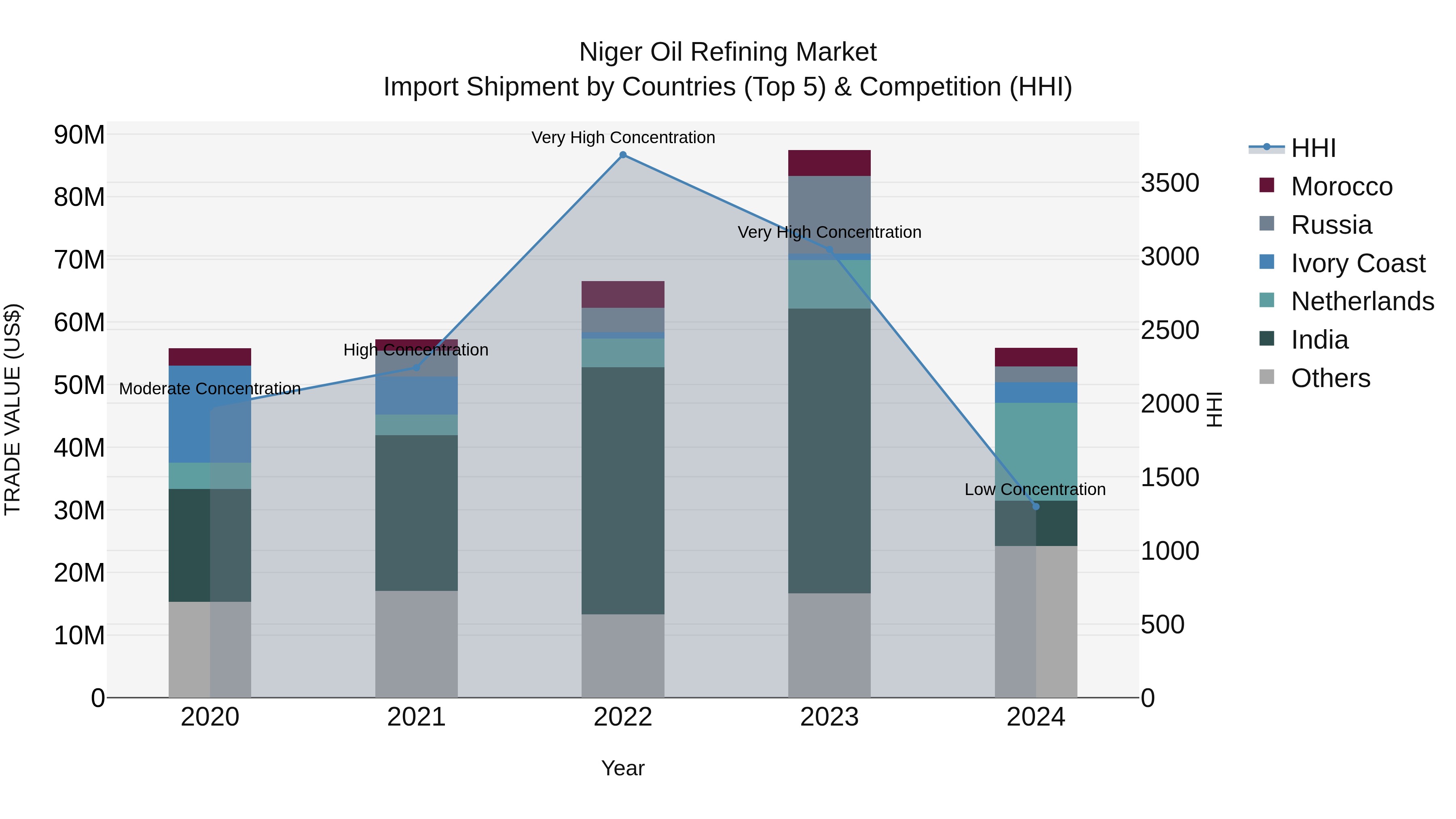
The oil refining import shipments to Niger in 2024 saw a shift in concentration from high to low, indicating a more diversified import market. Top exporting countries include Netherlands, India, Nigeria, Belgium, and Egypt. The overall Compound Annual Growth Rate (CAGR) from 2020 to 2024 was minimal at 0.02, with a notable decline in growth rate from 2023 to 2024 at -36.1%. This data suggests a fluctuating market environment for oil refining imports in Niger, possibly influenced by global economic factors and regional dynamics.
Niger Oil Refining Market Synopsis
The Niger Oil Refining Market is relatively small, with one major oil refinery located in Zinder. The Soraz refinery has a capacity of around 20,000 barrels per day, providing the majority of the country`s refined petroleum products. The market is primarily focused on meeting domestic demand for gasoline, diesel, and other refined products, with limited capacity for exports. Challenges facing the market include aging infrastructure, limited investment in upgrades, and dependency on imported crude oil for processing. However, there is potential for growth in the sector with increasing demand for petroleum products in Niger and the potential for infrastructure improvements to enhance efficiency and capacity in the future.
Niger Oil Refining Market Trends
Currently, the Niger Oil Refining Market is experiencing a shift towards modernization and efficiency improvement initiatives. Key trends include investments in upgrading existing refineries to meet higher environmental standards, increasing focus on energy efficiency and sustainability, and the adoption of advanced technologies to enhance refining processes. Additionally, there is a growing emphasis on diversification of product portfolios to meet changing market demands and regulations, such as producing cleaner fuels and expanding petrochemical production. The market is also witnessing collaborations and partnerships between domestic and international companies to leverage expertise and resources for mutual growth. Overall, the Niger Oil Refining Market is evolving towards a more competitive and sustainable industry landscape driven by innovation and strategic investments.
Niger Oil Refining Market Challenges
In the Niger Oil Refining Market, several challenges are faced, including aging infrastructure, limited investment in modernization and expansion, inconsistent government policies, and security concerns in the region. The aging infrastructure hinders the efficiency and capacity of refineries, leading to lower output and higher operational costs. Limited investment in modernization and expansion further exacerbates this issue, preventing the industry from keeping up with technological advancements and global standards. Inconsistent government policies create uncertainty for investors and operators, impacting long-term planning and sustainability efforts. Additionally, security concerns in the region pose a risk to operations and deter potential investments. Addressing these challenges will be crucial for the Niger Oil Refining Market to enhance its competitiveness and attract much-needed investments for growth and development.
Niger Oil Refining Market Investment Opportunities
The Niger Oil Refining Market presents various investment opportunities for prospective investors. With the country being an oil-producing nation, there is a growing demand for refining capacity to process crude oil domestically, reducing the need for costly imports of refined petroleum products. Investing in the construction and expansion of oil refineries in Niger can be a lucrative opportunity, as it can help meet the local demand for petroleum products and potentially export to neighboring countries. Additionally, investing in technology and infrastructure upgrades within existing refineries can improve efficiency and output, leading to increased profitability. Collaborating with local partners and government entities can also provide valuable insights and support for navigating the regulatory environment and establishing a successful presence in the Niger Oil Refining Market.
Jordan Agar Market Government Policies
The government of Niger has implemented policies to promote the development of the oil refining market in the country. These policies include the establishment of the Niger Petroleum Code, which aims to attract foreign investments in the sector by providing incentives such as tax breaks and regulatory support. Additionally, the government has been working to improve infrastructure and facilitate partnerships with international oil companies to enhance the capacity and efficiency of the country`s refineries. Furthermore, there is a focus on promoting transparency and accountability in the sector through regulations and monitoring mechanisms to ensure sustainable growth and benefit sharing for both the government and investors in the Niger oil refining market.
Niger Oil Refining Market Future Outlook
The future outlook for the Niger Oil Refining Market appears promising as the country strives to develop its refining capacity to reduce its dependence on imported petroleum products. With ongoing investments in upgrading existing refineries and potential plans for new refinery projects, Niger aims to enhance its domestic refining capabilities and achieve self-sufficiency in meeting its energy needs. The government`s focus on promoting a conducive regulatory environment and attracting foreign investments in the oil refining sector further bolsters the positive outlook for the market. Additionally, the increasing demand for petroleum products in the region due to economic growth and urbanization trends is expected to drive the growth of the oil refining industry in Niger in the coming years.
Key Highlights of the Report:
- Niger Oil Refining Market Outlook
- Market Size of Niger Oil Refining Market, 2024
- Forecast of Niger Oil Refining Market, 2031
- Historical Data and Forecast of Niger Oil Refining Revenues & Volume for the Period 2021- 2031
- Niger Oil Refining Market Trend Evolution
- Niger Oil Refining Market Drivers and Challenges
- Niger Oil Refining Price Trends
- Niger Oil Refining Porter's Five Forces
- Niger Oil Refining Industry Life Cycle
- Historical Data and Forecast of Niger Oil Refining Market Revenues & Volume By Product for the Period 2021- 2031
- Historical Data and Forecast of Niger Oil Refining Market Revenues & Volume By Gasoline for the Period 2021- 2031
- Historical Data and Forecast of Niger Oil Refining Market Revenues & Volume By Gasoil for the Period 2021- 2031
- Historical Data and Forecast of Niger Oil Refining Market Revenues & Volume By Kerosene for the Period 2021- 2031
- Historical Data and Forecast of Niger Oil Refining Market Revenues & Volume By LPG for the Period 2021- 2031
- Historical Data and Forecast of Niger Oil Refining Market Revenues & Volume By Others for the Period 2021- 2031
- Historical Data and Forecast of Niger Oil Refining Market Revenues & Volume By End-user for the Period 2021- 2031
- Historical Data and Forecast of Niger Oil Refining Market Revenues & Volume By Transportation for the Period 2021- 2031
- Historical Data and Forecast of Niger Oil Refining Market Revenues & Volume By Aviation for the Period 2021- 2031
- Historical Data and Forecast of Niger Oil Refining Market Revenues & Volume By Marine Bunker for the Period 2021- 2031
- Historical Data and Forecast of Niger Oil Refining Market Revenues & Volume By Petrochemical for the Period 2021- 2031
- Historical Data and Forecast of Niger Oil Refining Market Revenues & Volume By Agriculture for the Period 2021- 2031
- Historical Data and Forecast of Niger Oil Refining Market Revenues & Volume By Others for the Period 2021- 2031
- Niger Oil Refining Import Export Trade Statistics
- Market Opportunity Assessment By Product
- Market Opportunity Assessment By End-user
- Niger Oil Refining Top Companies Market Share
- Niger Oil Refining Competitive Benchmarking By Technical and Operational Parameters
- Niger Oil Refining Company Profiles
- Niger Oil Refining Key Strategic Recommendations






































