Nigeria Adsorbents Market Top 5 Importing Countries and Market Competition (HHI) Analysis
The Nigeria adsorbents import market saw a significant increase in concentration in 2024, with the top exporting countries being India, Germany, China, South Africa, and Malaysia. The high Herfindahl-Hirschman Index (HHI) indicates a concentrated market, with a very high concentration in 2024. The market experienced a notable decline with a Compound Annual Growth Rate (CAGR) of -20.65% from 2020 to 2024. Additionally, the growth rate from 2023 to 2024 decreased by -23.73%, reflecting a challenging environment for adsorbents import shipments in Nigeria.
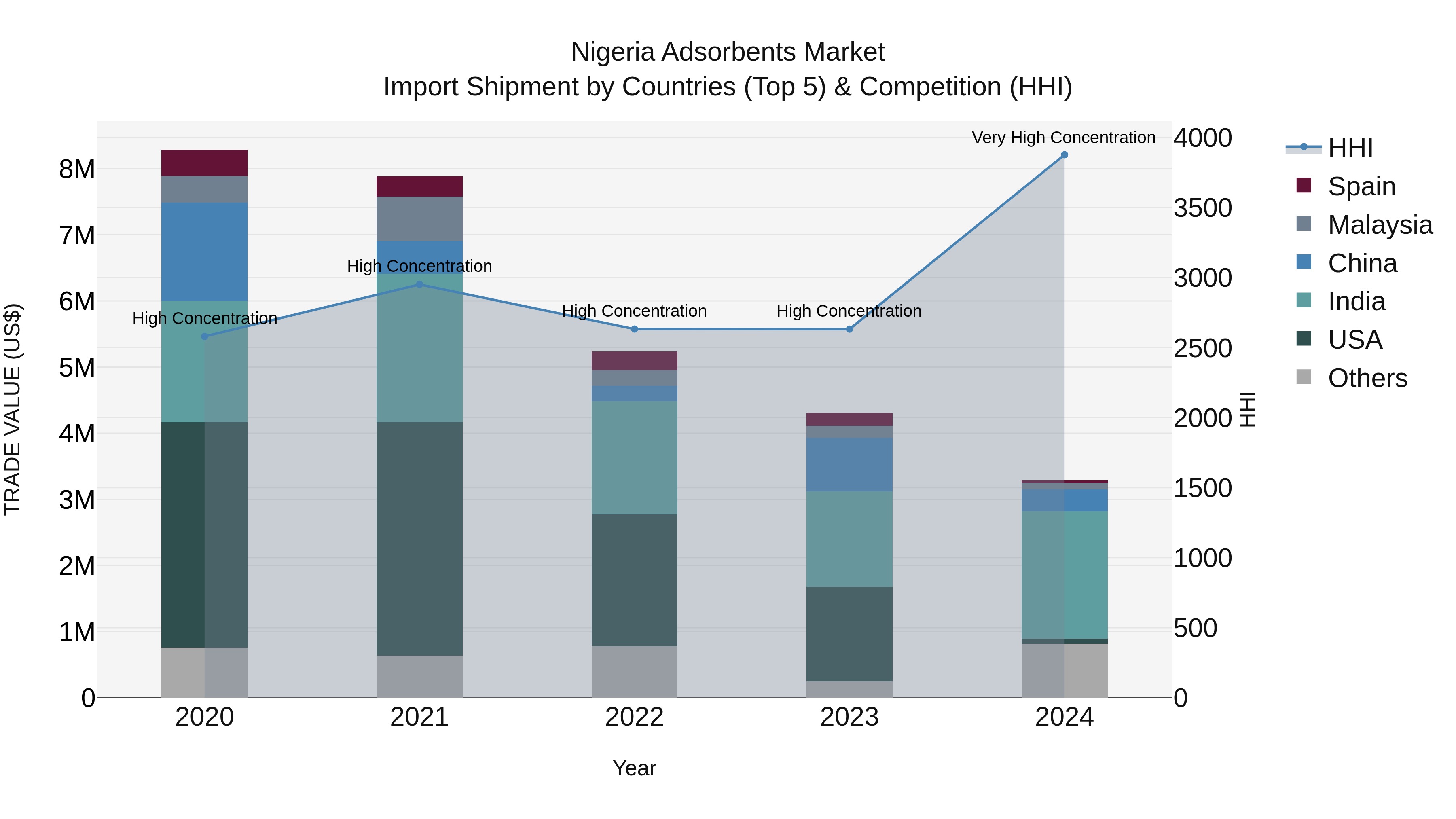
Nigeria Adsorbents Market Overview
The Nigeria adsorbents market is witnessing steady growth driven by industries such as oil & gas, petrochemicals, water treatment, and pharmaceuticals. Adsorbents are widely used for purification, separation, and filtration processes. The increasing focus on environmental regulations and the need for clean water and air are key factors propelling the demand for adsorbents in Nigeria. Activated carbon and molecular sieves are among the most commonly used adsorbents in the market. The market is competitive with both domestic and international players offering a variety of adsorbent products. As industries continue to expand and adopt advanced technologies, the Nigeria adsorbents market is expected to experience further growth in the coming years.
Nigeria Adsorbents Market Trends and Opportunities
The Nigeria Adsorbents Market is experiencing growth due to increasing industrial activities, especially in the oil and gas sector. The demand for adsorbents in applications such as water treatment, air purification, and chemical processing is on the rise, driven by environmental regulations and the need for efficient resource utilization. Opportunities lie in the development of innovative adsorbent materials with enhanced capabilities for specific applications, as well as in expanding the market reach through strategic partnerships and collaborations. Additionally, the growing awareness of the importance of clean air and water will continue to drive the demand for adsorbents in Nigeria, presenting a promising outlook for market players to capitalize on these trends and opportunities.
Nigeria Adsorbents Market Challenges
The Nigeria Adsorbents Market faces several challenges, including limited awareness and understanding of adsorbents among potential end-users, inconsistent quality of locally produced adsorbents, and dependency on imports for higher-quality products. Additionally, inadequate infrastructure and logistical challenges hinder the efficient distribution of adsorbents across the country. Regulatory hurdles and a lack of standardization in the industry further complicate market growth and development. Moreover, the volatility of raw material prices and currency fluctuations pose significant challenges for local manufacturers and distributors in maintaining competitive pricing. Addressing these challenges will be crucial for the Nigeria Adsorbents Market to realize its full potential and drive sustainable growth in the future.
Nigeria Adsorbents Market Drivers
The Nigeria Adsorbents Market is primarily driven by the increasing demand for water and wastewater treatment solutions in industries such as oil & gas, pharmaceuticals, and chemicals. The need for efficient adsorbents to remove contaminants and pollutants from water sources is fueling market growth. Additionally, the growing awareness about environmental sustainability and regulations pertaining to water quality are driving the adoption of adsorbents in Nigeria. Moreover, the expanding industrial sector and infrastructure development projects in the country are creating opportunities for adsorbent manufacturers to cater to the rising demand for clean water solutions. Overall, the Nigeria Adsorbents Market is expected to witness steady growth due to these drivers in the coming years.
Nigeria Adsorbents Market Government Policies
The Nigerian government has implemented various policies related to the adsorbents market, primarily focusing on environmental protection and sustainable development. The National Environmental Standards and Regulations Enforcement Agency (NESREA) oversees compliance with environmental regulations, including guidelines for the use and disposal of adsorbents to minimize pollution and protect ecosystems. Additionally, the government has introduced incentives for companies investing in research and development of eco-friendly adsorbents to promote green technology and reduce carbon emissions. Import restrictions and quality standards are also in place to ensure the safety and effectiveness of adsorbents used in various industries such as oil and gas, water treatment, and agriculture. Overall, the government`s policies aim to balance economic growth with environmental conservation in the Nigeria adsorbents market.
Nigeria Adsorbents Market Future Outlook
The Nigeria Adsorbents Market is expected to witness steady growth in the coming years due to factors such as increasing industrialization, growing environmental concerns, and the rising demand for water and wastewater treatment solutions. With a focus on sustainability and the need for efficient purification processes in various industries including oil and gas, pharmaceuticals, and water treatment, the demand for adsorbents is likely to rise. Additionally, advancements in technology leading to the development of new and innovative adsorbent materials and solutions will further drive market growth. However, challenges such as raw material procurement and pricing fluctuations may impact market dynamics. Overall, the Nigeria Adsorbents Market is poised for expansion in the foreseeable future, driven by industrial development and stringent environmental regulations.
Key Highlights of the Report:
- Nigeria Adsorbents Market Outlook
- Market Size of Nigeria Adsorbents Market, 2024
- Forecast of Nigeria Adsorbents Market, 2031
- Historical Data and Forecast of Nigeria Adsorbents Revenues & Volume for the Period 2021 - 2031
- Nigeria Adsorbents Market Trend Evolution
- Nigeria Adsorbents Market Drivers and Challenges
- Nigeria Adsorbents Price Trends
- Nigeria Adsorbents Porter's Five Forces
- Nigeria Adsorbents Industry Life Cycle
- Historical Data and Forecast of Nigeria Adsorbents Market Revenues & Volume By Type for the Period 2021 - 2031
- Historical Data and Forecast of Nigeria Adsorbents Market Revenues & Volume By Molecular Sieves for the Period 2021 - 2031
- Historical Data and Forecast of Nigeria Adsorbents Market Revenues & Volume By Activated Carbon for the Period 2021 - 2031
- Historical Data and Forecast of Nigeria Adsorbents Market Revenues & Volume By Silica Gel for the Period 2021 - 2031
- Historical Data and Forecast of Nigeria Adsorbents Market Revenues & Volume By Activated Alumina for the Period 2021 - 2031
- Historical Data and Forecast of Nigeria Adsorbents Market Revenues & Volume By Others for the Period 2021 - 2031
- Historical Data and Forecast of Nigeria Adsorbents Market Revenues & Volume By Application for the Period 2021 - 2031
- Historical Data and Forecast of Nigeria Adsorbents Market Revenues & Volume By Petroleum refining for the Period 2021 - 2031
- Historical Data and Forecast of Nigeria Adsorbents Market Revenues & Volume By Chemicals/Petrochemicals for the Period 2021 - 2031
- Historical Data and Forecast of Nigeria Adsorbents Market Revenues & Volume By Gas refining for the Period 2021 - 2031
- Historical Data and Forecast of Nigeria Adsorbents Market Revenues & Volume By Water treatment for the Period 2021 - 2031
- Historical Data and Forecast of Nigeria Adsorbents Market Revenues & Volume By Air Separation & Drying for the Period 2021 - 2031
- Historical Data and Forecast of Nigeria Adsorbents Market Revenues & Volume By Packaging for the Period 2021 - 2031
- Historical Data and Forecast of Nigeria Adsorbents Market Revenues & Volume By Others for the Period 2021 - 2031
- Nigeria Adsorbents Import Export Trade Statistics
- Market Opportunity Assessment By Type
- Market Opportunity Assessment By Application
- Nigeria Adsorbents Top Companies Market Share
- Nigeria Adsorbents Competitive Benchmarking By Technical and Operational Parameters
- Nigeria Adsorbents Company Profiles
- Nigeria Adsorbents Key Strategic Recommendations






































