Nigeria App Analytics Market Size & Growth Rate (2026-2032)
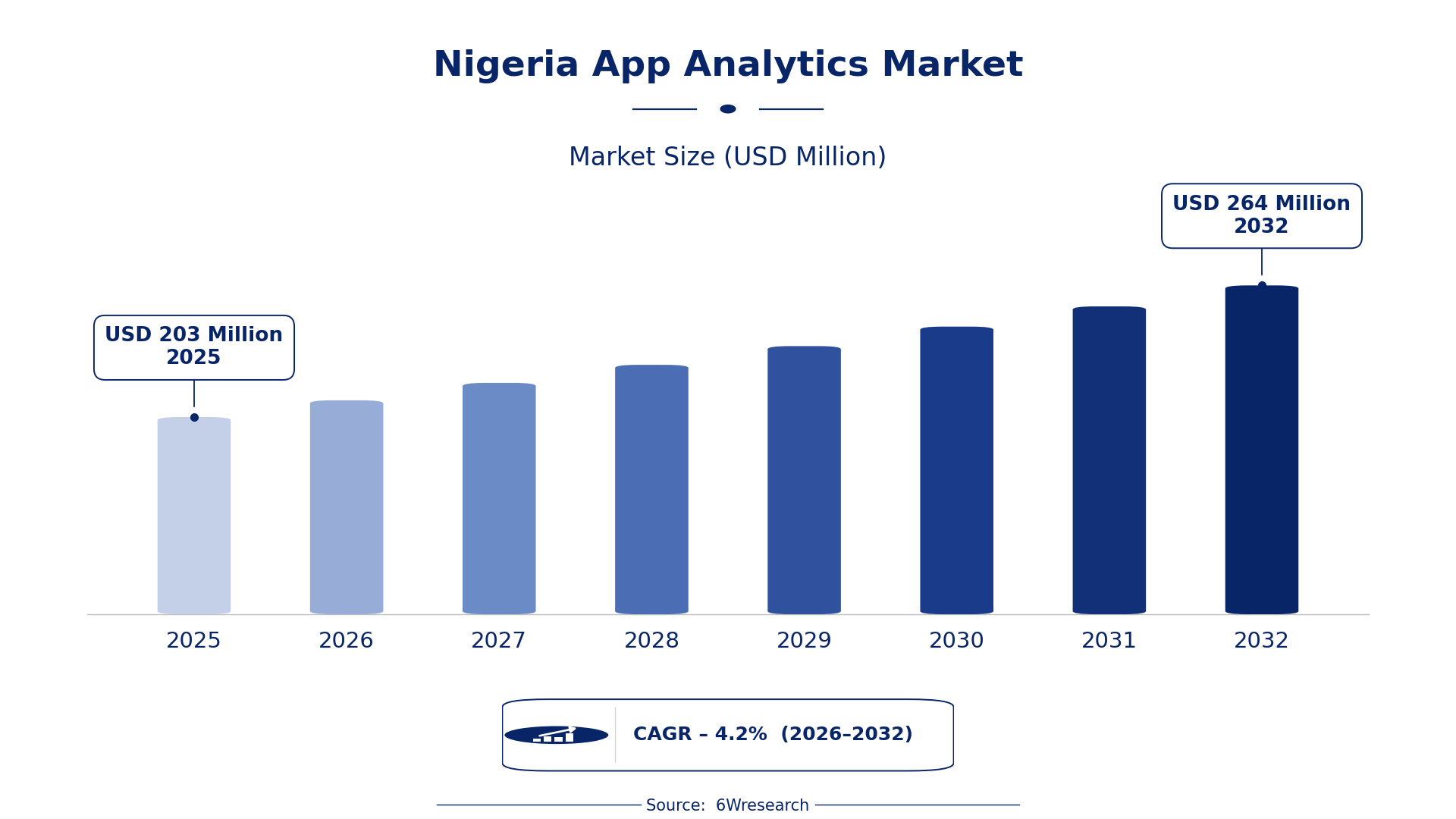
The Nigeria App Analytics Market was estimated at USD 203 Million in 2025 and is projected to reach USD 264 Million by 2032, growing at a CAGR of 4.2% from 2026 to 2032.
Nigeria App Analytics Market Synopsis
The Nigeria App Analytics Market has experienced robust momentum, fueled by a surge in mobile app adoption across various sectors. As businesses increasingly prioritize user engagement and performance metrics, the demand for sophisticated analytics tools has escalated.
Looking ahead, the market is set to evolve, driven by advancements in technology and a growing focus on personalized user experiences. Companies are expected to seek out tailored analytics solutions that offer real-time insights to stay ahead of the competition.
Nigeria App Analytics Market Year-wise Growth Rate and Key Drivers
This graph illustrates the annual growth rates of the Nigeria App Analytics Market from 2021 to 2032, highlighting a steady upward trajectory and projected expansion over the forecast period.
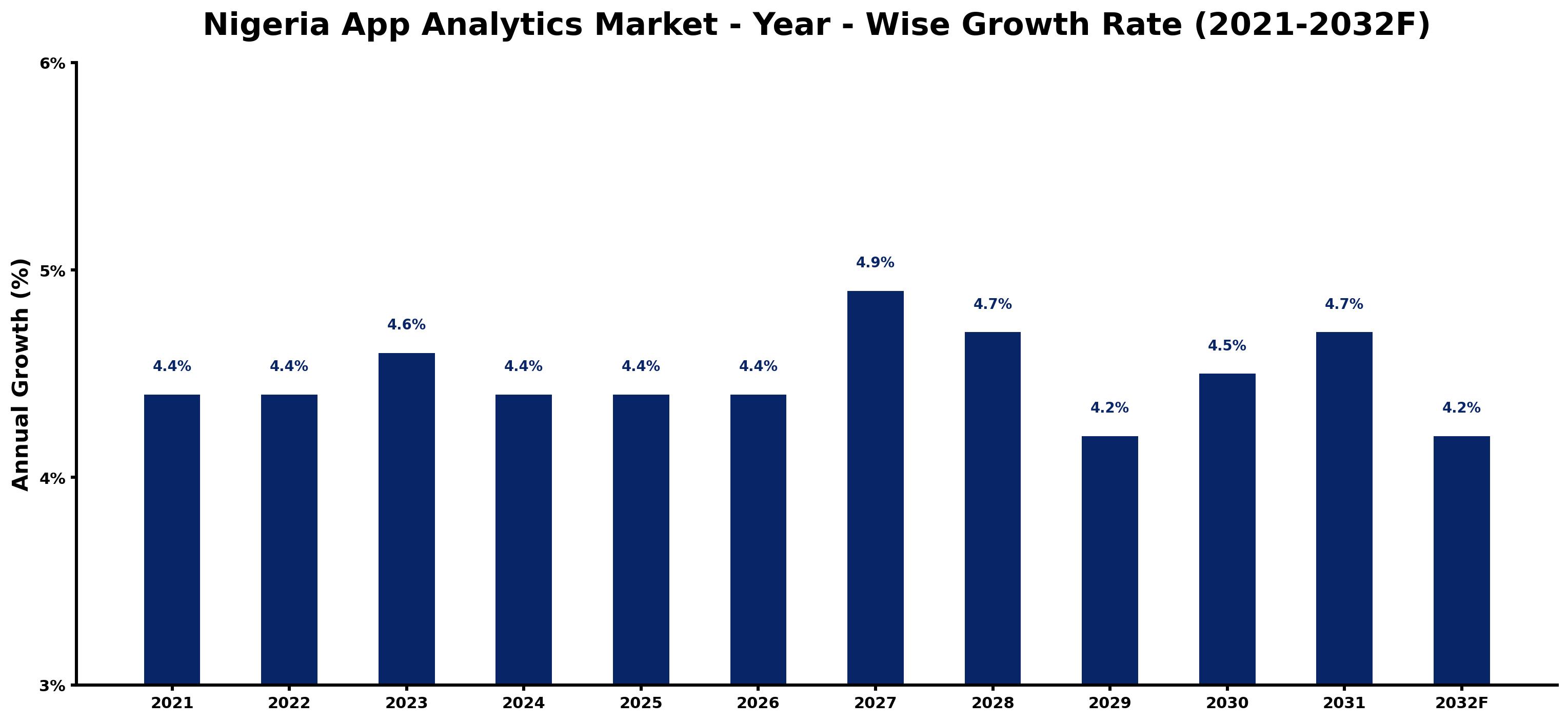
The table below presents the year‑wise growth rates along with the key drivers influencing the market
| Year | Growth Rate | Major Drivers |
| 2021 | 4.4% | Increasing smartphone penetration among Nigerian youth. |
| 2022 | 4.4% | NITDA guidelines promoting app performance measurement. |
| 2023 | 4.6% | Surge in e-commerce driving app engagement metrics. |
| 2024 | 4.4% | Local startups focusing on mobile solutions for businesses. |
| 2025 | 4.4% | Government initiatives boosting digital economy and apps. |
| 2026 | 4.4% | Growing fintech sector increasing app usage analytics. |
| 2027 | 4.9% | Rise of mobile payment apps boosting analytics demand. |
| 2028 | 4.7% | Expanding internet accessibility enhancing app market insights. |
| 2029 | 4.2% | Increased digital advertising budgets focusing on mobile apps. |
| 2030 | 4.5% | Collaborations between tech firms and universities on analytics. |
| 2031 | 4.7% | Emerging trends in mobile health apps boosting analytics. |
| 2032 | 4.2% | Surge in local content apps improving market measurement. |
Note: Market size estimations and growth projections presented in this report are based on 6Wresearch's proprietary forecasting methodology, utilizing the latest available industry data, government publications, and primary research inputs.
Nigeria App Analytics Market Key Takeaways
Below are some of the specific key takeaways from the market, including:
- The market is witnessing a shift towards real-time data analytics to enhance decision-making.
- Integration of AI and machine learning technologies is becoming increasingly common for advanced insights.
- There is a rising demand for customized analytics solutions tailored to specific industry needs.
- Investment in infrastructure is crucial for overcoming data collection challenges.
- Digital transformation initiatives are propelling the growth of app analytics in Nigeria.
Evaluation of Restraints in Nigeria App Analytics Market
Despite its growth potential, the Nigeria App Analytics Market faces several restraints. One major issue is the fragmented access to reliable data, which complicates the landscape for businesses seeking insights. on top of that, inadequate infrastructure hampers effective data collection and analysis, making it difficult for companies to implement comprehensive app analytics strategies.
Additionally, many businesses lack awareness of the benefits that app analytics can provide, resulting in underutilization of available tools. Data privacy and security concerns also loom large, as users grow increasingly wary about sharing personal information. Companies need to address these challenges head-on to fully unlock the market's potential.
Nigeria App Analytics Market Trends
A clear trend in the Nigeria App Analytics Market is the increasing emphasis on real-time data collection and analysis. Businesses are realizing the importance of tracking user behavior to optimize app performance and enhance customer experiences. Additionally, there is a notable shift towards the integration of advanced technologies like AI and machine learning, which allow for deeper insights and predictive analytics.
on top of that, the focus on user behavior analysis is becoming critical as companies strive to improve engagement metrics. As the landscape of mobile applications continues to expand, the demand for comprehensive app performance monitoring tools is expected to grow, presenting significant opportunities for analytics providers.
Nigeria App Analytics Market Opportunities
The Nigeria App Analytics Market is rich with opportunities for vendors and service providers. Customization is key; analytics solutions tailored to specific industries, such as fintech or e-commerce, are in high demand. This niche focus allows businesses to gather insights that resonate with their unique operational challenges and customer expectations.
Additionally, as more companies embrace mobile applications to reach their customers, the need for effective app analytics solutions will only intensify. This presents a chance for innovative providers to develop tools that help businesses optimize their mobile strategies and improve user retention.
Government Initiatives in the Nigeria App Analytics Market
Government policies are playing a significant role in shaping the Nigeria App Analytics Market, particularly in areas of data protection and regulatory compliance. The Nigerian Data Protection Regulation (NDPR) mandates how personal data should be handled, which is crucial for analytics firms aiming to build trust with users and ensure compliance.
- A regulatory framework introduced in 2020 mandates transparency in data collection practices, impacting how analytics firms operate.
- Currently, the National Information Technology Development Agency (NITDA) is overseeing the implementation of compliance measures for data protection, affecting market players.
- Future initiatives include plans for enhanced public-private partnerships aimed at improving digital infrastructure, expected to kick off by 2026.
- A recently completed initiative involved the establishment of guidelines for app developers regarding data security best practices.
- Ongoing efforts focus on public awareness campaigns to educate businesses about the importance of app analytics and data protection compliance.
Future Insights of the Nigeria App Analytics Market
Looking toward 2026-2032, the Nigeria App Analytics Market is set for robust expansion. As mobile applications continue to proliferate across various sectors, the demand for analytics tools will likely escalate. Businesses will increasingly recognize the value of data-driven insights in enhancing user engagement and performance optimization.
Additionally, as the digital ecosystem matures, the integration of advanced technologies will become more prevalent, providing deeper insights into consumer behavior. Companies that invest in innovative analytics solutions tailored to the Nigerian market will find significant growth opportunities in the coming years.
Nigeria App Analytics Market Latest Developments
In the past year, the Nigeria App Analytics Market has witnessed noteworthy developments, reflecting the growing interest in data-driven decision-making. Companies are increasingly investing in advanced analytics tools to enhance user experiences and optimize app performance.
- A major technology vendor launched a new analytics platform in early 2025 designed specifically for Nigerian businesses, focusing on real-time data insights.
- In mid-2025, an initiative aimed at improving data security standards among app developers was rolled out, enhancing trust in the market.
- A public-private partnership aimed at upgrading digital infrastructure is currently underway, expected to facilitate better data collection by mid-2026.
- A recent collaborative project between local startups and global firms focused on developing tailored analytics solutions was initiated in late 2025.
- Plans for a national conference on app analytics trends and technologies are expected to be announced for the second half of 2026.
Nigeria App Analytics Market - Key Attractiveness of the Report
- 10 Years of Market Numbers
- Historical Data Starting from 2022 to 2025
- Base Year: 2025
- Forecast Data until 2032
- Key Performance Indicators Impacting the Market
- Major Upcoming Developments and Projects
Key Highlights of the Report:
- Nigeria App Analytics Market Outlook
- Market Size of Nigeria App Analytics Market, 2025
- Forecast of Nigeria App Analytics Market, 2032
- Historical Data and Forecast of Nigeria App Analytics Revenues & Volume for the Period 2022-2032F
- Nigeria App Analytics Market Trend Evolution
- Nigeria App Analytics Market Drivers and Challenges
- Nigeria App Analytics Price Trends
- Nigeria App Analytics Porter's Five Forces
- Nigeria App Analytics Industry Life Cycle
- Historical Data and Forecast of Nigeria App Analytics Market Revenues & Volume By Component for the Period 2022-2032F
- Historical Data and Forecast of Nigeria App Analytics Market Revenues & Volume By Software for the Period 2022-2032F
- Historical Data and Forecast of Nigeria App Analytics Market Revenues & Volume By Services for the Period 2022-2032F
- Historical Data and Forecast of Nigeria App Analytics Market Revenues & Volume By Application for the Period 2022-2032F
- Historical Data and Forecast of Nigeria App Analytics Market Revenues & Volume By Revenue analytics for the Period 2022-2032F
- Historical Data and Forecast of Nigeria App Analytics Market Revenues & Volume By App performance analytics and operations for the Period 2022-2032F
- Historical Data and Forecast of Nigeria App Analytics Market Revenues & Volume By User analytics for the Period 2022-2032F
- Historical Data and Forecast of Nigeria App Analytics Market Revenues & Volume By Ad monitoring and marketing analytics for the Period 2022-2032F
- Historical Data and Forecast of Nigeria App Analytics Market Revenues & Volume By Type for the Period 2022-2032F
- Historical Data and Forecast of Nigeria App Analytics Market Revenues & Volume By Mobile app analytics for the Period 2022-2032F
- Historical Data and Forecast of Nigeria App Analytics Market Revenues & Volume By Web app analytics for the Period 2022-2032F
- Historical Data and Forecast of Nigeria App Analytics Market Revenues & Volume By Vertical for the Period 2022-2032F
- Historical Data and Forecast of Nigeria App Analytics Market Revenues & Volume By Banking, Financial Services, and Insurance (BFSI) for the Period 2022-2032F
- Historical Data and Forecast of Nigeria App Analytics Market Revenues & Volume By Retail for the Period 2022-2032F
- Historical Data and Forecast of Nigeria App Analytics Market Revenues & Volume By Media and entertainment for the Period 2022-2032F
- Historical Data and Forecast of Nigeria App Analytics Market Revenues & Volume By Logistics, travel, and transportation for the Period 2022-2032F
- Historical Data and Forecast of Nigeria App Analytics Market Revenues & Volume By Telecom and IT for the Period 2022-2032F
- Historical Data and Forecast of Nigeria App Analytics Market Revenues & Volume By Others for the Period 2022-2032F
- Nigeria App Analytics Import Export Trade Statistics
- Market Opportunity Assessment By Component
- Market Opportunity Assessment By Application
- Market Opportunity Assessment By Type
- Market Opportunity Assessment By Vertical
- Nigeria App Analytics Top Companies Market Share
- Nigeria App Analytics Competitive Benchmarking By Technical and Operational Parameters
- Nigeria App Analytics Company Profiles
- Nigeria App Analytics Key Strategic Recommendations






































