Nigeria Middleware Market Size & Growth Rate (2026-2032)
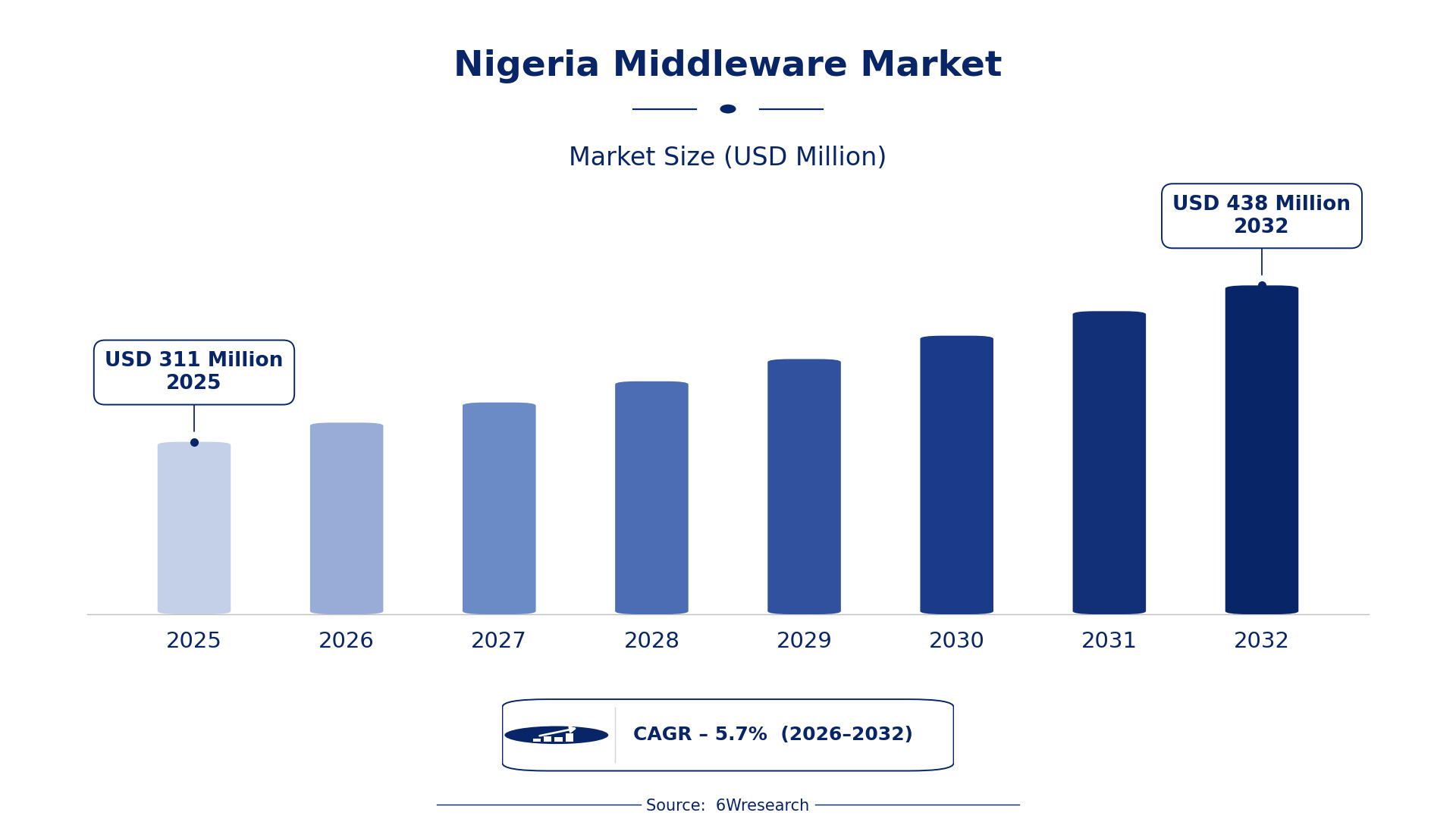
The Nigeria Middleware Market was estimated at USD 311 Million in 2025 and is projected to reach USD 438 Million by 2032, growing at a CAGR of 5.7% from 2026 to 2032.
Nigeria Middleware Market Synopsis
The increasing demand for seamless integration of enterprise applications stands out as the strongest force shaping the Nigeria Middleware Market. As businesses strive for operational efficiency and improved data management, middleware solutions have become essential in connecting disparate systems and enabling effective communication.
With the rise of cloud computing and big data analytics, organizations in Nigeria are accelerating their digital transformation efforts. This shift is not just a trend but a necessity, pushing companies to adopt middleware solutions that support application integration, data management, and workflow automation.
Nigeria Middleware Market Year-wise Growth Rate and Key Drivers
This graph illustrates the annual growth rates of the Nigeria Middleware Market from 2021 to 2032, highlighting a steady upward trajectory and projected expansion over the forecast period.
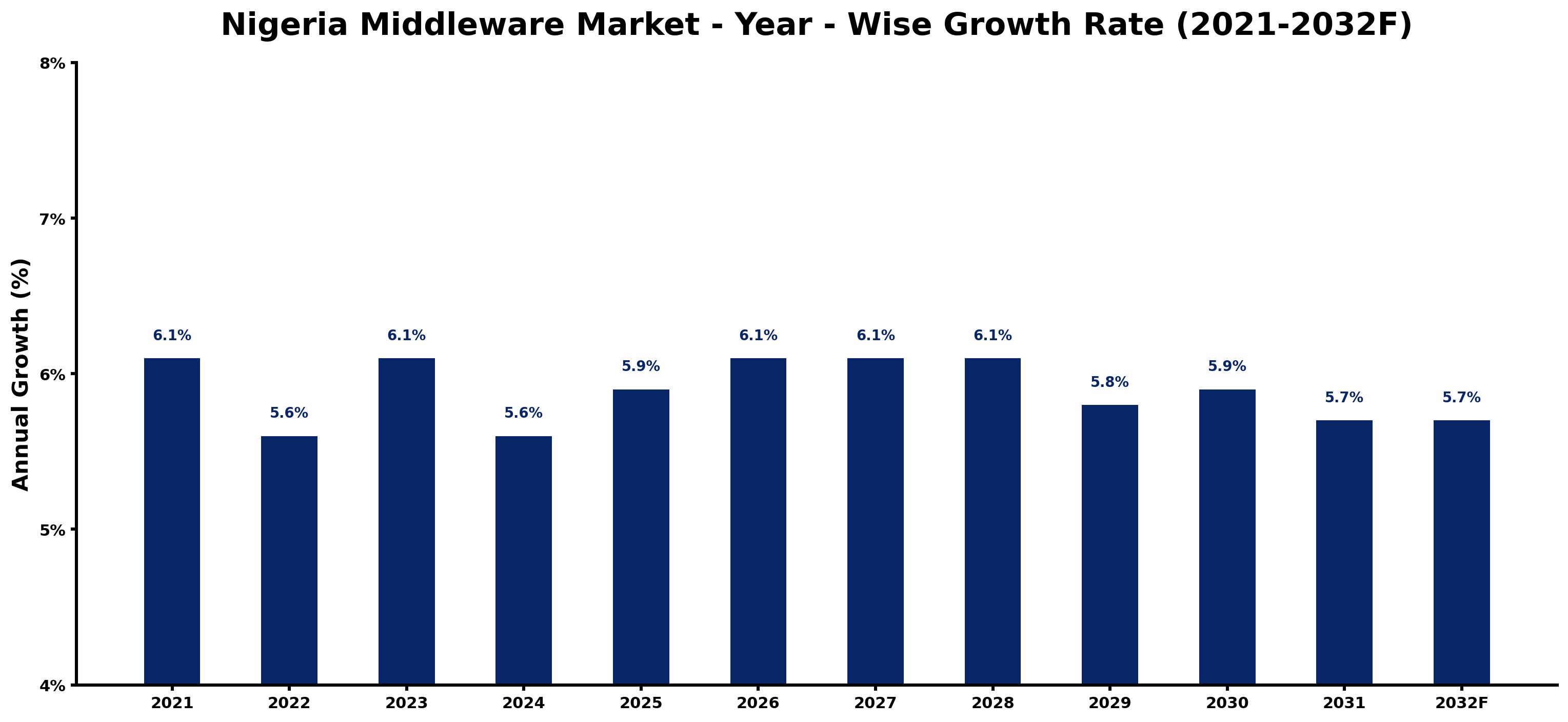
The table below presents the year‑wise growth rates along with the key drivers influencing the market
| Year | Growth Rate | Major Drivers |
| 2021 | 6.1% | Rise in local startups leveraging middleware for innovation. |
| 2022 | 5.6% | Increasing mobile internet penetration fostering middleware adoption. |
| 2023 | 6.1% | Digital banking regulations driving need for integration platforms. |
| 2024 | 5.6% | NITDA's initiatives encouraging software interoperability in businesses. |
| 2025 | 5.9% | Surge in e-commerce platforms requiring robust middleware solutions. |
| 2026 | 6.1% | Local tech hubs emerging to accelerate middleware development. |
| 2027 | 6.1% | Investment in fintech fueling demand for integration services. |
| 2028 | 6.1% | Government e-governance projects necessitating middleware enhancements. |
| 2029 | 5.8% | Growing reliance on APIs driving middleware market growth. |
| 2030 | 5.9% | Increased demand for digital services in remote areas. |
| 2031 | 5.7% | Smart city projects creating need for integrated software solutions. |
| 2032 | 5.7% | Corporate digital strategies prioritizing middleware for efficiency. |
Note: Market size estimations and growth projections presented in this report are based on 6Wresearch's proprietary forecasting methodology, utilizing the latest available industry data, government publications, and primary research inputs.
Nigeria Middleware Market Key Takeaways
Below are some of the specific key takeaways from the market, including:
- Middleware is crucial for enabling interoperability between diverse software applications.
- Cloud-native architectures and open-source platforms are driving innovation in the middleware space.
- Growing enterprise IT investments are accelerating the adoption of middleware solutions in Nigeria.
- Digital transformation initiatives are fueling demand for middleware in various industries.
Evaluation of Restraints in Nigeria Middleware Market
Despite the positive growth trajectory, several restraints hinder the Nigeria Middleware Market. A notable challenge is the limited technical expertise available within organizations, which complicates the integration of various systems. Many companies still rely on proprietary software platforms, leading to interoperability issues that stifle innovation. Without addressing these skill gaps and investing in middleware technologies, organizations may find it difficult to achieve the operational efficiencies they desire.
Nigeria Middleware Market Trends
Currently, the market is experiencing a shift towards the adoption of cloud-native middleware solutions. This trend is driven by the need for scalability and flexibility in IT operations. Additionally, the rise of big data analytics is pushing organizations to seek middleware that facilitates effective data management and real-time insights. Open-source middleware platforms are also gaining traction, allowing companies to reduce costs while fostering innovation through community collaboration.
Nigeria Middleware Market Opportunities
The Nigeria Middleware Market presents several avenues for growth and investment. Companies that focus on developing user-friendly integration solutions stand to gain a competitive edge. on top of that, as more businesses embrace digital transformation, there will be increasing demand for middleware that supports automation and streamlines workflows. Investing in training and skill development for technical teams will also open up opportunities for organizations looking to capitalize on the middleware sector.
Government Initiatives in the Nigeria Middleware Market
The Nigerian government is increasingly recognizing the significance of middleware in enhancing interoperability among diverse software systems. Public policy is now focused on fostering an environment conducive to the development and adoption of standardized middleware solutions. This regulatory posture is crucial for ensuring that middleware platforms are secure and reliable, ultimately safeguarding sensitive data and critical infrastructure.
- A national digital infrastructure upgrade programme launched in early 2025 aims to enhance connectivity and interoperability across sectors.
- Currently ongoing is a research initiative focusing on developing standardized middleware solutions to facilitate smoother integration processes.
- A planned public-private partnership is set to begin by late 2026, aimed at expanding middleware adoption across governmental and educational institutions.
- In 2025, a regulatory framework was introduced mandating compliance with security standards for middleware platforms.
Future Insights of the Nigeria Middleware Market
As we look ahead to 2026-2032, the Nigeria Middleware Market is expected to continue its upward trajectory. With ongoing digital transformation efforts, businesses will increasingly prioritize middleware solutions that enhance operational efficiency. The integration of AI and machine learning with middleware will likely redefine the capabilities of these platforms, making them even more essential for data-driven decision-making. Companies that adapt to these advancements will be well-positioned to capture market share.
Nigeria Middleware Market Latest Developments
In recent months, the Nigeria Middleware Market has seen significant activity, reflecting the growing recognition of middleware's importance in business operations. Companies are increasingly investing in technologies that facilitate integration and automation, while government initiatives are aligning to support these efforts.
- A major technology vendor launched an innovative middleware platform in Q2 2025, designed to enhance data integration capabilities for large enterprises.
- Currently ongoing is a collaborative project between universities and tech firms to develop open-source middleware solutions, aimed at fostering innovation and reducing costs.
- An initiative that began in early 2025 focuses on training programs for IT professionals to build expertise in middleware technologies.
- A rollout expected to commence in mid-2026 aims to expand middleware access to small and medium enterprises, enhancing their operational capabilities.
Nigeria Middleware Market - Key Attractiveness of the Report
- 10 Years of Market Numbers
- Historical Data Starting from 2022 to 2025
- Base Year: 2025
- Forecast Data until 2032
- Key Performance Indicators Impacting the Market
- Major Upcoming Developments and Projects
Key Highlights of the Report:
- Nigeria Middleware Market Outlook
- Market Size of Nigeria Middleware Market, 2025
- Forecast of Nigeria Middleware Market, 2032
- Historical Data and Forecast of Nigeria Middleware Revenues & Volume for the Period 2022-2032F
- Nigeria Middleware Market Trend Evolution
- Nigeria Middleware Market Drivers and Challenges
- Nigeria Middleware Price Trends
- Nigeria Middleware Porter's Five Forces
- Nigeria Middleware Industry Life Cycle
- Historical Data and Forecast of Nigeria Middleware Market Revenues & Volume By Product Type for the Period 2022-2032F
- Historical Data and Forecast of Nigeria Middleware Market Revenues & Volume By Communication Middleware for the Period 2022-2032F
- Historical Data and Forecast of Nigeria Middleware Market Revenues & Volume By Platform Middleware for the Period 2022-2032F
- Historical Data and Forecast of Nigeria Middleware Market Revenues & Volume By Integration Middleware for the Period 2022-2032F
- Historical Data and Forecast of Nigeria Middleware Market Revenues & Volume By Others for the Period 2022-2032F
- Historical Data and Forecast of Nigeria Middleware Market Revenues & Volume By Deployment Types for the Period 2022-2032F
- Historical Data and Forecast of Nigeria Middleware Market Revenues & Volume By On-Premise for the Period 2022-2032F
- Historical Data and Forecast of Nigeria Middleware Market Revenues & Volume By Hosted for the Period 2022-2032F
- Historical Data and Forecast of Nigeria Middleware Market Revenues & Volume By Hybrid for the Period 2022-2032F
- Historical Data and Forecast of Nigeria Middleware Market Revenues & Volume By Organization Size for the Period 2022-2032F
- Historical Data and Forecast of Nigeria Middleware Market Revenues & Volume By Small businesses for the Period 2022-2032F
- Historical Data and Forecast of Nigeria Middleware Market Revenues & Volume By Medium businesses for the Period 2022-2032F
- Historical Data and Forecast of Nigeria Middleware Market Revenues & Volume By Enterprises for the Period 2022-2032F
- Historical Data and Forecast of Nigeria Middleware Market Revenues & Volume By Large enterprises for the Period 2022-2032F
- Historical Data and Forecast of Nigeria Middleware Market Revenues & Volume By Verticals for the Period 2022-2032F
- Historical Data and Forecast of Nigeria Middleware Market Revenues & Volume By Banking, financial services and insurance (BFSI) for the Period 2022-2032F
- Historical Data and Forecast of Nigeria Middleware Market Revenues & Volume By Consumer Goods and Retail for the Period 2022-2032F
- Historical Data and Forecast of Nigeria Middleware Market Revenues & Volume By IT and telecom for the Period 2022-2032F
- Historical Data and Forecast of Nigeria Middleware Market Revenues & Volume By Manufacturing for the Period 2022-2032F
- Historical Data and Forecast of Nigeria Middleware Market Revenues & Volume By Oil and Gas for the Period 2022-2032F
- Historical Data and Forecast of Nigeria Middleware Market Revenues & Volume By Healthcare for the Period 2022-2032F
- Historical Data and Forecast of Nigeria Middleware Market Revenues & Volume By Government for the Period 2022-2032F
- Nigeria Middleware Import Export Trade Statistics
- Market Opportunity Assessment By Product Type
- Market Opportunity Assessment By Deployment Types
- Market Opportunity Assessment By Organization Size
- Market Opportunity Assessment By Verticals
- Nigeria Middleware Top Companies Market Share
- Nigeria Middleware Competitive Benchmarking By Technical and Operational Parameters
- Nigeria Middleware Company Profiles
- Nigeria Middleware Key Strategic Recommendations






































