Nigeria Phosphate Market Top 5 Importing Countries and Market Competition (HHI) Analysis
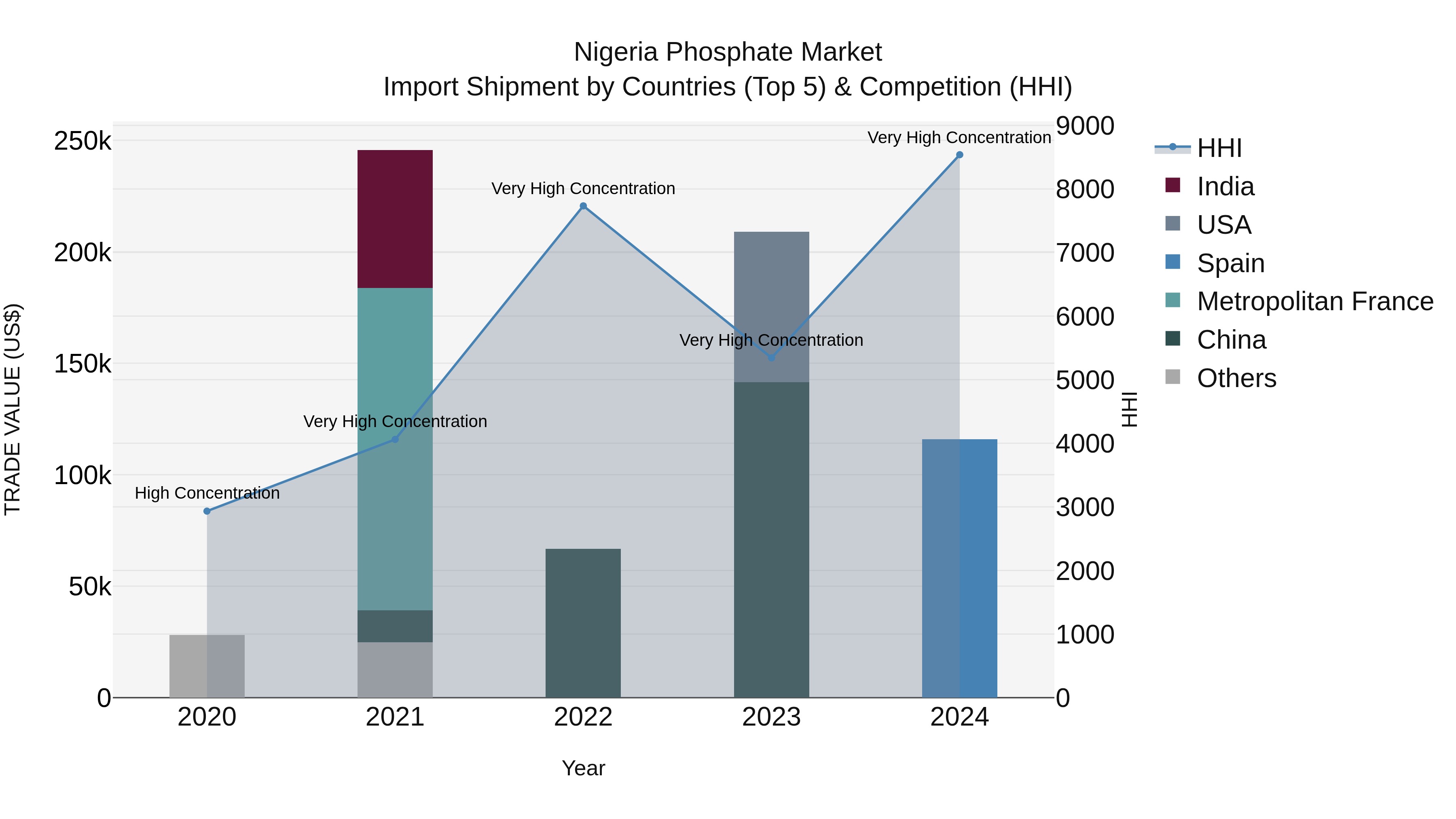
In 2024, Nigeria continued to rely heavily on phosphate imports, with top exporters being Spain, China, Germany, India, and Ghana. Despite the high concentration of the market indicated by the Herfindahl-Hirschman Index (HHI), the industry experienced significant growth with a CAGR of 42.47% from 2020 to 2024. However, there was a notable decline in growth rate from 2023 to 2024 at -44.52%, signaling potential shifts in market dynamics or external factors impacting phosphate imports in Nigeria.
Nigeria Phosphate Market Overview
The Nigeria phosphate market is experiencing steady growth driven by increasing demand from the agriculture sector for phosphate-based fertilizers. Phosphates are essential nutrients for plant growth and are crucial for soil fertility maintenance. The market is also influenced by the country`s efforts to improve agricultural productivity and food security. Key players in the Nigeria phosphate market include local and international fertilizer companies, as well as phosphate rock miners and processors. However, challenges such as limited domestic phosphate reserves and reliance on imports for raw materials impact the market dynamics. Despite these challenges, the Nigeria phosphate market presents opportunities for investments in phosphate mining, processing, and fertilizer production to meet the growing demand for agricultural inputs in the country.
Nigeria Phosphate Market Trends and Opportunities
The Nigeria Phosphate Market is witnessing a growing demand due to the country`s emphasis on agricultural development and increasing use of fertilizers. The market is experiencing a shift towards sustainable and organic farming practices, driving the demand for phosphate-based fertilizers. With Nigeria being predominantly an agrarian economy, there are significant opportunities for both domestic production and importation of phosphate products to meet the agricultural needs of the country. Additionally, the government`s initiatives to boost the agricultural sector and improve soil fertility are expected to further drive the growth of the phosphate market in Nigeria. Companies in the phosphate industry can capitalize on these trends by expanding their product offerings, investing in research and development for innovative fertilizer solutions, and forming strategic partnerships with local farmers and distributors.
Nigeria Phosphate Market Challenges
In the Nigeria Phosphate Market, some key challenges include limited domestic production capacity, dependence on imports to meet demand, inconsistent government policies affecting the industry, lack of infrastructure for efficient mining and processing of phosphate minerals, and environmental concerns related to mining activities. The market also faces competition from other phosphate-producing countries, price volatility in global markets, and inadequate funding for research and development to improve production efficiency and quality. Additionally, issues such as corruption, bureaucracy, and regulatory hurdles further hinder the growth and competitiveness of the Nigeria Phosphate Market. Addressing these challenges will require strategic investments in infrastructure, technology, and policy reforms to enhance domestic production capabilities and ensure sustainable development of the industry.
Nigeria Phosphate Market Drivers
The Nigeria Phosphate Market is primarily driven by the growth in the agriculture sector, where phosphates are essential for plant nutrition and crop production. Increasing population and changing dietary patterns are driving the demand for food products, leading to higher consumption of phosphate-based fertilizers. Additionally, government initiatives promoting agricultural productivity and sustainability further support the market growth. The expansion of the mining industry in Nigeria, coupled with investments in infrastructure development, is also contributing to the demand for phosphates used in various industrial applications. Furthermore, the rising awareness about the benefits of phosphate in improving soil fertility and crop yield is expected to fuel market growth in the coming years.
Nigeria Phosphate Market Government Policy
The Nigeria Phosphate Market is influenced by government policies aimed at regulating the mining and export of phosphate resources in the country. The Nigerian government has implemented regulations to promote sustainable development and ensure that the exploitation of phosphate reserves is done in an environmentally responsible manner. Additionally, there are policies in place to encourage local beneficiation of phosphate resources, with the aim of adding value to the raw materials before export. The government also seeks to attract foreign investment in the phosphate sector through incentives and partnerships to boost production and drive economic growth. Overall, government policies in Nigeria related to the phosphate market focus on sustainable exploitation, value addition, and attracting investment to maximize the potential of the country`s phosphate resources.
Nigeria Phosphate Market Future Outlook
The future outlook for the Nigeria Phosphate Market appears promising due to the country`s abundant phosphate reserves and the growing demand for fertilizers in the agriculture sector. With Nigeria`s increasing population and focus on improving agricultural productivity, there is a strong need for phosphate-based fertilizers to enhance soil fertility and crop yields. Additionally, the government`s initiatives to promote sustainable agriculture practices and increase food production are expected to drive the demand for phosphate products in the coming years. However, challenges such as infrastructure limitations and regulatory issues may impact the market`s growth trajectory. Overall, the Nigeria Phosphate Market is poised for expansion, driven by the agricultural sector`s requirements and the country`s untapped phosphate reserves.
Key Highlights of the Report:
- Nigeria Phosphate Market Outlook
- Market Size of Nigeria Phosphate Market, 2024
- Forecast of Nigeria Phosphate Market, 2031
- Historical Data and Forecast of Nigeria Phosphate Revenues & Volume for the Period 2021 - 2031
- Nigeria Phosphate Market Trend Evolution
- Nigeria Phosphate Market Drivers and Challenges
- Nigeria Phosphate Price Trends
- Nigeria Phosphate Porter's Five Forces
- Nigeria Phosphate Industry Life Cycle
- Historical Data and Forecast of Nigeria Phosphate Market Revenues & Volume By Type/Derivative for the Period 2021 - 2031
- Historical Data and Forecast of Nigeria Phosphate Market Revenues & Volume By Ammonium Phosphate for the Period 2021 - 2031
- Historical Data and Forecast of Nigeria Phosphate Market Revenues & Volume By Calcium Phosphate for the Period 2021 - 2031
- Historical Data and Forecast of Nigeria Phosphate Market Revenues & Volume By Phosphoric Acid for the Period 2021 - 2031
- Historical Data and Forecast of Nigeria Phosphate Market Revenues & Volume By Application for the Period 2021 - 2031
- Historical Data and Forecast of Nigeria Phosphate Market Revenues & Volume By Fertilizers for the Period 2021 - 2031
- Historical Data and Forecast of Nigeria Phosphate Market Revenues & Volume By Foods & Beverages for the Period 2021 - 2031
- Historical Data and Forecast of Nigeria Phosphate Market Revenues & Volume By Detergents for the Period 2021 - 2031
- Historical Data and Forecast of Nigeria Phosphate Market Revenues & Volume By Type of Resource for the Period 2021 - 2031
- Historical Data and Forecast of Nigeria Phosphate Market Revenues & Volume By Sedimentary Marine Deposits for the Period 2021 - 2031
- Historical Data and Forecast of Nigeria Phosphate Market Revenues & Volume By Igneous & Weathered for the Period 2021 - 2031
- Historical Data and Forecast of Nigeria Phosphate Market Revenues & Volume By Biogenic for the Period 2021 - 2031
- Nigeria Phosphate Import Export Trade Statistics
- Market Opportunity Assessment By Type/Derivative
- Market Opportunity Assessment By Application
- Market Opportunity Assessment By Type of Resource
- Nigeria Phosphate Top Companies Market Share
- Nigeria Phosphate Competitive Benchmarking By Technical and Operational Parameters
- Nigeria Phosphate Company Profiles
- Nigeria Phosphate Key Strategic Recommendations






































