Norway Molasses Market Top 5 Importing Countries and Market Competition (HHI) Analysis
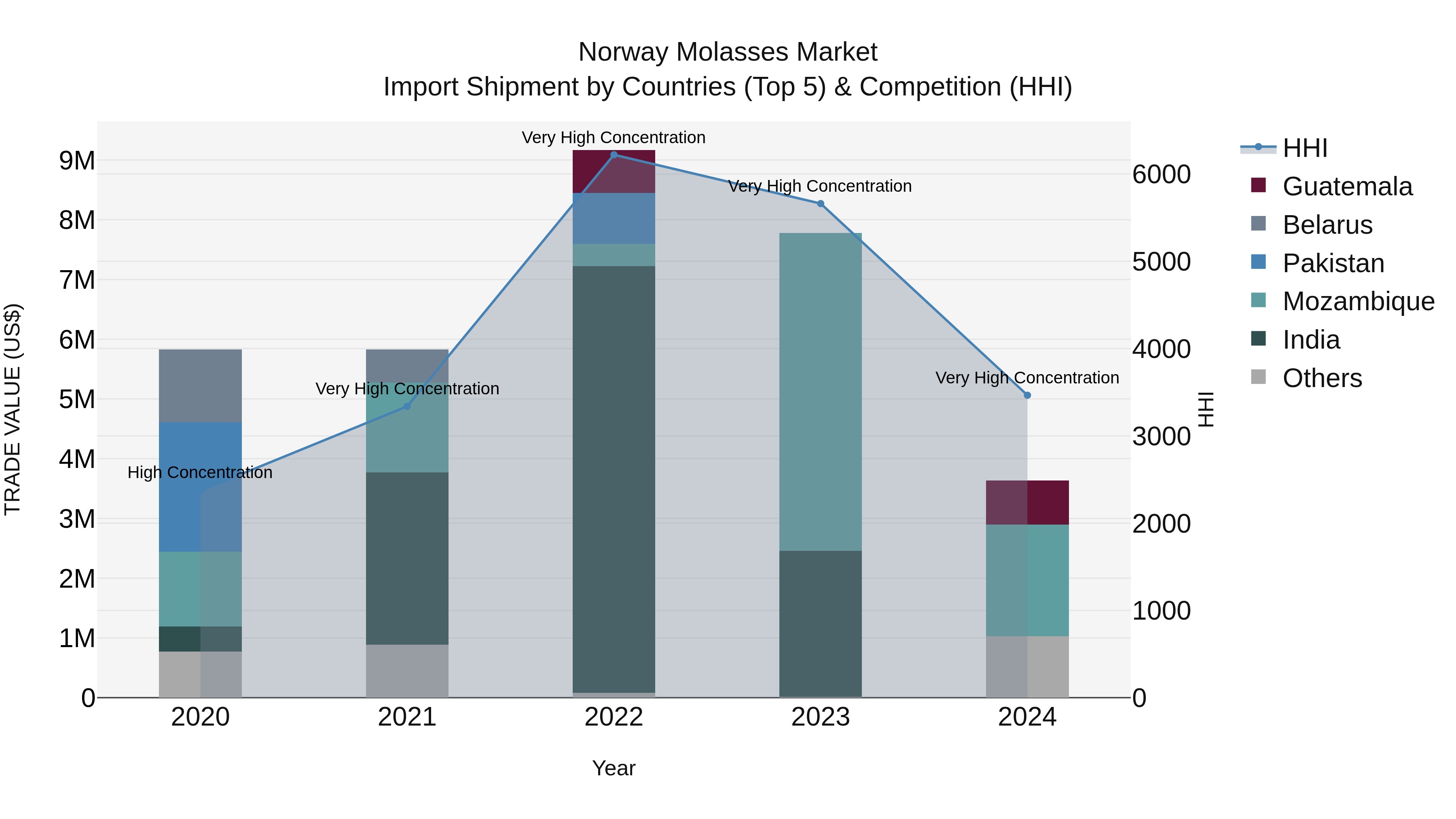
Norway`s molasses import market in 2024 continues to be dominated by top exporting countries such as Mozambique, Guatemala, El Salvador, Lithuania, and Germany. Despite a significant decline in Compound Annual Growth Rate (CAGR) from 2020-24 at -11.13%, the market saw a sharp contraction in growth rate from 2023-24 at -53.26%. The high Herfindahl-Hirschman Index (HHI) indicates a concentrated market, suggesting a competitive landscape among the major exporting nations. Trends in the molasses import market for Norway in 2024 highlight challenges and opportunities for industry players to navigate.
Norway Molasses Market Overview
The Norway Molasses market is influenced by the use of molasses as a feedstock in the production of ethanol and animal feed, as well as its application in the food and beverage industry. Despite Norway`s limited sugar production, the market for molasses is supported by imports and its role in various industrial processes. The demand for molasses is driven by its functional properties and its use as a cost-effective ingredient in multiple applications, including fermentation and flavoring.
Drivers of the market
The molasses market in Norway is influenced by the demand for molasses in food production, animal feed, and biofuel applications. As Norway continues to focus on sustainable and renewable energy sources, molasses serves as an important component in bioethanol production. Additionally, the food and beverage industrys need for molasses as a sweetener and flavoring agent supports market growth.
Challenges of the market
In the Norway Molasses market, fluctuations in supply and demand are a significant challenge. Variations in agricultural production and global commodity prices can lead to instability in molasses availability and pricing. Moreover, the market faces competition from alternative sweeteners and by-products, which can affect market dynamics and profitability.
Government Policy of the market
The Norwegian governments policies on the molasses market are part of a broader agricultural strategy. Support includes subsidies for agricultural producers involved in molasses production, as well as regulations to ensure the quality and safety of molasses products. There are also initiatives to promote sustainable practices in molasses production, aligning with broader environmental goals.
Key Highlights of the Report:
- Norway Molasses Market Outlook
- Market Size of Norway Molasses Market, 2024
- Forecast of Norway Molasses Market, 2031
- Historical Data and Forecast of Norway Molasses Revenues & Volume for the Period 2021-2031
- Norway Molasses Market Trend Evolution
- Norway Molasses Market Drivers and Challenges
- Norway Molasses Price Trends
- Norway Molasses Porter`s Five Forces
- Norway Molasses Industry Life Cycle
- Historical Data and Forecast of Norway Molasses Market Revenues & Volume By Source for the Period 2021-2031
- Historical Data and Forecast of Norway Molasses Market Revenues & Volume By Sugarcane for the Period 2021-2031
- Historical Data and Forecast of Norway Molasses Market Revenues & Volume By Sugarbeet for the Period 2021-2031
- Historical Data and Forecast of Norway Molasses Market Revenues & Volume By Type for the Period 2021-2031
- Historical Data and Forecast of Norway Molasses Market Revenues & Volume By Regular Molasses for the Period 2021-2031
- Historical Data and Forecast of Norway Molasses Market Revenues & Volume By Blackstrap Molasses for the Period 2021-2031
- Historical Data and Forecast of Norway Molasses Market Revenues & Volume By Nature for the Period 2021-2031
- Historical Data and Forecast of Norway Molasses Market Revenues & Volume By Organic for the Period 2021-2031
- Historical Data and Forecast of Norway Molasses Market Revenues & Volume By Conventional for the Period 2021-2031
- Historical Data and Forecast of Norway Molasses Market Revenues & Volume By End-Use for the Period 2021-2031
- Historical Data and Forecast of Norway Molasses Market Revenues & Volume By Industrial for the Period 2021-2031
- Historical Data and Forecast of Norway Molasses Market Revenues & Volume By Commercial for the Period 2021-2031
- Historical Data and Forecast of Norway Molasses Market Revenues & Volume By Household for the Period 2021-2031
- Historical Data and Forecast of Norway Molasses Market Revenues & Volume By Sales Channel for the Period 2021-2031
- Historical Data and Forecast of Norway Molasses Market Revenues & Volume By Direct for the Period 2021-2031
- Historical Data and Forecast of Norway Molasses Market Revenues & Volume By Indirect for the Period 2021-2031
- Norway Molasses Import Export Trade Statistics
- Market Opportunity Assessment By Source
- Market Opportunity Assessment By Type
- Market Opportunity Assessment By Nature
- Market Opportunity Assessment By End-Use
- Market Opportunity Assessment By Sales Channel
- Norway Molasses Top Companies Market Share
- Norway Molasses Competitive Benchmarking By Technical and Operational Parameters
- Norway Molasses Company Profiles
- Norway Molasses Key Strategic Recommendations






































